


















MOTIVATION
BY,
VEDANTHA VINOD
ASSISTANT LECTURER
CCON-MYSORE
CONTENTS TO BE DISCUSSED:-
• INTRODUCTION
• MEANING
• DEFINITION
• FEATURES
• TYPES
• NEED-BASED THEORY
• IMPORTANCE
INTRODUCTION
•The word “motivation" is derived from
“motive” which means an active form of a
desire, craving or need that needs to be
satisfied.
MEANING
•Motivation is one of the key elements
required to maintain dynamic academic
culture in an educational institution by
facilitating effective teaching-learning
activities. Both learners and teachers are
required to be motivated to attain the best
possible learning outcome.
DEFINITION
•Motivation is the desire within an individual
that stimulates him or her to act.
- George R Terry
•Motivation is the complex force that makes
a person to start and keep working in an
organization.
FEATURES OF MOTIVATION
•It is an internal feeling which prompts the
person to act.
•It is an ever continuing process.
• It is dynamic and varies among individuals
at different times.
•It could be positive or negative, depending
upon the way by which it is developed.
TYPES OF MOTIVATION
There are four different types
of motivation that can impel
people to act.
EXTRINSIC IDENTIFIED
INTRINSIC
INTROJECTE
D
EXTERNALINTERNAL
ACTION NON-
ACTION
SOURCE
ACTION
EXTRINSIC MOTIVATION
•Extrinsic motivation comes from outside us. We
do it because we are impelled to, for example
because we are told to by someone who has
power over us.
•Many employment motivation systems work on
the principle of extrinsic reward, where people
are 'bought' and then commanded. Whilst this is
effective for simple activities, it is less useful
INTRINSIC MOTIVATION
•Intrinsic motivation is done for internal
reasons, for example to align with values
or simply for the hedonistic pleasure of
doing something.
•In work, people are intrinsically motivated
by working for an inspiring leader or in
areas where they have a personal interest.
IDENTIFIED MOTIVATION
•Identified motivation is where a person
knows that something needs doing but has
not yet decided to do anything about it.
INTROJECTED MOTIVATION
•Introjected motivation is similar to
intrinsic motivation in that it is
internalized. The distinctive aspect of this
is that if it is not done, then the person
feels the tension of guilt.
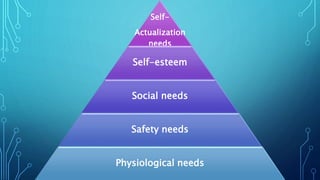
HIERARCH
Y OF
NEEDSSelf-
Actualizatio
n needs
Self-esteem
Social needs
Safety needs
Physiological needs
NEED-BASED THEORIES OF
MOTIVATION
•The basic objective of need-based theories
is to answer the question, “What are the
factors responsible to motivate people to
adopt certain behaviors"?
The following need-based theories would
better address this question:
MASLOW’S HIERARCHY OF
NEEDS
•Maslow Abraham postulated his theory of
basic human needs, popularly known as
the Hierarchy of Needs in the 1940s. This
theory assumes that individuals are
motivated to achieve or satisfy five basic
needs at different levels-physiological,
security, belongingness, self-esteem and
Self-
Actualization
needs
Self-esteem
Social needs
Safety needs
Physiological needs
PHYSIOLOGICAL NEEDS
•Represent the basic issues of survival
such as food, sex, water and air.
•In educational institutions, most of the
students and teachers' physiological
needs are satisfied by physical
infrastructure of the learning environment
includes good classrooms, adequate
lighting, comfortable temperatures and
SECURITY OR SAFETY NEED
•Which indicates the requirement for a secure
physical and emotional environment. This
includes the desire for good hostel
accommodation, being free from financial
worries and sense of secured feeling.
•Security needs of students should be met by
the educational institution by providing job
security, having a strong grievance address
system along with an adequate insurance and
retirement benefit package.
SOCIAL NEEDS
•Sense of belonging or social needs depends on
existing social support structure. The need for
love, affection and being accepted by one's peers
are few of the basic social needs.
•Administrators of an educational institution can
ensure the achievement of these important needs
by encouraging team work, entertaining social
interaction among employees and by
SELF-ESTEEM NEEDS
Which comprises of two different sets of needs:
1. The need for a strong positive self-image and
self-respect.
2. The need to be recognized, appreciated and
respected by others.
Educational institutions must address the self-
esteem needs for students and teachers by
providing variety of external symbols of
accomplishment such as rewards, academic
SELF-ACTUALIZATION NEEDS
•These are placed at the top of the
hierarchy. These needs involve realizing
one's potential for continuous as well as
prospective growth and individual
development.
•As these needs are highly individualized
and personal, administrators find it
difficult to address, both among students
IMPORTANCE OF MOTIVATION
•Motivation is an integral part of planning
and managing any educational activity.
•A team of highly motivated teachers and
learners are necessary for achieving the
learning objectives of an institution.
•Motivation helps the students or learners
to dream higher and achieve excellent
•Individuals who are motivated in right
direction make full use of their potentials
and upgrade their existing level of
efficiency.
•Motivation helps individuals to pursue
goal-directed efforts.
•Motivation is always regarded as a back
bone of institutions, which values human
relations.
CONCLUSION : DISCUSSED
CONTENTS
• INTRODUCTION
• MEANING
• DEFINITION
• FEATURES
• TYPES
• NEED-BASED THEORY
• IMPORTANCE
ANY DOUBTS ??
THANK YOU

Motivation

  • 1.
  • 2.
    CONTENTS TO BEDISCUSSED:- • INTRODUCTION • MEANING • DEFINITION • FEATURES • TYPES • NEED-BASED THEORY • IMPORTANCE
  • 3.
    INTRODUCTION •The word “motivation"is derived from “motive” which means an active form of a desire, craving or need that needs to be satisfied.
  • 4.
    MEANING •Motivation is oneof the key elements required to maintain dynamic academic culture in an educational institution by facilitating effective teaching-learning activities. Both learners and teachers are required to be motivated to attain the best possible learning outcome.
  • 5.
    DEFINITION •Motivation is thedesire within an individual that stimulates him or her to act. - George R Terry •Motivation is the complex force that makes a person to start and keep working in an organization.
  • 6.
    FEATURES OF MOTIVATION •Itis an internal feeling which prompts the person to act. •It is an ever continuing process. • It is dynamic and varies among individuals at different times. •It could be positive or negative, depending upon the way by which it is developed.
  • 7.
    TYPES OF MOTIVATION Thereare four different types of motivation that can impel people to act.
  • 8.
  • 9.
    EXTRINSIC MOTIVATION •Extrinsic motivationcomes from outside us. We do it because we are impelled to, for example because we are told to by someone who has power over us. •Many employment motivation systems work on the principle of extrinsic reward, where people are 'bought' and then commanded. Whilst this is effective for simple activities, it is less useful
  • 10.
    INTRINSIC MOTIVATION •Intrinsic motivationis done for internal reasons, for example to align with values or simply for the hedonistic pleasure of doing something. •In work, people are intrinsically motivated by working for an inspiring leader or in areas where they have a personal interest.
  • 11.
    IDENTIFIED MOTIVATION •Identified motivationis where a person knows that something needs doing but has not yet decided to do anything about it.
  • 12.
    INTROJECTED MOTIVATION •Introjected motivationis similar to intrinsic motivation in that it is internalized. The distinctive aspect of this is that if it is not done, then the person feels the tension of guilt.
  • 13.
  • 14.
    NEED-BASED THEORIES OF MOTIVATION •Thebasic objective of need-based theories is to answer the question, “What are the factors responsible to motivate people to adopt certain behaviors"? The following need-based theories would better address this question:
  • 15.
    MASLOW’S HIERARCHY OF NEEDS •MaslowAbraham postulated his theory of basic human needs, popularly known as the Hierarchy of Needs in the 1940s. This theory assumes that individuals are motivated to achieve or satisfy five basic needs at different levels-physiological, security, belongingness, self-esteem and
  • 16.
  • 17.
    PHYSIOLOGICAL NEEDS •Represent thebasic issues of survival such as food, sex, water and air. •In educational institutions, most of the students and teachers' physiological needs are satisfied by physical infrastructure of the learning environment includes good classrooms, adequate lighting, comfortable temperatures and
  • 18.
    SECURITY OR SAFETYNEED •Which indicates the requirement for a secure physical and emotional environment. This includes the desire for good hostel accommodation, being free from financial worries and sense of secured feeling. •Security needs of students should be met by the educational institution by providing job security, having a strong grievance address system along with an adequate insurance and retirement benefit package.
  • 19.
    SOCIAL NEEDS •Sense ofbelonging or social needs depends on existing social support structure. The need for love, affection and being accepted by one's peers are few of the basic social needs. •Administrators of an educational institution can ensure the achievement of these important needs by encouraging team work, entertaining social interaction among employees and by
  • 20.
    SELF-ESTEEM NEEDS Which comprisesof two different sets of needs: 1. The need for a strong positive self-image and self-respect. 2. The need to be recognized, appreciated and respected by others. Educational institutions must address the self- esteem needs for students and teachers by providing variety of external symbols of accomplishment such as rewards, academic
  • 21.
    SELF-ACTUALIZATION NEEDS •These areplaced at the top of the hierarchy. These needs involve realizing one's potential for continuous as well as prospective growth and individual development. •As these needs are highly individualized and personal, administrators find it difficult to address, both among students
  • 22.
    IMPORTANCE OF MOTIVATION •Motivationis an integral part of planning and managing any educational activity. •A team of highly motivated teachers and learners are necessary for achieving the learning objectives of an institution. •Motivation helps the students or learners to dream higher and achieve excellent
  • 23.
    •Individuals who aremotivated in right direction make full use of their potentials and upgrade their existing level of efficiency. •Motivation helps individuals to pursue goal-directed efforts. •Motivation is always regarded as a back bone of institutions, which values human relations.
  • 24.
    CONCLUSION : DISCUSSED CONTENTS •INTRODUCTION • MEANING • DEFINITION • FEATURES • TYPES • NEED-BASED THEORY • IMPORTANCE
  • 25.
  • 26.