EXAMINATION
OF EAR NOSE
&THROAT
BY,
VEDANTHA VINOD
ASSISTANT LECTURER
CCON-MYSORE
CONTENTS TO BE DISCUSSED:
• BASIC ANATOMY & PHYSIOLOGY OF
EAR,NOSE AND THROAT.
• HISTORY
• OTOSCOPIC EXAMINATION
• EXAMINATION OF EAR , NOSE AND
THROAT,
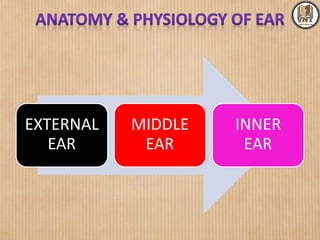
EXTERNAL
EAR
MIDDLE
EAR
INNER
EAR
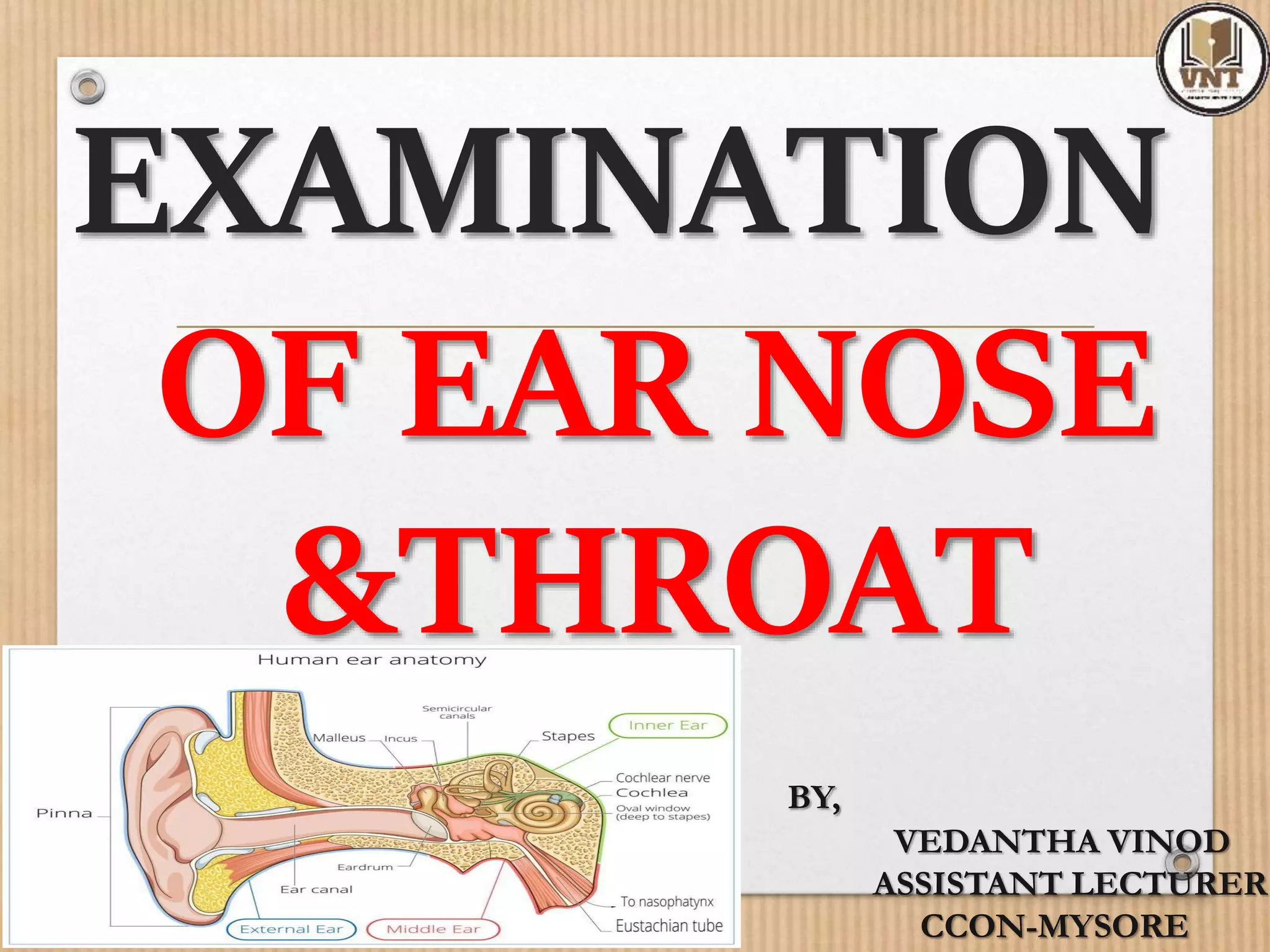
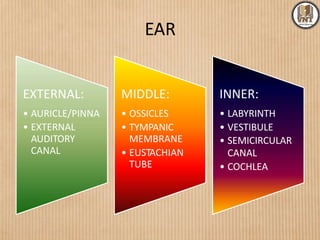
EAR
EXTERNAL:
• AURICLE/PINNA
• EXTERNAL
AUDITORY
CANAL
MIDDLE:
• OSSICLES
• TYMPANIC
MEMBRANE
• EUSTACHIAN
TUBE
INNER:
• LABYRINTH
• VESTIBULE
• SEMICIRCULAR
CANAL
• COCHLEA
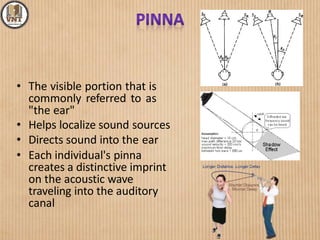
• The visible portion that is
commonly referred to as
"the ear"
• Helps localize sound sources
• Directs sound into the ear
• Each individual's pinna
creates a distinctive imprint
on the acoustic wave
traveling into the auditory
canal
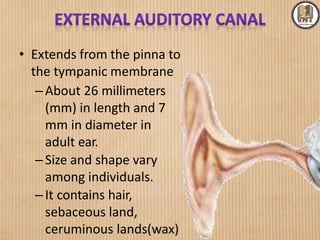
• Extends from the pinna to
the tympanic membrane
–About 26 millimeters
(mm) in length and 7
mm in diameter in
adult ear.
–Size and shape vary
among individuals.
–It contains hair,
sebaceous land,
ceruminous lands(wax)
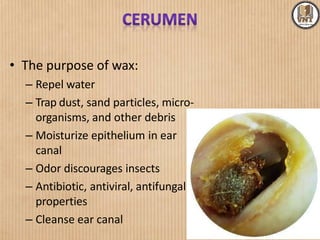
• The purpose of wax:
– Repel water
– Trap dust, sand particles, micro-
organisms, and other debris
– Moisturize epithelium in ear
canal
– Odor discourages insects
– Antibiotic, antiviral, antifungal
properties
– Cleanse ear canal
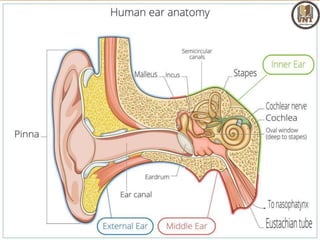
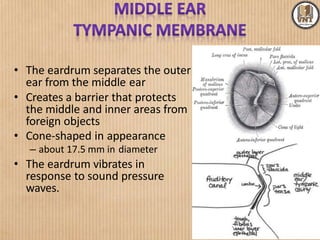
• The eardrum separates the outer
ear from the middle ear
• Creates a barrier that protects
the middle and inner areas from
foreign objects
• Cone-shaped in appearance
– about 17.5 mm in diameter
• The eardrum vibrates in
response to sound pressure
waves.
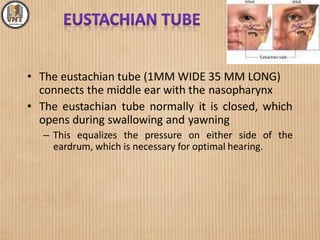
• The eustachian tube (1MM WIDE 35 MM LONG)
connects the middle ear with the nasopharynx
• The eustachian tube normally it is closed, which
opens during swallowing and yawning
– This equalizes the pressure on either side of the
eardrum, which is necessary for optimal hearing.
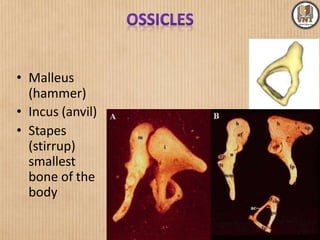
• Malleus
(hammer)
• Incus (anvil)
• Stapes
(stirrup)
smallest
bone of the
body
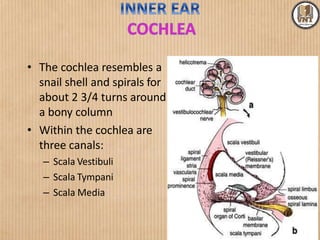
• The cochlea resembles a
snail shell and spirals for
about 2 3/4 turns around
a bony column
• Within the cochlea are
three canals:
– Scala Vestibuli
– Scala Tympani
– Scala Media
FUNCTIONS
• Hearing
• Balance & equilibrium
• History of present illness
• General – onset, chronology, current situation,
location, radiation, quality, timing, factors,
associated symptoms, previous treatments
• Cardinal signs&symptoms:
EAR: Recent changes in hearing, itching,
earache, discharge, tinnitus, vertigo,ear
trauma, Q-TIP Use
• NOSE&SINUSES: Rhinorrhea, epistaxis,
obstruction of airflow, sinus pain &
localised headache, itching, anosomia,
nasal trauma. Sneezing
• MOUTH& THROAT: Hoarseness, dental
chanes, oral lesions, bleeding gums, sore
throat, dysphagia
• NECK: Pain, swelling, enlarged glands
• OTHERS: Fever, malaise, N/V
• Medical conditions& surgeries
• Allergies(season)
• Medications
• Herbal preparations
MEDICAL HISTORY RELATED
TO ENT
• Frequent ear or throat
infections
• Sinusitis
• Trauma to head, ENT
• ENT Surgery
• Seasonal allergies
• Asthma
• Hearing loss
• Meniere’s disease
• ENT Cancer
PERSONAL & SOCIAL
HISTORY
• Smoking
• Frequent exposure to water
• Use of foreign object to ear
• Over crowding
• Use of ear protection
• Recent air travels
• Occupational exposure to toxins or
loud noises
• Inspection: auricle & surrounding tissue
should be inspected for deformities,
lesions & discharge
• Palpation: palpate the auricle – if pain
– A/C External otitis, tenderness on
mastoid – A/C Mastoiditis
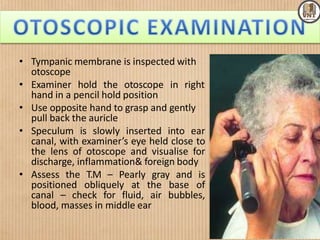
• Tympanic membrane is inspected with
otoscope
• Examiner hold the otoscope in right
hand in a pencil hold position
• Use opposite hand to grasp and gently
pull back the auricle
• Speculum is slowly inserted into ear
canal, with examiner’s eye held close to
the lens of otoscope and visualise for
discharge, inflammation& foreign body
• Assess the T.M – Pearly gray and is
positioned obliquely at the base of
canal – check for fluid, air bubbles,
blood, masses in middle ear
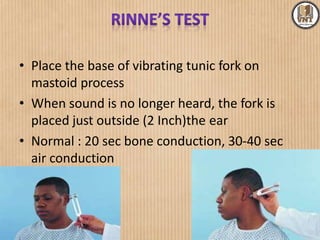
• Place the base of vibrating tunic fork on
mastoid process
• When sound is no longer heard, the fork is
placed just outside (2 Inch)the ear
• Normal : 20 sec bone conduction, 30-40 sec
air conduction
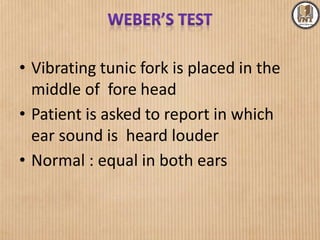
• Vibrating tunic fork is placed in the
middle of fore head
• Patient is asked to report in which
ear sound is heard louder
• Normal : equal in both ears
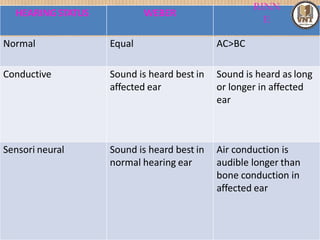
HEARING STATUS WEBER
RINN
E
Normal Equal AC>BC
Conductive Sound is heard best in
affected ear
Sound is heard as long
or longer in affected
ear
Sensori neural Sound is heard best in
normal hearing ear
Air conduction is
audible longer than
bone conduction in
affected ear
WHISPER
TEST
• Examiner cover the untested ear with
palm of the hand
• Then the examiner whispers softly
from a distance of 1 or 2 feet from
unoccluded ear and out of the
patients sight
• The patient with normal acuity repeat
what was whispered.
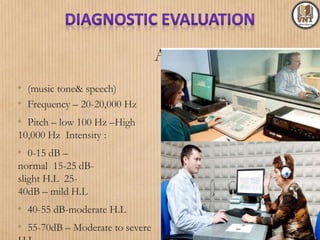
AUDIOMETRY:
• (music tone& speech)
• Frequency – 20-20,000 Hz
• Pitch – low 100 Hz –High
10,000 Hz Intensity :
• 0-15 dB –
normal 15-25 dB-
slight H.L 25-
40dB – mild H.L
• 40-55 dB-moderate H.L
• 55-70dB – Moderate to severe
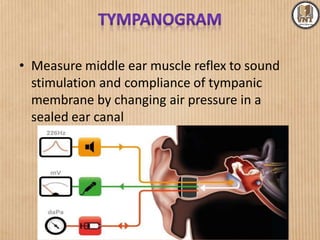
• Measure middle ear muscle reflex to sound
stimulation and compliance of tympanic
membrane by changing air pressure in a
sealed ear canal
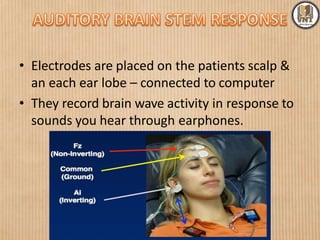
• Electrodes are placed on the patients scalp &
an each ear lobe – connected to computer
• They record brain wave activity in response to
sounds you hear through earphones.
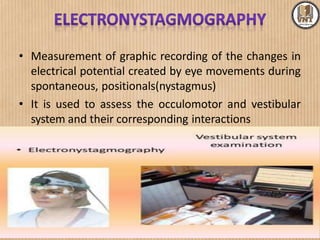
• Measurement of graphic recording of the changes in
electrical potential created by eye movements during
spontaneous, positionals(nystagmus)
• It is used to assess the occulomotor and vestibular
system and their corresponding interactions
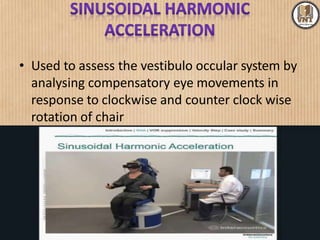
• Used to assess the vestibulo occular system by
analysing compensatory eye movements in
response to clockwise and counter clock wise
rotation of chair
PRINCIPAL NASAL SYMPTOMS
 Airway obstruction
 Runny nose (rhinorrhoea)
 Sneezing
 Loss of smell (anosmia)
 Facial pain due to sinusitis
 Snoring associated with nasal
obstruction
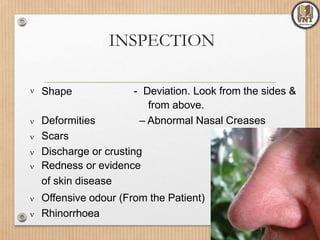
INSPECTION
 Shape - Deviation. Look from the sides &
from above.
– Abnormal Nasal Creases Deformities
 Scars
 Discharge or crusting
 Redness or evidence
of skin disease
 Offensive odour (From the Patient)
 Rhinorrhoea
INSPECTION

• Inspect the front of the nose first
by tipping the nose up and
inspecting without a speculum.
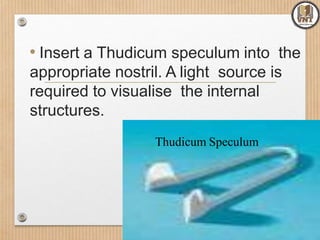
• Insert a Thudicum speculum into the
appropriate nostril. A light source is
required to visualise the internal
structures.
Thudicum Speculum
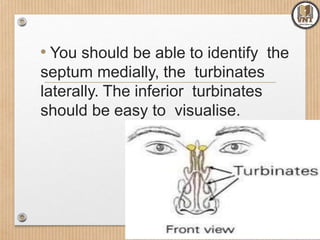
• You should be able to identify the
septum medially, the turbinates
laterally. The inferior turbinates
should be easy to visualise.
INSPECTION
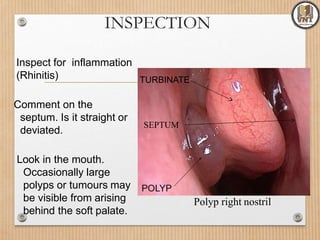
Inspect for inflammation
(Rhinitis)
Comment on the
septum. Is it straight or
deviated.
Look in the mouth.
Occasionally large
polyps or tumours may
be visible from arising
behind the soft palate.
Polyp right nostril
TURBINATE
SEPTUM
PALPATION
• If you see what you believe is a polyp
then it is useful to assess sensitivity.
• Polyps are not sensitive to touch
whereas turbinates are tender to touch.
• Polyps are grey / yellow whereas
turbinates are pink.
NASAL AIRWAY ASSESSMENT
 Hold a cold metal tongue depressor under the
patient’s nose whilst they breath in and out
through their nose. Condensation should be
visible as air passes over the metal.
 To assess nasal airway efficiency. Occlude one
nostril and ask the patient to sniff. This gives a
reasonable idea on nasal airway efficiency.
THROAT EXAMINATION
Enquire on general history.
Sore throat, feeling run down, visible lesions & causing pain.
Ask about alcohol & tobaccohabits.
Ask about their general dentalhistory.
INSPECTION 1
Ask the patient to remove any dentures.
 Inspect the lips. Note the Vermillion border
& the corners of the mouth for any deviation.
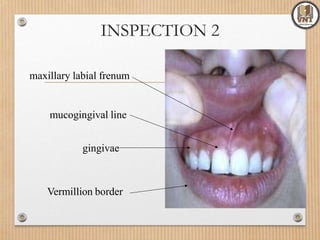
 Retract the upper lip with the front teeth
closed together. Note the maxillary labial
frenum, gingivae, mucogingival line with
teeth.
Vermillion border
maxillary labial frenum
mucogingival line
gingivae
INSPECTION 2
INSPECTION 3
 Note oral hydration
 Halitosis?
 Note any varicosities,
missing teeth, dental
carries, ulceration or
haemangiomas.
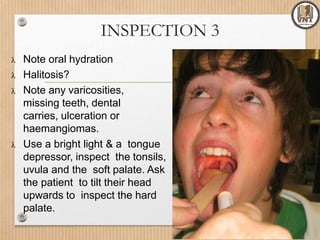
 Use a bright light & a tongue
depressor, inspect the tonsils,
uvula and the soft palate. Ask
the patient to tilt their head
upwards to inspect the hard
palate.
INSPECTION 4
 Note the mucosal lining of the cheeks, noting
Stensen’s glands. Located behind the 2nd molar. It
carries saliva from the Parotid gland.
Any blockage can render the mouth dry.
 Note the frenum. Note any ulceration / discharge.
 Ask the patient to lift their tongue upwards to
inspect the floor of the mouth. Note if the tip of
the tongue can touch the roof of the mouth.
Failure to do so may indicated tongue tie.
(Ankyloglosia.)
PAROTID
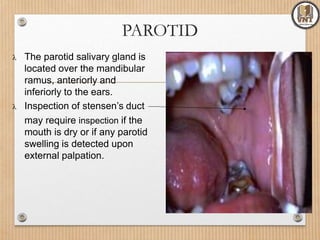
 The parotid salivary gland is
located over the mandibular
ramus, anteriorly and
inferiorly to the ears.
 Inspection of stensen’s duct
may require inspection if the
mouth is dry or if any parotid
swelling is detected upon
external palpation.
PAROTID PALPATION
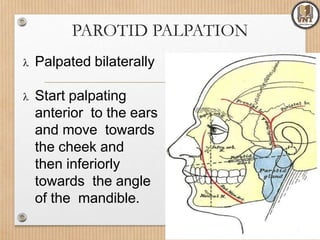
 Palpated bilaterally
 Start palpating
anterior to the ears
and move towards
the cheek and
then inferiorly
towards the angle
of the mandible.
INSPECTION 4
Any further examination of the
larynx requires specialised
equipment.
 Inspection of the oral cavity may also
have a neurological element. C.N’s
7.9 &12
ANY DOUBTS?

ENT Examination

  • 1.
    EXAMINATION OF EAR NOSE &THROAT BY, VEDANTHAVINOD ASSISTANT LECTURER CCON-MYSORE
  • 2.
    CONTENTS TO BEDISCUSSED: • BASIC ANATOMY & PHYSIOLOGY OF EAR,NOSE AND THROAT. • HISTORY • OTOSCOPIC EXAMINATION • EXAMINATION OF EAR , NOSE AND THROAT,
  • 3.
  • 5.
    EAR EXTERNAL: • AURICLE/PINNA • EXTERNAL AUDITORY CANAL MIDDLE: •OSSICLES • TYMPANIC MEMBRANE • EUSTACHIAN TUBE INNER: • LABYRINTH • VESTIBULE • SEMICIRCULAR CANAL • COCHLEA
  • 6.
    • The visibleportion that is commonly referred to as "the ear" • Helps localize sound sources • Directs sound into the ear • Each individual's pinna creates a distinctive imprint on the acoustic wave traveling into the auditory canal
  • 7.
    • Extends fromthe pinna to the tympanic membrane –About 26 millimeters (mm) in length and 7 mm in diameter in adult ear. –Size and shape vary among individuals. –It contains hair, sebaceous land, ceruminous lands(wax)
  • 8.
    • The purposeof wax: – Repel water – Trap dust, sand particles, micro- organisms, and other debris – Moisturize epithelium in ear canal – Odor discourages insects – Antibiotic, antiviral, antifungal properties – Cleanse ear canal
  • 9.
    • The eardrumseparates the outer ear from the middle ear • Creates a barrier that protects the middle and inner areas from foreign objects • Cone-shaped in appearance – about 17.5 mm in diameter • The eardrum vibrates in response to sound pressure waves.
  • 10.
    • The eustachiantube (1MM WIDE 35 MM LONG) connects the middle ear with the nasopharynx • The eustachian tube normally it is closed, which opens during swallowing and yawning – This equalizes the pressure on either side of the eardrum, which is necessary for optimal hearing.
  • 11.
    • Malleus (hammer) • Incus(anvil) • Stapes (stirrup) smallest bone of the body
  • 12.
    • The cochlearesembles a snail shell and spirals for about 2 3/4 turns around a bony column • Within the cochlea are three canals: – Scala Vestibuli – Scala Tympani – Scala Media
  • 13.
  • 14.
    • History ofpresent illness • General – onset, chronology, current situation, location, radiation, quality, timing, factors, associated symptoms, previous treatments • Cardinal signs&symptoms: EAR: Recent changes in hearing, itching, earache, discharge, tinnitus, vertigo,ear trauma, Q-TIP Use
  • 15.
    • NOSE&SINUSES: Rhinorrhea,epistaxis, obstruction of airflow, sinus pain & localised headache, itching, anosomia, nasal trauma. Sneezing • MOUTH& THROAT: Hoarseness, dental chanes, oral lesions, bleeding gums, sore throat, dysphagia • NECK: Pain, swelling, enlarged glands • OTHERS: Fever, malaise, N/V
  • 16.
    • Medical conditions&surgeries • Allergies(season) • Medications • Herbal preparations
  • 17.
    MEDICAL HISTORY RELATED TOENT • Frequent ear or throat infections • Sinusitis • Trauma to head, ENT • ENT Surgery • Seasonal allergies • Asthma • Hearing loss • Meniere’s disease • ENT Cancer
  • 18.
    PERSONAL & SOCIAL HISTORY •Smoking • Frequent exposure to water • Use of foreign object to ear • Over crowding • Use of ear protection • Recent air travels • Occupational exposure to toxins or loud noises
  • 19.
    • Inspection: auricle& surrounding tissue should be inspected for deformities, lesions & discharge • Palpation: palpate the auricle – if pain – A/C External otitis, tenderness on mastoid – A/C Mastoiditis
  • 20.
    • Tympanic membraneis inspected with otoscope • Examiner hold the otoscope in right hand in a pencil hold position • Use opposite hand to grasp and gently pull back the auricle • Speculum is slowly inserted into ear canal, with examiner’s eye held close to the lens of otoscope and visualise for discharge, inflammation& foreign body • Assess the T.M – Pearly gray and is positioned obliquely at the base of canal – check for fluid, air bubbles, blood, masses in middle ear
  • 21.
    • Place thebase of vibrating tunic fork on mastoid process • When sound is no longer heard, the fork is placed just outside (2 Inch)the ear • Normal : 20 sec bone conduction, 30-40 sec air conduction
  • 22.
    • Vibrating tunicfork is placed in the middle of fore head • Patient is asked to report in which ear sound is heard louder • Normal : equal in both ears
  • 23.
    HEARING STATUS WEBER RINN E NormalEqual AC>BC Conductive Sound is heard best in affected ear Sound is heard as long or longer in affected ear Sensori neural Sound is heard best in normal hearing ear Air conduction is audible longer than bone conduction in affected ear
  • 24.
    WHISPER TEST • Examiner coverthe untested ear with palm of the hand • Then the examiner whispers softly from a distance of 1 or 2 feet from unoccluded ear and out of the patients sight • The patient with normal acuity repeat what was whispered.
  • 25.
    AUDIOMETRY: • (music tone&speech) • Frequency – 20-20,000 Hz • Pitch – low 100 Hz –High 10,000 Hz Intensity : • 0-15 dB – normal 15-25 dB- slight H.L 25- 40dB – mild H.L • 40-55 dB-moderate H.L • 55-70dB – Moderate to severe
  • 26.
    • Measure middleear muscle reflex to sound stimulation and compliance of tympanic membrane by changing air pressure in a sealed ear canal
  • 27.
    • Electrodes areplaced on the patients scalp & an each ear lobe – connected to computer • They record brain wave activity in response to sounds you hear through earphones.
  • 28.
    • Measurement ofgraphic recording of the changes in electrical potential created by eye movements during spontaneous, positionals(nystagmus) • It is used to assess the occulomotor and vestibular system and their corresponding interactions
  • 29.
    • Used toassess the vestibulo occular system by analysing compensatory eye movements in response to clockwise and counter clock wise rotation of chair
  • 30.
    PRINCIPAL NASAL SYMPTOMS Airway obstruction  Runny nose (rhinorrhoea)  Sneezing  Loss of smell (anosmia)  Facial pain due to sinusitis  Snoring associated with nasal obstruction
  • 31.
    INSPECTION  Shape -Deviation. Look from the sides & from above. – Abnormal Nasal Creases Deformities  Scars  Discharge or crusting  Redness or evidence of skin disease  Offensive odour (From the Patient)  Rhinorrhoea
  • 32.
    INSPECTION  • Inspect thefront of the nose first by tipping the nose up and inspecting without a speculum.
  • 33.
    • Insert aThudicum speculum into the appropriate nostril. A light source is required to visualise the internal structures. Thudicum Speculum
  • 34.
    • You shouldbe able to identify the septum medially, the turbinates laterally. The inferior turbinates should be easy to visualise.
  • 35.
    INSPECTION Inspect for inflammation (Rhinitis) Commenton the septum. Is it straight or deviated. Look in the mouth. Occasionally large polyps or tumours may be visible from arising behind the soft palate. Polyp right nostril TURBINATE SEPTUM
  • 36.
    PALPATION • If yousee what you believe is a polyp then it is useful to assess sensitivity. • Polyps are not sensitive to touch whereas turbinates are tender to touch. • Polyps are grey / yellow whereas turbinates are pink.
  • 37.
    NASAL AIRWAY ASSESSMENT Hold a cold metal tongue depressor under the patient’s nose whilst they breath in and out through their nose. Condensation should be visible as air passes over the metal.  To assess nasal airway efficiency. Occlude one nostril and ask the patient to sniff. This gives a reasonable idea on nasal airway efficiency.
  • 38.
    THROAT EXAMINATION Enquire ongeneral history. Sore throat, feeling run down, visible lesions & causing pain. Ask about alcohol & tobaccohabits. Ask about their general dentalhistory.
  • 39.
    INSPECTION 1 Ask thepatient to remove any dentures.  Inspect the lips. Note the Vermillion border & the corners of the mouth for any deviation.  Retract the upper lip with the front teeth closed together. Note the maxillary labial frenum, gingivae, mucogingival line with teeth.
  • 40.
    Vermillion border maxillary labialfrenum mucogingival line gingivae INSPECTION 2
  • 41.
    INSPECTION 3  Noteoral hydration  Halitosis?  Note any varicosities, missing teeth, dental carries, ulceration or haemangiomas.  Use a bright light & a tongue depressor, inspect the tonsils, uvula and the soft palate. Ask the patient to tilt their head upwards to inspect the hard palate.
  • 42.
    INSPECTION 4  Notethe mucosal lining of the cheeks, noting Stensen’s glands. Located behind the 2nd molar. It carries saliva from the Parotid gland. Any blockage can render the mouth dry.  Note the frenum. Note any ulceration / discharge.  Ask the patient to lift their tongue upwards to inspect the floor of the mouth. Note if the tip of the tongue can touch the roof of the mouth. Failure to do so may indicated tongue tie. (Ankyloglosia.)
  • 43.
    PAROTID  The parotidsalivary gland is located over the mandibular ramus, anteriorly and inferiorly to the ears.  Inspection of stensen’s duct may require inspection if the mouth is dry or if any parotid swelling is detected upon external palpation.
  • 44.
    PAROTID PALPATION  Palpatedbilaterally  Start palpating anterior to the ears and move towards the cheek and then inferiorly towards the angle of the mandible.
  • 45.
    INSPECTION 4 Any furtherexamination of the larynx requires specialised equipment.  Inspection of the oral cavity may also have a neurological element. C.N’s 7.9 &12
  • 46.