

WORK MOTIVATION
Submitted By: Nitish Sadotra
Subject : Management Process and Organisation Behaviour.
Content:
▪ Introduction
▪ Need of Motivation
▪ Importance of Motivation For Organisation
▪ Motivational Factors
▪ Motivational Theories
▪ Conclusion
Introduction: Motivation
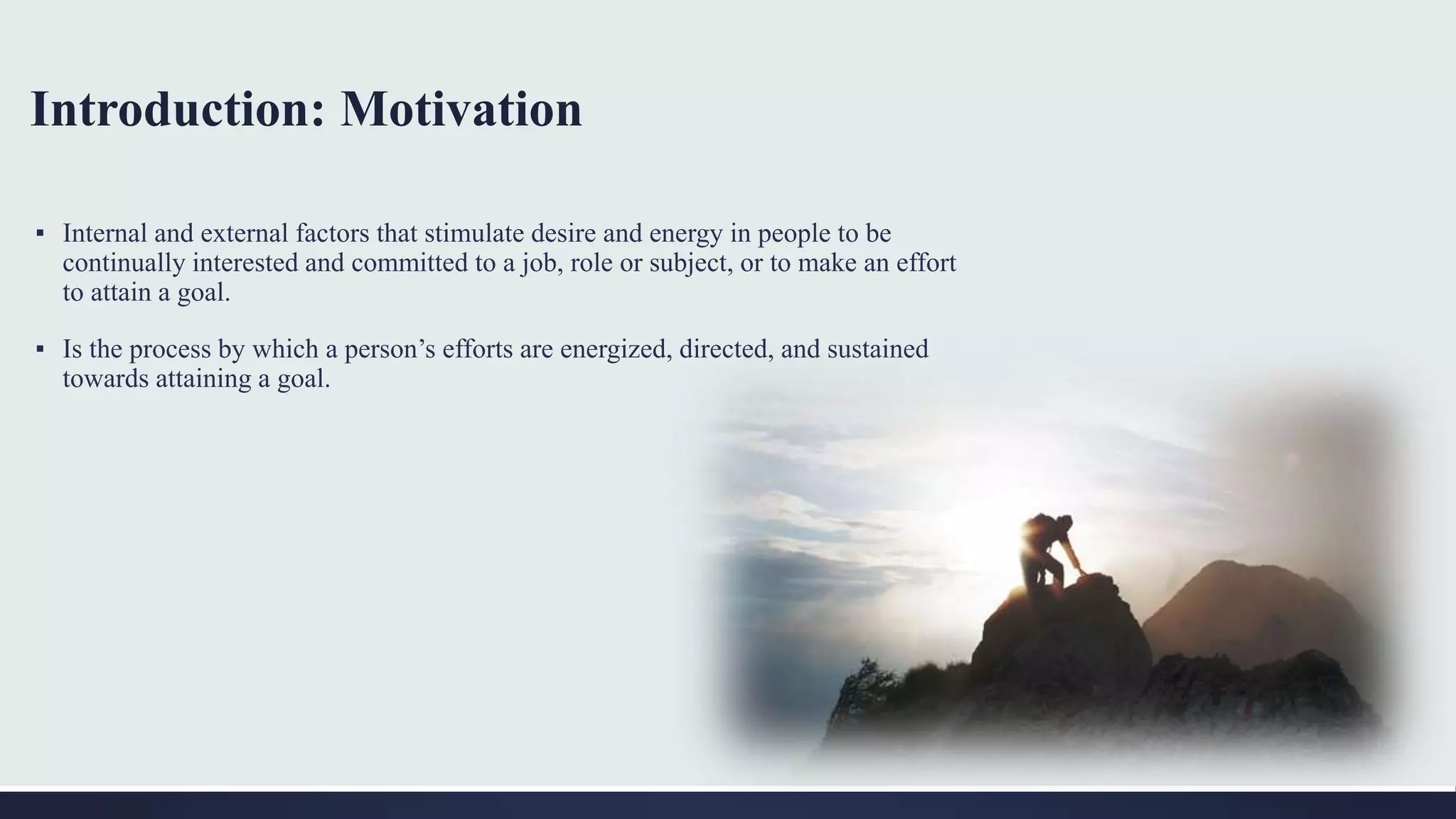
▪ Internal and external factors that stimulate desire and energy in people to be
continually interested and committed to a job, role or subject, or to make an effort
to attain a goal.
▪ Is the process by which a person’s efforts are energized, directed, and sustained
towards attaining a goal.
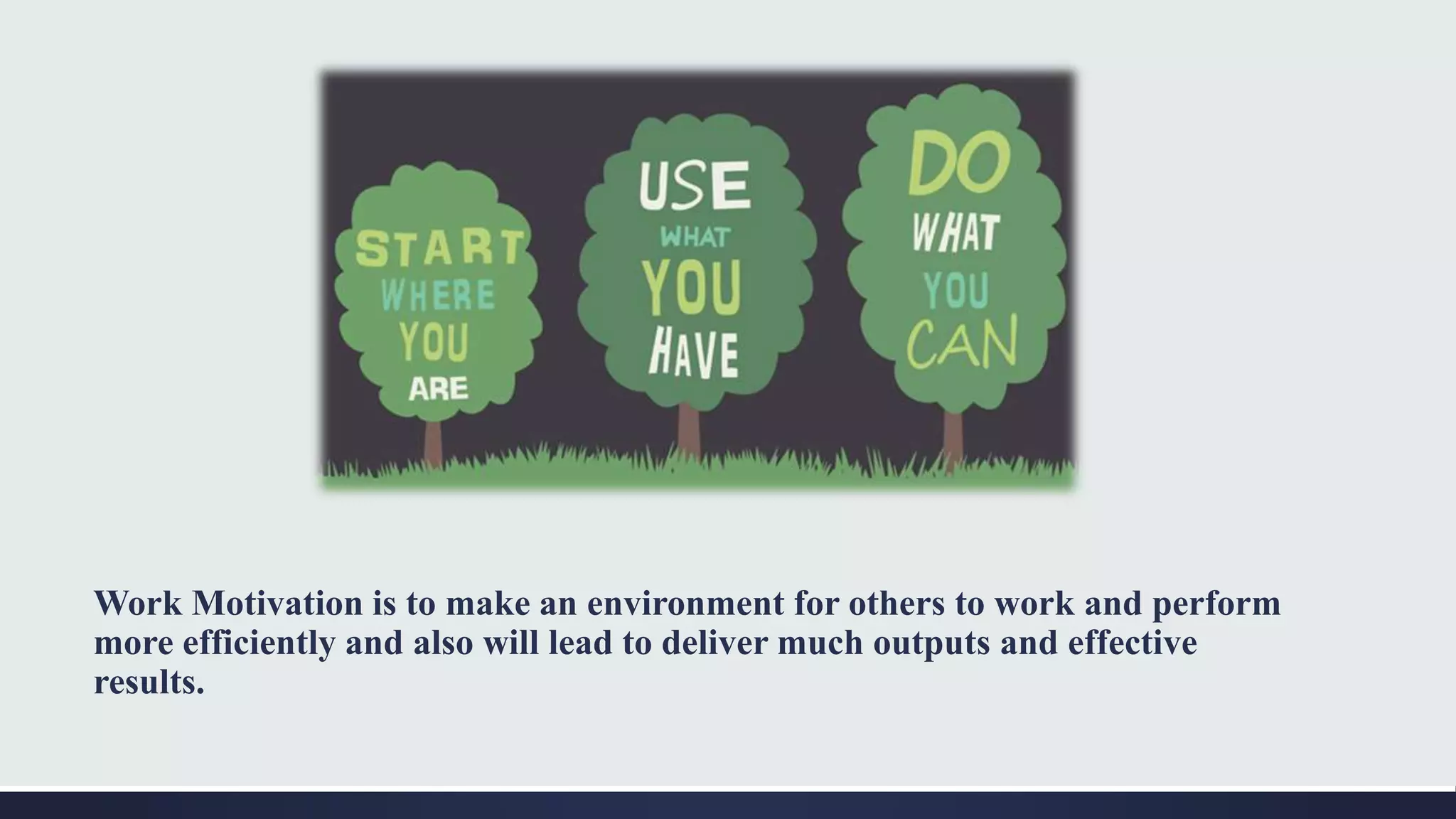
Work Motivation is to make an environment for others to work and perform
more efficiently and also will lead to deliver much outputs and effective
results.
Need Of Motivation
▪ Every concern requires physical, financial and human resources to accomplish the goals.
▪ It is through motivation that the human resources can be utilized by making full use of it.
▪ This can be done by building willingness in employees to work. This will help the enterprise in
securing best possible utilization of resources.
Importance of Motivation For Organisation
▪ Motivation is generally what energizes, maintains, and controls behavior.
▪ The role of motivation in the workplace is straightforward theoretically but is difficult to actually measure.
▪ Salary is often enough motivation to keep employees working for an organization, but it's not always enough
to push them to put their full potential.
▪ Motivated employees will retain a high level of innovation while producing higher-quality work at a higher
level of efficiency.
▪ The opportunity cost in motivating employees is essentially zero.
Motivating employees can lead to increased productivity and allow an organization to
achieve higher levels of output.
Motivational Factors:
Monetary Factors:
 Salaries or Wages
 Bonus
 Incentives
Non-Monetary Factors:
 Status or job title
 Appreciation and recognition
 Job security
 Working conditions
 Good superiors
 Flexible working hours
Motivational Theories
▪ Maslow’s-Hierarchy of Needs Theory
▪ Alderfer's ERG Theory
▪ McClelland’s Theory of Needs
▪ Herzberg's Two Factor Theory
▪ Carrot and Stick Theory
▪ Vroom’s Expectancy Theory
▪ Equity Theory
Maslow’s-Hierarchy of Needs Theory
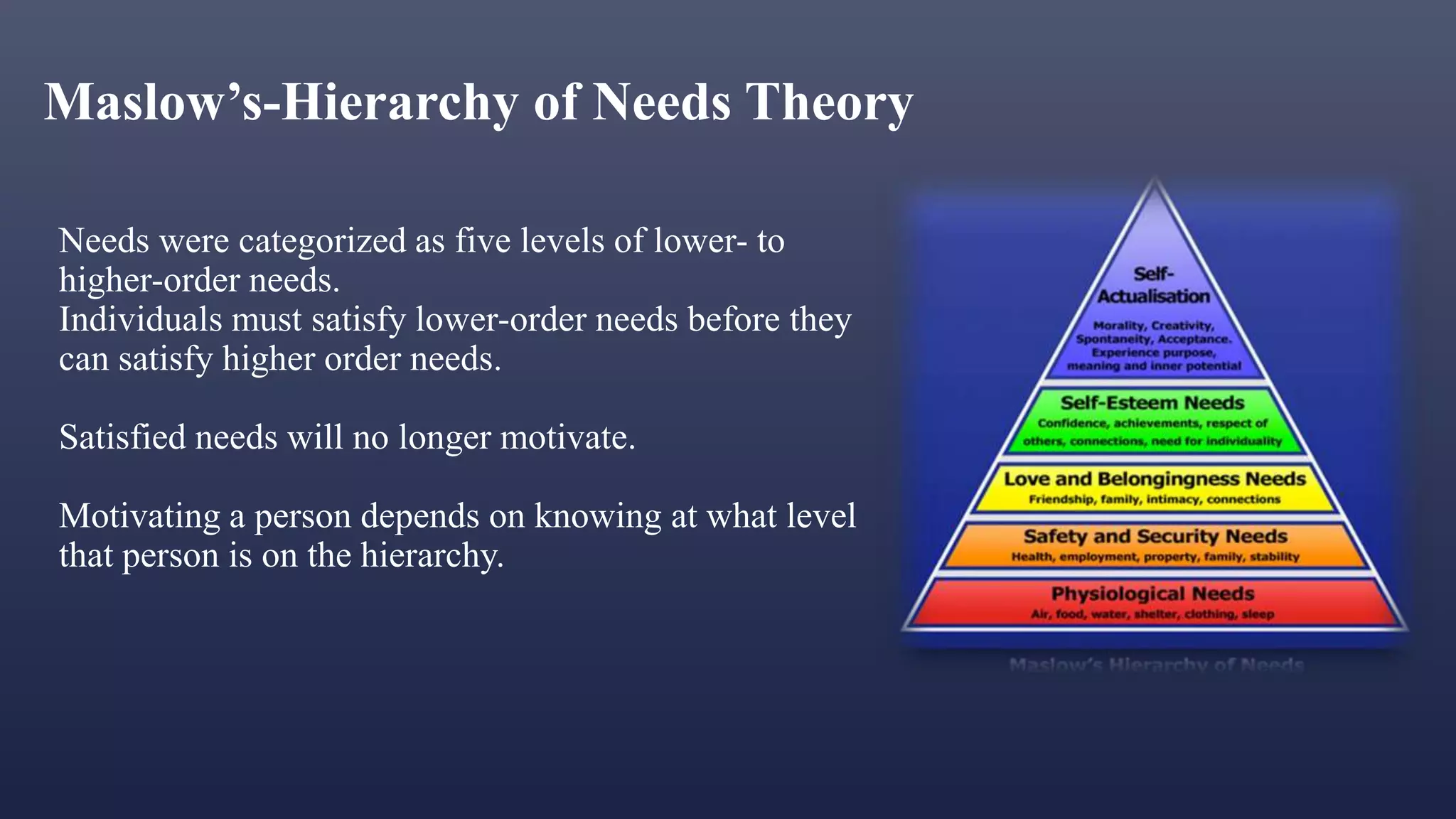
Needs were categorized as five levels of lower- to
higher-order needs.
Individuals must satisfy lower-order needs before they
can satisfy higher order needs.
Satisfied needs will no longer motivate.
Motivating a person depends on knowing at what level
that person is on the hierarchy.
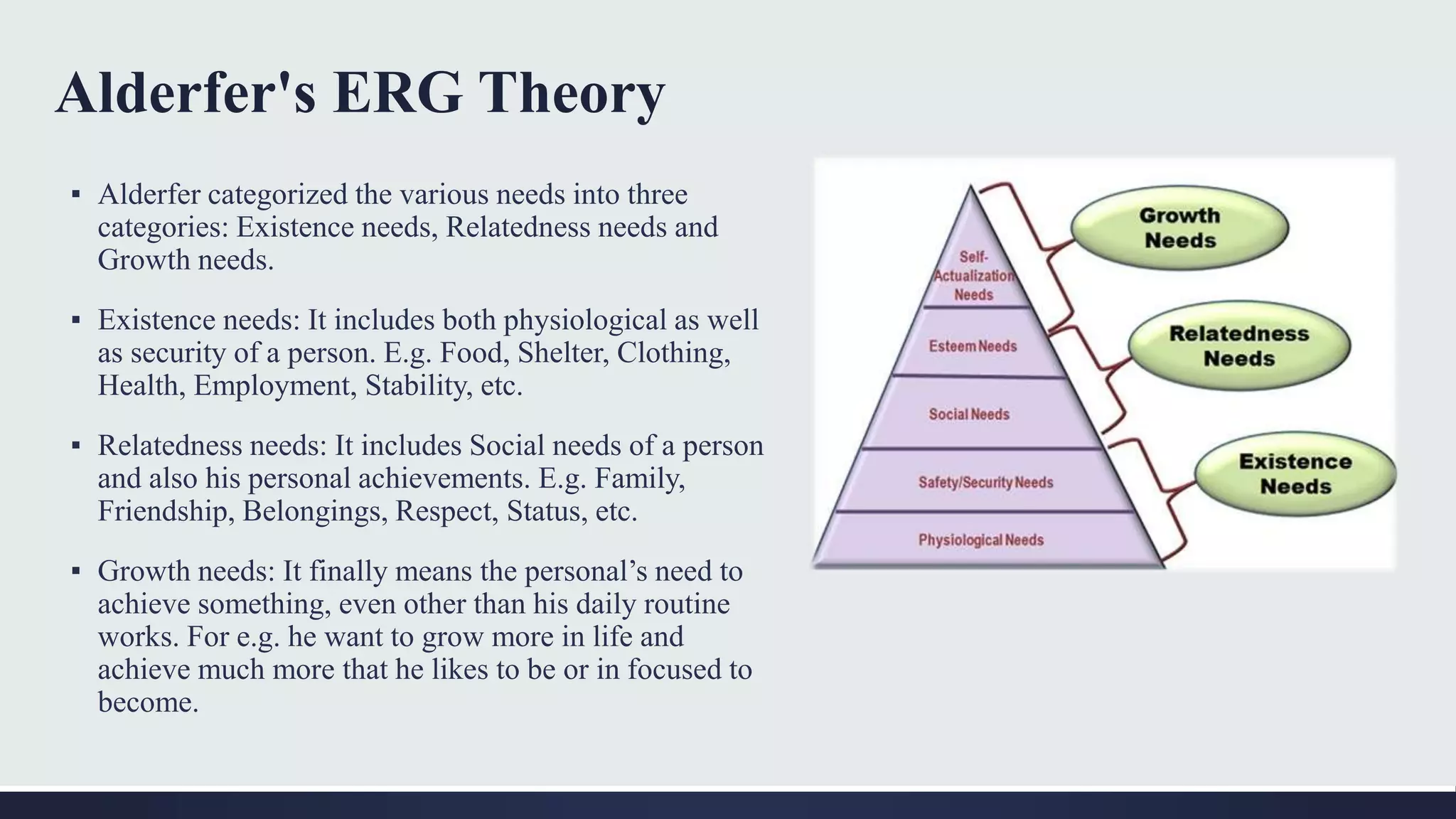
Alderfer's ERG Theory
▪ Alderfer categorized the various needs into three
categories: Existence needs, Relatedness needs and
Growth needs.
▪ Existence needs: It includes both physiological as well
as security of a person. E.g. Food, Shelter, Clothing,
Health, Employment, Stability, etc.
▪ Relatedness needs: It includes Social needs of a person
and also his personal achievements. E.g. Family,
Friendship, Belongings, Respect, Status, etc.
▪ Growth needs: It finally means the personal’s need to
achieve something, even other than his daily routine
works. For e.g. he want to grow more in life and
achieve much more that he likes to be or in focused to
become.
McClelland’s Theory of Needs
According to David McClelland, regardless of culture or gender, people are
driven by three motives:
 Need of Achievement (n/Ach): The need for achievement is characterized by the wish to
take responsibility for finding solutions to problems, master complex tasks, set goals, get feedback
on level of success.
 Need of Power (n/Pow): The need for power is characterized by a drive to control and influence
others, a need to win arguments, a need to persuade and prevail.
 Need of affiliation (n/Aff): The need for affiliation is characterized by a desire to belong, an
enjoyment of teamwork, a concern about interpersonal relationships, and a need to reduce
uncertainty
Herzberg's Two Factor Theory
It is also known as the Motivation Hygiene Theory. Because these are the two factors upon
which the job Satisfaction and dissatisfaction matters.
SATISFACTION (MOTIVATION)
achievement
recognition
work itself
responsibility
advancement
DISSATISFACTION (HYGIENE)
company policy
administrative policies
supervision
salary
interpersonal relations
working conditions
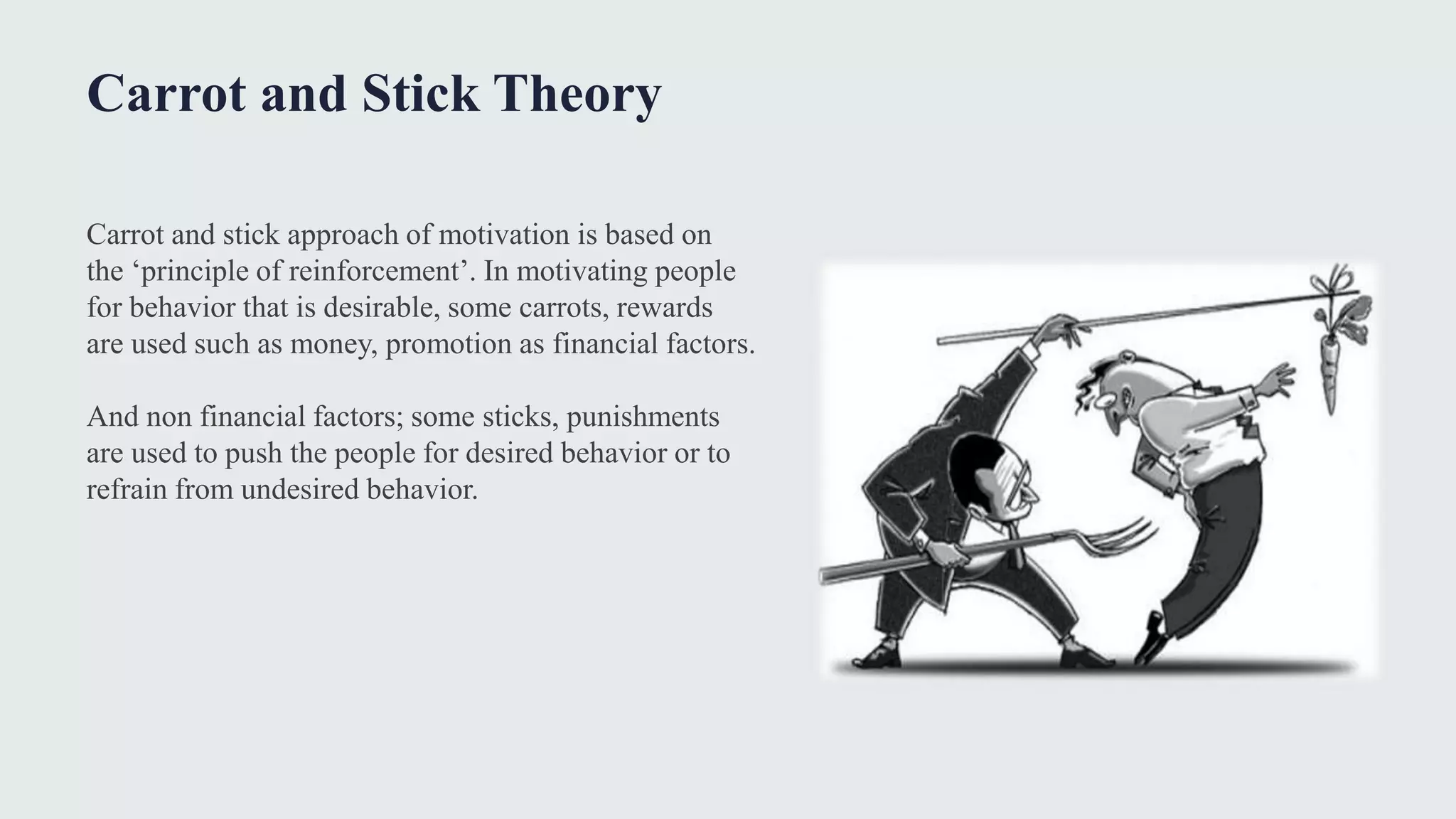
Carrot and Stick Theory
Carrot and stick approach of motivation is based on
the ‘principle of reinforcement’. In motivating people
for behavior that is desirable, some carrots, rewards
are used such as money, promotion as financial factors.
And non financial factors; some sticks, punishments
are used to push the people for desired behavior or to
refrain from undesired behavior.
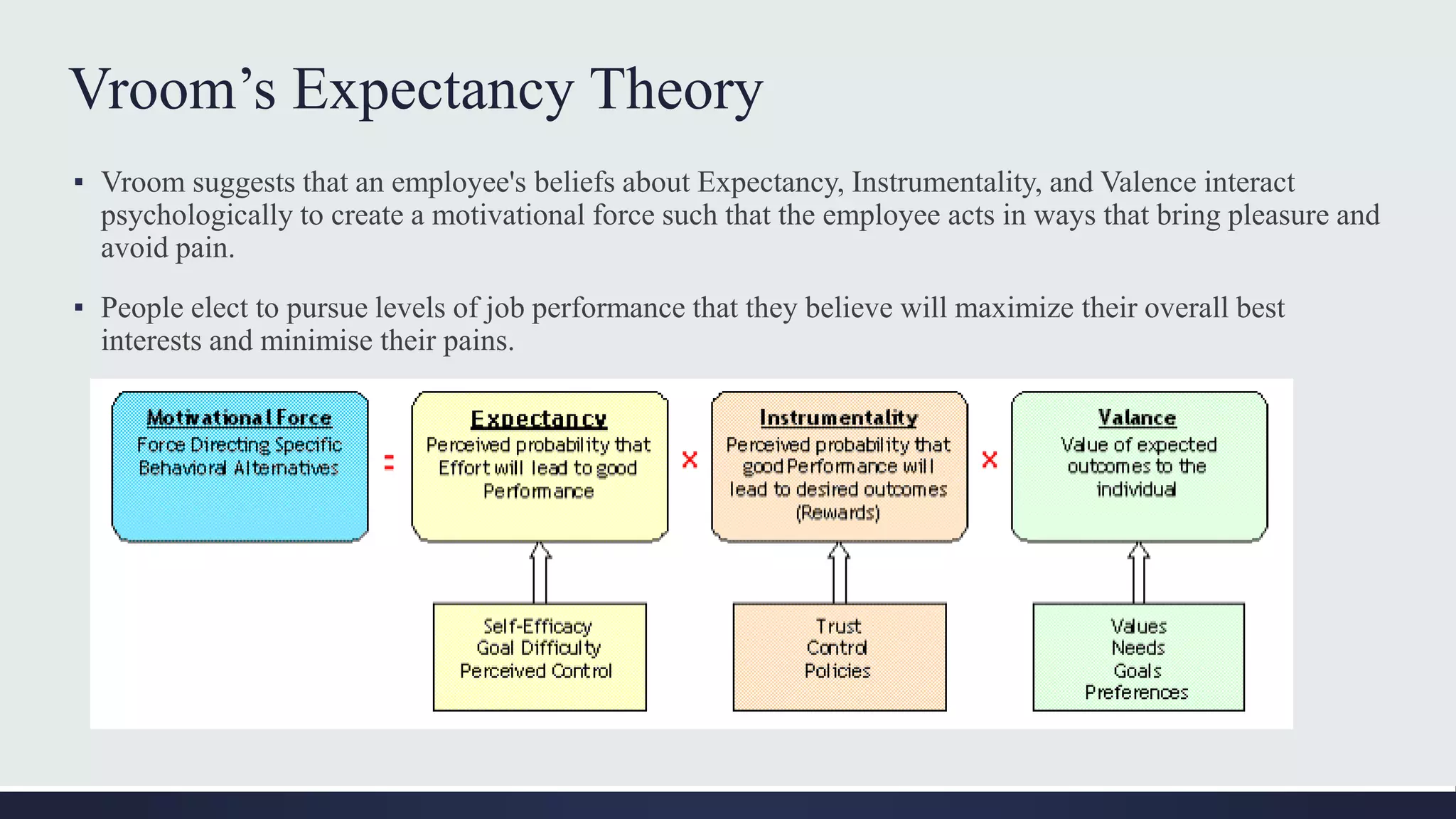
Vroom’s Expectancy Theory
▪ Vroom suggests that an employee's beliefs about Expectancy, Instrumentality, and Valence interact
psychologically to create a motivational force such that the employee acts in ways that bring pleasure and
avoid pain.
▪ People elect to pursue levels of job performance that they believe will maximize their overall best
interests and minimise their pains.
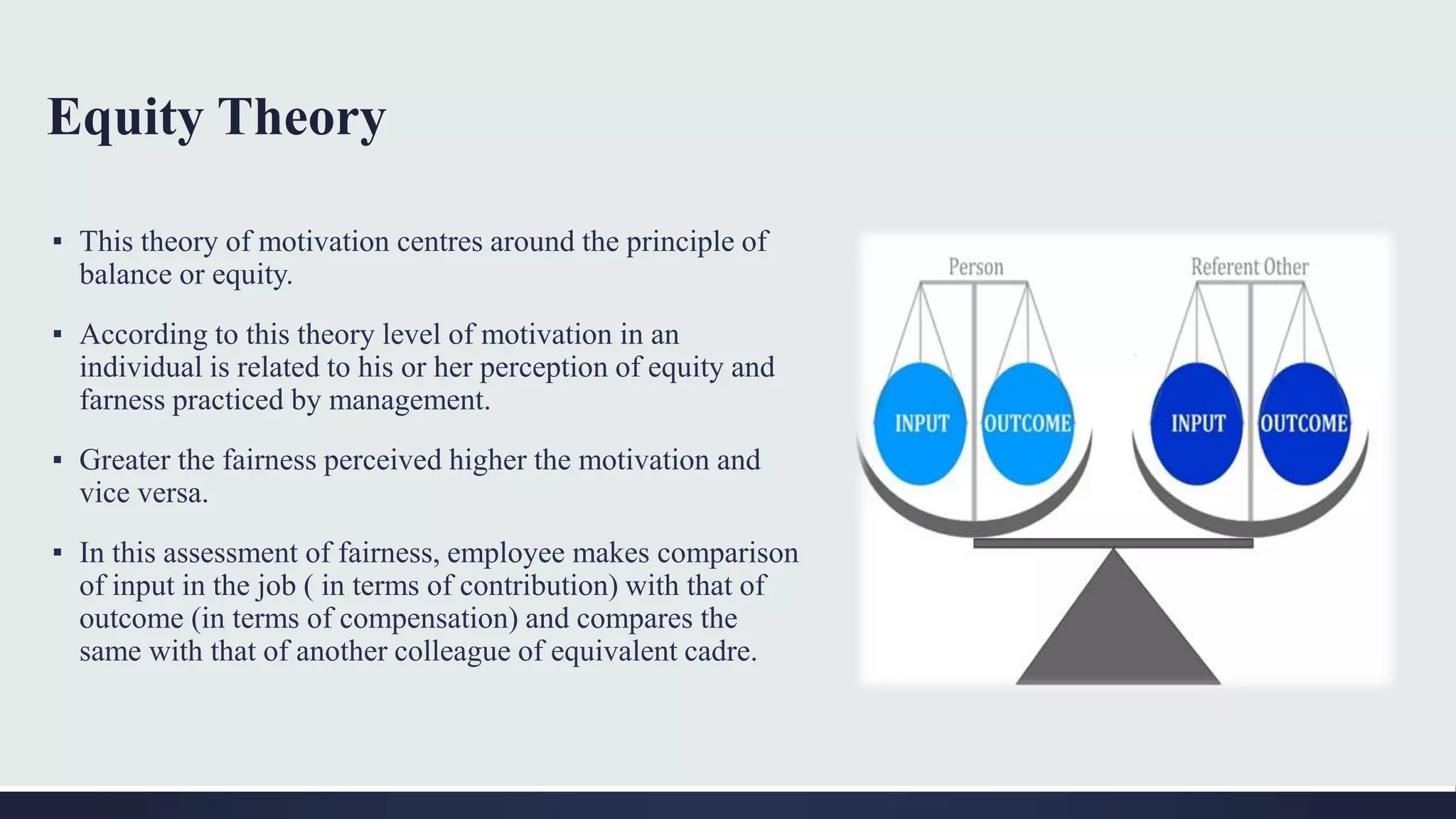
Equity Theory
▪ This theory of motivation centres around the principle of
balance or equity.
▪ According to this theory level of motivation in an
individual is related to his or her perception of equity and
farness practiced by management.
▪ Greater the fairness perceived higher the motivation and
vice versa.
▪ In this assessment of fairness, employee makes comparison
of input in the job ( in terms of contribution) with that of
outcome (in terms of compensation) and compares the
same with that of another colleague of equivalent cadre.
Work motivation

Work motivation

  • 1.
    WORK MOTIVATION Submitted By:Nitish Sadotra Subject : Management Process and Organisation Behaviour.
  • 2.
    Content: ▪ Introduction ▪ Needof Motivation ▪ Importance of Motivation For Organisation ▪ Motivational Factors ▪ Motivational Theories ▪ Conclusion
  • 3.
    Introduction: Motivation ▪ Internaland external factors that stimulate desire and energy in people to be continually interested and committed to a job, role or subject, or to make an effort to attain a goal. ▪ Is the process by which a person’s efforts are energized, directed, and sustained towards attaining a goal.
  • 4.
    Work Motivation isto make an environment for others to work and perform more efficiently and also will lead to deliver much outputs and effective results.
  • 5.
    Need Of Motivation ▪Every concern requires physical, financial and human resources to accomplish the goals. ▪ It is through motivation that the human resources can be utilized by making full use of it. ▪ This can be done by building willingness in employees to work. This will help the enterprise in securing best possible utilization of resources.
  • 6.
    Importance of MotivationFor Organisation ▪ Motivation is generally what energizes, maintains, and controls behavior. ▪ The role of motivation in the workplace is straightforward theoretically but is difficult to actually measure. ▪ Salary is often enough motivation to keep employees working for an organization, but it's not always enough to push them to put their full potential. ▪ Motivated employees will retain a high level of innovation while producing higher-quality work at a higher level of efficiency. ▪ The opportunity cost in motivating employees is essentially zero. Motivating employees can lead to increased productivity and allow an organization to achieve higher levels of output.
  • 7.
    Motivational Factors: Monetary Factors: Salaries or Wages  Bonus  Incentives Non-Monetary Factors:  Status or job title  Appreciation and recognition  Job security  Working conditions  Good superiors  Flexible working hours
  • 8.
    Motivational Theories ▪ Maslow’s-Hierarchyof Needs Theory ▪ Alderfer's ERG Theory ▪ McClelland’s Theory of Needs ▪ Herzberg's Two Factor Theory ▪ Carrot and Stick Theory ▪ Vroom’s Expectancy Theory ▪ Equity Theory
  • 9.
    Maslow’s-Hierarchy of NeedsTheory Needs were categorized as five levels of lower- to higher-order needs. Individuals must satisfy lower-order needs before they can satisfy higher order needs. Satisfied needs will no longer motivate. Motivating a person depends on knowing at what level that person is on the hierarchy.
  • 10.
    Alderfer's ERG Theory ▪Alderfer categorized the various needs into three categories: Existence needs, Relatedness needs and Growth needs. ▪ Existence needs: It includes both physiological as well as security of a person. E.g. Food, Shelter, Clothing, Health, Employment, Stability, etc. ▪ Relatedness needs: It includes Social needs of a person and also his personal achievements. E.g. Family, Friendship, Belongings, Respect, Status, etc. ▪ Growth needs: It finally means the personal’s need to achieve something, even other than his daily routine works. For e.g. he want to grow more in life and achieve much more that he likes to be or in focused to become.
  • 11.
    McClelland’s Theory ofNeeds According to David McClelland, regardless of culture or gender, people are driven by three motives:  Need of Achievement (n/Ach): The need for achievement is characterized by the wish to take responsibility for finding solutions to problems, master complex tasks, set goals, get feedback on level of success.  Need of Power (n/Pow): The need for power is characterized by a drive to control and influence others, a need to win arguments, a need to persuade and prevail.  Need of affiliation (n/Aff): The need for affiliation is characterized by a desire to belong, an enjoyment of teamwork, a concern about interpersonal relationships, and a need to reduce uncertainty
  • 12.
    Herzberg's Two FactorTheory It is also known as the Motivation Hygiene Theory. Because these are the two factors upon which the job Satisfaction and dissatisfaction matters. SATISFACTION (MOTIVATION) achievement recognition work itself responsibility advancement DISSATISFACTION (HYGIENE) company policy administrative policies supervision salary interpersonal relations working conditions
  • 13.
    Carrot and StickTheory Carrot and stick approach of motivation is based on the ‘principle of reinforcement’. In motivating people for behavior that is desirable, some carrots, rewards are used such as money, promotion as financial factors. And non financial factors; some sticks, punishments are used to push the people for desired behavior or to refrain from undesired behavior.
  • 14.
    Vroom’s Expectancy Theory ▪Vroom suggests that an employee's beliefs about Expectancy, Instrumentality, and Valence interact psychologically to create a motivational force such that the employee acts in ways that bring pleasure and avoid pain. ▪ People elect to pursue levels of job performance that they believe will maximize their overall best interests and minimise their pains.
  • 15.
    Equity Theory ▪ Thistheory of motivation centres around the principle of balance or equity. ▪ According to this theory level of motivation in an individual is related to his or her perception of equity and farness practiced by management. ▪ Greater the fairness perceived higher the motivation and vice versa. ▪ In this assessment of fairness, employee makes comparison of input in the job ( in terms of contribution) with that of outcome (in terms of compensation) and compares the same with that of another colleague of equivalent cadre.