MORPHOLOGY
MA IV Sem
Paper II Language
Unit ! Morphology
Dr. Abha Pandey
Professor
Govt. Mahakoshal College Jabalpur
MORPHOLOGY
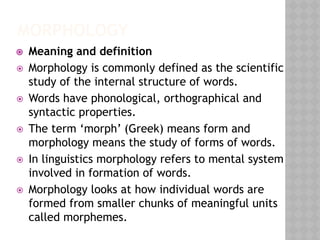
⦿ Meaning and definition
⦿ Morphology is commonly defined as the scientific
study of the internal structure of words.
⦿ Words have phonological, orthographical and
syntactic properties.
⦿ The term ‘morph’ (Greek) means form and
morphology means the study of forms of words.
⦿ In linguistics morphology refers to mental system
involved in formation of words.
⦿ Morphology looks at how individual words are
formed from smaller chunks of meaningful units
called morphemes.
EXAMPLES
⦿ unhappiness un-happi-ness
⦿ un carries negative meaning
⦿ happy is an adjective (feeling)
⦿ -ness expresses as state or quality
⦿ Horses horse-s
⦿ -s expresses plurality
⦿ Walking walk-ing
⦿ Walk is a verb (movement)
⦿ -ing expresses the sense of duration
MORPHEME
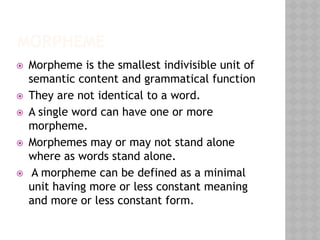
⦿ Morpheme is the smallest indivisible unit of
semantic content and grammatical function
⦿ They are not identical to a word.
⦿ A single word can have one or more
morpheme.
⦿ Morphemes may or may not stand alone
where as words stand alone.
⦿ A morpheme can be defined as a minimal
unit having more or less constant meaning
and more or less constant form.
TYPES OF MORPHEMES
1. FREE VS. BOUND MORPHEME
⦿ Free morphemes stand alone example: yes,
no etc.
⦿ Bound morphemes never exist as words
themselves, but are always attached to some
other morpheme.
⦿ Example: Un, -s,-er, -ing, -ment
⦿ Identifying the number and types of
morphemes that a given word consists of, is
looking at what is referred to as the
structure of a word.
MORPHEME
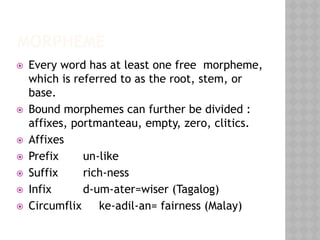
⦿ Every word has at least one free morpheme,
which is referred to as the root, stem, or
base.
⦿ Bound morphemes can further be divided :
affixes, portmanteau, empty, zero, clitics.
⦿ Affixes
⦿ Prefix un-like
⦿ Suffix rich-ness
⦿ Infix d-um-ater=wiser (Tagalog)
⦿ Circumflix ke-adil-an= fairness (Malay)
TYPES OF MORPHEMES: AFFIXES
⦿ Affixes are also classified as
⦿ Derivational vs. Inflectional afiixes.
⦿ Derivational morphemes create or derive
new words by changing the meaning or by
changing the word class of the word.
⦿ Example
⦿ Happy----- unhappiness ( Adj--N)
⦿ Girl--------girlish (N-Adj)
⦿ Modern-------modernize (adj—V)
⦿ Beautiful----beautifully (Adj—Adv)
⦿ In English: Derivatioal morphemes can be
either prefixes or suffixes. Eg. Un-happiness
AFFIXES: INFLECTIONAL MORPHEME
⦿ Inflectional morphemes don’t alter words
the meaning or word class of a word.
⦿ Instead they only refine and give extra
information about word’s already existing
meaning.
⦿ They create new forms of the same wordwith
addition of grammatical propeties.
⦿ Nominal suffix: cats-plural, cat’s-possessive
⦿ Adjectival: dark, darker, darkest.
⦿ Verbal: Walk –walking, plays, walked.
INFLECTIONAL MORPHEMES
⦿ In English: Inflectional morphemes are all
suffixes (by chance, since in other langauges
this is not true.)
⦿ There are only 8 inflectional morphemes in
English:
⦿ -s - 3rd
person singular present
⦿ -ed past tense, - ing progressive
⦿ -en past participle
⦿ -s- plural, -’s -possessive
⦿ -er -comparative, -est -superlative
INFLECTIONAL SUFFIXES
⦿ Inflexional morphemes are required by syntax.
⦿ That is , they indicate syntactic or semantic
relations between different words in a sentence.
⦿ For example:
⦿ Nim loves
⦿ But
⦿ They love bananas.
2. PORTMANTEAU, EMPTY
MORPHEME
⦿ (ii) Portmanteau morphemes carry more
than one piece of meaning.
⦿ Itcannot be broken down into separate
morphemes.
⦿ E.g. -s means singular, present and 3rd
person, but these meanings cannot be
separated.
⦿ (iii) Empty morphemes have structure phone
but no meaning example in the word
Cran-berry, though Berry has meaning, cran
does not have a meaning of its own.
IV. ZERO MORPHEME
⦿ (iv) Zero morpheme are physically
not present in the word yet fulfill
the requirement of the language.
⦿ Eg. the word ‘cut’ has the same
form in both past and present tense
and past.
⦿ It is the null morphemes added to
the root,thus it has a function but
no form.
(V) CLITICS
⦿ Clitics have grammatical rather than lexical
meaning.
⦿ They belong to closed classes like pronouns,
preposition and conjunctions.
⦿ Clitics are usually attached to the edges of
the words, outside the derivational and
inflectional affixes.
⦿ E.g. contraction of the morpheme is, as in
What’s going on?
CLASSIFICATION OF MORPHEMES
⦿ Morpheme are classified as
⦿ Free - Bound - Zero
⦿ Bound morphemes are
⦿ Affixes- clitics-portmanteau-
Empty
⦿ Affixes
⦿ Prefix-Suffix-Inflix-Circumfix
⦿ Derivational & Inflectional
MORPHEME AND SYLLABLE
⦿ A morpheme is not equal to a syllable:
⦿ Coats has 1 syllable , but 2 morphemes.
⦿ Syllables has 2 syllables, but only 1
morpheme
⦿ Example the word ‘buyers’ is made up of
three morphemes
⦿ {buy} +{er}+{s}.
⦿ In the formation of multi morphemic words
(Words that have more than one morpheme)
⦿ Morphemes do not combine in arbitrary ways,
they follow a definite pattern.
MORPHEME AND WORD
⦿ Morpheme can have varying size one cannot
judge whether something is a morpheme or
not by relying only on the number of syllables
or the length of the word.
⦿ Example ‘constituent’ a long word and a
plural marker ‘-s’ qualify as a morpheme.
⦿ Yes is a morpheme, but also happens to be a
word.

Unit 1 Morphology.pptx - Google Slides.pdf

  • 1.
    MORPHOLOGY MA IV Sem PaperII Language Unit ! Morphology Dr. Abha Pandey Professor Govt. Mahakoshal College Jabalpur
  • 2.
    MORPHOLOGY ⦿ Meaning anddefinition ⦿ Morphology is commonly defined as the scientific study of the internal structure of words. ⦿ Words have phonological, orthographical and syntactic properties. ⦿ The term ‘morph’ (Greek) means form and morphology means the study of forms of words. ⦿ In linguistics morphology refers to mental system involved in formation of words. ⦿ Morphology looks at how individual words are formed from smaller chunks of meaningful units called morphemes.
  • 3.
    EXAMPLES ⦿ unhappiness un-happi-ness ⦿un carries negative meaning ⦿ happy is an adjective (feeling) ⦿ -ness expresses as state or quality ⦿ Horses horse-s ⦿ -s expresses plurality ⦿ Walking walk-ing ⦿ Walk is a verb (movement) ⦿ -ing expresses the sense of duration
  • 4.
    MORPHEME ⦿ Morpheme isthe smallest indivisible unit of semantic content and grammatical function ⦿ They are not identical to a word. ⦿ A single word can have one or more morpheme. ⦿ Morphemes may or may not stand alone where as words stand alone. ⦿ A morpheme can be defined as a minimal unit having more or less constant meaning and more or less constant form.
  • 5.
    TYPES OF MORPHEMES 1.FREE VS. BOUND MORPHEME ⦿ Free morphemes stand alone example: yes, no etc. ⦿ Bound morphemes never exist as words themselves, but are always attached to some other morpheme. ⦿ Example: Un, -s,-er, -ing, -ment ⦿ Identifying the number and types of morphemes that a given word consists of, is looking at what is referred to as the structure of a word.
  • 6.
    MORPHEME ⦿ Every wordhas at least one free morpheme, which is referred to as the root, stem, or base. ⦿ Bound morphemes can further be divided : affixes, portmanteau, empty, zero, clitics. ⦿ Affixes ⦿ Prefix un-like ⦿ Suffix rich-ness ⦿ Infix d-um-ater=wiser (Tagalog) ⦿ Circumflix ke-adil-an= fairness (Malay)
  • 7.
    TYPES OF MORPHEMES:AFFIXES ⦿ Affixes are also classified as ⦿ Derivational vs. Inflectional afiixes. ⦿ Derivational morphemes create or derive new words by changing the meaning or by changing the word class of the word. ⦿ Example ⦿ Happy----- unhappiness ( Adj--N) ⦿ Girl--------girlish (N-Adj) ⦿ Modern-------modernize (adj—V) ⦿ Beautiful----beautifully (Adj—Adv) ⦿ In English: Derivatioal morphemes can be either prefixes or suffixes. Eg. Un-happiness
  • 8.
    AFFIXES: INFLECTIONAL MORPHEME ⦿Inflectional morphemes don’t alter words the meaning or word class of a word. ⦿ Instead they only refine and give extra information about word’s already existing meaning. ⦿ They create new forms of the same wordwith addition of grammatical propeties. ⦿ Nominal suffix: cats-plural, cat’s-possessive ⦿ Adjectival: dark, darker, darkest. ⦿ Verbal: Walk –walking, plays, walked.
  • 9.
    INFLECTIONAL MORPHEMES ⦿ InEnglish: Inflectional morphemes are all suffixes (by chance, since in other langauges this is not true.) ⦿ There are only 8 inflectional morphemes in English: ⦿ -s - 3rd person singular present ⦿ -ed past tense, - ing progressive ⦿ -en past participle ⦿ -s- plural, -’s -possessive ⦿ -er -comparative, -est -superlative
  • 10.
    INFLECTIONAL SUFFIXES ⦿ Inflexionalmorphemes are required by syntax. ⦿ That is , they indicate syntactic or semantic relations between different words in a sentence. ⦿ For example: ⦿ Nim loves ⦿ But ⦿ They love bananas.
  • 11.
    2. PORTMANTEAU, EMPTY MORPHEME ⦿(ii) Portmanteau morphemes carry more than one piece of meaning. ⦿ Itcannot be broken down into separate morphemes. ⦿ E.g. -s means singular, present and 3rd person, but these meanings cannot be separated. ⦿ (iii) Empty morphemes have structure phone but no meaning example in the word Cran-berry, though Berry has meaning, cran does not have a meaning of its own.
  • 12.
    IV. ZERO MORPHEME ⦿(iv) Zero morpheme are physically not present in the word yet fulfill the requirement of the language. ⦿ Eg. the word ‘cut’ has the same form in both past and present tense and past. ⦿ It is the null morphemes added to the root,thus it has a function but no form.
  • 13.
    (V) CLITICS ⦿ Cliticshave grammatical rather than lexical meaning. ⦿ They belong to closed classes like pronouns, preposition and conjunctions. ⦿ Clitics are usually attached to the edges of the words, outside the derivational and inflectional affixes. ⦿ E.g. contraction of the morpheme is, as in What’s going on?
  • 14.
    CLASSIFICATION OF MORPHEMES ⦿Morpheme are classified as ⦿ Free - Bound - Zero ⦿ Bound morphemes are ⦿ Affixes- clitics-portmanteau- Empty ⦿ Affixes ⦿ Prefix-Suffix-Inflix-Circumfix ⦿ Derivational & Inflectional
  • 15.
    MORPHEME AND SYLLABLE ⦿A morpheme is not equal to a syllable: ⦿ Coats has 1 syllable , but 2 morphemes. ⦿ Syllables has 2 syllables, but only 1 morpheme ⦿ Example the word ‘buyers’ is made up of three morphemes ⦿ {buy} +{er}+{s}. ⦿ In the formation of multi morphemic words (Words that have more than one morpheme) ⦿ Morphemes do not combine in arbitrary ways, they follow a definite pattern.
  • 16.
    MORPHEME AND WORD ⦿Morpheme can have varying size one cannot judge whether something is a morpheme or not by relying only on the number of syllables or the length of the word. ⦿ Example ‘constituent’ a long word and a plural marker ‘-s’ qualify as a morpheme. ⦿ Yes is a morpheme, but also happens to be a word.