MORPHOLOGY Presented to  Mr Nazir Malik Presented by Amnah Moghees 100784015  Nouman Malik 100784014
Morphology The study of internal structure of words, and of the rules by which words are formed
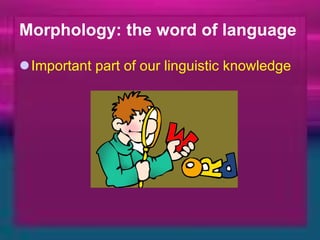
Morphology: the word of language Important part of our linguistic knowledge
Word “ A unit of expression which has universal intuitive recognition by native speaker, in both spoken and written language” (Crystal) “ The smallest of linguistic unit which can occur on its own in speech or writing” (Richard & Schmidt)
Conti…. “ A unit of meaning” (Finch) “ A minimal free form” (Bloomfield)
Word at different level Orthographic word (I saw a cat on sofa) Phonological word (Deer is dear but dear) Lexical item\ Lexeme (take,took,taken…) Grammatical word form\ Morphosyntactic word (ball, balls) Semantic words (table, table)
analysis of song at levels of words “ Lost” by Coldplay
Dictionaries Lexicography
Content words Noun, verbs, adjectives and adverbs Denote concept such as objects, action, attributes and ideas Open class  words
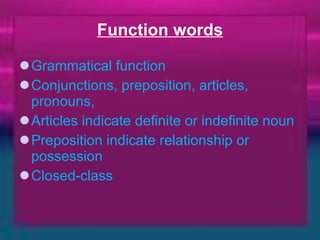
Function words Grammatical function Conjunctions, preposition, articles, pronouns,  Articles indicate definite or indefinite noun Preposition indicate relationship or possession Closed-class
Content words and function words Brain treats differently Slip of tongue phenomenon Language acquisition
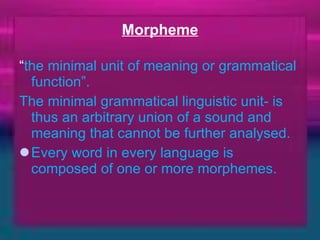
Morpheme “ the minimal unit of meaning or grammatical function”. The minimal grammatical linguistic unit- is thus an arbitrary union of a sound and meaning that cannot be further analysed.  Every word in every language is composed of one or more morphemes.
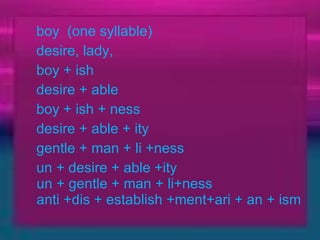
boy  (one syllable)    desire, lady, boy + ish  desire + able  boy + ish + ness    desire + able + ity  gentle + man + li +ness    un + desire + able +ity  un + gentle + man + li+ness  anti +dis + establish +ment+ari + an + ism  
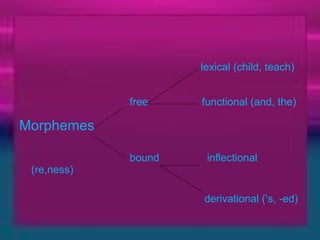
lexical (child, teach) free  functional (and, the) Morphemes   bound  inflectional (re,ness) derivational (‘s, -ed)
Bound Morphemes Cannot normally stand alone or typically attached to another form All affixes (prefixes and suffixes) in English


Prefix Bound morphemes which occur only before other morphemes.  Examples:  un- ( uncover, undo )  dis- ( displeased, disconnect),   pre- ( predetermine, prejudge )
Suffixes Bound morphemes which occur   following other morphemes.  Examples:  -er ( singer, performer)   -ist (t ypist, pianist)   -ly ( manly, friendly )
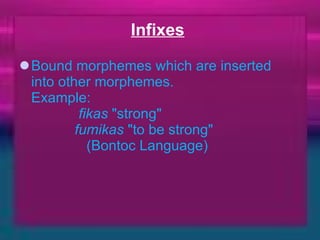
Infixes   Bound morphemes which are inserted   into other morphemes.  Example:               fikas  "strong"              fumikas  "to be strong"                 (Bontoc Language)
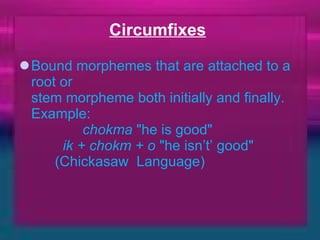
Circumfixes   Bound morphemes that are attached to a root or  stem morpheme both initially and finally.  Example:               chokma  "he is good"           ik + chokm + o  "he isn’t’ good"         (Chickasaw  Language)
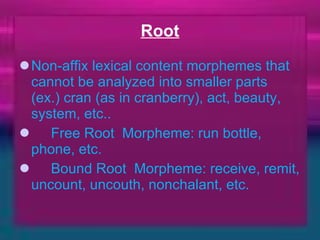
Root Non-affix lexical content morphemes that cannot be analyzed into smaller parts   (ex.) cran (as in cranberry), act, beauty, system, etc..         Free Root  Morpheme: run bottle, phone, etc.        Bound Root  Morpheme: receive, remit, uncount, uncouth, nonchalant, etc. 
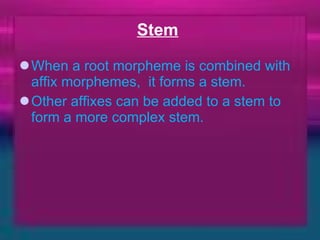
Stem   When a root morpheme is combined with affix morphemes,  it forms a stem.   Other affixes can be added to a stem to form a more complex stem.  
Root           believe    (verb)  Stem           believe + able (verb + suffix) Word          un + believe + able   (prefix + verb + suffix)
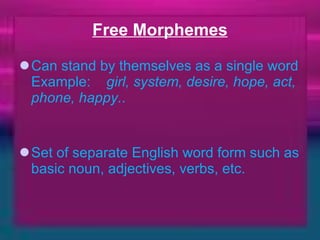
Free Morphemes Can stand by themselves as a single word Example:     girl, system, desire, hope, act, phone, happy. .     Set of separate English word form such as basic noun, adjectives, verbs, etc.
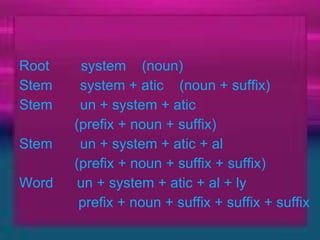
Root        system    (noun) Stem       system + atic    (noun + suffix)  Stem       un + system + atic     (prefix + noun + suffix) Stem       un + system + atic + al  (prefix + noun + suffix + suffix) Word      un + system + atic + al + ly  prefix + noun + suffix + suffix + suffix        
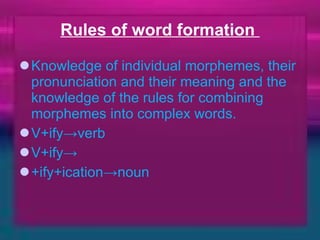
Rules of word formation  Knowledge of individual morphemes, their pronunciation and their meaning and the knowledge of the rules for combining morphemes into complex words. V+ify->verb V+ify-> +ify+ication->noun
The form that result from addition of a derivational morpheme is called a  derived  word
Derivational Morphology Derivational morphemes derive a new word by being attached to root morphemes or stems They can be both suffixes and prefixes in  English. Examples:     beautiful, exactly, unhappy, impossible, recover   Change of Meaning   Examples: un+do (the opposite meaning of ‘do’) sing+er ( deriving a new word with the meaning of a person who sings).  
The Hierarchical Structure of Words A word is not a simple sequence of morphemes. It has an internal structure. Hierarchical structure is an essential property of human language.
More about Derivational Morphemes Moralise Friendship Conformist Abstraction reprint Decentralization
Lexical gaps Recognition of possible and impossible words.
Rule productivity Morphological rules can be used freely to form new  words from the list of free and bound morphemes Un -> antonyms Does not change grammatical class
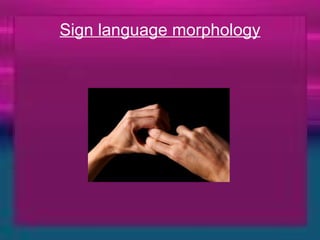
Sign language morphology
Pullete surprise Knowledge of the morphemes of the language and morphological rules we may guess the meaning Errors lead to non deviant form e.g. Diatribe-> food for the whole clan Bibliography-> holy geography Homogeneous-> devoted to home life
Word Coinage Invention of totally new terms Words are used usually without capital letters e.g,Kleenex, Xerox, etc
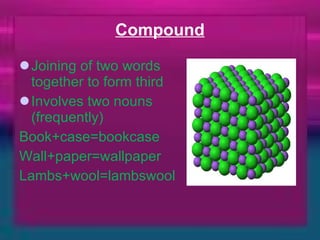
Compound Joining of two words together to form third Involves two nouns (frequently) Book+case=bookcase Wall+paper=wallpaper Lambs+wool=lambswool
Acronyms Words derived from the initial s of several words
National Aeronautics and Space Agency
United Nations Educational, Scientific and Cultural Organisation
R andom  A ccess  M emory V ideo  C assette  R ecorder
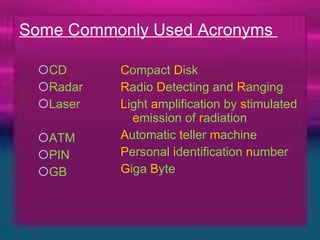
Some Commonly Used Acronyms  CD Radar Laser ATM PIN GB C ompact  D isk R adio  D etecting and  R anging L ight  a mplification by  s timulated  e mission of  r adiation A utomatic  t eller  m achine P ersonal  i dentification  n umber G iga  B yte
Back-formation Specified reduction process Word of one type is reduced to form a word of another type (usually N -> V)
Continued…….  Television ………Televise Donation………...Donate Emotion………… Emote Editor …………... Edit
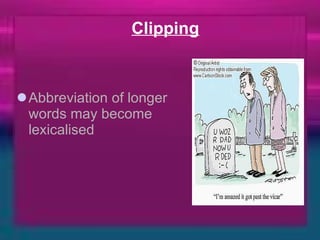
Clipping Abbreviation of longer words may become lexicalised
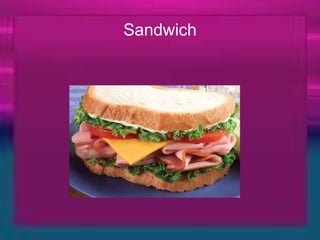
Eponyms Sandwich Robot Gargantuan Jumbo
Gargantuan
Robot
Sandwich
Jumbo
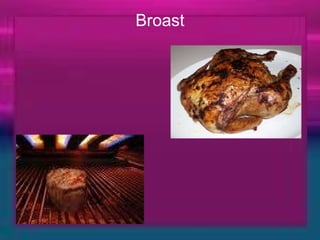
Blends
Smog
Motel
Broast
Brunch
Grammatical Morphemes Have not any clear lexical meaning have only clear sense in a sentence , e.g. to , it and etc
Inflectional Morphemes Inflectional morphemes signal grammatical information such as number (plural), tense, possession and so on. They are thus often called bound grammatical morphemes  They are only found in suffixes in  English.   Examples:   boys,  Mary’s , walked  
Inflectional Morphemes Inflectional morphemes signal grammatical information such as number (plural), tense, possession and so on. They are thus often called bound grammatical morphemes  They are only found in suffixes in  English.   Examples:   boys,  Mary’s , walked 
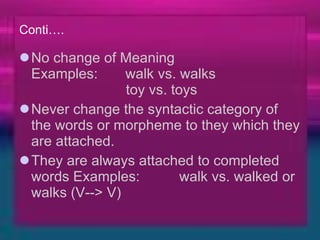
Conti…. No change of Meaning   Examples:       walk vs. walks                           toy vs. toys  Never change the syntactic category of the words or morpheme to they which they are attached.  They are always attached to completed words Examples:          walk vs. walked or walks (V--> V) 
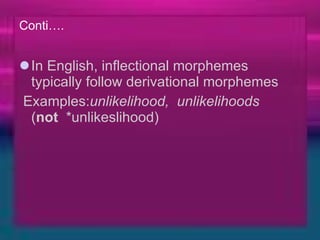
Conti…. In English, inflectional morphemes typically follow derivational morphemes    Examples: unlikelihood,  unlikelihoods    ( not   *unlikeslihood)
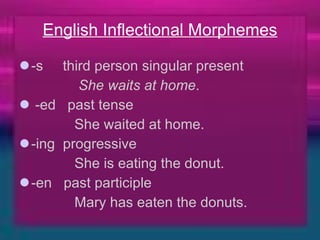
English Inflectional Morphemes -s     third person singular present               She waits at home .  -ed   past tense  She waited at home.  -ing  progressive                                       She is eating the donut. -en   past participle                                  Mary has eaten the donuts.
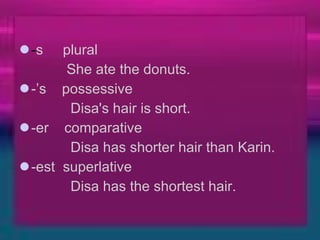
- s     plural                                               She ate the donuts. -’s    possessive                             Disa's hair is short. -er    comparative                                 Disa has shorter   hair than Karin. -est  superlative                                       Disa has the shortest hair.
Morph Phonological realization of a morpheme  Allomorphs and variants The appearance of one morph over another
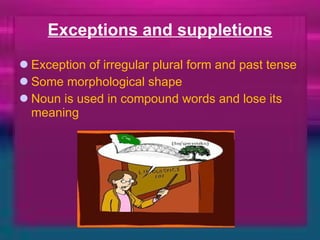
Exceptions and suppletions Exception of irregular plural form and past tense Some morphological shape Noun is used in compound words and lose its meaning
Morphological analysis Speaker of a language have the knowledge to perceive the component morphemes and morphological rules for their combination
Conclusion
Reference Books An Introduction to Language By Victoria Fromkin The Study of Language By Goerge Yule What is morphology? By Mark Arnoff & Kristen Ferdiman An Introduction to English Morphology By Andrew Carstairs-McCarthy An Introduction to Linguistics By Loreto Todd
No   Questions?   Pleeease ! W
 

Morphology2

  • 1.
    MORPHOLOGY Presented to Mr Nazir Malik Presented by Amnah Moghees 100784015 Nouman Malik 100784014
  • 2.
    Morphology The studyof internal structure of words, and of the rules by which words are formed
  • 3.
    Morphology: the wordof language Important part of our linguistic knowledge
  • 4.
    Word “ Aunit of expression which has universal intuitive recognition by native speaker, in both spoken and written language” (Crystal) “ The smallest of linguistic unit which can occur on its own in speech or writing” (Richard & Schmidt)
  • 5.
    Conti…. “ Aunit of meaning” (Finch) “ A minimal free form” (Bloomfield)
  • 6.
    Word at differentlevel Orthographic word (I saw a cat on sofa) Phonological word (Deer is dear but dear) Lexical item\ Lexeme (take,took,taken…) Grammatical word form\ Morphosyntactic word (ball, balls) Semantic words (table, table)
  • 7.
    analysis of songat levels of words “ Lost” by Coldplay
  • 8.
  • 9.
    Content words Noun,verbs, adjectives and adverbs Denote concept such as objects, action, attributes and ideas Open class words
  • 10.
    Function words Grammaticalfunction Conjunctions, preposition, articles, pronouns, Articles indicate definite or indefinite noun Preposition indicate relationship or possession Closed-class
  • 11.
    Content words andfunction words Brain treats differently Slip of tongue phenomenon Language acquisition
  • 12.
    Morpheme “ theminimal unit of meaning or grammatical function”. The minimal grammatical linguistic unit- is thus an arbitrary union of a sound and meaning that cannot be further analysed. Every word in every language is composed of one or more morphemes.
  • 13.
    boy  (one syllable)   desire, lady, boy + ish desire + able boy + ish + ness   desire + able + ity gentle + man + li +ness   un + desire + able +ity un + gentle + man + li+ness anti +dis + establish +ment+ari + an + ism  
  • 14.
    lexical (child, teach)free functional (and, the) Morphemes bound inflectional (re,ness) derivational (‘s, -ed)
  • 15.
    Bound Morphemes Cannotnormally stand alone or typically attached to another form All affixes (prefixes and suffixes) in English
  • 16.
    Prefix Bound morphemeswhich occur only before other morphemes. Examples: un- ( uncover, undo ) dis- ( displeased, disconnect), pre- ( predetermine, prejudge )
  • 17.
    Suffixes Bound morphemeswhich occur  following other morphemes. Examples: -er ( singer, performer) -ist (t ypist, pianist) -ly ( manly, friendly )
  • 18.
    Infixes Bound morphemes which are inserted  into other morphemes. Example:             fikas "strong"             fumikas "to be strong"                (Bontoc Language)
  • 19.
    Circumfixes Bound morphemes that are attached to a root or stem morpheme both initially and finally. Example:              chokma "he is good"          ik + chokm + o "he isn’t’ good"        (Chickasaw Language)
  • 20.
    Root Non-affix lexicalcontent morphemes that cannot be analyzed into smaller parts  (ex.) cran (as in cranberry), act, beauty, system, etc..       Free Root  Morpheme: run bottle, phone, etc.      Bound Root  Morpheme: receive, remit, uncount, uncouth, nonchalant, etc. 
  • 21.
    Stem When a root morpheme is combined with affix morphemes,  it forms a stem.  Other affixes can be added to a stem to form a more complex stem.  
  • 22.
    Root           believe    (verb) Stem           believe + able (verb + suffix) Word          un + believe + able   (prefix + verb + suffix)
  • 23.
    Free Morphemes Canstand by themselves as a single word Example:    girl, system, desire, hope, act, phone, happy. .   Set of separate English word form such as basic noun, adjectives, verbs, etc.
  • 24.
    Root        system    (noun)Stem       system + atic    (noun + suffix) Stem       un + system + atic    (prefix + noun + suffix) Stem       un + system + atic + al  (prefix + noun + suffix + suffix) Word      un + system + atic + al + ly  prefix + noun + suffix + suffix + suffix       
  • 25.
    Rules of wordformation Knowledge of individual morphemes, their pronunciation and their meaning and the knowledge of the rules for combining morphemes into complex words. V+ify->verb V+ify-> +ify+ication->noun
  • 26.
    The form thatresult from addition of a derivational morpheme is called a derived word
  • 27.
    Derivational Morphology Derivationalmorphemes derive a new word by being attached to root morphemes or stems They can be both suffixes and prefixes in  English. Examples:    beautiful, exactly, unhappy, impossible, recover Change of Meaning  Examples: un+do (the opposite meaning of ‘do’) sing+er ( deriving a new word with the meaning of a person who sings).  
  • 28.
    The Hierarchical Structureof Words A word is not a simple sequence of morphemes. It has an internal structure. Hierarchical structure is an essential property of human language.
  • 29.
    More about DerivationalMorphemes Moralise Friendship Conformist Abstraction reprint Decentralization
  • 30.
    Lexical gaps Recognitionof possible and impossible words.
  • 31.
    Rule productivity Morphologicalrules can be used freely to form new words from the list of free and bound morphemes Un -> antonyms Does not change grammatical class
  • 32.
  • 33.
    Pullete surprise Knowledgeof the morphemes of the language and morphological rules we may guess the meaning Errors lead to non deviant form e.g. Diatribe-> food for the whole clan Bibliography-> holy geography Homogeneous-> devoted to home life
  • 34.
    Word Coinage Inventionof totally new terms Words are used usually without capital letters e.g,Kleenex, Xerox, etc
  • 35.
    Compound Joining oftwo words together to form third Involves two nouns (frequently) Book+case=bookcase Wall+paper=wallpaper Lambs+wool=lambswool
  • 36.
    Acronyms Words derivedfrom the initial s of several words
  • 37.
  • 38.
    United Nations Educational,Scientific and Cultural Organisation
  • 39.
    R andom A ccess M emory V ideo C assette R ecorder
  • 40.
    Some Commonly UsedAcronyms CD Radar Laser ATM PIN GB C ompact D isk R adio D etecting and R anging L ight a mplification by s timulated e mission of r adiation A utomatic t eller m achine P ersonal i dentification n umber G iga B yte
  • 41.
    Back-formation Specified reductionprocess Word of one type is reduced to form a word of another type (usually N -> V)
  • 42.
    Continued……. Television………Televise Donation………...Donate Emotion………… Emote Editor …………... Edit
  • 43.
    Clipping Abbreviation oflonger words may become lexicalised
  • 44.
    Eponyms Sandwich RobotGargantuan Jumbo
  • 45.
  • 46.
  • 47.
  • 48.
  • 49.
  • 50.
  • 51.
  • 52.
  • 53.
  • 54.
    Grammatical Morphemes Havenot any clear lexical meaning have only clear sense in a sentence , e.g. to , it and etc
  • 55.
    Inflectional Morphemes Inflectionalmorphemes signal grammatical information such as number (plural), tense, possession and so on. They are thus often called bound grammatical morphemes  They are only found in suffixes in  English.  Examples:  boys,  Mary’s , walked  
  • 56.
    Inflectional Morphemes Inflectionalmorphemes signal grammatical information such as number (plural), tense, possession and so on. They are thus often called bound grammatical morphemes  They are only found in suffixes in  English.  Examples:  boys,  Mary’s , walked 
  • 57.
    Conti…. No changeof Meaning  Examples:       walk vs. walks                          toy vs. toys  Never change the syntactic category of the words or morpheme to they which they are attached. They are always attached to completed words Examples:          walk vs. walked or walks (V--> V) 
  • 58.
    Conti…. In English,inflectional morphemes typically follow derivational morphemes   Examples: unlikelihood,  unlikelihoods    ( not   *unlikeslihood)
  • 59.
    English Inflectional Morphemes-s     third person singular present              She waits at home . -ed   past tense  She waited at home. -ing  progressive                                      She is eating the donut. -en   past participle                                  Mary has eaten the donuts.
  • 60.
    - s     plural                                              She ate the donuts. -’s    possessive                             Disa's hair is short. -er    comparative                                Disa has shorter hair than Karin. -est  superlative                                       Disa has the shortest hair.
  • 61.
    Morph Phonological realizationof a morpheme Allomorphs and variants The appearance of one morph over another
  • 62.
    Exceptions and suppletionsException of irregular plural form and past tense Some morphological shape Noun is used in compound words and lose its meaning
  • 63.
    Morphological analysis Speakerof a language have the knowledge to perceive the component morphemes and morphological rules for their combination
  • 64.
  • 65.
    Reference Books AnIntroduction to Language By Victoria Fromkin The Study of Language By Goerge Yule What is morphology? By Mark Arnoff & Kristen Ferdiman An Introduction to English Morphology By Andrew Carstairs-McCarthy An Introduction to Linguistics By Loreto Todd
  • 66.
    No Questions? Pleeease ! W
  • 67.