Syntax
(Phrases)
Course code- 1606-222
Level- 4
What is Phrase?
• A phrase is a group of words (or possibly a single word)
that functions as a constituent in the syntax of a sentence,
a single unit within a grammatical hierarchy.
• A phrase appears within a clause, but it is possible also
for a phrase to be a clause or to contain a clause within it.
What is Phrase?
• There is a difference between the common use of the
term phrase and its technical use in linguistics. In
common usage, a phrase is usually a group of words
with some special idiomatic meaning or other
significance, such as "all rights reserved",
"economical with the truth", "kick the bucket“.
Heads and dependents
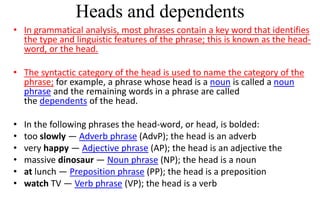
• In grammatical analysis, most phrases contain a key word that identifies
the type and linguistic features of the phrase; this is known as the head-
word, or the head.
• The syntactic category of the head is used to name the category of the
phrase; for example, a phrase whose head is a noun is called a noun
phrase and the remaining words in a phrase are called
the dependents of the head.
• In the following phrases the head-word, or head, is bolded:
• too slowly — Adverb phrase (AdvP); the head is an adverb
• very happy — Adjective phrase (AP); the head is an adjective the
• massive dinosaur — Noun phrase (NP); the head is a noun
• at lunch — Preposition phrase (PP); the head is a preposition
• watch TV — Verb phrase (VP); the head is a verb
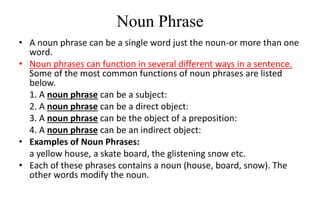
Noun Phrase
• A noun phrase can be a single word just the noun-or more than one
word.
• Noun phrases can function in several different ways in a sentence.
Some of the most common functions of noun phrases are listed
below.
1. A noun phrase can be a subject:
2. A noun phrase can be a direct object:
3. A noun phrase can be the object of a preposition:
4. A noun phrase can be an indirect object:
• Examples of Noun Phrases:
a yellow house, a skate board, the glistening snow etc.
• Each of these phrases contains a noun (house, board, snow). The
other words modify the noun.
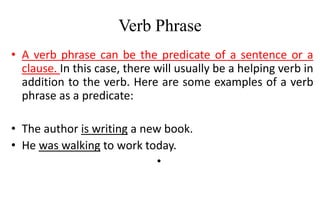
Verb Phrase
• A verb phrase can be the predicate of a sentence or a
clause. In this case, there will usually be a helping verb in
addition to the verb. Here are some examples of a verb
phrase as a predicate:
• The author is writing a new book.
• He was walking to work today.
•
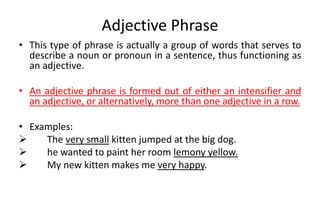
Adjective Phrase
• This type of phrase is actually a group of words that serves to
describe a noun or pronoun in a sentence, thus functioning as
an adjective.
• An adjective phrase is formed out of either an intensifier and
an adjective, or alternatively, more than one adjective in a row.
• Examples:
 The very small kitten jumped at the big dog.
 he wanted to paint her room lemony yellow.
 My new kitten makes me very happy.
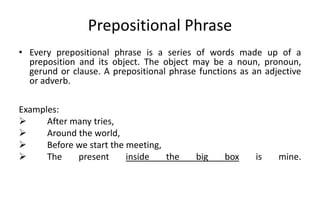
Prepositional Phrase
• Every prepositional phrase is a series of words made up of a
preposition and its object. The object may be a noun, pronoun,
gerund or clause. A prepositional phrase functions as an adjective
or adverb.
Examples:
 After many tries,
 Around the world,
 Before we start the meeting,
 The present inside the big box is mine.
Phrase Structure Tree
• Many theories of syntax and grammar illustrate
sentence structure using phrase 'trees', which
provide schematics of how the words in a sentence
are grouped and relate to each other.
• Phrase structure trees show the words, phrases, and,
at times, clauses that make up sentences. Any word
combination that corresponds to a complete sub-
tree can be seen as a phrase.
A tree diagram represents several aspects of “how
words are put together” in a sentence:
•The order of the words in a sentence.
•The word class (Part of Speech) of each word.
•The hierarchical structure of a sentence – the
grouping of words into phrases, and the
grouping of phrases into larger phrases.
Constituency and dependency trees
There are two established and competing principles for
constructing trees; they produce 'constituency' and
'dependency' trees and both are illustrated here
using an example sentence. The constituency-based
tree is on the left and the dependency-based tree is
on the right in next slide.
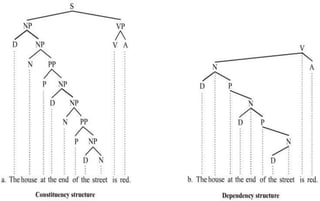
• The tree on the left is of the constituency-based, phrase
structure grammar and the tree on the right is of
the dependency grammar. The node labels in the two
trees mark the syntactic category of the
different constituents, or word elements, of the
sentence.
• In the constituency tree each phrase is marked by a
phrasal node (NP, PP, VP); and there are eight phrases
identified by phrase structure analysis in the example
sentence. On the other hand, the dependency tree
identifies a phrase by any node that exerts dependency
upon, or dominates, another node. And, using
dependency analysis, there are six phrases in the
sentence.

Phrase

  • 1.
  • 2.
    What is Phrase? •A phrase is a group of words (or possibly a single word) that functions as a constituent in the syntax of a sentence, a single unit within a grammatical hierarchy. • A phrase appears within a clause, but it is possible also for a phrase to be a clause or to contain a clause within it.
  • 3.
    What is Phrase? •There is a difference between the common use of the term phrase and its technical use in linguistics. In common usage, a phrase is usually a group of words with some special idiomatic meaning or other significance, such as "all rights reserved", "economical with the truth", "kick the bucket“.
  • 4.
    Heads and dependents •In grammatical analysis, most phrases contain a key word that identifies the type and linguistic features of the phrase; this is known as the head- word, or the head. • The syntactic category of the head is used to name the category of the phrase; for example, a phrase whose head is a noun is called a noun phrase and the remaining words in a phrase are called the dependents of the head. • In the following phrases the head-word, or head, is bolded: • too slowly — Adverb phrase (AdvP); the head is an adverb • very happy — Adjective phrase (AP); the head is an adjective the • massive dinosaur — Noun phrase (NP); the head is a noun • at lunch — Preposition phrase (PP); the head is a preposition • watch TV — Verb phrase (VP); the head is a verb
  • 5.
    Noun Phrase • Anoun phrase can be a single word just the noun-or more than one word. • Noun phrases can function in several different ways in a sentence. Some of the most common functions of noun phrases are listed below. 1. A noun phrase can be a subject: 2. A noun phrase can be a direct object: 3. A noun phrase can be the object of a preposition: 4. A noun phrase can be an indirect object: • Examples of Noun Phrases: a yellow house, a skate board, the glistening snow etc. • Each of these phrases contains a noun (house, board, snow). The other words modify the noun.
  • 6.
    Verb Phrase • Averb phrase can be the predicate of a sentence or a clause. In this case, there will usually be a helping verb in addition to the verb. Here are some examples of a verb phrase as a predicate: • The author is writing a new book. • He was walking to work today. •
  • 7.
    Adjective Phrase • Thistype of phrase is actually a group of words that serves to describe a noun or pronoun in a sentence, thus functioning as an adjective. • An adjective phrase is formed out of either an intensifier and an adjective, or alternatively, more than one adjective in a row. • Examples:  The very small kitten jumped at the big dog.  he wanted to paint her room lemony yellow.  My new kitten makes me very happy.
  • 8.
    Prepositional Phrase • Everyprepositional phrase is a series of words made up of a preposition and its object. The object may be a noun, pronoun, gerund or clause. A prepositional phrase functions as an adjective or adverb. Examples:  After many tries,  Around the world,  Before we start the meeting,  The present inside the big box is mine.
  • 9.
    Phrase Structure Tree •Many theories of syntax and grammar illustrate sentence structure using phrase 'trees', which provide schematics of how the words in a sentence are grouped and relate to each other. • Phrase structure trees show the words, phrases, and, at times, clauses that make up sentences. Any word combination that corresponds to a complete sub- tree can be seen as a phrase.
  • 10.
    A tree diagramrepresents several aspects of “how words are put together” in a sentence: •The order of the words in a sentence. •The word class (Part of Speech) of each word. •The hierarchical structure of a sentence – the grouping of words into phrases, and the grouping of phrases into larger phrases.
  • 11.
    Constituency and dependencytrees There are two established and competing principles for constructing trees; they produce 'constituency' and 'dependency' trees and both are illustrated here using an example sentence. The constituency-based tree is on the left and the dependency-based tree is on the right in next slide.
  • 13.
    • The treeon the left is of the constituency-based, phrase structure grammar and the tree on the right is of the dependency grammar. The node labels in the two trees mark the syntactic category of the different constituents, or word elements, of the sentence. • In the constituency tree each phrase is marked by a phrasal node (NP, PP, VP); and there are eight phrases identified by phrase structure analysis in the example sentence. On the other hand, the dependency tree identifies a phrase by any node that exerts dependency upon, or dominates, another node. And, using dependency analysis, there are six phrases in the sentence.