VSO Structure
Syntax (Level-4)
Introduction
Word order typology is the study of the order of the syntactic constituents of
a language, and how different languages employ different orders. Correlations
between orders found in different syntactic sub-domains are also of interest.
The primary word orders that are of interest are
the constituent order of a clause, namely the relative order of subject, object,
and verb;
the order of modifiers (adjectives, numerals, demonstratives, possessives,
and adjuncts) in a noun phrase;
the order of adverbials.
Some languages use relatively fixed word order, often relying on the order of
constituents to convey grammatical information. Other languages—often those
that convey grammatical information through inflection—allow more flexible
word order.
VSO word order
 A verb–subject–object (VSO) language is one in which the
most typical sentences arrange their elements in that order, as
in Ate Sam oranges (Sam ate oranges).
 VSO is the third-most common word order among the world's
languages, after SOV (as in Hindi and Japanese) and SVO (as
in English and Mandarin).
Language families where all or many of the languages are
VSO include the following;
 The Celtic languages
(including Irish, Scottish Gaelic, Manx, Welsh, Cornish and Breton)
 The Afro-asiatic languages
(including Berber, Assyrian, Egyptian, Arabic, Biblical Hebrew and Ge'ez)
 The Austronesian languages
(including Tagalog, Visayan, Pangasinan, Kapampangan, Kadazan
Dusun, Hawaiian, Māori and Tongan).
 The Mayan languages
(including Classic Maya)
 The Oto-Manguean languages
(including Zapotec languages and Mixtecan languages)
 The Salishan languages
 Many Mesoamerican languages
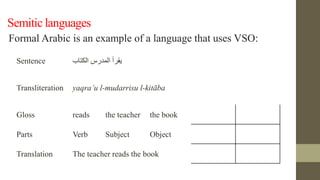
Semitic languages
Sentence ‫الكتاب‬ ‫المدرس‬ ‫يقرأ‬
Transliteration yaqraʼu l-mudarrisu l-kitāba
Gloss reads the teacher the book
Parts Verb Subject Object
Translation The teacher reads the book
Formal Arabic is an example of a language that uses VSO:
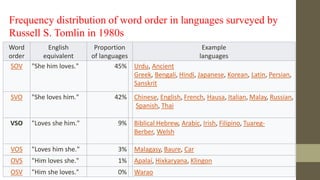
Word
order
English
equivalent
Proportion
of languages
Example
languages
SOV "She him loves." 45% Urdu, Ancient
Greek, Bengali, Hindi, Japanese, Korean, Latin, Persian,
Sanskrit
SVO "She loves him." 42% Chinese, English, French, Hausa, Italian, Malay, Russian,
Spanish, Thai
VSO "Loves she him." 9% Biblical Hebrew, Arabic, Irish, Filipino, Tuareg-
Berber, Welsh
VOS "Loves him she." 3% Malagasy, Baure, Car
OVS "Him loves she." 1% Apalaí, Hixkaryana, Klingon
OSV "Him she loves." 0% Warao
Frequency distribution of word order in languages surveyed by
Russell S. Tomlin in 1980s
Inversion to VSO order
There are many SVO languages that switch to VSO with different
constructions, usually for emphasis. For example, sentences
in English poetry can sometimes be found to have a VSO order, and Early
Modern English explicitly reflects the VSO order that is now implicit in
Modern English by the suppression of the imperative's now-understood
subject. For example, "Gather ye rosebuds while ye may" contrasts with
modern "Gather rosebuds while you may".
Arabic sentences use either SVO or VSO, depending on whether the subject
or the verb is more important. If VOS is used, the form of a word changes,
depending on whether it is a subject or an object. Arabic also uses VOS in
optional cases, and in some cases it is mandatory.
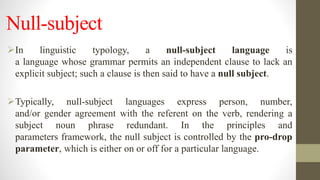
Null-subject
In linguistic typology, a null-subject language is
a language whose grammar permits an independent clause to lack an
explicit subject; such a clause is then said to have a null subject.
Typically, null-subject languages express person, number,
and/or gender agreement with the referent on the verb, rendering a
subject noun phrase redundant. In the principles and
parameters framework, the null subject is controlled by the pro-drop
parameter, which is either on or off for a particular language.
Null-subject
For example, in Italian the subject "she" can be either explicit or implicit:
 Maria non vuole mangiare. Maria not wants [to-]eat, "Maria does not want to eat".
 Non vuole mangiare. Subject not wants [to-]eat, "[(S)he] does not want to eat.
"The subject "(s)he" of the second sentence is only implied in Italian. English and French, on
the other hand, require an explicit subject in this sentence.
Of the thousands of languages in the world, a considerable number are null-subject languages,
from a wide diversity of unrelated language families. They
include Albanian, Arabic, Basque, Berber, Bengali, Catalan, Chinese, Estonian, Finnish, Galic
ian, Gujarati, Greek, Hebrew, Hindi, Hungarian, Italian, Romanian, Japanese, Korean, Persian
, Portuguese, Punjabi, Sindhi, Slavic languages, Spanish, Tamil and the Turkic languages, as
well as most languages related to these, and many others still.
In fact, it is rather the absence of pronoun dropping that is an areal feature of Standard
Average European, including French, German, and English.
Null-subject
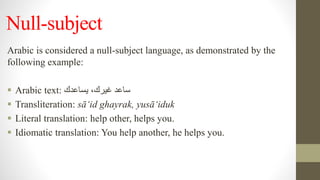
Arabic is considered a null-subject language, as demonstrated by the
following example:
 Arabic text: ،‫غيرك‬ ‫ساعد‬‫يساعدك‬
 Transliteration: sā‘id ghayrak, yusā‘iduk
 Literal translation: help other, helps you.
 Idiomatic translation: You help another, he helps you.
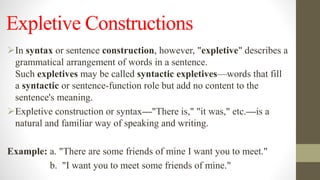
Expletive Constructions
In syntax or sentence construction, however, "expletive" describes a
grammatical arrangement of words in a sentence.
Such expletives may be called syntactic expletives—words that fill
a syntactic or sentence-function role but add no content to the
sentence's meaning.
Expletive construction or syntax—"There is," "it was," etc.—is a
natural and familiar way of speaking and writing.
Example: a. "There are some friends of mine I want you to meet."
b. "I want you to meet some friends of mine."
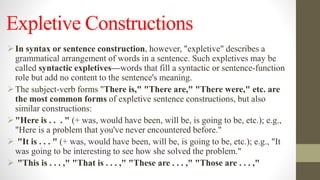
Expletive Constructions
In syntax or sentence construction, however, "expletive" describes a
grammatical arrangement of words in a sentence. Such expletives may be
called syntactic expletives—words that fill a syntactic or sentence-function
role but add no content to the sentence's meaning.
The subject-verb forms "There is," "There are," "There were," etc. are
the most common forms of expletive sentence constructions, but also
similar constructions:
"Here is . . . " (+ was, would have been, will be, is going to be, etc.); e.g.,
"Here is a problem that you've never encountered before."
 "It is . . . " (+ was, would have been, will be, is going to be, etc.); e.g., "It
was going to be interesting to see how she solved the problem."
 "This is . . . ," "That is . . . ," "These are . . . ," "Those are . . . ,"

VSO structure

  • 1.
  • 2.
    Introduction Word order typologyis the study of the order of the syntactic constituents of a language, and how different languages employ different orders. Correlations between orders found in different syntactic sub-domains are also of interest. The primary word orders that are of interest are the constituent order of a clause, namely the relative order of subject, object, and verb; the order of modifiers (adjectives, numerals, demonstratives, possessives, and adjuncts) in a noun phrase; the order of adverbials. Some languages use relatively fixed word order, often relying on the order of constituents to convey grammatical information. Other languages—often those that convey grammatical information through inflection—allow more flexible word order.
  • 3.
    VSO word order A verb–subject–object (VSO) language is one in which the most typical sentences arrange their elements in that order, as in Ate Sam oranges (Sam ate oranges).  VSO is the third-most common word order among the world's languages, after SOV (as in Hindi and Japanese) and SVO (as in English and Mandarin).
  • 4.
    Language families whereall or many of the languages are VSO include the following;  The Celtic languages (including Irish, Scottish Gaelic, Manx, Welsh, Cornish and Breton)  The Afro-asiatic languages (including Berber, Assyrian, Egyptian, Arabic, Biblical Hebrew and Ge'ez)  The Austronesian languages (including Tagalog, Visayan, Pangasinan, Kapampangan, Kadazan Dusun, Hawaiian, Māori and Tongan).  The Mayan languages (including Classic Maya)  The Oto-Manguean languages (including Zapotec languages and Mixtecan languages)  The Salishan languages  Many Mesoamerican languages
  • 5.
    Semitic languages Sentence ‫الكتاب‬‫المدرس‬ ‫يقرأ‬ Transliteration yaqraʼu l-mudarrisu l-kitāba Gloss reads the teacher the book Parts Verb Subject Object Translation The teacher reads the book Formal Arabic is an example of a language that uses VSO:
  • 6.
    Word order English equivalent Proportion of languages Example languages SOV "Shehim loves." 45% Urdu, Ancient Greek, Bengali, Hindi, Japanese, Korean, Latin, Persian, Sanskrit SVO "She loves him." 42% Chinese, English, French, Hausa, Italian, Malay, Russian, Spanish, Thai VSO "Loves she him." 9% Biblical Hebrew, Arabic, Irish, Filipino, Tuareg- Berber, Welsh VOS "Loves him she." 3% Malagasy, Baure, Car OVS "Him loves she." 1% Apalaí, Hixkaryana, Klingon OSV "Him she loves." 0% Warao Frequency distribution of word order in languages surveyed by Russell S. Tomlin in 1980s
  • 7.
    Inversion to VSOorder There are many SVO languages that switch to VSO with different constructions, usually for emphasis. For example, sentences in English poetry can sometimes be found to have a VSO order, and Early Modern English explicitly reflects the VSO order that is now implicit in Modern English by the suppression of the imperative's now-understood subject. For example, "Gather ye rosebuds while ye may" contrasts with modern "Gather rosebuds while you may". Arabic sentences use either SVO or VSO, depending on whether the subject or the verb is more important. If VOS is used, the form of a word changes, depending on whether it is a subject or an object. Arabic also uses VOS in optional cases, and in some cases it is mandatory.
  • 8.
    Null-subject In linguistic typology,a null-subject language is a language whose grammar permits an independent clause to lack an explicit subject; such a clause is then said to have a null subject. Typically, null-subject languages express person, number, and/or gender agreement with the referent on the verb, rendering a subject noun phrase redundant. In the principles and parameters framework, the null subject is controlled by the pro-drop parameter, which is either on or off for a particular language.
  • 9.
    Null-subject For example, inItalian the subject "she" can be either explicit or implicit:  Maria non vuole mangiare. Maria not wants [to-]eat, "Maria does not want to eat".  Non vuole mangiare. Subject not wants [to-]eat, "[(S)he] does not want to eat. "The subject "(s)he" of the second sentence is only implied in Italian. English and French, on the other hand, require an explicit subject in this sentence. Of the thousands of languages in the world, a considerable number are null-subject languages, from a wide diversity of unrelated language families. They include Albanian, Arabic, Basque, Berber, Bengali, Catalan, Chinese, Estonian, Finnish, Galic ian, Gujarati, Greek, Hebrew, Hindi, Hungarian, Italian, Romanian, Japanese, Korean, Persian , Portuguese, Punjabi, Sindhi, Slavic languages, Spanish, Tamil and the Turkic languages, as well as most languages related to these, and many others still. In fact, it is rather the absence of pronoun dropping that is an areal feature of Standard Average European, including French, German, and English.
  • 10.
    Null-subject Arabic is considereda null-subject language, as demonstrated by the following example:  Arabic text: ،‫غيرك‬ ‫ساعد‬‫يساعدك‬  Transliteration: sā‘id ghayrak, yusā‘iduk  Literal translation: help other, helps you.  Idiomatic translation: You help another, he helps you.
  • 11.
    Expletive Constructions In syntaxor sentence construction, however, "expletive" describes a grammatical arrangement of words in a sentence. Such expletives may be called syntactic expletives—words that fill a syntactic or sentence-function role but add no content to the sentence's meaning. Expletive construction or syntax—"There is," "it was," etc.—is a natural and familiar way of speaking and writing. Example: a. "There are some friends of mine I want you to meet." b. "I want you to meet some friends of mine."
  • 12.
    Expletive Constructions In syntaxor sentence construction, however, "expletive" describes a grammatical arrangement of words in a sentence. Such expletives may be called syntactic expletives—words that fill a syntactic or sentence-function role but add no content to the sentence's meaning. The subject-verb forms "There is," "There are," "There were," etc. are the most common forms of expletive sentence constructions, but also similar constructions: "Here is . . . " (+ was, would have been, will be, is going to be, etc.); e.g., "Here is a problem that you've never encountered before."  "It is . . . " (+ was, would have been, will be, is going to be, etc.); e.g., "It was going to be interesting to see how she solved the problem."  "This is . . . ," "That is . . . ," "These are . . . ," "Those are . . . ,"