MORPH*O*LOG*Y
Prepared by: Wanna Phadyen
Present to: Dr. Jitpanat Suwanthep
1
Woof
Woofing
Woofs
Woofed
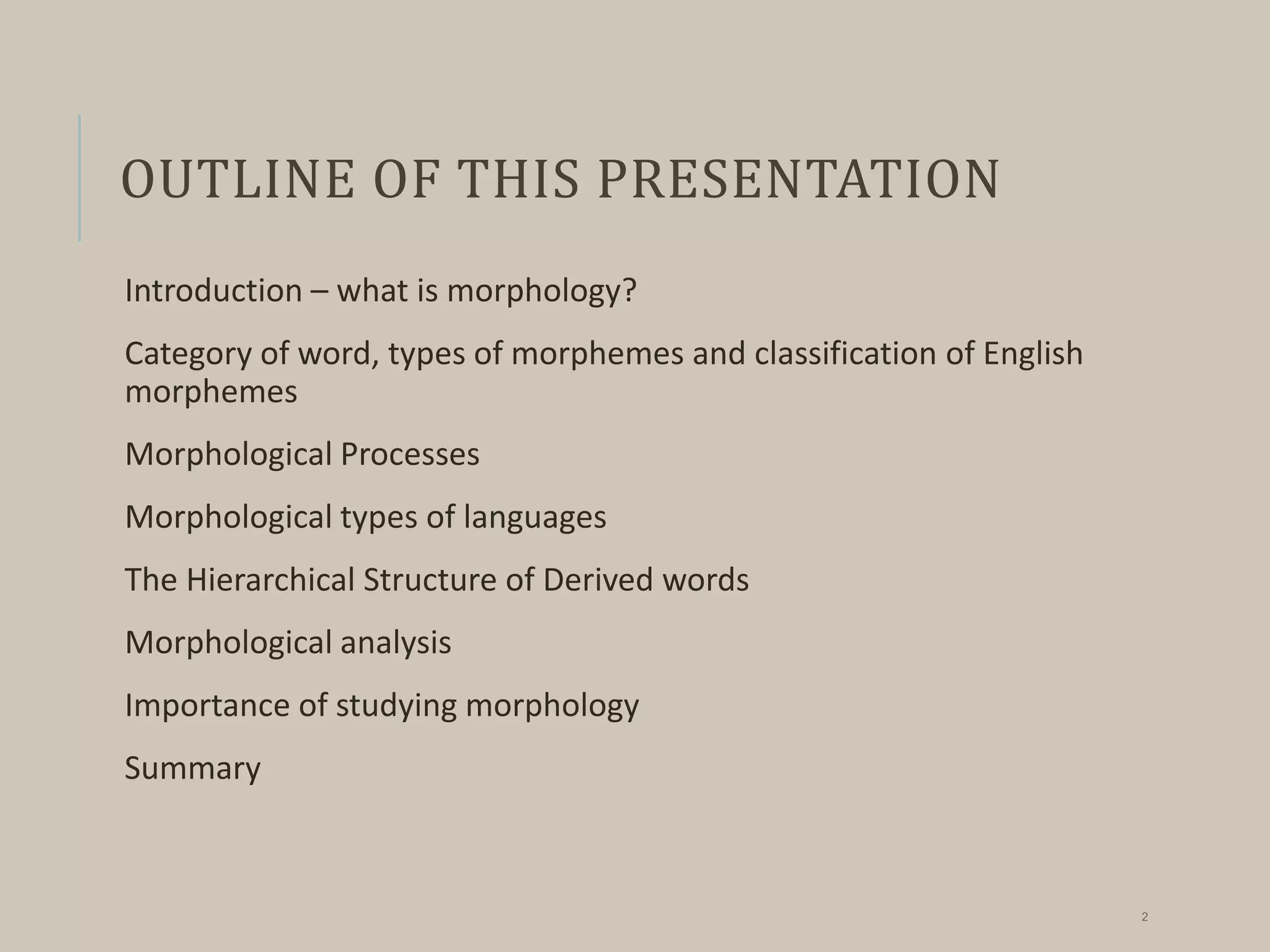
OUTLINE OF THIS PRESENTATION
Introduction – what is morphology?
Category of word, types of morphemes and classification of English
morphemes
Morphological Processes
Morphological types of languages
The Hierarchical Structure of Derived words
Morphological analysis
Importance of studying morphology
Summary
2
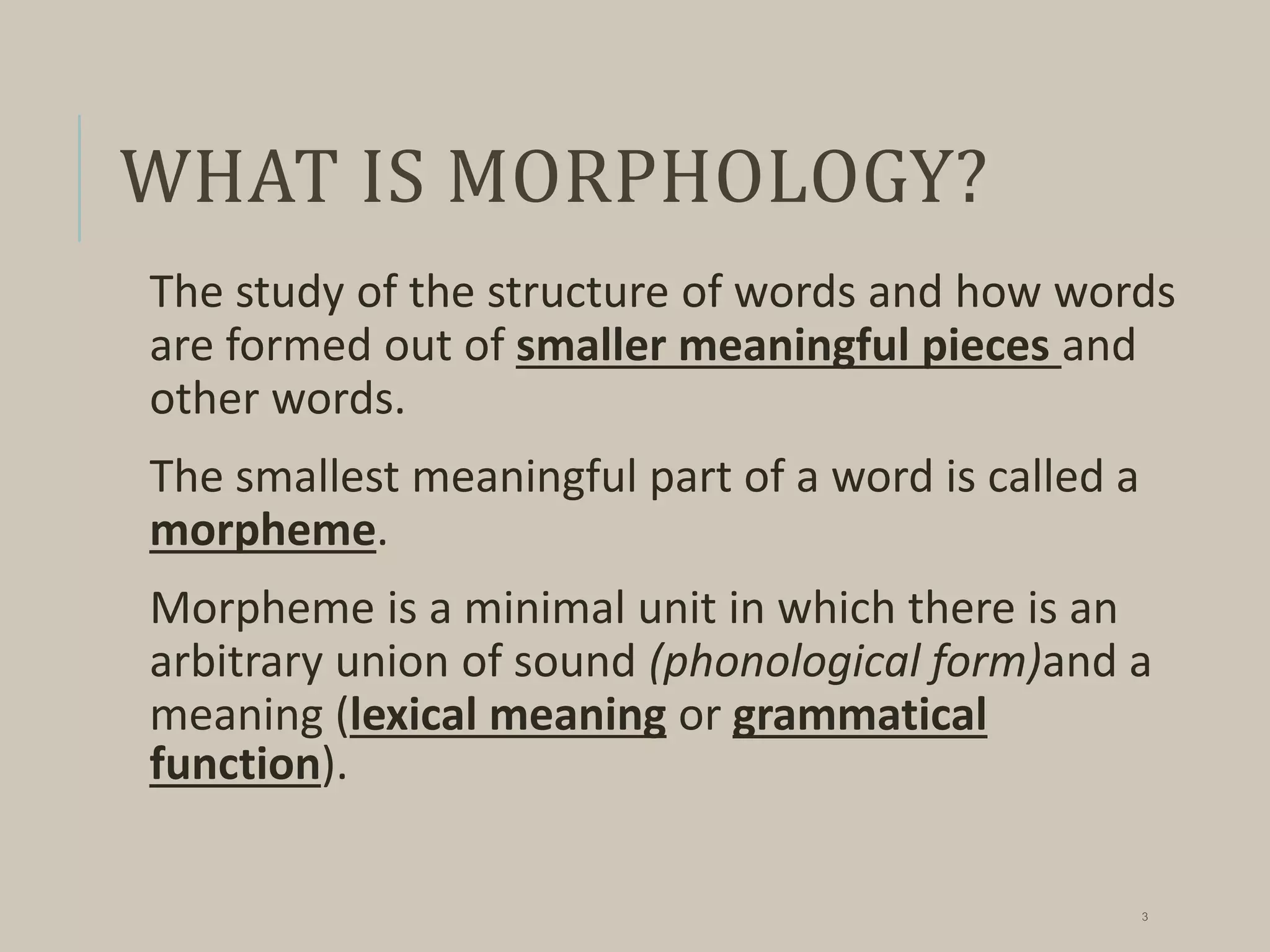
WHAT IS MORPHOLOGY?
The study of the structure of words and how words
are formed out of smaller meaningful pieces and
other words.
The smallest meaningful part of a word is called a
morpheme.
Morpheme is a minimal unit in which there is an
arbitrary union of sound (phonological form)and a
meaning (lexical meaning or grammatical
function).
3
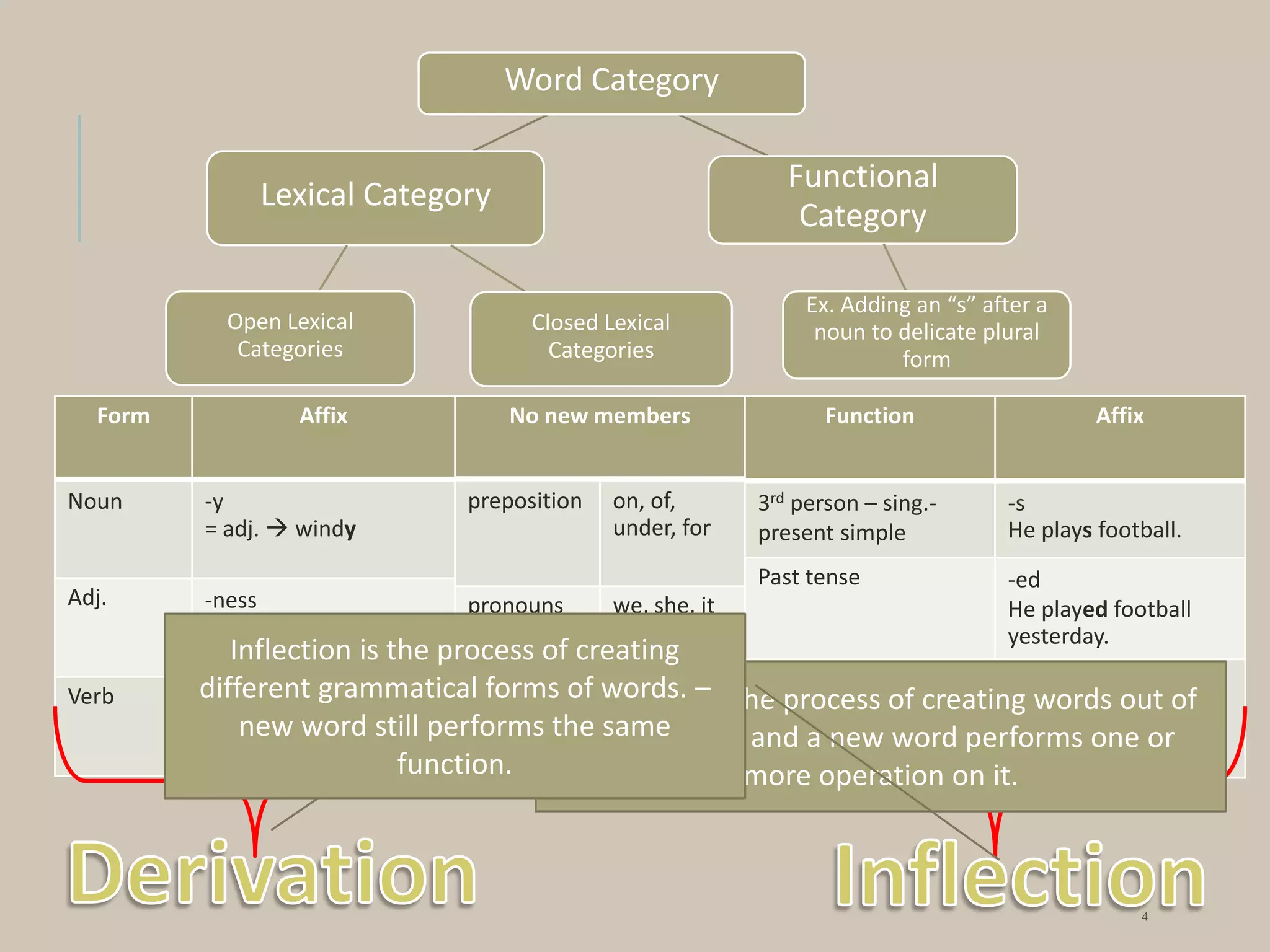
Word Category
Functional
Category
Ex. Adding an “s” after a
noun to delicate plural
form
Lexical Category
Open Lexical
Categories
Closed Lexical
Categories
4
Form Affix
Noun -y
= adj.  windy
Adj. -ness
= noun  happiness
Verb -able
= adj.  drinkable
No new members
preposition on, of,
under, for
pronouns we, she, it
determiner
s
a, the, his,
this
Function Affix
3rd person – sing.-
present simple
-s
He plays football.
Past tense -ed
He played football
yesterday.
plural -s,es
Two cats are in the
house.
Derivation is the process of creating words out of
other words and a new word performs one or
more operation on it.
Inflection is the process of creating
different grammatical forms of words. –
new word still performs the same
function.
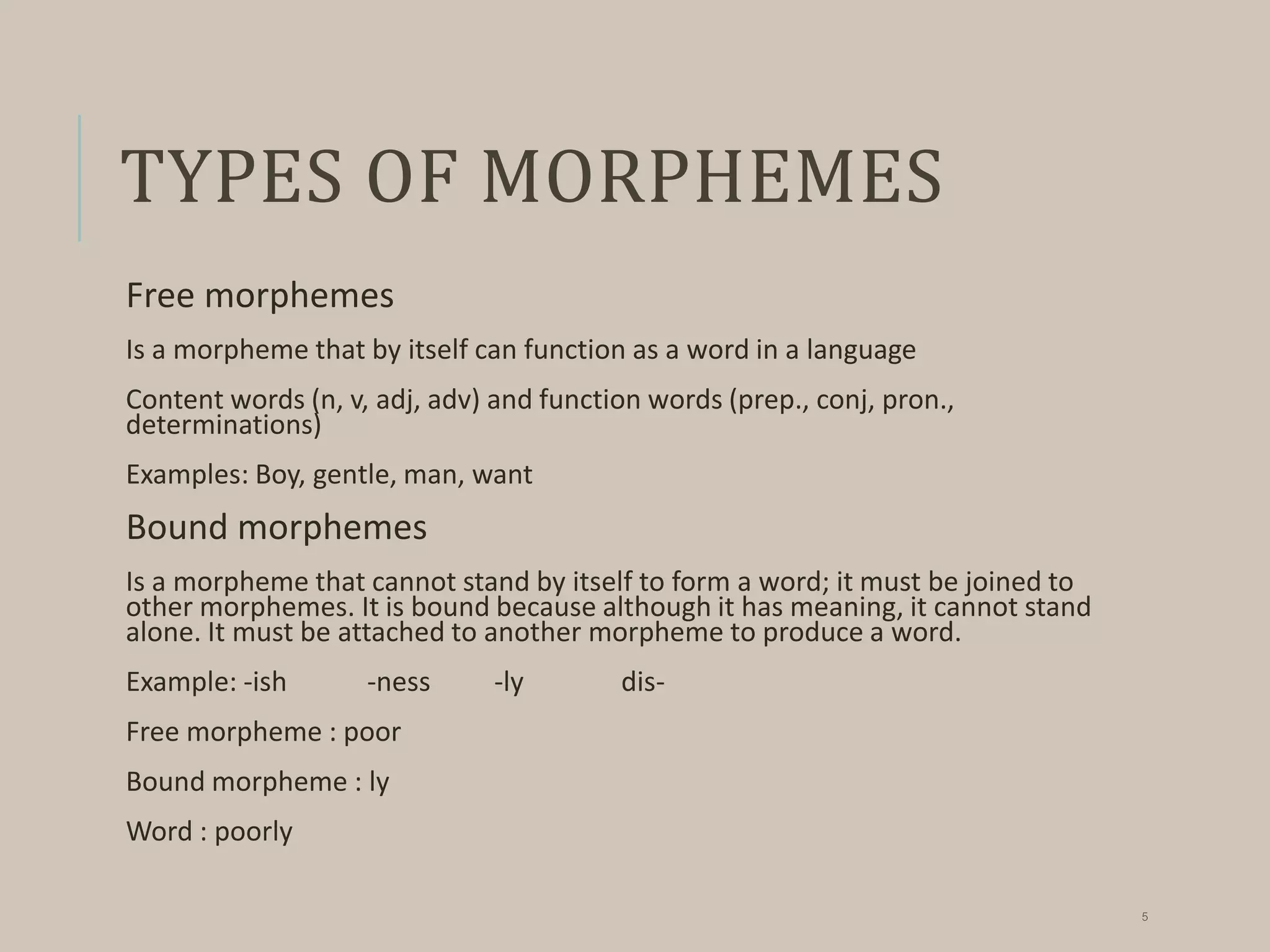
TYPES OF MORPHEMES
Free morphemes
Is a morpheme that by itself can function as a word in a language
Content words (n, v, adj, adv) and function words (prep., conj, pron.,
determinations)
Examples: Boy, gentle, man, want
Bound morphemes
Is a morpheme that cannot stand by itself to form a word; it must be joined to
other morphemes. It is bound because although it has meaning, it cannot stand
alone. It must be attached to another morpheme to produce a word.
Example: -ish -ness -ly dis-
Free morpheme : poor
Bound morpheme : ly
Word : poorly
5
TYPES OF MORPHEMES
6
Morphemes
Free
Bound
Functional
Lexical
Derivational
Inflectional (-s, -ed)
(re- , -ness)
Conjunction,
preposition,
determiners
Noun, verb, adj.,
adv.
CLASSIFICATION OF ENGLISH MORPHEMES
Morphemes
Free
Open class
Nouns (man)
Verbs (hit)
Adjective
(happy)
Adverb
(slowly)
Closed class
Conjunction
(and, or)
Preposition
(of, on)
Pronouns (I,
you)
Auxiliary
verbs (is,
may, can)
Bound
Affix
Prefix
Pre-
Un-
Dis-
Suffix
-ly
-ist
-ment
Root
form
bene
cent
7
MORPHOLOGICAL PROCESSES
8
Concatenative
Compounding
Affixation
Non-
concatenative
Alternations
Reduplication
Suppletion
Putting
morpheme
together
Modifying
internal
structure of
morphemes
1. AFFIXATION
Prefix
Prefixes are letters that are added to the beginning of the word.
A prefix changes the meaning of a word.
Example: “premature”  done before the usual or proper time.
Pre- = before, mature = full-grown
Suffix
Suffixes are letters that are added at the end of the word.
A suffix changes the meaning and the word class of a word.
Example: “powerful”  having great power or strength
- ful = full of, forming adjective from noun.
9
EXAMPLE LIST OF PREFIX AND SUFFIX
10
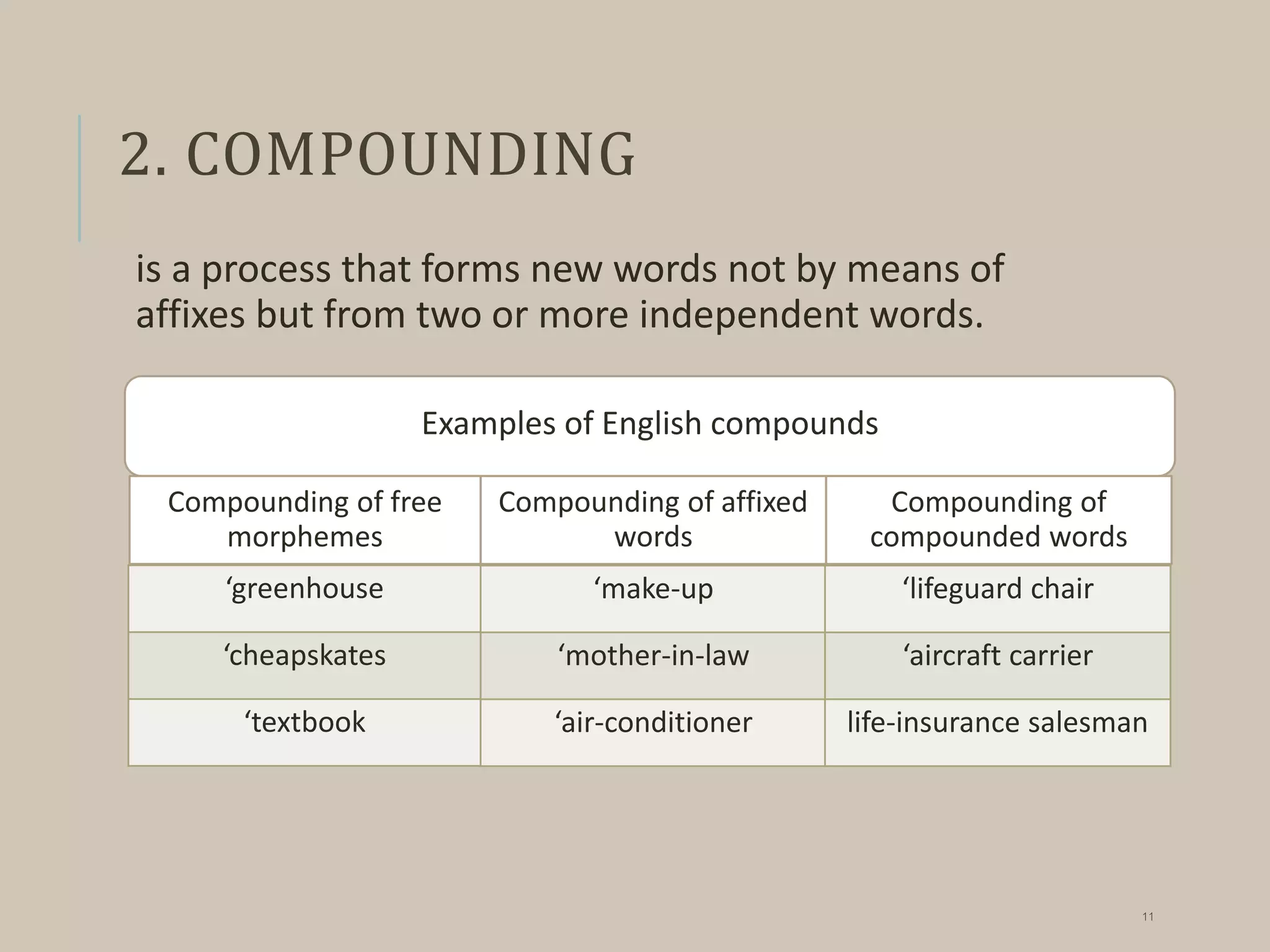
2. COMPOUNDING
is a process that forms new words not by means of
affixes but from two or more independent words.
11
Examples of English compounds
Compounding of free
morphemes
Compounding of affixed
words
Compounding of
compounded words
‘greenhouse
‘cheapskates
‘textbook
‘make-up
‘mother-in-law
‘air-conditioner
‘lifeguard chair
‘aircraft carrier
life-insurance salesman
COMPOUNDING (CON.) -STRESSING
12
a ‘darkroom
A green house’A ‘greenhouse
A dark room’
3. REDUPLICATION
is a process of forming new words by doubling either an
entire free morpheme (total reduplication) or part of it
(partial reduplication).
Example: bye bye, night night, sit sit, super-duper
In conversational speech, reduplication may be used to
indicate intensity; this can happen with verbs, adjectives,
and nouns.
"So... do you like like me, or just like me?"
“I have to go now, now I have the phone call.”
13
4. ALTERNATIONS
Making morphemes internal modifications
Vowel modifications
Some irregular verbs show an internal modification:
[I] – [oe] – [v] = begin – began – begun, ring – rang – rung
[ai] – [au] = find – found, bind – bound
Some verbs show both an alternation and the addition of an affix
Root Alternation Alternation and Affixation
break broke broken
bite bit bitten
fall fell fallen
14
4. ALTERNATIONS (CON.)
Consonant modification
Noun/ Verb
[f] – [v] = belief – believe, grief – grieve, proof – prove
[s] – [z] = advice – advise, device – devise, use – use
[s] – [d] = defense – defend, offence – offend
[t] – [d] = bent – bend, ascent – ascend
15
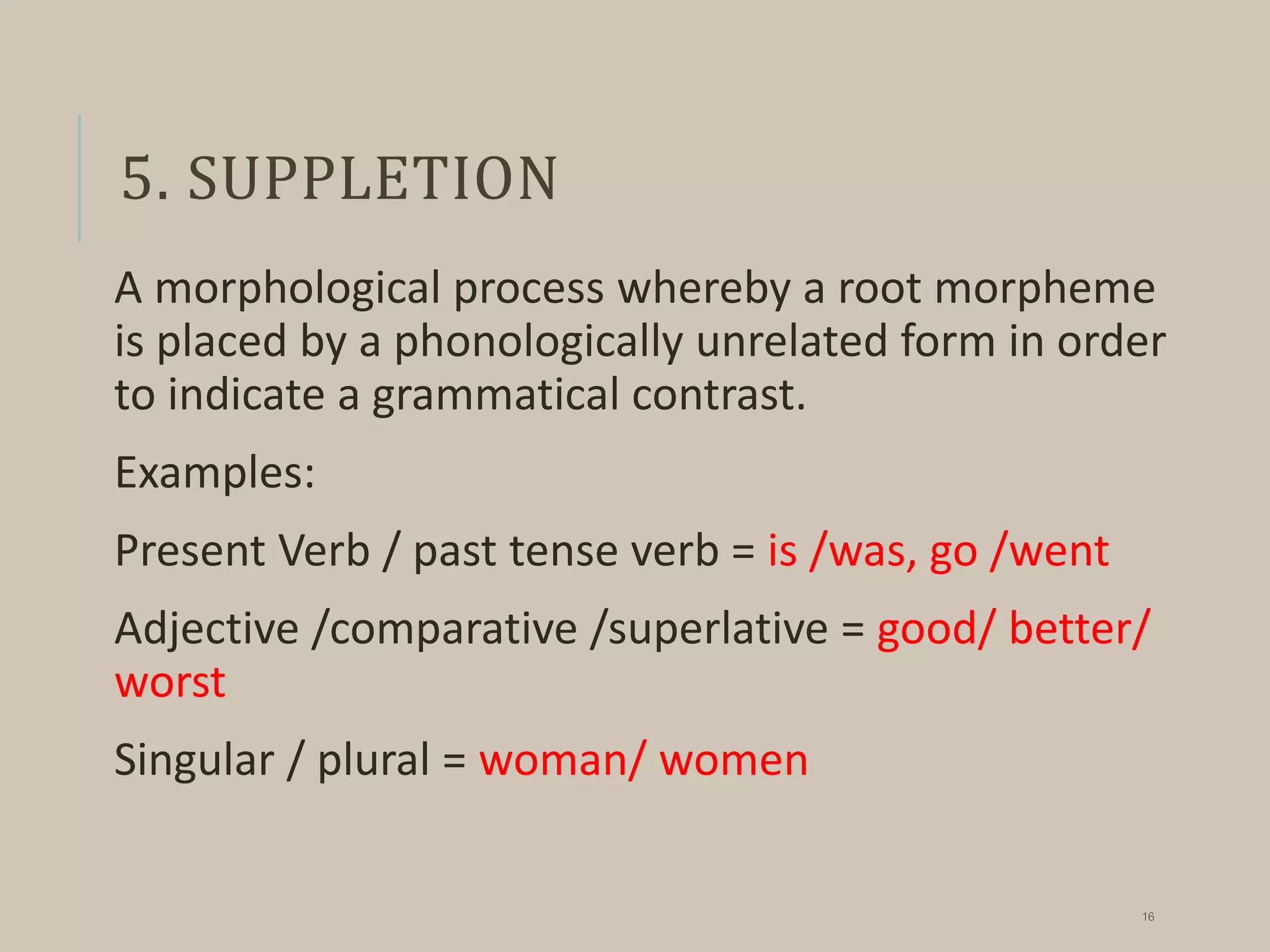
5. SUPPLETION
A morphological process whereby a root morpheme
is placed by a phonologically unrelated form in order
to indicate a grammatical contrast.
Examples:
Present Verb / past tense verb = is /was, go /went
Adjective /comparative /superlative = good/ better/
worst
Singular / plural = woman/ women
16
MORPHOLOGICAL TYPES
OF LANGUAGES
There are 2 basic morphological types
Analytic languages
Synthesis languages
17
MORPHOLOGICAL TYPES
OF LANGUAGES
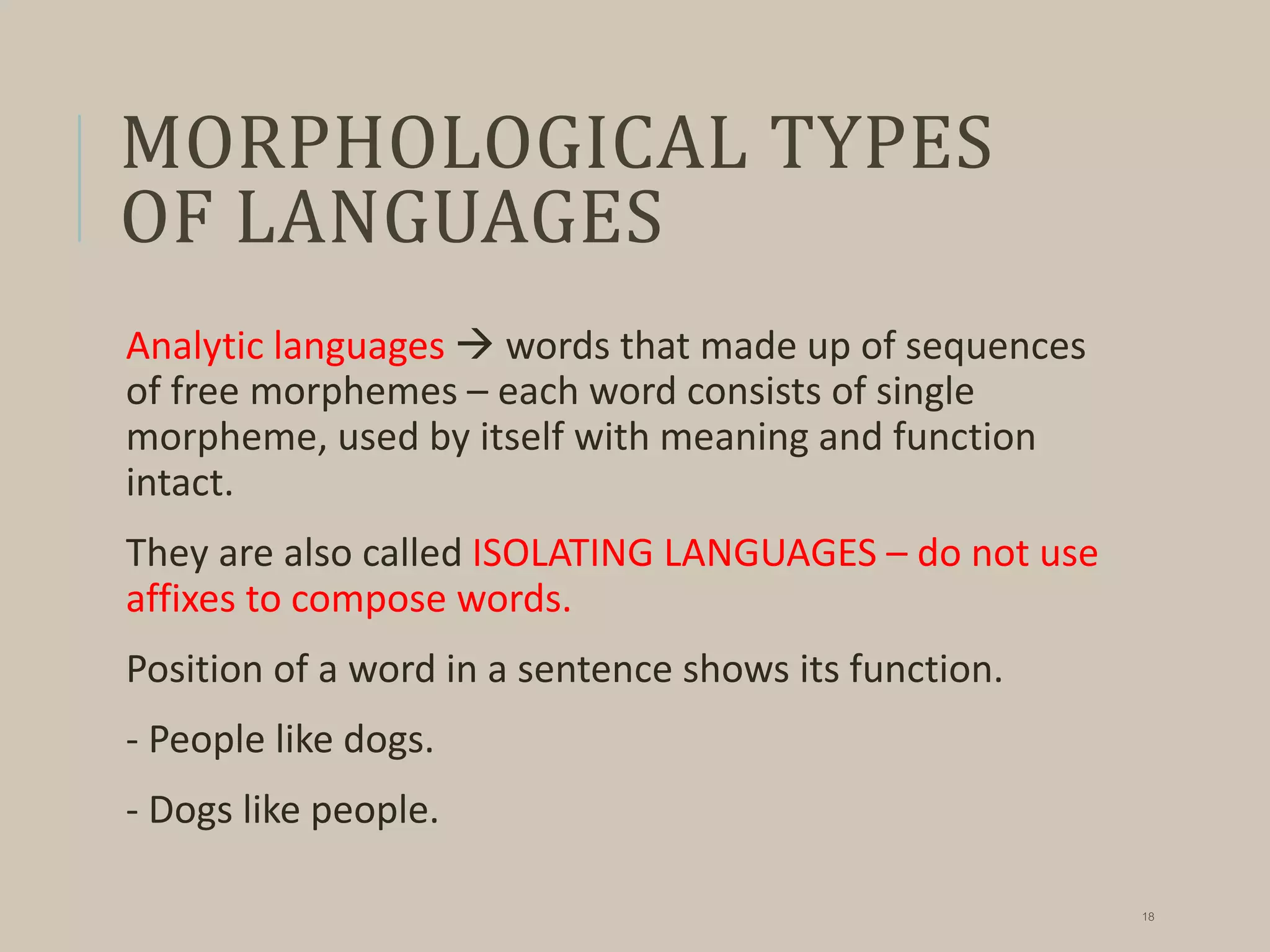
Analytic languages  words that made up of sequences
of free morphemes – each word consists of single
morpheme, used by itself with meaning and function
intact.
They are also called ISOLATING LANGUAGES – do not use
affixes to compose words.
Position of a word in a sentence shows its function.
- People like dogs.
- Dogs like people.
18
MORPHOLOGICAL TYPES
OF LANGUAGES
Synthetic Languages
Bound morphemes are attached to other morphemes – a word may be
made up of several meaningful elements.
Stem refers to that part of the word in affixes are added. Example: rerun(s)
3 types of synthetic languages
1. Agglutinating languages – morphemes are joined together loosely, so it is
easy to identify
2. Fusional languages – the affixed are characteristically fused with the stem.
Spanish – [ablo] = I am speaking, [abla] = S/he is speaking, [able] = I spoke.
3. Polysynthetic language – highly complex words may be formed by
combining several stems and affixes. (India)
19
THE HIERARCHICAL STRUCTURE OF
DERIVED WORDS
A word is not a simple sequences of morphemes. It has an internal structure.
Hierarchical structure is an essential property of human language.
It can be represented by a tree diagram that indicates the steps involved in the
formation of the word.
20
(V)
Adj
usere
Verb
able
(V)
Adj
useun
Adj
able
The difference is “reuse” is a verb but “unuse” is not a word.
THE HIERARCHICAL STRUCTURE OF
DERIVED WORDS (CON.)
Ambiguous Morphemes and Words
Are words that can be associated with more than one meaning for
example “unlockable”. It could mean either ‘not able to be locked’ or
‘able to be unlocked’.
21
THE HIERARCHICAL STRUCTURE OF
DERIVED WORDS (CON.)
Morphemes that can attach to more than one lexical
category.
Most prefixes combine with a verb, the result of a new word
is still a verb. Example re+do (v) = redo (v).
Or adding an adjective after a prefix creates an adjective.
Example: un+happy (adj.) = unhappy (adj.)
There are a few prefixes that do not attach exclusively to one
lexical category.
For example “pre”
22
THE HIERARCHICAL STRUCTURE OF
DERIVED WORDS (CON.)
Pre- means before time, the combination of pre- and word will
result in a change of meaning.
Pre- + Verb = Verb
 Preexist
 Premeditate
 Preboard
Pre- + Noun = Adjective
 Preseason
 Pregame
 Prewar
Pre- + Adjective = Adjective
 Predental
 Prehistoric
 prefrontal
23
MORPHOLOGICAL
ANALYSIS
Analyzing words into their linguistic components (morphemes).
24
word Function Morphological Analysis Morphemic analysis
teachers noun 3 morphs teach/er/s 3 morphemes {teach}+{-
er}+{pl}
smaller adj 2 morphs small/er 2 morphemes {small}+{-er}
working verb 2 morphs work/ing 2 morphemes
{work}+{prs.prt}
working noun 2 morphs work/ing 3 morphemes
{work}+{gerund}+{sg.}
IMPORTANCE OF STUDYING
MORPHOLOGY
Decoding – Readers who recognize morphemes read more
quickly and accurately.
Vocabulary – Knowledge of meaning of word parts expands
reader’s vocabulary.
Comprehension – knowledge of morphemes helps make
meaning from text.
Spelling – Morphemes are units that can be predictably
spelled.
25
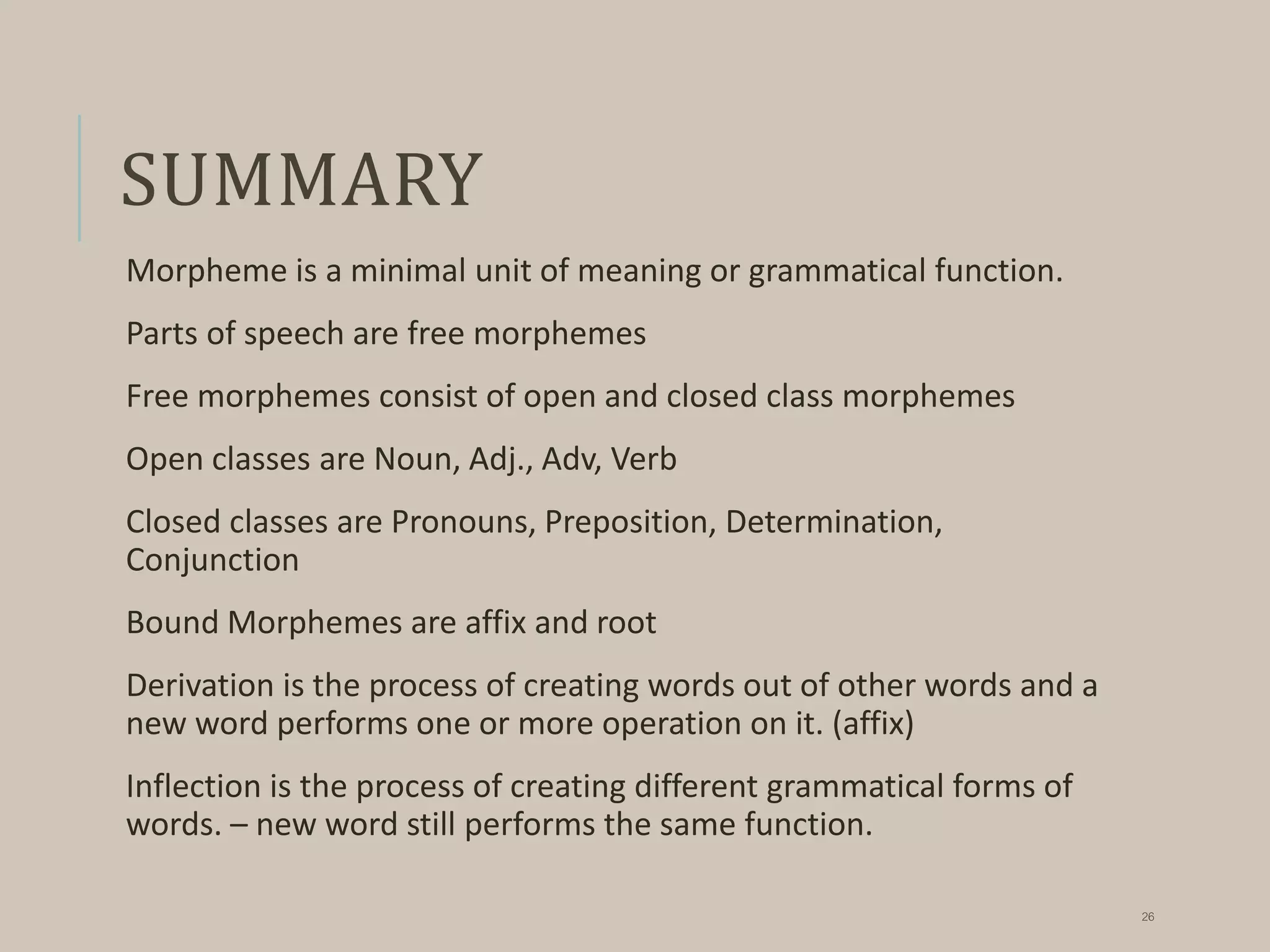
SUMMARY
Morpheme is a minimal unit of meaning or grammatical function.
Parts of speech are free morphemes
Free morphemes consist of open and closed class morphemes
Open classes are Noun, Adj., Adv, Verb
Closed classes are Pronouns, Preposition, Determination,
Conjunction
Bound Morphemes are affix and root
Derivation is the process of creating words out of other words and a
new word performs one or more operation on it. (affix)
Inflection is the process of creating different grammatical forms of
words. – new word still performs the same function.
26
QUIZ – “RELATIONSHIP”
27
Divide the word into component morphemes and give the meaning.

Morphology

  • 1.
    MORPH*O*LOG*Y Prepared by: WannaPhadyen Present to: Dr. Jitpanat Suwanthep 1 Woof Woofing Woofs Woofed
  • 2.
    OUTLINE OF THISPRESENTATION Introduction – what is morphology? Category of word, types of morphemes and classification of English morphemes Morphological Processes Morphological types of languages The Hierarchical Structure of Derived words Morphological analysis Importance of studying morphology Summary 2
  • 3.
    WHAT IS MORPHOLOGY? Thestudy of the structure of words and how words are formed out of smaller meaningful pieces and other words. The smallest meaningful part of a word is called a morpheme. Morpheme is a minimal unit in which there is an arbitrary union of sound (phonological form)and a meaning (lexical meaning or grammatical function). 3
  • 4.
    Word Category Functional Category Ex. Addingan “s” after a noun to delicate plural form Lexical Category Open Lexical Categories Closed Lexical Categories 4 Form Affix Noun -y = adj.  windy Adj. -ness = noun  happiness Verb -able = adj.  drinkable No new members preposition on, of, under, for pronouns we, she, it determiner s a, the, his, this Function Affix 3rd person – sing.- present simple -s He plays football. Past tense -ed He played football yesterday. plural -s,es Two cats are in the house. Derivation is the process of creating words out of other words and a new word performs one or more operation on it. Inflection is the process of creating different grammatical forms of words. – new word still performs the same function.
  • 5.
    TYPES OF MORPHEMES Freemorphemes Is a morpheme that by itself can function as a word in a language Content words (n, v, adj, adv) and function words (prep., conj, pron., determinations) Examples: Boy, gentle, man, want Bound morphemes Is a morpheme that cannot stand by itself to form a word; it must be joined to other morphemes. It is bound because although it has meaning, it cannot stand alone. It must be attached to another morpheme to produce a word. Example: -ish -ness -ly dis- Free morpheme : poor Bound morpheme : ly Word : poorly 5
  • 6.
    TYPES OF MORPHEMES 6 Morphemes Free Bound Functional Lexical Derivational Inflectional(-s, -ed) (re- , -ness) Conjunction, preposition, determiners Noun, verb, adj., adv.
  • 7.
    CLASSIFICATION OF ENGLISHMORPHEMES Morphemes Free Open class Nouns (man) Verbs (hit) Adjective (happy) Adverb (slowly) Closed class Conjunction (and, or) Preposition (of, on) Pronouns (I, you) Auxiliary verbs (is, may, can) Bound Affix Prefix Pre- Un- Dis- Suffix -ly -ist -ment Root form bene cent 7
  • 8.
  • 9.
    1. AFFIXATION Prefix Prefixes areletters that are added to the beginning of the word. A prefix changes the meaning of a word. Example: “premature”  done before the usual or proper time. Pre- = before, mature = full-grown Suffix Suffixes are letters that are added at the end of the word. A suffix changes the meaning and the word class of a word. Example: “powerful”  having great power or strength - ful = full of, forming adjective from noun. 9
  • 10.
    EXAMPLE LIST OFPREFIX AND SUFFIX 10
  • 11.
    2. COMPOUNDING is aprocess that forms new words not by means of affixes but from two or more independent words. 11 Examples of English compounds Compounding of free morphemes Compounding of affixed words Compounding of compounded words ‘greenhouse ‘cheapskates ‘textbook ‘make-up ‘mother-in-law ‘air-conditioner ‘lifeguard chair ‘aircraft carrier life-insurance salesman
  • 12.
    COMPOUNDING (CON.) -STRESSING 12 a‘darkroom A green house’A ‘greenhouse A dark room’
  • 13.
    3. REDUPLICATION is aprocess of forming new words by doubling either an entire free morpheme (total reduplication) or part of it (partial reduplication). Example: bye bye, night night, sit sit, super-duper In conversational speech, reduplication may be used to indicate intensity; this can happen with verbs, adjectives, and nouns. "So... do you like like me, or just like me?" “I have to go now, now I have the phone call.” 13
  • 14.
    4. ALTERNATIONS Making morphemesinternal modifications Vowel modifications Some irregular verbs show an internal modification: [I] – [oe] – [v] = begin – began – begun, ring – rang – rung [ai] – [au] = find – found, bind – bound Some verbs show both an alternation and the addition of an affix Root Alternation Alternation and Affixation break broke broken bite bit bitten fall fell fallen 14
  • 15.
    4. ALTERNATIONS (CON.) Consonantmodification Noun/ Verb [f] – [v] = belief – believe, grief – grieve, proof – prove [s] – [z] = advice – advise, device – devise, use – use [s] – [d] = defense – defend, offence – offend [t] – [d] = bent – bend, ascent – ascend 15
  • 16.
    5. SUPPLETION A morphologicalprocess whereby a root morpheme is placed by a phonologically unrelated form in order to indicate a grammatical contrast. Examples: Present Verb / past tense verb = is /was, go /went Adjective /comparative /superlative = good/ better/ worst Singular / plural = woman/ women 16
  • 17.
    MORPHOLOGICAL TYPES OF LANGUAGES Thereare 2 basic morphological types Analytic languages Synthesis languages 17
  • 18.
    MORPHOLOGICAL TYPES OF LANGUAGES Analyticlanguages  words that made up of sequences of free morphemes – each word consists of single morpheme, used by itself with meaning and function intact. They are also called ISOLATING LANGUAGES – do not use affixes to compose words. Position of a word in a sentence shows its function. - People like dogs. - Dogs like people. 18
  • 19.
    MORPHOLOGICAL TYPES OF LANGUAGES SyntheticLanguages Bound morphemes are attached to other morphemes – a word may be made up of several meaningful elements. Stem refers to that part of the word in affixes are added. Example: rerun(s) 3 types of synthetic languages 1. Agglutinating languages – morphemes are joined together loosely, so it is easy to identify 2. Fusional languages – the affixed are characteristically fused with the stem. Spanish – [ablo] = I am speaking, [abla] = S/he is speaking, [able] = I spoke. 3. Polysynthetic language – highly complex words may be formed by combining several stems and affixes. (India) 19
  • 20.
    THE HIERARCHICAL STRUCTUREOF DERIVED WORDS A word is not a simple sequences of morphemes. It has an internal structure. Hierarchical structure is an essential property of human language. It can be represented by a tree diagram that indicates the steps involved in the formation of the word. 20 (V) Adj usere Verb able (V) Adj useun Adj able The difference is “reuse” is a verb but “unuse” is not a word.
  • 21.
    THE HIERARCHICAL STRUCTUREOF DERIVED WORDS (CON.) Ambiguous Morphemes and Words Are words that can be associated with more than one meaning for example “unlockable”. It could mean either ‘not able to be locked’ or ‘able to be unlocked’. 21
  • 22.
    THE HIERARCHICAL STRUCTUREOF DERIVED WORDS (CON.) Morphemes that can attach to more than one lexical category. Most prefixes combine with a verb, the result of a new word is still a verb. Example re+do (v) = redo (v). Or adding an adjective after a prefix creates an adjective. Example: un+happy (adj.) = unhappy (adj.) There are a few prefixes that do not attach exclusively to one lexical category. For example “pre” 22
  • 23.
    THE HIERARCHICAL STRUCTUREOF DERIVED WORDS (CON.) Pre- means before time, the combination of pre- and word will result in a change of meaning. Pre- + Verb = Verb  Preexist  Premeditate  Preboard Pre- + Noun = Adjective  Preseason  Pregame  Prewar Pre- + Adjective = Adjective  Predental  Prehistoric  prefrontal 23
  • 24.
    MORPHOLOGICAL ANALYSIS Analyzing words intotheir linguistic components (morphemes). 24 word Function Morphological Analysis Morphemic analysis teachers noun 3 morphs teach/er/s 3 morphemes {teach}+{- er}+{pl} smaller adj 2 morphs small/er 2 morphemes {small}+{-er} working verb 2 morphs work/ing 2 morphemes {work}+{prs.prt} working noun 2 morphs work/ing 3 morphemes {work}+{gerund}+{sg.}
  • 25.
    IMPORTANCE OF STUDYING MORPHOLOGY Decoding– Readers who recognize morphemes read more quickly and accurately. Vocabulary – Knowledge of meaning of word parts expands reader’s vocabulary. Comprehension – knowledge of morphemes helps make meaning from text. Spelling – Morphemes are units that can be predictably spelled. 25
  • 26.
    SUMMARY Morpheme is aminimal unit of meaning or grammatical function. Parts of speech are free morphemes Free morphemes consist of open and closed class morphemes Open classes are Noun, Adj., Adv, Verb Closed classes are Pronouns, Preposition, Determination, Conjunction Bound Morphemes are affix and root Derivation is the process of creating words out of other words and a new word performs one or more operation on it. (affix) Inflection is the process of creating different grammatical forms of words. – new word still performs the same function. 26
  • 27.
    QUIZ – “RELATIONSHIP” 27 Dividethe word into component morphemes and give the meaning.

Editor's Notes

  • #5 Derivation is the process of creating words out of other words and a new word performs one or more operation on it. Inflection is the process of creating different grammatical forms of words. – new word still performs the same function.
  • #9 A morphological process is a means of changing a stem to adjust its meaning to fit its syntactic and communicational context. Concatenation is a process which deals with the formation of new lexical items by putting at least two distinct morphemes together.
  • #21 The difference between these 2 are reuse is classified as a verb and unuse is not a verb.