MORPHOLOGY
In many languages, what appear to be single forms actually turn out to contain a large
number of 'word-like' elements.
Morphology. This term, which literally means 'the study of forms', was originally used in
biology, but, since the middle of the nineteenth century, has also been used to describe that
type of investigation which analyzes all those basic 'elements' which are used in a language.
What we have been describing as 'elements' in the form of a linguistic message are more
technically known as morphemes.
Morphemes
We do not actually have to go to other languages such as Swahili to discover that 'word-
forms' may consist of a number of elements. We can recognize that English word-forms
such as talks, talker, talked and talking must consist of one element talk, and a number of
other elements such as -s,-er,-ed,-ing. All these elements are described as morphemes.
The definition of a morpheme is "a minimal unit of meaning or grammatical function". Let's
clarify this definition with some examples. We would say that the word reopened in the
sentence The police reopened the investigation consists of three morphemes. One minimal
unit of meaning is open, another minimal unit 'of meaning is re- (meaning 'again'), and a
minimal unit of grammatical function is -ed (indicating past tense).The word tourists also
contains three morphemes. There is one minimal unit of meaning, tour, another minimal
unit of meaning -ist (meaning 'person who does something'), and a minimal unit of
grammatical function -s (indicating plural).
Free and bound morphemes from these two examples, we can make a broad distinction
between two types of morphemes. There are free morphemes, that is, morphemes which
can stand by themselves as single words, e.g. open and tour. There are also bound
morphemes, that is, those which cannot normally stand alone, but which are typically
attached to another form, e.g. re-,-ist, -ed, -s. You will recognize this last set as a group of
what we have already described in Chapter 7 as affixes. So, all affixes in English are bound
morphemes. The free morphemes can be generally considered as the set of separate
English word-forms. When they are used with bound morphemes, the basic word-form
involved is technically known as the stem. For example:
undressed carelessness
un- dress -ed care -less -ness
prefix stem suffix stem suffix suffix
(bound) (free) (bound) (free) (bound) (bound)
It should be noted that this type of description is a partial simplification of the
morphological facts of English, There are a number of English words in which the element
which seems to be the 'stem' is not, in fact, a free morpheme, In words like receive, reduce,
repeal we can recognize the bound morpheme re-, but the elements -ceive, -duce and -peat
are clearly not free morphemes. There is still some disagreement over the proper
characterization of these elements and you may encounter a variety of technical terms used
to describe them. It may help to work with a simple distinction between those forms like -
ceive and -duce as 'bound stems' and other forms like dress and care as 'free stems'.
Free morphemes What we have described as free morphemes fall into two categories.
The first category is that set of ordinary nouns, adjectives and verbs which we think of as
the words which carry the 'content' of messages we convey. These free morphemes are
called lexical morphemes and some examples are: boy, man, house, tiger, sad, long,
yellow, sincere, open, look, follow, break. We can add new lexical morphemes to the
language rather easily, so they are treated as an 'open' class of words.
The other group of free morphemes are called functional morphemes, Examples are:
and, but, when, because, on, near, above, in, the, that> /Z.This set consists largely of the
functional words in the language such as conjunc tions, prepositions, articles and pronouns.
Because we almost never add new functional morphemes to the language, they are
described as a 'closed' class of words.
Bound morphemes The set of affixes which fall into the 'bound' category can also be
divided into two types. One type we have already considered in Chapter 7, the derivational
morphemes. These are used to make new words in the language and are often used to
make words of a different grammatical category from the stem. Thus, the addition of the
derivational morpheme -ness changes the adjective good to the noun goodness.The noun
care can become the adjectives careful or careless via the derivational morphemes -ful or -
less, A list of derivational morphemes will include suffixes such as the -ish in. foolish, the -
/y in badly and the -ment in payment. It will also include prefixes such as re-, pre-, ex-,
dis-, co-, un- and many more.
The second set of bound morphemes contains what are called inflectional morphemes.
These are not used to produce new words in the English language, but rather to indicate
aspects of the grammatical function of a word. Inflectional morphemes are used to show if a
word is plural or singular, if it is past tense or not, and if it is a comparative or possessive
form. English has only eight inflectional morphemes, illustrated in the following:
Let me tell you about Jim's two sisters.
One likes to have fun and is always laughing
The other liked to study and has always tak en things seriously,
One is the loudest person in the house and the other is quieter than a mouse.
From these examples, we can see that two of the inflections, - 's (possessive) and -s
(plural) are attached to nouns. There are four attached to verbs, -s (3rd person present
singular), -ing (present participle), -ed (past tense) and -en (past participle). There are two
inflections, -est (superlative) and -er (comparative) attached to adjectives. Note that, in
English, all inflectional morphemes listed here are suffixes.
Noun+ -'s,-s
Verb + -s, -ing, -ed, -en
Adjective + -est, -er
There is some variation in the form of these inflectional morphemes, with, for example, the
possessive sometimes occurring as -s' (those boys' bags) and the past participle as -ed
(they have finished).
Derivational versus inflectional The difference between derivational and inflectional
morphemes is worth emphasizing, An inflectional morpheme never changes the
grammatical category of a word. For example, both old and older are adjectives. The -er
inflection (from Old English -ra) simply creates a different version of the adjective.
However, a derivational morpheme can change the grammatical category of a word. The
verb teach becomes the noun teacher if we add the derivational morpheme -er (from Old
English -ere). So, the suffix form -er can be an inflectional morpheme as part of an
adjective and also a distinct derivational morpheme as part of a noun. Just because they (-
er) look the same doesn't mean they do the same kind of work. In both cases, they are
bound morphemes.
Whenever there is a derivational suffix and an inflectional suffix attached to the same
word, they always appear in that order. First the derivational -er attaches to teach, then the
inflectional -s is added to yield teachers.
Morphological description Armed with all these terms for the different types of
morphemes, you can now take most sentences of English apart and list the 'elements'. As
an example, the English sentence The girl's wildness shocked the teachers contains the
following elements:
The girl - 's wild -ness
(functional) (lexical) (inflectional) (lexical) (derivational)
shock -ed the
(lexical) (inflectional) (functional)
teach er s
(lexical) (derivational) (inflectional)
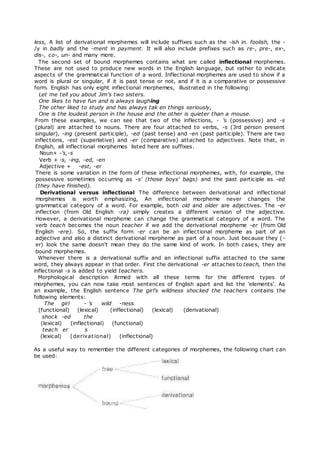
As a useful way to remember the different categories of morphemes, the following chart can
be used:

Morphology.doc

  • 1.
    MORPHOLOGY In many languages,what appear to be single forms actually turn out to contain a large number of 'word-like' elements. Morphology. This term, which literally means 'the study of forms', was originally used in biology, but, since the middle of the nineteenth century, has also been used to describe that type of investigation which analyzes all those basic 'elements' which are used in a language. What we have been describing as 'elements' in the form of a linguistic message are more technically known as morphemes. Morphemes We do not actually have to go to other languages such as Swahili to discover that 'word- forms' may consist of a number of elements. We can recognize that English word-forms such as talks, talker, talked and talking must consist of one element talk, and a number of other elements such as -s,-er,-ed,-ing. All these elements are described as morphemes. The definition of a morpheme is "a minimal unit of meaning or grammatical function". Let's clarify this definition with some examples. We would say that the word reopened in the sentence The police reopened the investigation consists of three morphemes. One minimal unit of meaning is open, another minimal unit 'of meaning is re- (meaning 'again'), and a minimal unit of grammatical function is -ed (indicating past tense).The word tourists also contains three morphemes. There is one minimal unit of meaning, tour, another minimal unit of meaning -ist (meaning 'person who does something'), and a minimal unit of grammatical function -s (indicating plural). Free and bound morphemes from these two examples, we can make a broad distinction between two types of morphemes. There are free morphemes, that is, morphemes which can stand by themselves as single words, e.g. open and tour. There are also bound morphemes, that is, those which cannot normally stand alone, but which are typically attached to another form, e.g. re-,-ist, -ed, -s. You will recognize this last set as a group of what we have already described in Chapter 7 as affixes. So, all affixes in English are bound morphemes. The free morphemes can be generally considered as the set of separate English word-forms. When they are used with bound morphemes, the basic word-form involved is technically known as the stem. For example: undressed carelessness un- dress -ed care -less -ness prefix stem suffix stem suffix suffix (bound) (free) (bound) (free) (bound) (bound) It should be noted that this type of description is a partial simplification of the morphological facts of English, There are a number of English words in which the element which seems to be the 'stem' is not, in fact, a free morpheme, In words like receive, reduce, repeal we can recognize the bound morpheme re-, but the elements -ceive, -duce and -peat are clearly not free morphemes. There is still some disagreement over the proper characterization of these elements and you may encounter a variety of technical terms used to describe them. It may help to work with a simple distinction between those forms like - ceive and -duce as 'bound stems' and other forms like dress and care as 'free stems'. Free morphemes What we have described as free morphemes fall into two categories. The first category is that set of ordinary nouns, adjectives and verbs which we think of as the words which carry the 'content' of messages we convey. These free morphemes are called lexical morphemes and some examples are: boy, man, house, tiger, sad, long, yellow, sincere, open, look, follow, break. We can add new lexical morphemes to the language rather easily, so they are treated as an 'open' class of words. The other group of free morphemes are called functional morphemes, Examples are: and, but, when, because, on, near, above, in, the, that> /Z.This set consists largely of the functional words in the language such as conjunc tions, prepositions, articles and pronouns. Because we almost never add new functional morphemes to the language, they are described as a 'closed' class of words. Bound morphemes The set of affixes which fall into the 'bound' category can also be divided into two types. One type we have already considered in Chapter 7, the derivational morphemes. These are used to make new words in the language and are often used to make words of a different grammatical category from the stem. Thus, the addition of the derivational morpheme -ness changes the adjective good to the noun goodness.The noun care can become the adjectives careful or careless via the derivational morphemes -ful or -
  • 2.
    less, A listof derivational morphemes will include suffixes such as the -ish in. foolish, the - /y in badly and the -ment in payment. It will also include prefixes such as re-, pre-, ex-, dis-, co-, un- and many more. The second set of bound morphemes contains what are called inflectional morphemes. These are not used to produce new words in the English language, but rather to indicate aspects of the grammatical function of a word. Inflectional morphemes are used to show if a word is plural or singular, if it is past tense or not, and if it is a comparative or possessive form. English has only eight inflectional morphemes, illustrated in the following: Let me tell you about Jim's two sisters. One likes to have fun and is always laughing The other liked to study and has always tak en things seriously, One is the loudest person in the house and the other is quieter than a mouse. From these examples, we can see that two of the inflections, - 's (possessive) and -s (plural) are attached to nouns. There are four attached to verbs, -s (3rd person present singular), -ing (present participle), -ed (past tense) and -en (past participle). There are two inflections, -est (superlative) and -er (comparative) attached to adjectives. Note that, in English, all inflectional morphemes listed here are suffixes. Noun+ -'s,-s Verb + -s, -ing, -ed, -en Adjective + -est, -er There is some variation in the form of these inflectional morphemes, with, for example, the possessive sometimes occurring as -s' (those boys' bags) and the past participle as -ed (they have finished). Derivational versus inflectional The difference between derivational and inflectional morphemes is worth emphasizing, An inflectional morpheme never changes the grammatical category of a word. For example, both old and older are adjectives. The -er inflection (from Old English -ra) simply creates a different version of the adjective. However, a derivational morpheme can change the grammatical category of a word. The verb teach becomes the noun teacher if we add the derivational morpheme -er (from Old English -ere). So, the suffix form -er can be an inflectional morpheme as part of an adjective and also a distinct derivational morpheme as part of a noun. Just because they (- er) look the same doesn't mean they do the same kind of work. In both cases, they are bound morphemes. Whenever there is a derivational suffix and an inflectional suffix attached to the same word, they always appear in that order. First the derivational -er attaches to teach, then the inflectional -s is added to yield teachers. Morphological description Armed with all these terms for the different types of morphemes, you can now take most sentences of English apart and list the 'elements'. As an example, the English sentence The girl's wildness shocked the teachers contains the following elements: The girl - 's wild -ness (functional) (lexical) (inflectional) (lexical) (derivational) shock -ed the (lexical) (inflectional) (functional) teach er s (lexical) (derivational) (inflectional) As a useful way to remember the different categories of morphemes, the following chart can be used: