Molecular Dynamics (Part 1)

       Sparisoma Viridi*

       Nuclear Physics and Biophysics Research Division
       Institut Teknologi Bandung, Jalan Ganesha 10, Bandung 40132, Indonesia
       *dudung@gmail.com


SK6202
                                 Senin, 4 Februari 2013
                                                                                1
                                                          BSC-A Lantai 3
Kapita Selekta Sains Komputasi
Outline
•    Short history of molecular dynamics (MD)
•    Introduction to MD
•    MD Algorithm
•    Example
•    Assignments


SK6202
                                 Senin, 4 Februari 2013
                                                                           2
                                                          BSC-A Lantai 3
Kapita Selekta Sains Komputasi
Short history

    Molecular dynamics
    Contribution from some works


SK6202
                                 Senin, 4 Februari 2013
                                                                           3
                                                          BSC-A Lantai 3
Kapita Selekta Sains Komputasi
History of MD
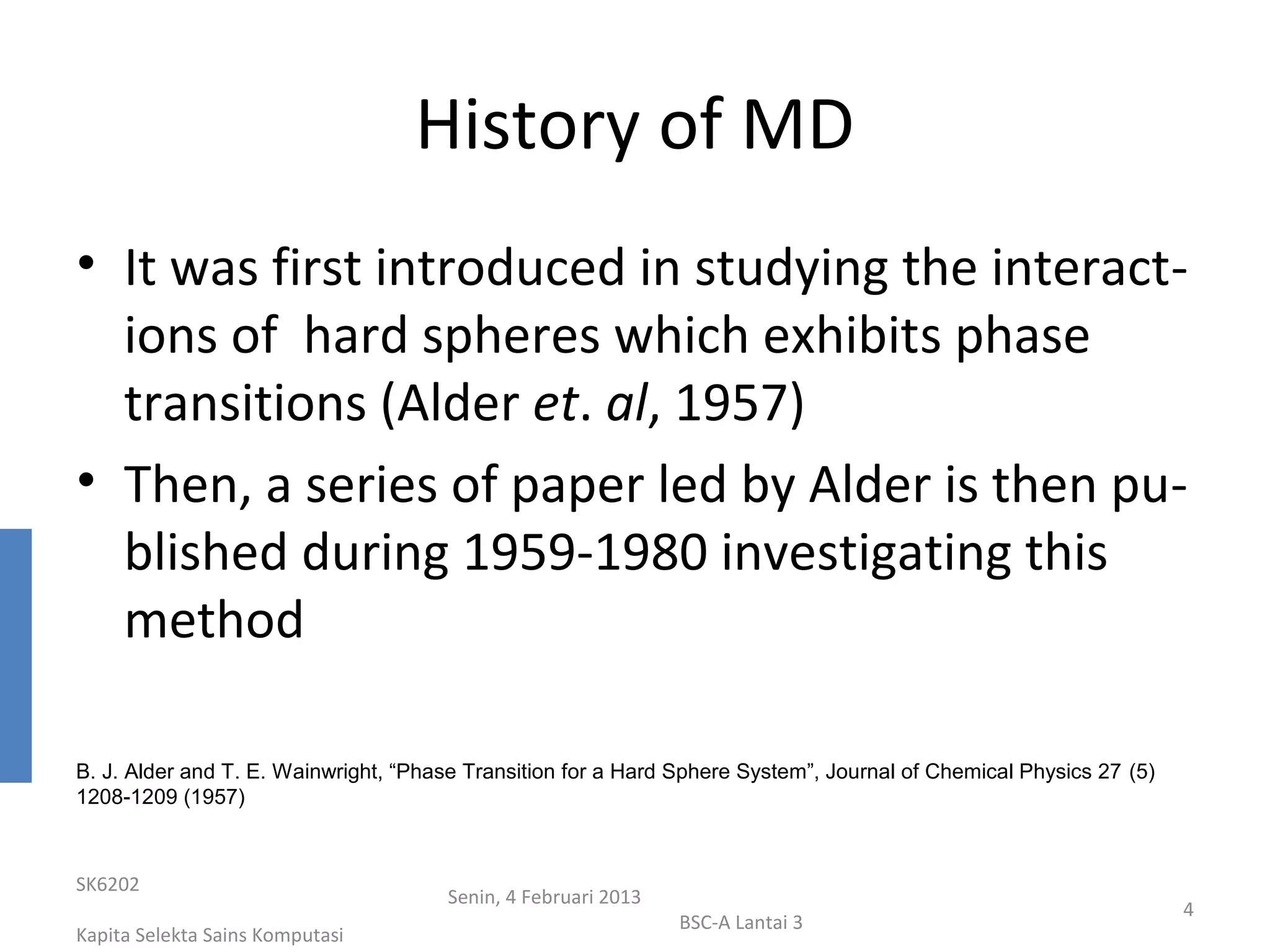
• It was first introduced in studying the interact-
  ions of hard spheres which exhibits phase
  transitions (Alder et. al, 1957)
• Then, a series of paper led by Alder is then pu-
  blished during 1959-1980 investigating this
  method

B. J. Alder and T. E. Wainwright, “Phase Transition for a Hard Sphere System”, Journal of Chemical Physics 27 (5)
1208-1209 (1957)


SK6202
                                      Senin, 4 Februari 2013
                                                                                                                    4
                                                               BSC-A Lantai 3
Kapita Selekta Sains Komputasi
History of MD (cont.)
• Studies of Alder and Wainwright in 1957 and
  1959 induced other studies concerning beha-
  ior of simple liquids
• Realistic potential for liquid argon is then used
  (Rahman, 1964)
• Simulation of realistic system is conducted for
  the first time for water (Stillinger et. al, 1974)
A. Rahman, “Correlations in the Motion of Atoms in Liquid Argon”, Physical Review 136 (2A), A405-A411 (1964)
F. H. Stillinger and A. Rahman, “Improved Simulation of Liquid Water by Molecular Dynamics”, Journal of Chemical
Physics 60 (4), 1545-1557 (1974)

SK6202
                                      Senin, 4 Februari 2013
                                                                                                                   5
                                                               BSC-A Lantai 3
Kapita Selekta Sains Komputasi
History of MD (cont.)
• The dynamics of folded of globular protein
  (bovine pancreatic trypsin inhibitor) is the first
  protein simulation (McCammon et. al, 1977)
• Many program and code are released, e.g.
  Chemistry HARvard Molecular Mechanics
  (CHARMM) (Stote et. al, 1999)

J. A. McCammon, B. R. Gelin, and M. Karplus, “Dynamics of Folded Proteins”, Nature 267 (5612) 585-590 (1977)
R. Stote, A. Dejaegere, D. Kuznetsov, and L. Falquet, “Theory of Molecular Dynamcis Simulation ” in Tutori@l
Molecular Dynamics Simulation CHARMM, URI http://www.ch .embnet.org/MD_tutorial /pages/MD.Part1. html
[2012.02.13]
SK6202
                                     Senin, 4 Februari 2013
                                                                                                               6
                                                              BSC-A Lantai 3
Kapita Selekta Sains Komputasi
Alder’s papers
• This series of papers published during 1959-
  1980, a lot of time of consistency of studying
  something
       – I. General Method (1959)
       – IV. Behavior of a Small Number of Elastic Spheres
         (1960)
       – III. A Mixture of Hard Spheres (1964)
       – IV. The Pressure, Collision Rate, and Their Number
         Dependence for Hard Disks (1967)
SK6202
                                  Senin, 4 Februari 2013
                                                                            7
                                                           BSC-A Lantai 3
Kapita Selekta Sains Komputasi
Alder’s papers (cont.)
       – V. High-Density Equation of State and Entropy for
         Hard Disks and Spheres
       – VI. Free-Path Distributions and Collision Rates for
         Hard-Sphere and Square-Well Molecules (1968)
       – VII. Hard-Sphere Distribution Functions and an
         Augmented van der Waals Theory (1969)
       – VIII. The Transport Coefficients for a Hard-Sphere
         Fluid (1970)
       – IX. Vacancies in Hard Sphere Crystals (1971)
SK6202
                                 Senin, 4 Februari 2013
                                                                           8
                                                          BSC-A Lantai 3
Kapita Selekta Sains Komputasi
Alder’s papers (cont.)
       – X. Corrections to the Augmented van der Waals
         Theory for the Square Well Fluid (1972)
       – XI. Correlation Functions of a Hard-Sphere Test
         Particle (1972)
       – XII. Band Shape of the Depolarized Light Scattered
         from Atomic Fluids (1973)
       – XIII. Singlet and Pair Distribution Functions for
         Hard-Disk and Hard-Sphere Solids (1974)


SK6202
                                 Senin, 4 Februari 2013
                                                                           9
                                                          BSC-A Lantai 3
Kapita Selekta Sains Komputasi
Alder’s papers (cont.)
       – XIV. Mass and Size Dependence of the Binary
         Diffusion Coefficient (1974)
       – XV. High Temperature Description of the
         Transport Coefficients (1975)
       – XVI. Fluctuation Driven Resonance (1977)
       – XVII. Phase diagrams for ’’step’’ potentials in two
         and three dimensions (1979)
       – XVIII. The square-well phase diagram (1980)


SK6202
                                 Senin, 4 Februari 2013
                                                                           10
                                                          BSC-A Lantai 3
Kapita Selekta Sains Komputasi
Introduction

    Molecular dynamics
    Definitions, use, and limitations


SK6202
                                 Senin, 4 Februari 2013
                                                                           11
                                                          BSC-A Lantai 3
Kapita Selekta Sains Komputasi
Molecular dynamics
• Molecular dynamics (MD) is a computer
  simulation of physical movements of atoms
  and molecules (Wikipedia, 2011)
• MD simulation consists of the numerical, step-
  by-step, solution of classical equation of
  motion (Allen, 2004)

Wikipedia contributors, “Molecular dynamics”, Wikipedia, The Free Encyclopedia, 5 September 2011, 15:49 UTC,
oldid:448597141 [2011.09.21]
M. P. Allen, “Introduction to Molecular Dynamics Simulation”, in Computational Soft Matter: From Synthetic Polymers
to Proteins, Lecture Notes, Norberg Attig, Kurt Binder, Helmut Grubmüller, Kurt Kremer (Eds.), John von Nuemann
Institut for Computing, Jülich, NIC Series, Vol. 23, pp. 1-28, 2004
SK6202
                                         Senin, 4 Februari 2013
                                                                                                                    12
                                                                   BSC-A Lantai 3
Kapita Selekta Sains Komputasi
Molecular dynamics (cont.)
• It is a computer simulation technique where
  the time evolution of a set of interacting
  atoms is followed by integrating their
  equations of motion (Ercolessi, 1997)
• MD simulations can provide the ultimate
  detail concerning individual motions as a
  function of time (Karplus et. al, 2002)
F. Ercolessi, “A Molecular Dynamics Primer”, Spring College in Computational Physics, ICTP, Trieste, 9/10/1997 URI
http://www.fisica.uniud.it/~ercolessi/md /md/node6.html [2011.09.21]
M. Karplus and J. A. McCammon, “Molecular Dynamics Simulations of Biomolecules”, Nature Structural Biology 9 (9),
646-653 (2002)
SK6202
                                      Senin, 4 Februari 2013
                                                                                                                 13
                                                               BSC-A Lantai 3
Kapita Selekta Sains Komputasi
Range of use
• It is used from atomic until planetoid scale
• Calculation of electronic ground state as
  function of time of liquid metal (Kresse et. al,
  1993)
• Motion of n-Alkanes molecules (Ryckaert et.
  al, 1977)

G. Kresse and J. Hafner, “Ab Initio Molecular Dynamics for Liquid Metals”, Physical Review B 47 (1), 558-561 (1993)
J. P. Ryckaert, G. Ciccotti, and H. J. C. Berendsen, “Numerical Integration of the Cartesian Equations of Motion of a
System with Constraints: Molecular Dynamics of n-Alkanes”, Journal of Computational Physics 23 (3), 327-341 (1977)

SK6202
                                       Senin, 4 Februari 2013
                                                                                                                   14
                                                                BSC-A Lantai 3
Kapita Selekta Sains Komputasi
Range of use (cont.)
• Nanodroplet on a surface (Sedighi et. al, 2010)
• Grains in mm and cm size (Gallas et. al, 1996)
• Simulation of asteroids movement (Jaffé et. al,
  2002)


N, Sedighi, S. Murad, and S. K. Aggarwal, “Molecular Dynamics Simulations of Nanodroplet Spreading on Solid
Surfaces, Effect of Droplet Size”, Fluid Dynamics Research 42 (3), 035501 (2010)
J. A. C. Gallas, H. J. Herrmann, T. Pöschel, and Stefan Sokolowski, “Molecular Dynamics Simulation of Size
Segregation in Three Dimensions”, Journal of Statistical Physics 82 (1-2), 443-450 (1996)
C. Jaffé, S. D. Ross, M. W. Lo, J. Marsden, D. Farrelly, and T. Uzer, “Statistical Theory of Asteroid Escape Rates”,
SK6202
Physical Review Letters 89 (1), 011101 Senin, 4 Februari 2013
                                          (2002)
                                                                                                                       15
                                                                 BSC-A Lantai 3
Kapita Selekta Sains Komputasi
Use of MD
• There are three main scenarios for the use of
  MD (Fedman, 2006)
• In the first scenario the simulated properties
  are compared with experimental results, and
  when the two agree it is reasonable to claim
  that the experimental results can be explained
  by the simulation model.
F. Hedman, “Algorithms for Molecular Dynamics Simulations: Advancing the Computational Horizon”, Ph.D. Thesis,
Avdelningen för fysikalisk kemi, Arrheniuslaboratoriet, Stockholms Universitet, Stockholm, 2006


SK6202
                                     Senin, 4 Februari 2013
                                                                                                                 16
                                                              BSC-A Lantai 3
Kapita Selekta Sains Komputasi
Use of MD (cont.)
• In the second scenario, MD simulations are
  used to interpret experimental results. In a
  sense the second scenario is the inverse of the
  first.
• In the third scenario, simulations are used as
  an exploratory tool to help gain an initial
  understanding of a problem and give guidance
  among possible lines of investigation, be it
  theoretical or experimental.
SK6202
                                   Senin, 4 Februari 2013
                                                                             17
                                                            BSC-A Lantai 3
Kapita Selekta Sains Komputasi
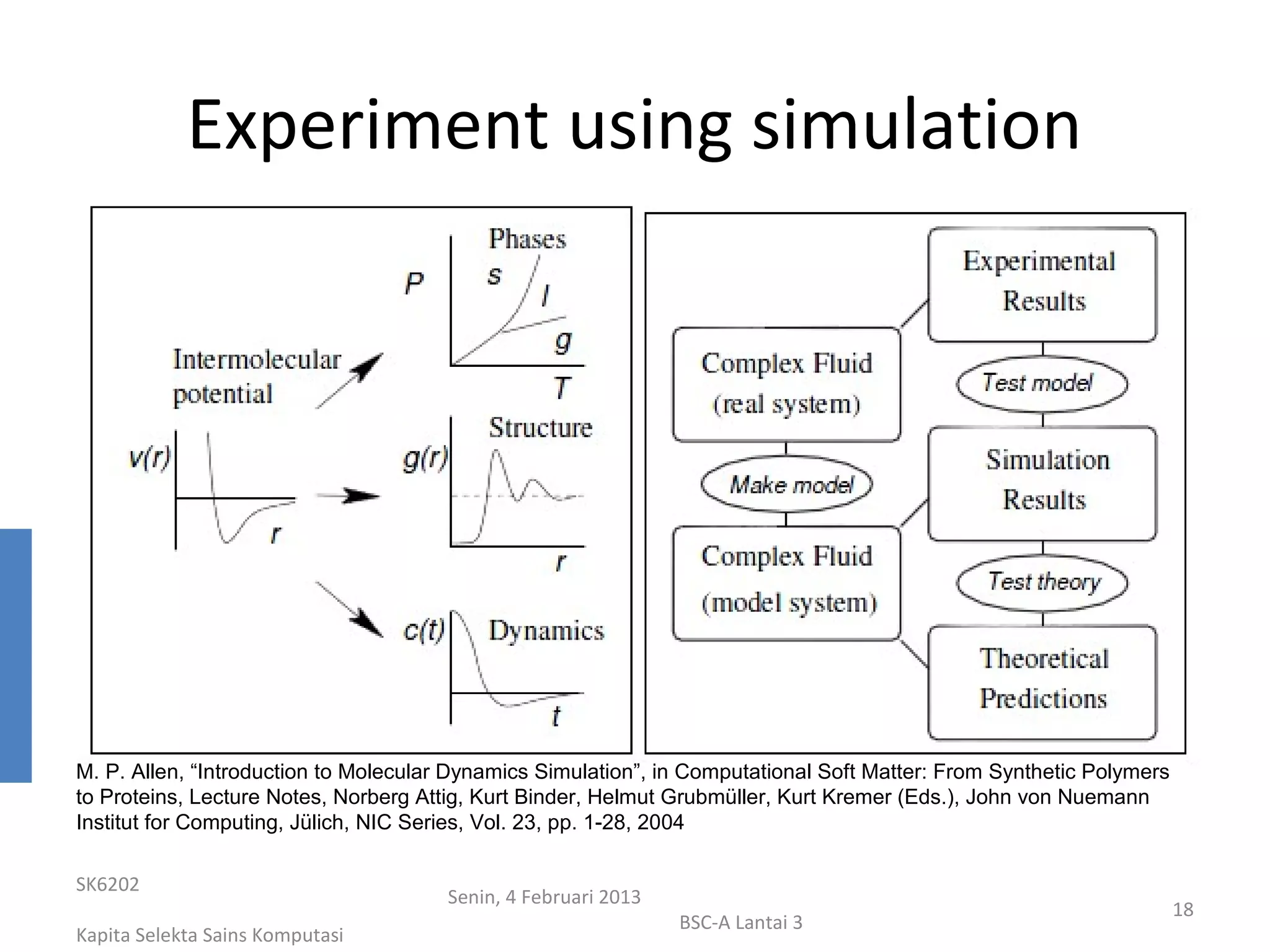
Experiment using simulation


M. P. Allen, “Introduction to Molecular Dynamics Simulation”, in Computational Soft Matter: From Synthetic Polymers
to Proteins, Lecture Notes, Norberg Attig, Kurt Binder, Helmut Grubmüller, Kurt Kremer (Eds.), John von Nuemann
Institut for Computing, Jülich, NIC Series, Vol. 23, pp. 1-28, 2004

SK6202
                                       Senin, 4 Februari 2013
                                                                                                                      18
                                                                BSC-A Lantai 3
Kapita Selekta Sains Komputasi
Experiment .. simulation (cont.)
• It is a bridge between microscopic and
  macroscopic
• It is also a bridge between theory and
  experiment
• Do the experiment using simulation is a smart
  way to reduce the financial problem
• Even all considered nature laws are input to
  the system, it could give the unexpected
SK6202
                                 Senin, 4 Februari 2013
                                                                           19
                                                          BSC-A Lantai 3
Kapita Selekta Sains Komputasi
Is MD so perfect?
• Unfortunately not
• It has problem even all forces are already
  considered
• It can produce unreported results or
  unexpected (wrong) results
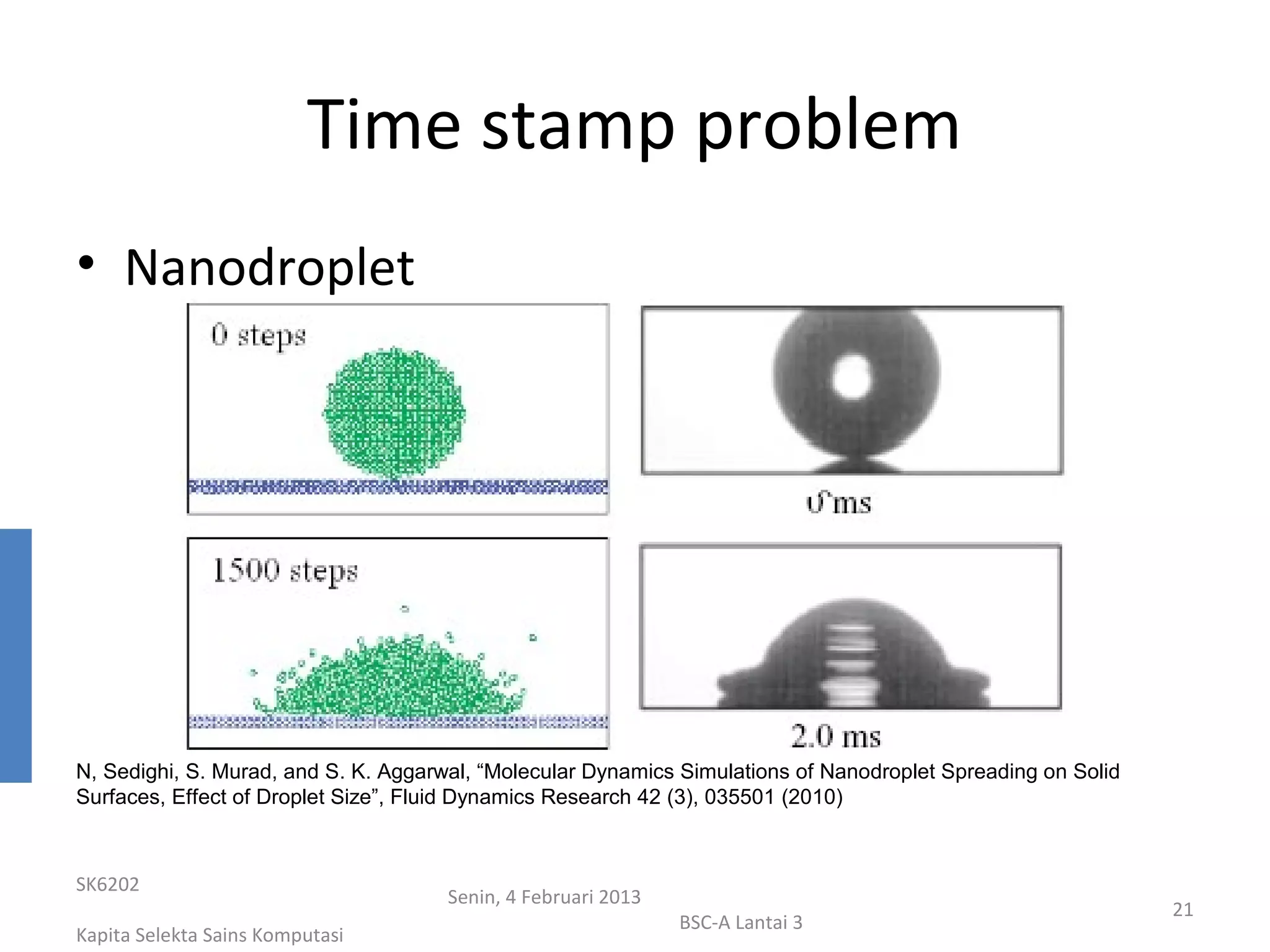
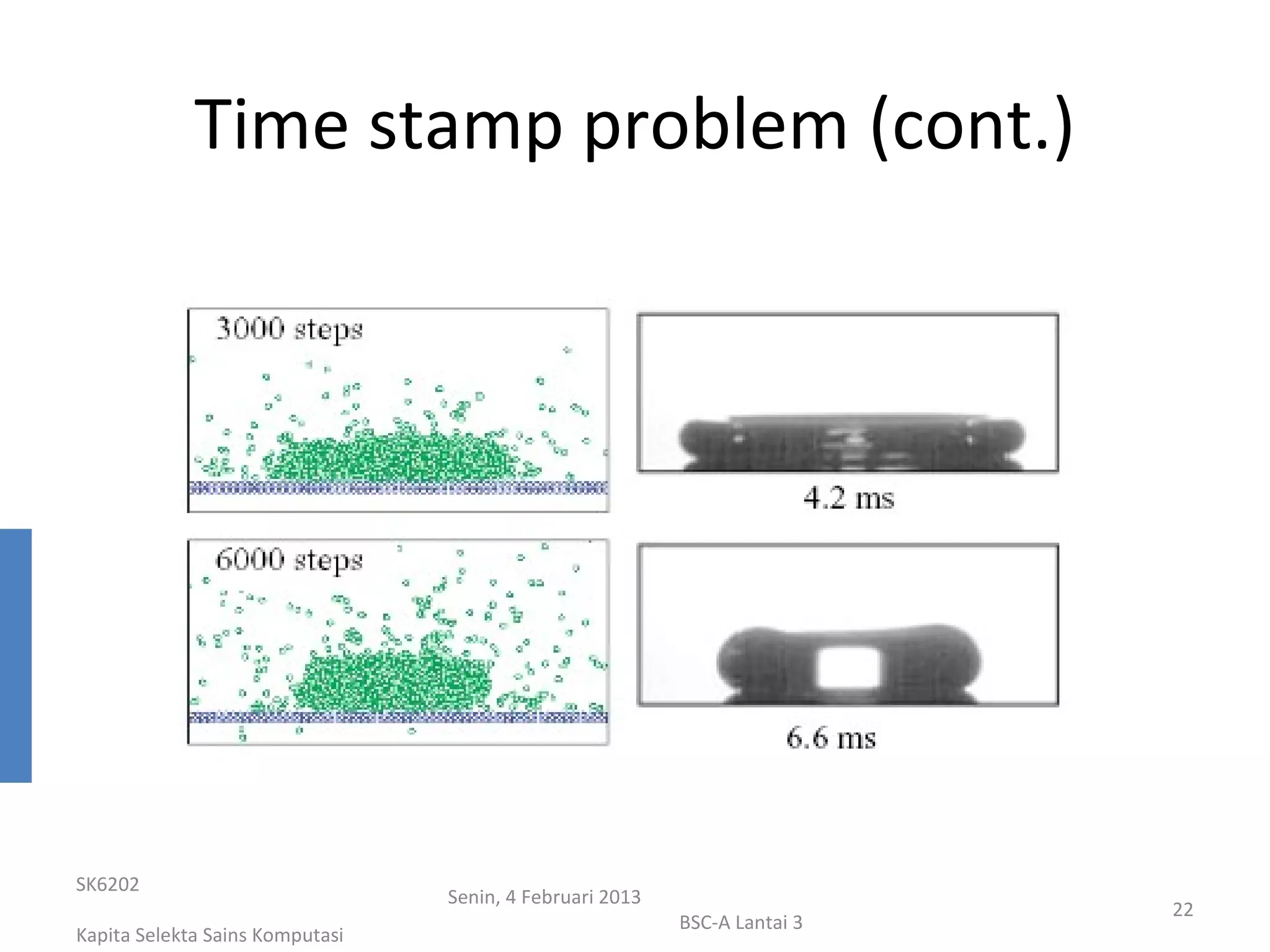
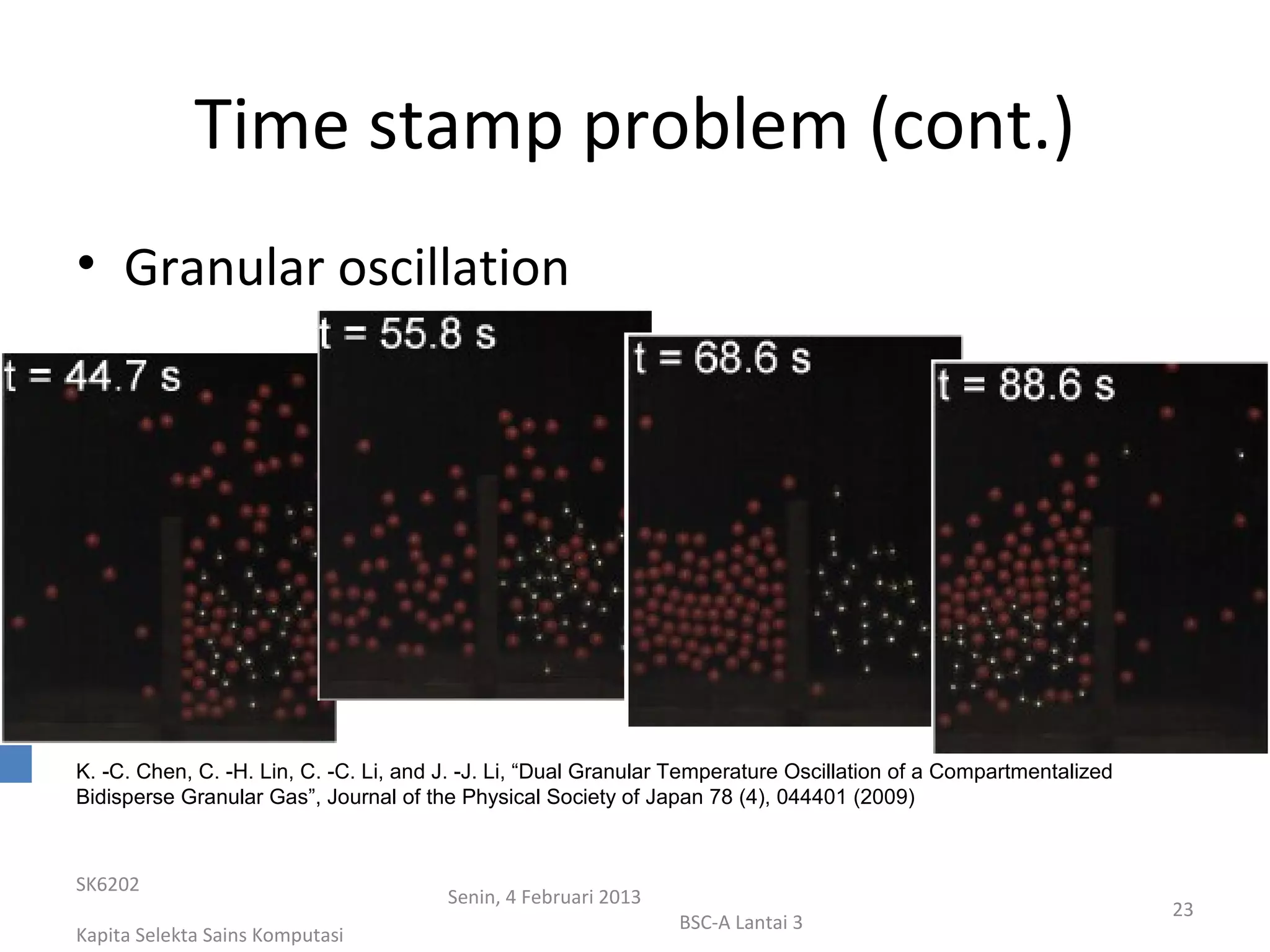
• It has problem in time stamp


SK6202
                                   Senin, 4 Februari 2013
                                                                             20
                                                            BSC-A Lantai 3
Kapita Selekta Sains Komputasi
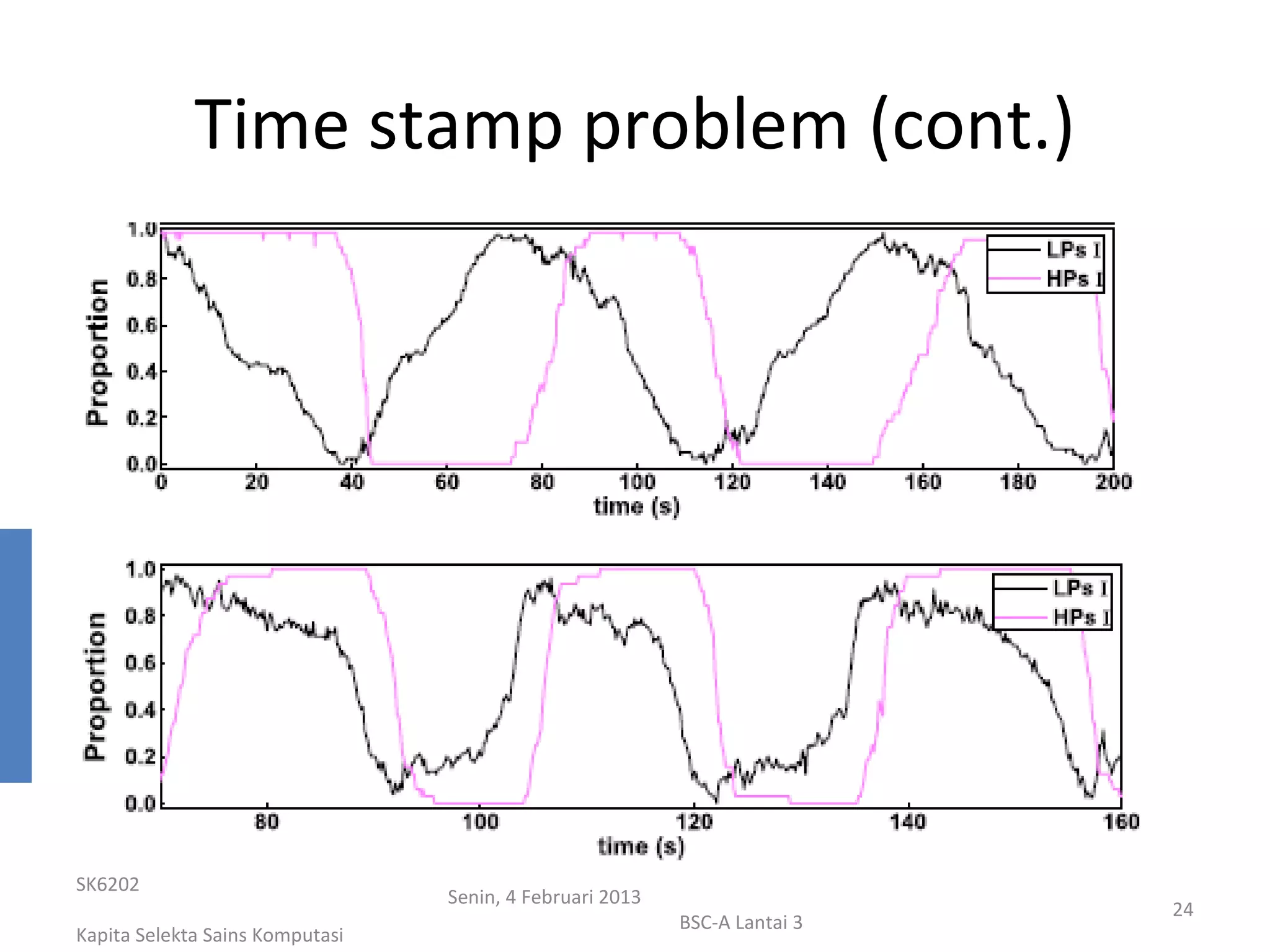
Time stamp problem
• Nanodroplet


N, Sedighi, S. Murad, and S. K. Aggarwal, “Molecular Dynamics Simulations of Nanodroplet Spreading on Solid
Surfaces, Effect of Droplet Size”, Fluid Dynamics Research 42 (3), 035501 (2010)


SK6202
                                      Senin, 4 Februari 2013
                                                                                                              21
                                                               BSC-A Lantai 3
Kapita Selekta Sains Komputasi
Time stamp problem (cont.)


SK6202
                                 Senin, 4 Februari 2013
                                                                           22
                                                          BSC-A Lantai 3
Kapita Selekta Sains Komputasi
Time stamp problem (cont.)
• Granular oscillation


K. -C. Chen, C. -H. Lin, C. -C. Li, and J. -J. Li, “Dual Granular Temperature Oscillation of a Compartmentalized
Bidisperse Granular Gas”, Journal of the Physical Society of Japan 78 (4), 044401 (2009)


SK6202
                                        Senin, 4 Februari 2013
                                                                                                                   23
                                                                 BSC-A Lantai 3
Kapita Selekta Sains Komputasi
Time stamp problem (cont.)


SK6202
                                 Senin, 4 Februari 2013
                                                                           24
                                                          BSC-A Lantai 3
Kapita Selekta Sains Komputasi
MD Algorithm

    Trajectory of a particle
    Potentials, the forms, and their physical meaning


SK6202
                                 Senin, 4 Februari 2013
                                                                           25
                                                          BSC-A Lantai 3
Kapita Selekta Sains Komputasi
Algorithms
• It is uses Newton’s second law of motion to
  get the acceleration a
• It using numerical integration to get the
  equation of motion, use the simple method
  i.e. original Euler method
• New motion parameters will cause new value
  of all forces
• Calculate the new forces to get new a
SK6202
                                 Senin, 4 Februari 2013
                                                                           26
                                                          BSC-A Lantai 3
Kapita Selekta Sains Komputasi
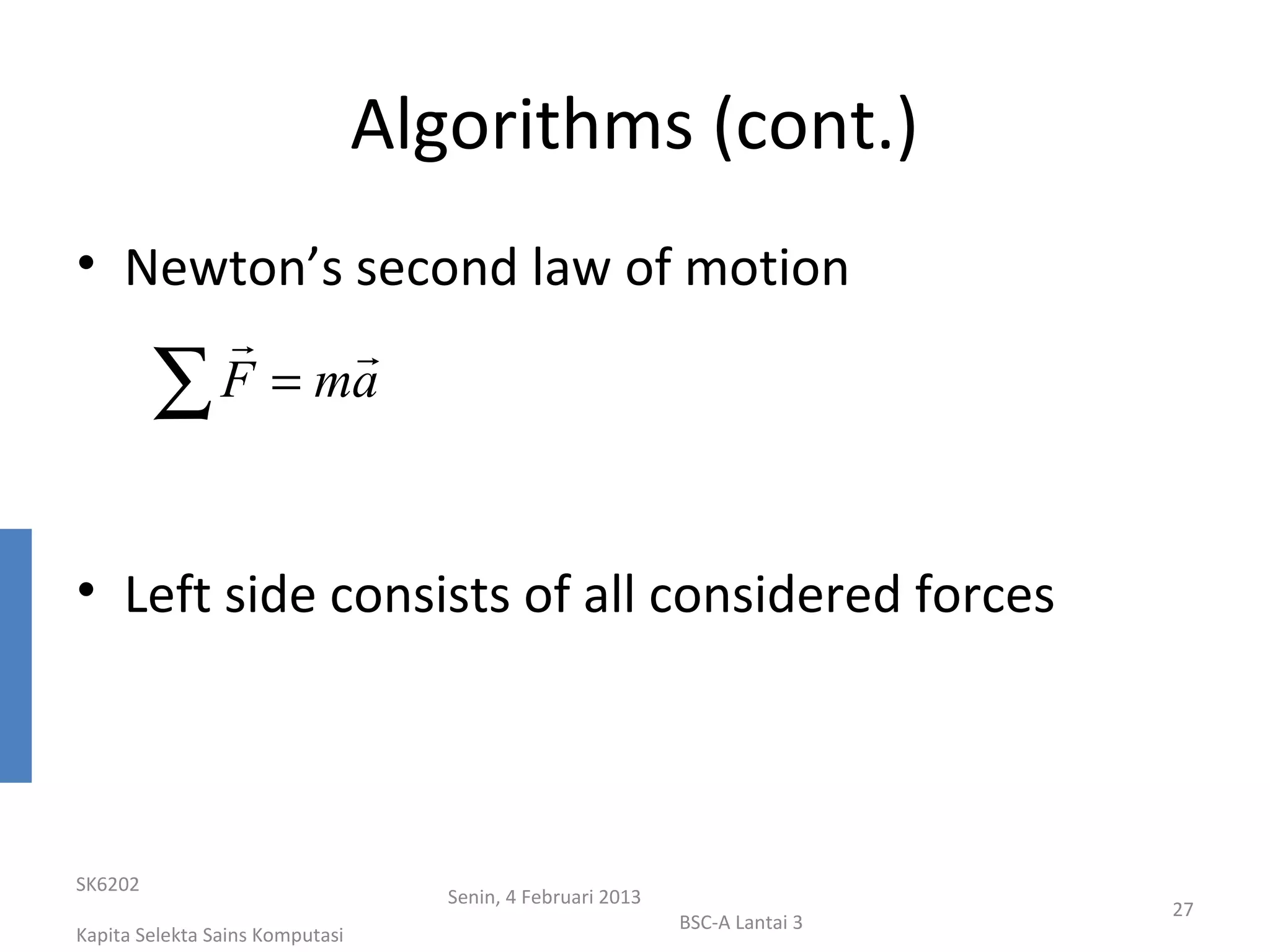
Algorithms (cont.)
• Newton’s second law of motion
                    
         ∑      F = ma


• Left side consists of all considered forces


SK6202
                                    Senin, 4 Februari 2013
                                                                              27
                                                             BSC-A Lantai 3
Kapita Selekta Sains Komputasi
Algorithms (cont.)
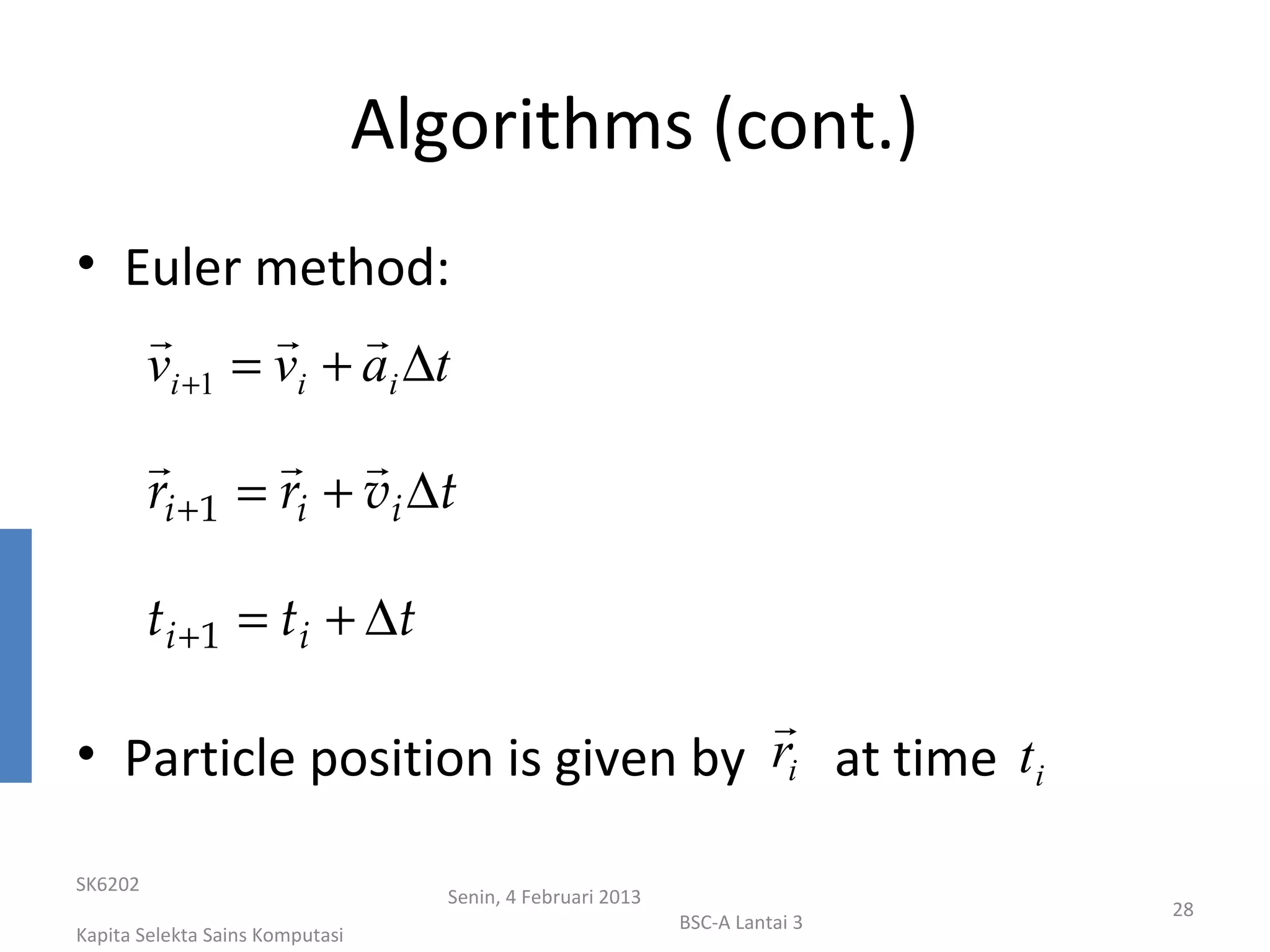
• Euler method:
                 
         vi +1 = vi + ai ∆t
                  
         ri + 1 = ri + vi ∆t

         t i +1 = t i + ∆t
                                
• Particle position is given by ri at time t i

SK6202
                                    Senin, 4 Februari 2013
                                                                              28
                                                             BSC-A Lantai 3
Kapita Selekta Sains Komputasi
Algorithms (cont.)
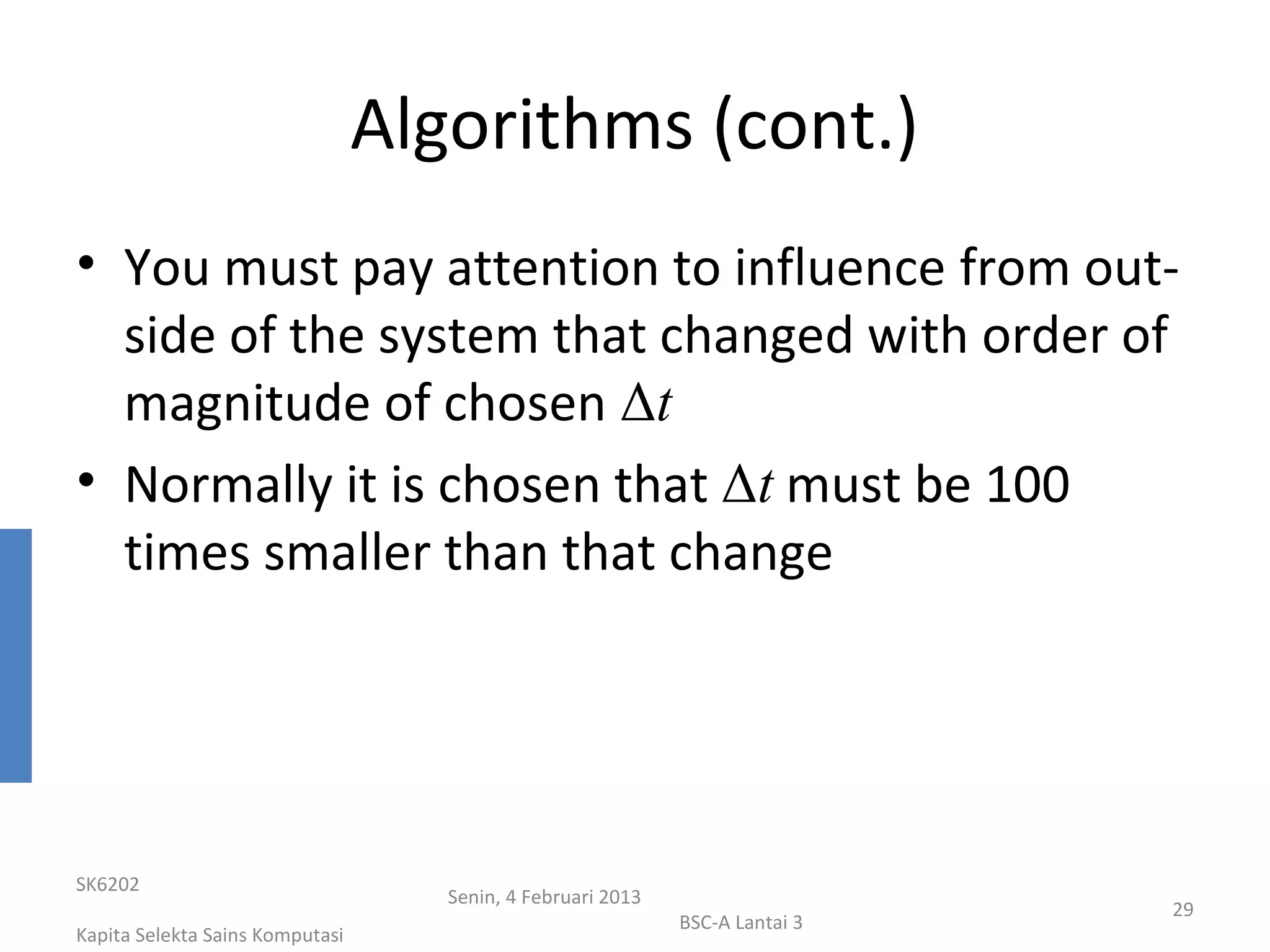
• You must pay attention to influence from out-
  side of the system that changed with order of
  magnitude of chosen Δt
• Normally it is chosen that Δt must be 100
  times smaller than that change


SK6202
                                    Senin, 4 Februari 2013
                                                                              29
                                                             BSC-A Lantai 3
Kapita Selekta Sains Komputasi
Potentials
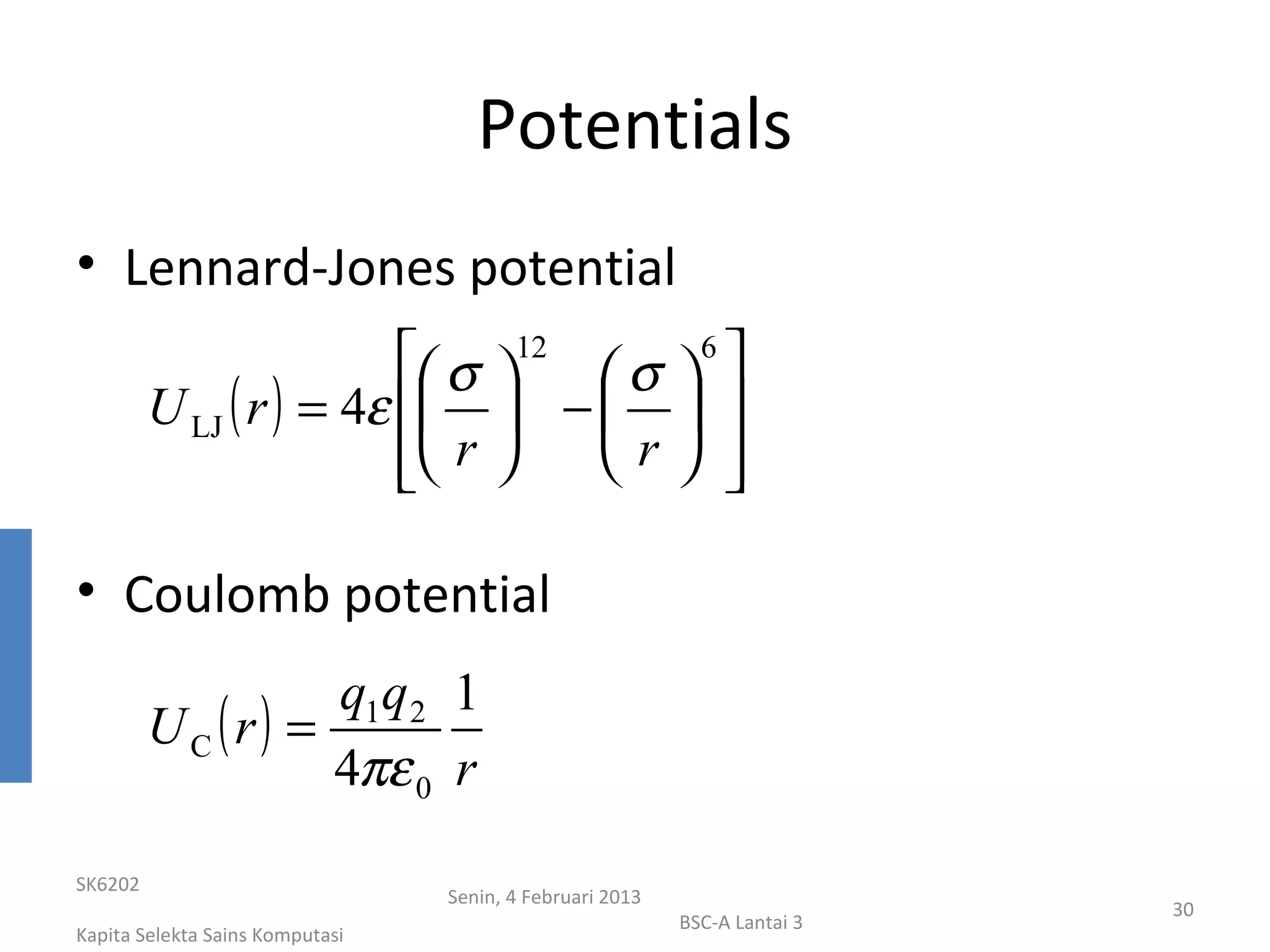
• Lennard-Jones potential
                          σ 12  σ  6 
         U LJ ( r ) = 4ε   −   
                          r 
                                 r    

• Coulomb potential
                  q1q 2 1
         UC (r) =
                  4πε 0 r
SK6202
                                 Senin, 4 Februari 2013
                                                                           30
                                                          BSC-A Lantai 3
Kapita Selekta Sains Komputasi
Potentials (cont.)
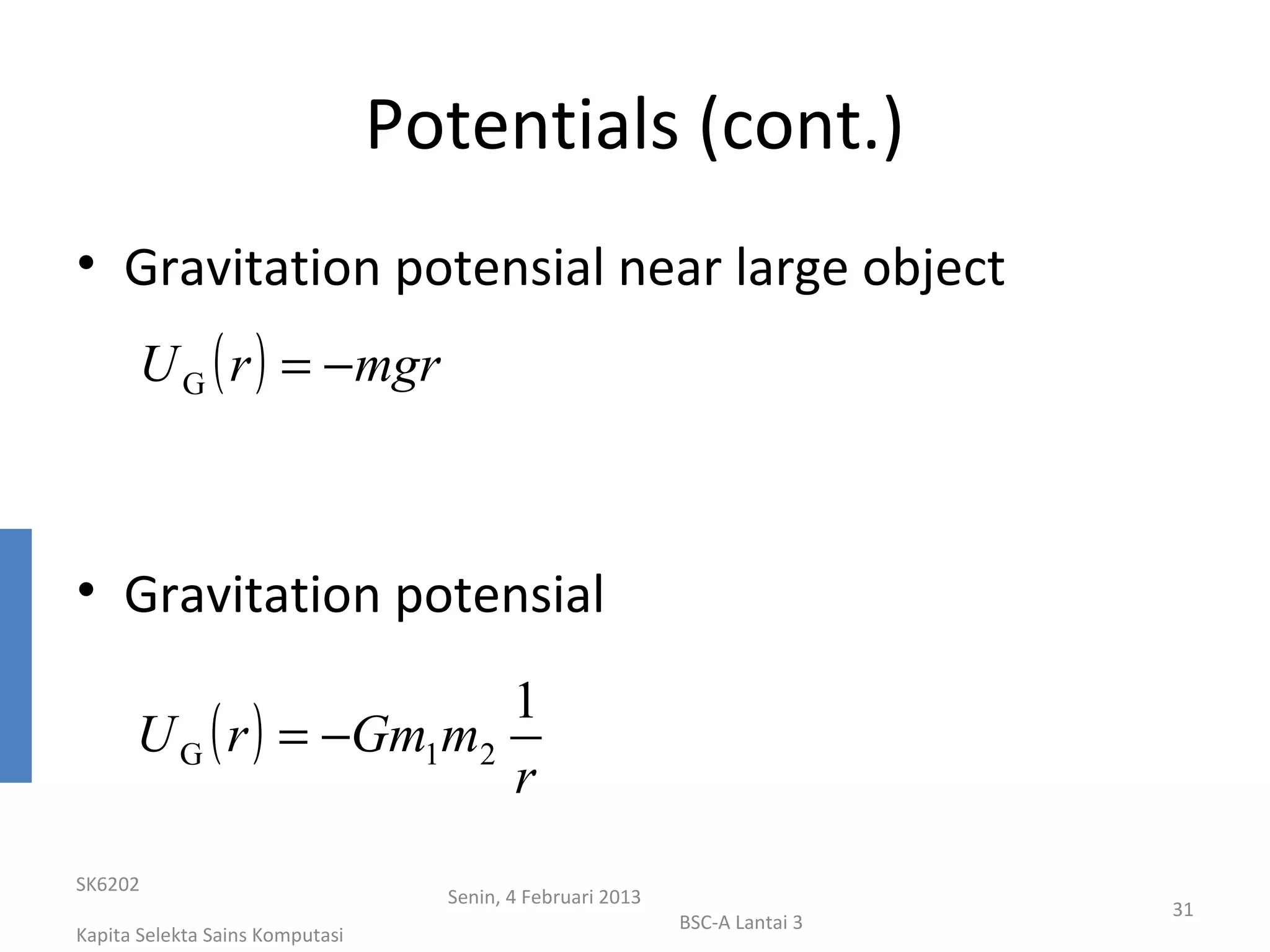
• Gravitation potensial near large object
       U G ( r ) = −mgr


• Gravitation potensial
                         1
      U G ( r ) = −Gm1m2
                         r
SK6202
                                   Senin, 4 Februari 2013
                                                                             31
                                                            BSC-A Lantai 3
Kapita Selekta Sains Komputasi
Potentials (cont.)
• Morse potential

         U M ( r ) = De 1 − e    [                        ]
                                              −α ( r − re ) 2


• Yukawa potential
                                         − kmr
                                     e
         U Y ( r) = −g           2

                                          r
SK6202
                                     Senin, 4 Februari 2013
                                                                                 32
                                                                BSC-A Lantai 3
Kapita Selekta Sains Komputasi
Potentials (cont.)
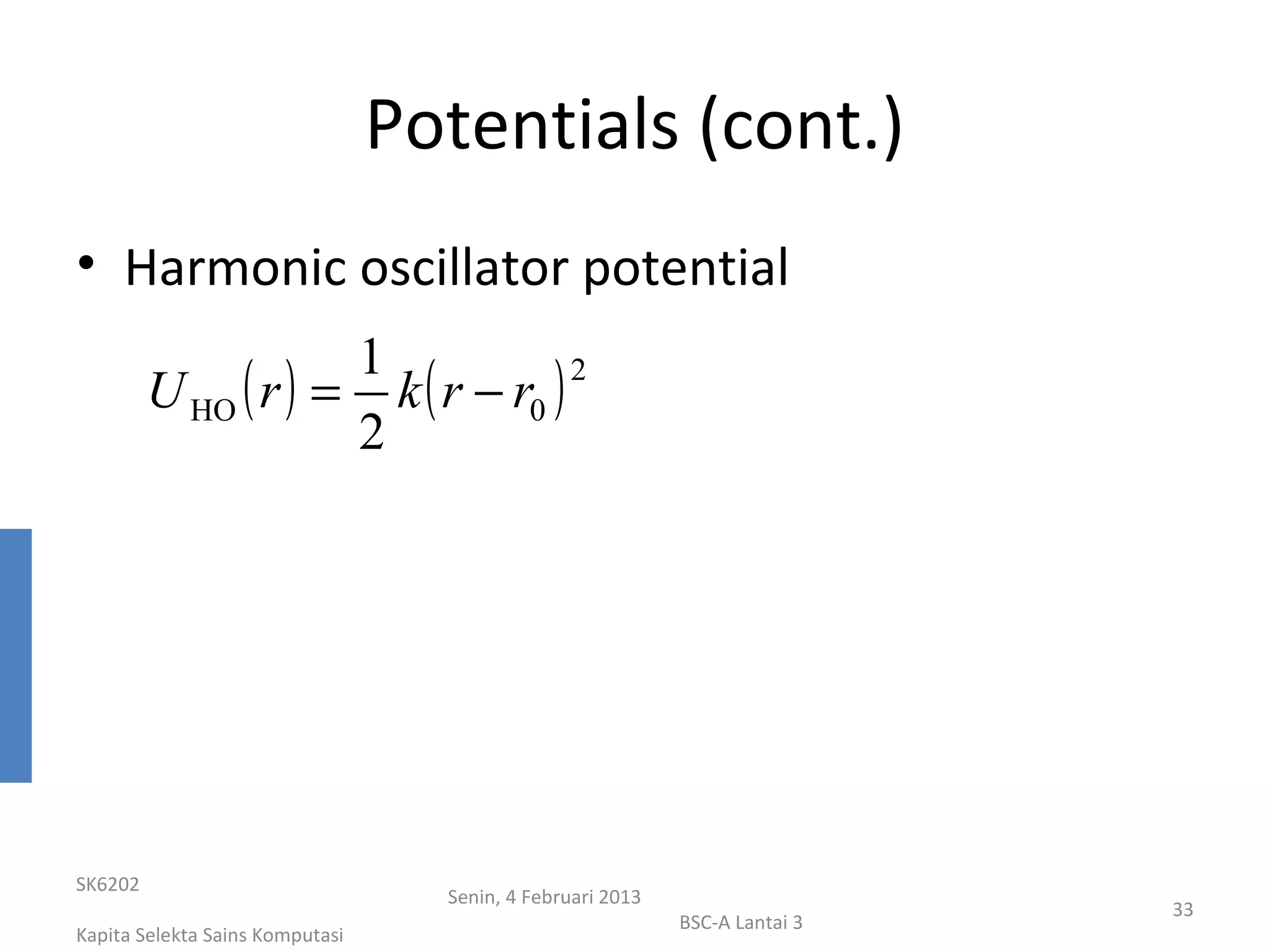
• Harmonic oscillator potential
                     1
         U HO ( r ) = k ( r − r0 )
                                   2

                     2


SK6202
                                   Senin, 4 Februari 2013
                                                                             33
                                                            BSC-A Lantai 3
Kapita Selekta Sains Komputasi
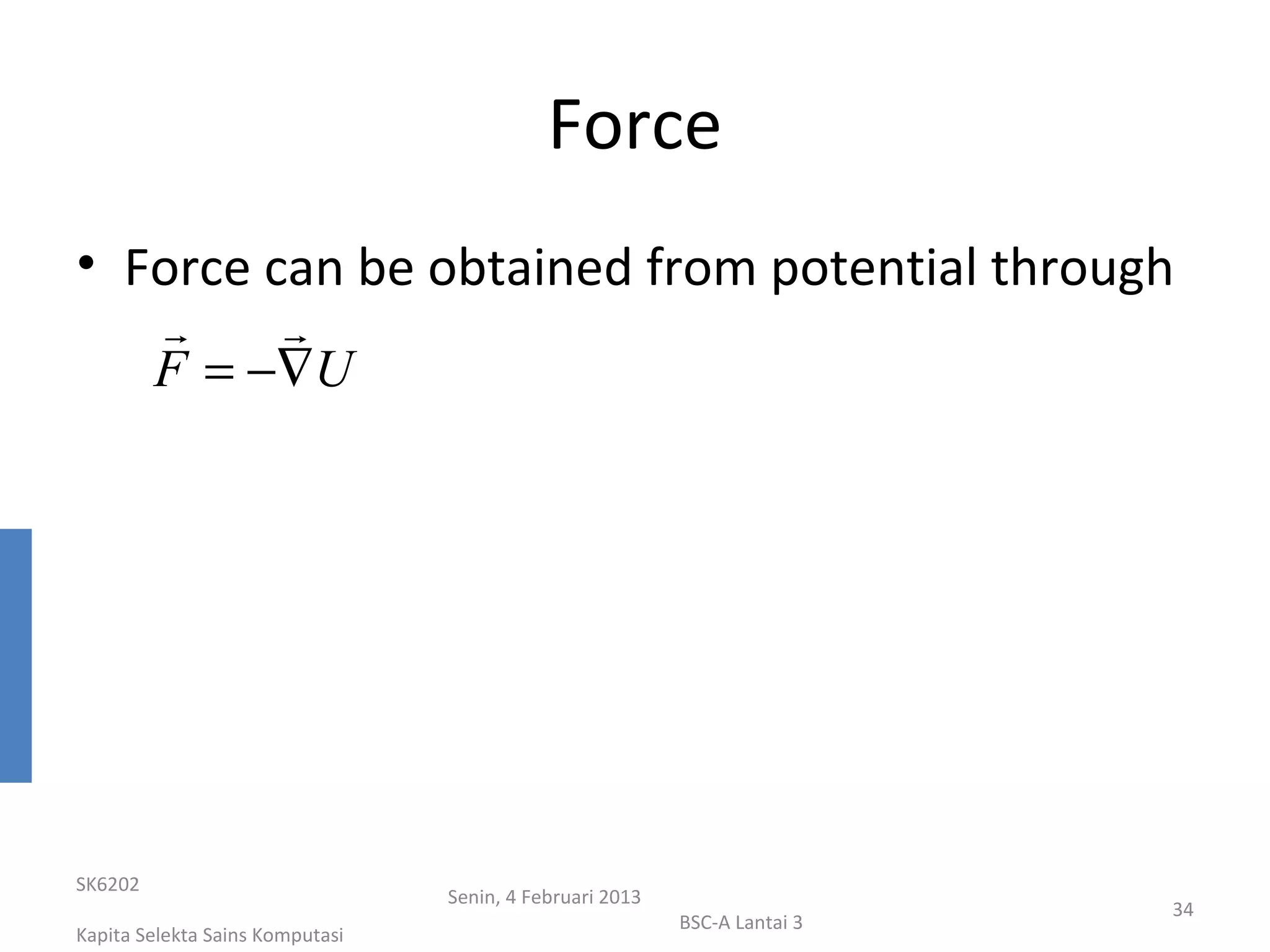
Force
• Force can be obtained from potential through
             
         F = −∇U


SK6202
                                 Senin, 4 Februari 2013
                                                                           34
                                                          BSC-A Lantai 3
Kapita Selekta Sains Komputasi
Granular memory device

    Example
    Sequence of particle under gravitation potential


SK6202
                                 Senin, 4 Februari 2013
                                                                           35
                                                          BSC-A Lantai 3
Kapita Selekta Sains Komputasi
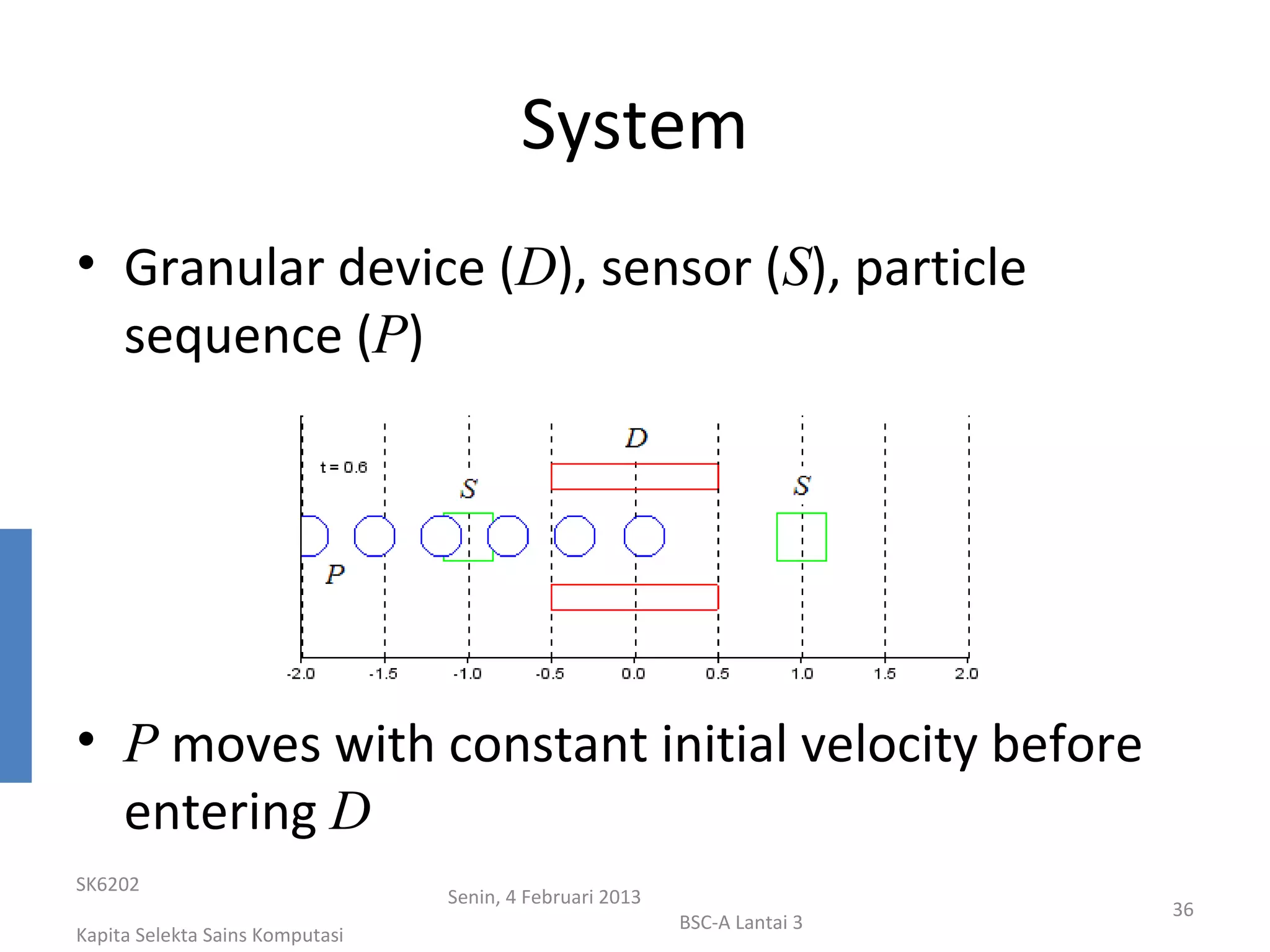
System
• Granular device (D), sensor (S), particle
  sequence (P)


• P moves with constant initial velocity before
  entering D
SK6202
                                 Senin, 4 Februari 2013
                                                                           36
                                                          BSC-A Lantai 3
Kapita Selekta Sains Komputasi
Typical states
• Observed states are:
       – s10w0r0 (two configurations)
       – s10w1r0
       – s10w1r1


SK6202
                                 Senin, 4 Februari 2013
                                                                           37
                                                          BSC-A Lantai 3
Kapita Selekta Sains Komputasi
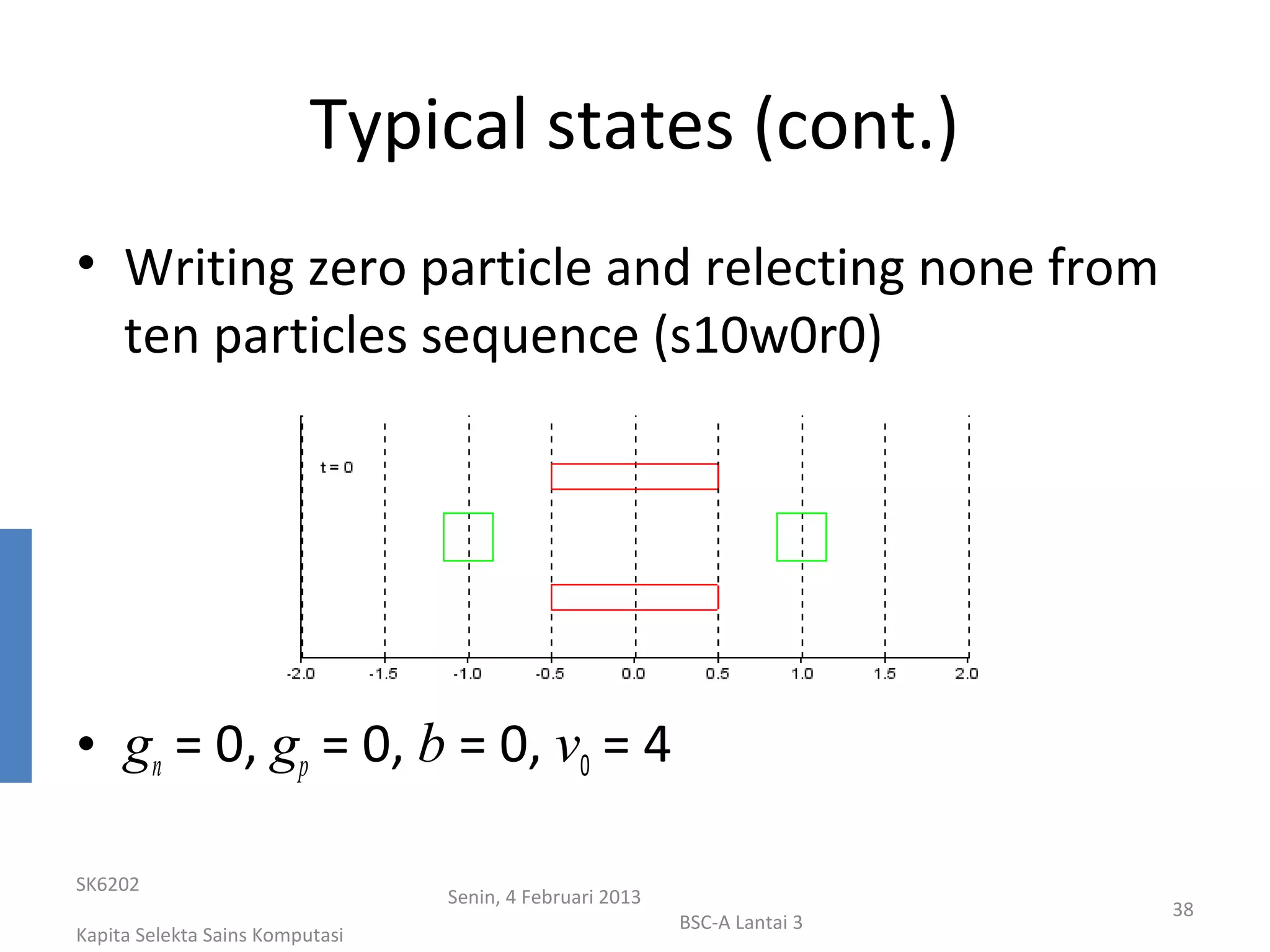
Typical states (cont.)
• Writing zero particle and relecting none from
  ten particles sequence (s10w0r0)


• gn = 0, gp = 0, b = 0, v0 = 4

SK6202
                                 Senin, 4 Februari 2013
                                                                           38
                                                          BSC-A Lantai 3
Kapita Selekta Sains Komputasi
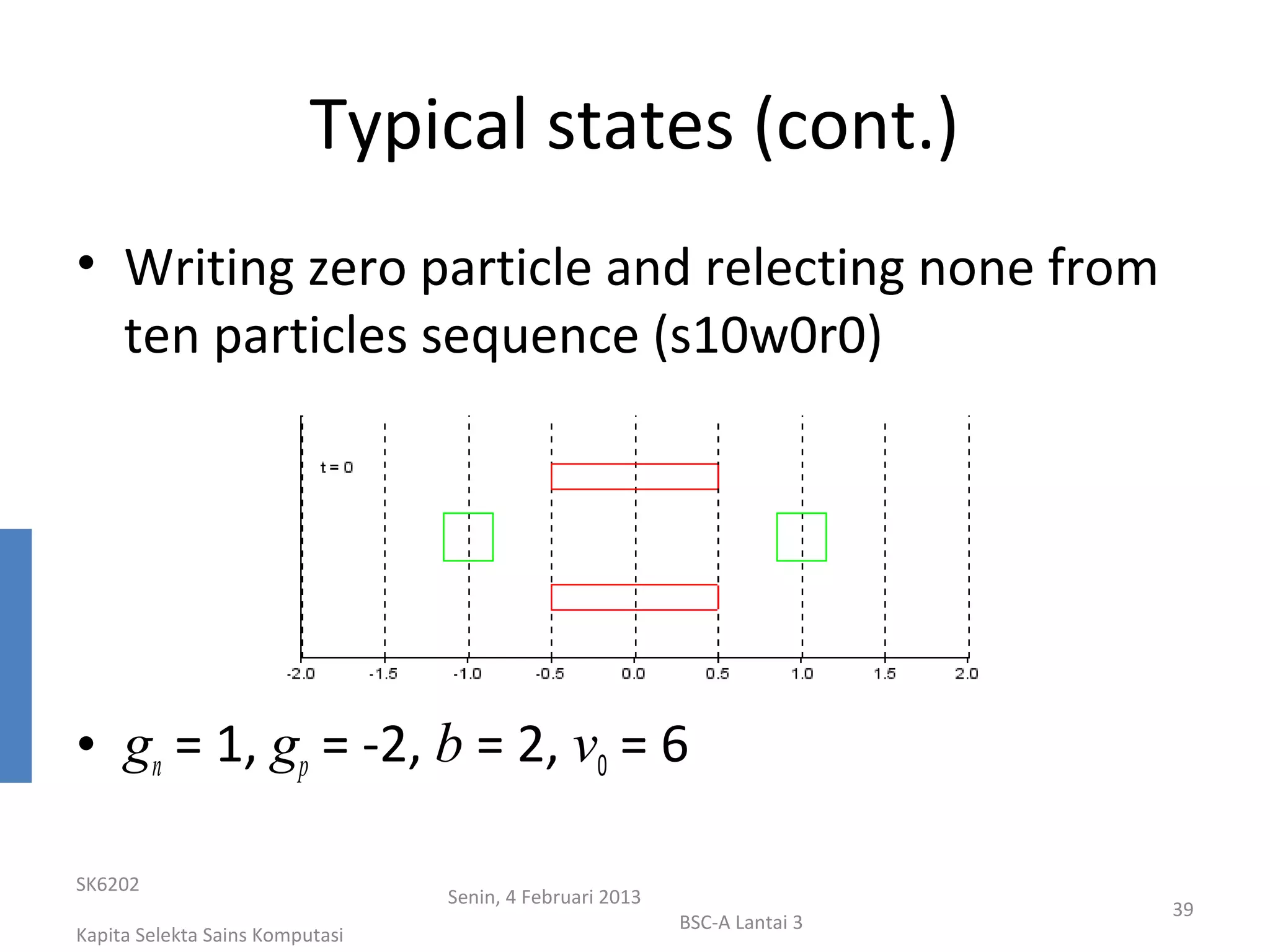
Typical states (cont.)
• Writing zero particle and relecting none from
  ten particles sequence (s10w0r0)


• gn = 1, gp = -2, b = 2, v0 = 6

SK6202
                                 Senin, 4 Februari 2013
                                                                           39
                                                          BSC-A Lantai 3
Kapita Selekta Sains Komputasi
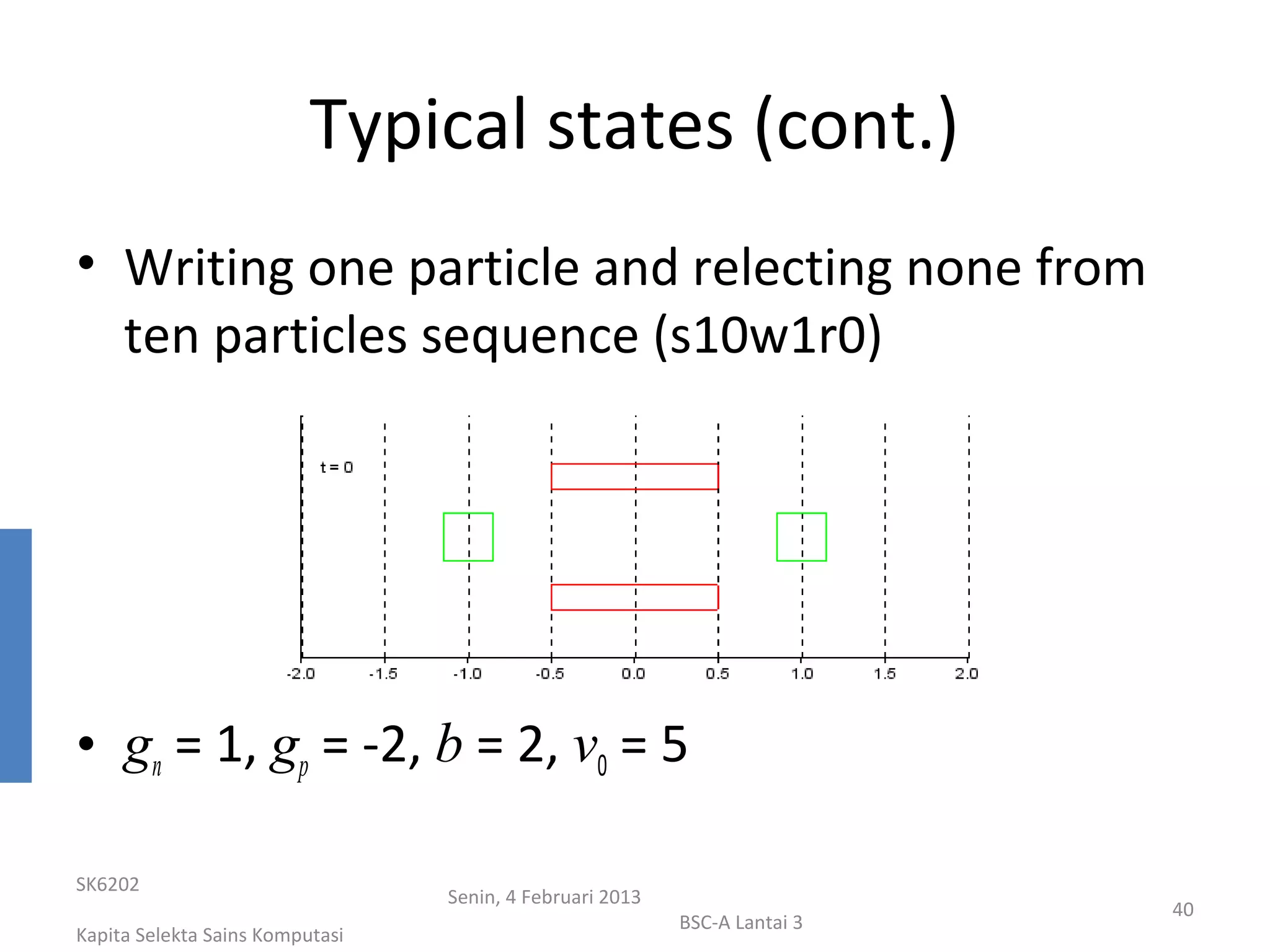
Typical states (cont.)
• Writing one particle and relecting none from
  ten particles sequence (s10w1r0)


• gn = 1, gp = -2, b = 2, v0 = 5

SK6202
                                 Senin, 4 Februari 2013
                                                                           40
                                                          BSC-A Lantai 3
Kapita Selekta Sains Komputasi
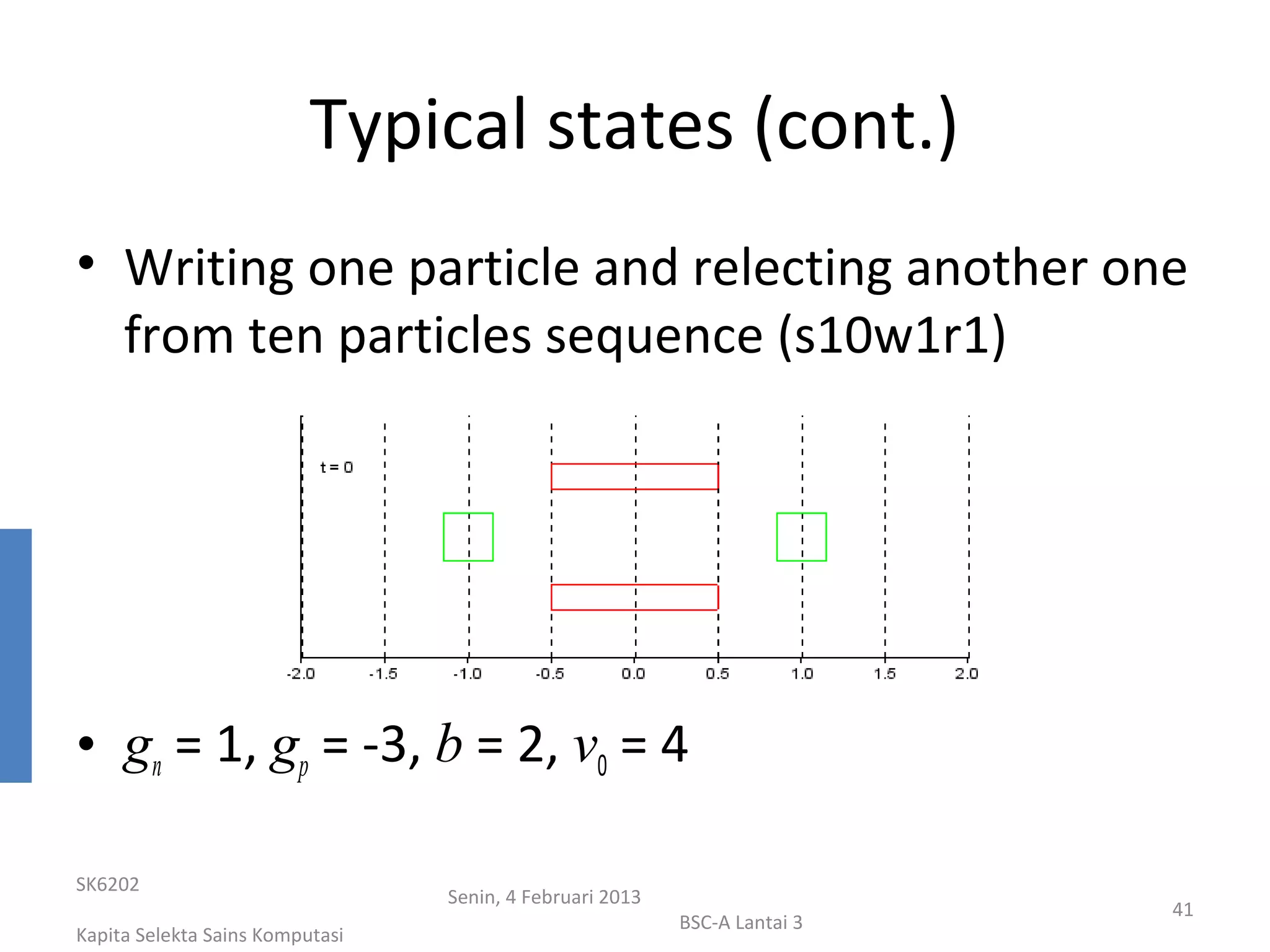
Typical states (cont.)
• Writing one particle and relecting another one
  from ten particles sequence (s10w1r1)


• gn = 1, gp = -3, b = 2, v0 = 4

SK6202
                                 Senin, 4 Februari 2013
                                                                           41
                                                          BSC-A Lantai 3
Kapita Selekta Sains Komputasi
Assignments

SK6202
                                 Senin, 4 Februari 2013
                                                                           42
                                                          BSC-A Lantai 3
Kapita Selekta Sains Komputasi
Assignments
• Make six groups of 2-3 students
• Each group collects only one answer file
• Answer file should be sent to
  dudung@gmail.com with subject [SK6202] MD
  Assignment 1
• The file sould be received before 11 February
  2013

SK6202
                                 Senin, 4 Februari 2013
                                                                           43
                                                          BSC-A Lantai 3
Kapita Selekta Sains Komputasi
Assignments (cont.)
• Question 1. Derive force formulation for
  following potential:
  (a) harmonic oscillator,
  (b) Coulomb,
  (c) gravitation,
  (d) Lennard-Jones,
  (e) Morse,
  (f) Yukawa
SK6202
                                 Senin, 4 Februari 2013
                                                                           44
                                                          BSC-A Lantai 3
Kapita Selekta Sains Komputasi
Assignments (cont.)
• Question 2. Describe the physical meaning of
  parameters used in each force or potential
  formulation
• Question 3. Tell the difference between
  molecular dynamics and molecular mechanics
• Question 4. Find the Euler, Verlet, Gear pre-
  dictor-corrector, Rattle, and Shake algorithm
• Question 5. Find a topic to be solved using
  molecular dynamics and explain
SK6202
                                 Senin, 4 Februari 2013
                                                                           45
                                                          BSC-A Lantai 3
Kapita Selekta Sains Komputasi
Thank you


SK6202
                                 Senin, 4 Februari 2013
                                                                           46
                                                          BSC-A Lantai 3
Kapita Selekta Sains Komputasi

Molecular Dynamics

  • 1.
    Molecular Dynamics (Part1) Sparisoma Viridi* Nuclear Physics and Biophysics Research Division Institut Teknologi Bandung, Jalan Ganesha 10, Bandung 40132, Indonesia *dudung@gmail.com SK6202 Senin, 4 Februari 2013 1 BSC-A Lantai 3 Kapita Selekta Sains Komputasi
  • 2.
    Outline • Short history of molecular dynamics (MD) • Introduction to MD • MD Algorithm • Example • Assignments SK6202 Senin, 4 Februari 2013 2 BSC-A Lantai 3 Kapita Selekta Sains Komputasi
  • 3.
    Short history Molecular dynamics Contribution from some works SK6202 Senin, 4 Februari 2013 3 BSC-A Lantai 3 Kapita Selekta Sains Komputasi
  • 4.
    History of MD •It was first introduced in studying the interact- ions of hard spheres which exhibits phase transitions (Alder et. al, 1957) • Then, a series of paper led by Alder is then pu- blished during 1959-1980 investigating this method B. J. Alder and T. E. Wainwright, “Phase Transition for a Hard Sphere System”, Journal of Chemical Physics 27 (5) 1208-1209 (1957) SK6202 Senin, 4 Februari 2013 4 BSC-A Lantai 3 Kapita Selekta Sains Komputasi
  • 5.
    History of MD(cont.) • Studies of Alder and Wainwright in 1957 and 1959 induced other studies concerning beha- ior of simple liquids • Realistic potential for liquid argon is then used (Rahman, 1964) • Simulation of realistic system is conducted for the first time for water (Stillinger et. al, 1974) A. Rahman, “Correlations in the Motion of Atoms in Liquid Argon”, Physical Review 136 (2A), A405-A411 (1964) F. H. Stillinger and A. Rahman, “Improved Simulation of Liquid Water by Molecular Dynamics”, Journal of Chemical Physics 60 (4), 1545-1557 (1974) SK6202 Senin, 4 Februari 2013 5 BSC-A Lantai 3 Kapita Selekta Sains Komputasi
  • 6.
    History of MD(cont.) • The dynamics of folded of globular protein (bovine pancreatic trypsin inhibitor) is the first protein simulation (McCammon et. al, 1977) • Many program and code are released, e.g. Chemistry HARvard Molecular Mechanics (CHARMM) (Stote et. al, 1999) J. A. McCammon, B. R. Gelin, and M. Karplus, “Dynamics of Folded Proteins”, Nature 267 (5612) 585-590 (1977) R. Stote, A. Dejaegere, D. Kuznetsov, and L. Falquet, “Theory of Molecular Dynamcis Simulation ” in Tutori@l Molecular Dynamics Simulation CHARMM, URI http://www.ch .embnet.org/MD_tutorial /pages/MD.Part1. html [2012.02.13] SK6202 Senin, 4 Februari 2013 6 BSC-A Lantai 3 Kapita Selekta Sains Komputasi
  • 7.
    Alder’s papers • Thisseries of papers published during 1959- 1980, a lot of time of consistency of studying something – I. General Method (1959) – IV. Behavior of a Small Number of Elastic Spheres (1960) – III. A Mixture of Hard Spheres (1964) – IV. The Pressure, Collision Rate, and Their Number Dependence for Hard Disks (1967) SK6202 Senin, 4 Februari 2013 7 BSC-A Lantai 3 Kapita Selekta Sains Komputasi
  • 8.
    Alder’s papers (cont.) – V. High-Density Equation of State and Entropy for Hard Disks and Spheres – VI. Free-Path Distributions and Collision Rates for Hard-Sphere and Square-Well Molecules (1968) – VII. Hard-Sphere Distribution Functions and an Augmented van der Waals Theory (1969) – VIII. The Transport Coefficients for a Hard-Sphere Fluid (1970) – IX. Vacancies in Hard Sphere Crystals (1971) SK6202 Senin, 4 Februari 2013 8 BSC-A Lantai 3 Kapita Selekta Sains Komputasi
  • 9.
    Alder’s papers (cont.) – X. Corrections to the Augmented van der Waals Theory for the Square Well Fluid (1972) – XI. Correlation Functions of a Hard-Sphere Test Particle (1972) – XII. Band Shape of the Depolarized Light Scattered from Atomic Fluids (1973) – XIII. Singlet and Pair Distribution Functions for Hard-Disk and Hard-Sphere Solids (1974) SK6202 Senin, 4 Februari 2013 9 BSC-A Lantai 3 Kapita Selekta Sains Komputasi
  • 10.
    Alder’s papers (cont.) – XIV. Mass and Size Dependence of the Binary Diffusion Coefficient (1974) – XV. High Temperature Description of the Transport Coefficients (1975) – XVI. Fluctuation Driven Resonance (1977) – XVII. Phase diagrams for ’’step’’ potentials in two and three dimensions (1979) – XVIII. The square-well phase diagram (1980) SK6202 Senin, 4 Februari 2013 10 BSC-A Lantai 3 Kapita Selekta Sains Komputasi
  • 11.
    Introduction Molecular dynamics Definitions, use, and limitations SK6202 Senin, 4 Februari 2013 11 BSC-A Lantai 3 Kapita Selekta Sains Komputasi
  • 12.
    Molecular dynamics • Moleculardynamics (MD) is a computer simulation of physical movements of atoms and molecules (Wikipedia, 2011) • MD simulation consists of the numerical, step- by-step, solution of classical equation of motion (Allen, 2004) Wikipedia contributors, “Molecular dynamics”, Wikipedia, The Free Encyclopedia, 5 September 2011, 15:49 UTC, oldid:448597141 [2011.09.21] M. P. Allen, “Introduction to Molecular Dynamics Simulation”, in Computational Soft Matter: From Synthetic Polymers to Proteins, Lecture Notes, Norberg Attig, Kurt Binder, Helmut Grubmüller, Kurt Kremer (Eds.), John von Nuemann Institut for Computing, Jülich, NIC Series, Vol. 23, pp. 1-28, 2004 SK6202 Senin, 4 Februari 2013 12 BSC-A Lantai 3 Kapita Selekta Sains Komputasi
  • 13.
    Molecular dynamics (cont.) •It is a computer simulation technique where the time evolution of a set of interacting atoms is followed by integrating their equations of motion (Ercolessi, 1997) • MD simulations can provide the ultimate detail concerning individual motions as a function of time (Karplus et. al, 2002) F. Ercolessi, “A Molecular Dynamics Primer”, Spring College in Computational Physics, ICTP, Trieste, 9/10/1997 URI http://www.fisica.uniud.it/~ercolessi/md /md/node6.html [2011.09.21] M. Karplus and J. A. McCammon, “Molecular Dynamics Simulations of Biomolecules”, Nature Structural Biology 9 (9), 646-653 (2002) SK6202 Senin, 4 Februari 2013 13 BSC-A Lantai 3 Kapita Selekta Sains Komputasi
  • 14.
    Range of use •It is used from atomic until planetoid scale • Calculation of electronic ground state as function of time of liquid metal (Kresse et. al, 1993) • Motion of n-Alkanes molecules (Ryckaert et. al, 1977) G. Kresse and J. Hafner, “Ab Initio Molecular Dynamics for Liquid Metals”, Physical Review B 47 (1), 558-561 (1993) J. P. Ryckaert, G. Ciccotti, and H. J. C. Berendsen, “Numerical Integration of the Cartesian Equations of Motion of a System with Constraints: Molecular Dynamics of n-Alkanes”, Journal of Computational Physics 23 (3), 327-341 (1977) SK6202 Senin, 4 Februari 2013 14 BSC-A Lantai 3 Kapita Selekta Sains Komputasi
  • 15.
    Range of use(cont.) • Nanodroplet on a surface (Sedighi et. al, 2010) • Grains in mm and cm size (Gallas et. al, 1996) • Simulation of asteroids movement (Jaffé et. al, 2002) N, Sedighi, S. Murad, and S. K. Aggarwal, “Molecular Dynamics Simulations of Nanodroplet Spreading on Solid Surfaces, Effect of Droplet Size”, Fluid Dynamics Research 42 (3), 035501 (2010) J. A. C. Gallas, H. J. Herrmann, T. Pöschel, and Stefan Sokolowski, “Molecular Dynamics Simulation of Size Segregation in Three Dimensions”, Journal of Statistical Physics 82 (1-2), 443-450 (1996) C. Jaffé, S. D. Ross, M. W. Lo, J. Marsden, D. Farrelly, and T. Uzer, “Statistical Theory of Asteroid Escape Rates”, SK6202 Physical Review Letters 89 (1), 011101 Senin, 4 Februari 2013 (2002) 15 BSC-A Lantai 3 Kapita Selekta Sains Komputasi
  • 16.
    Use of MD •There are three main scenarios for the use of MD (Fedman, 2006) • In the first scenario the simulated properties are compared with experimental results, and when the two agree it is reasonable to claim that the experimental results can be explained by the simulation model. F. Hedman, “Algorithms for Molecular Dynamics Simulations: Advancing the Computational Horizon”, Ph.D. Thesis, Avdelningen för fysikalisk kemi, Arrheniuslaboratoriet, Stockholms Universitet, Stockholm, 2006 SK6202 Senin, 4 Februari 2013 16 BSC-A Lantai 3 Kapita Selekta Sains Komputasi
  • 17.
    Use of MD(cont.) • In the second scenario, MD simulations are used to interpret experimental results. In a sense the second scenario is the inverse of the first. • In the third scenario, simulations are used as an exploratory tool to help gain an initial understanding of a problem and give guidance among possible lines of investigation, be it theoretical or experimental. SK6202 Senin, 4 Februari 2013 17 BSC-A Lantai 3 Kapita Selekta Sains Komputasi
  • 18.
    Experiment using simulation M.P. Allen, “Introduction to Molecular Dynamics Simulation”, in Computational Soft Matter: From Synthetic Polymers to Proteins, Lecture Notes, Norberg Attig, Kurt Binder, Helmut Grubmüller, Kurt Kremer (Eds.), John von Nuemann Institut for Computing, Jülich, NIC Series, Vol. 23, pp. 1-28, 2004 SK6202 Senin, 4 Februari 2013 18 BSC-A Lantai 3 Kapita Selekta Sains Komputasi
  • 19.
    Experiment .. simulation(cont.) • It is a bridge between microscopic and macroscopic • It is also a bridge between theory and experiment • Do the experiment using simulation is a smart way to reduce the financial problem • Even all considered nature laws are input to the system, it could give the unexpected SK6202 Senin, 4 Februari 2013 19 BSC-A Lantai 3 Kapita Selekta Sains Komputasi
  • 20.
    Is MD soperfect? • Unfortunately not • It has problem even all forces are already considered • It can produce unreported results or unexpected (wrong) results • It has problem in time stamp SK6202 Senin, 4 Februari 2013 20 BSC-A Lantai 3 Kapita Selekta Sains Komputasi
  • 21.
    Time stamp problem •Nanodroplet N, Sedighi, S. Murad, and S. K. Aggarwal, “Molecular Dynamics Simulations of Nanodroplet Spreading on Solid Surfaces, Effect of Droplet Size”, Fluid Dynamics Research 42 (3), 035501 (2010) SK6202 Senin, 4 Februari 2013 21 BSC-A Lantai 3 Kapita Selekta Sains Komputasi
  • 22.
    Time stamp problem(cont.) SK6202 Senin, 4 Februari 2013 22 BSC-A Lantai 3 Kapita Selekta Sains Komputasi
  • 23.
    Time stamp problem(cont.) • Granular oscillation K. -C. Chen, C. -H. Lin, C. -C. Li, and J. -J. Li, “Dual Granular Temperature Oscillation of a Compartmentalized Bidisperse Granular Gas”, Journal of the Physical Society of Japan 78 (4), 044401 (2009) SK6202 Senin, 4 Februari 2013 23 BSC-A Lantai 3 Kapita Selekta Sains Komputasi
  • 24.
    Time stamp problem(cont.) SK6202 Senin, 4 Februari 2013 24 BSC-A Lantai 3 Kapita Selekta Sains Komputasi
  • 25.
    MD Algorithm Trajectory of a particle Potentials, the forms, and their physical meaning SK6202 Senin, 4 Februari 2013 25 BSC-A Lantai 3 Kapita Selekta Sains Komputasi
  • 26.
    Algorithms • It isuses Newton’s second law of motion to get the acceleration a • It using numerical integration to get the equation of motion, use the simple method i.e. original Euler method • New motion parameters will cause new value of all forces • Calculate the new forces to get new a SK6202 Senin, 4 Februari 2013 26 BSC-A Lantai 3 Kapita Selekta Sains Komputasi
  • 27.
    Algorithms (cont.) • Newton’ssecond law of motion   ∑ F = ma • Left side consists of all considered forces SK6202 Senin, 4 Februari 2013 27 BSC-A Lantai 3 Kapita Selekta Sains Komputasi
  • 28.
    Algorithms (cont.) • Eulermethod:    vi +1 = vi + ai ∆t    ri + 1 = ri + vi ∆t t i +1 = t i + ∆t  • Particle position is given by ri at time t i SK6202 Senin, 4 Februari 2013 28 BSC-A Lantai 3 Kapita Selekta Sains Komputasi
  • 29.
    Algorithms (cont.) • Youmust pay attention to influence from out- side of the system that changed with order of magnitude of chosen Δt • Normally it is chosen that Δt must be 100 times smaller than that change SK6202 Senin, 4 Februari 2013 29 BSC-A Lantai 3 Kapita Selekta Sains Komputasi
  • 30.
    Potentials • Lennard-Jones potential  σ 12  σ  6  U LJ ( r ) = 4ε   −     r   r   • Coulomb potential q1q 2 1 UC (r) = 4πε 0 r SK6202 Senin, 4 Februari 2013 30 BSC-A Lantai 3 Kapita Selekta Sains Komputasi
  • 31.
    Potentials (cont.) • Gravitationpotensial near large object U G ( r ) = −mgr • Gravitation potensial 1 U G ( r ) = −Gm1m2 r SK6202 Senin, 4 Februari 2013 31 BSC-A Lantai 3 Kapita Selekta Sains Komputasi
  • 32.
    Potentials (cont.) • Morsepotential U M ( r ) = De 1 − e [ ] −α ( r − re ) 2 • Yukawa potential − kmr e U Y ( r) = −g 2 r SK6202 Senin, 4 Februari 2013 32 BSC-A Lantai 3 Kapita Selekta Sains Komputasi
  • 33.
    Potentials (cont.) • Harmonicoscillator potential 1 U HO ( r ) = k ( r − r0 ) 2 2 SK6202 Senin, 4 Februari 2013 33 BSC-A Lantai 3 Kapita Selekta Sains Komputasi
  • 34.
    Force • Force canbe obtained from potential through   F = −∇U SK6202 Senin, 4 Februari 2013 34 BSC-A Lantai 3 Kapita Selekta Sains Komputasi
  • 35.
    Granular memory device Example Sequence of particle under gravitation potential SK6202 Senin, 4 Februari 2013 35 BSC-A Lantai 3 Kapita Selekta Sains Komputasi
  • 36.
    System • Granular device(D), sensor (S), particle sequence (P) • P moves with constant initial velocity before entering D SK6202 Senin, 4 Februari 2013 36 BSC-A Lantai 3 Kapita Selekta Sains Komputasi
  • 37.
    Typical states • Observedstates are: – s10w0r0 (two configurations) – s10w1r0 – s10w1r1 SK6202 Senin, 4 Februari 2013 37 BSC-A Lantai 3 Kapita Selekta Sains Komputasi
  • 38.
    Typical states (cont.) •Writing zero particle and relecting none from ten particles sequence (s10w0r0) • gn = 0, gp = 0, b = 0, v0 = 4 SK6202 Senin, 4 Februari 2013 38 BSC-A Lantai 3 Kapita Selekta Sains Komputasi
  • 39.
    Typical states (cont.) •Writing zero particle and relecting none from ten particles sequence (s10w0r0) • gn = 1, gp = -2, b = 2, v0 = 6 SK6202 Senin, 4 Februari 2013 39 BSC-A Lantai 3 Kapita Selekta Sains Komputasi
  • 40.
    Typical states (cont.) •Writing one particle and relecting none from ten particles sequence (s10w1r0) • gn = 1, gp = -2, b = 2, v0 = 5 SK6202 Senin, 4 Februari 2013 40 BSC-A Lantai 3 Kapita Selekta Sains Komputasi
  • 41.
    Typical states (cont.) •Writing one particle and relecting another one from ten particles sequence (s10w1r1) • gn = 1, gp = -3, b = 2, v0 = 4 SK6202 Senin, 4 Februari 2013 41 BSC-A Lantai 3 Kapita Selekta Sains Komputasi
  • 42.
    Assignments SK6202 Senin, 4 Februari 2013 42 BSC-A Lantai 3 Kapita Selekta Sains Komputasi
  • 43.
    Assignments • Make sixgroups of 2-3 students • Each group collects only one answer file • Answer file should be sent to dudung@gmail.com with subject [SK6202] MD Assignment 1 • The file sould be received before 11 February 2013 SK6202 Senin, 4 Februari 2013 43 BSC-A Lantai 3 Kapita Selekta Sains Komputasi
  • 44.
    Assignments (cont.) • Question1. Derive force formulation for following potential: (a) harmonic oscillator, (b) Coulomb, (c) gravitation, (d) Lennard-Jones, (e) Morse, (f) Yukawa SK6202 Senin, 4 Februari 2013 44 BSC-A Lantai 3 Kapita Selekta Sains Komputasi
  • 45.
    Assignments (cont.) • Question2. Describe the physical meaning of parameters used in each force or potential formulation • Question 3. Tell the difference between molecular dynamics and molecular mechanics • Question 4. Find the Euler, Verlet, Gear pre- dictor-corrector, Rattle, and Shake algorithm • Question 5. Find a topic to be solved using molecular dynamics and explain SK6202 Senin, 4 Februari 2013 45 BSC-A Lantai 3 Kapita Selekta Sains Komputasi
  • 46.
    Thank you SK6202 Senin, 4 Februari 2013 46 BSC-A Lantai 3 Kapita Selekta Sains Komputasi