1
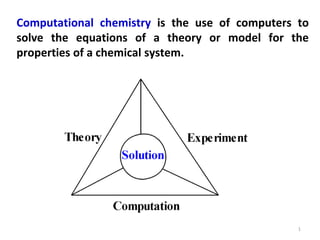
Computational chemistry is the use of computers to
solve the equations of a theory or model for the
properties of a chemical system.
2
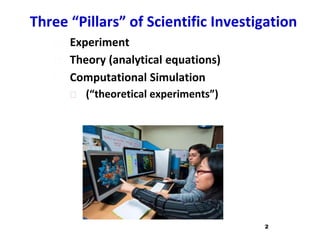
Three “Pillars” of Scientific Investigation
⮚ Experiment
⮚ Theory (analytical equations)
⮚ Computational Simulation
⮚ (“theoretical experiments”)
3
⮚Simulation is becoming a third pillar of science, along
with theory and experiment.
⮚Using theory, we develop models: simplified
representations of physical systems.
⮚We test the accuracy of these models in experiment,
and use simulation to help refine this feedback loop.
⮚Anything that can be measured can be simulated,
including properties related to energetics, structures,
and spectra of chemical systems.
The Nobel Prize in Chemistry 1998
John A. Pople Walter
Kohn
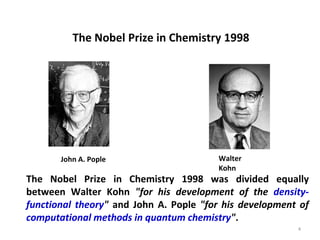
The Nobel Prize in Chemistry 1998 was divided equally
between Walter Kohn "for his development of the density-
functional theory" and John A. Pople "for his development of
computational methods in quantum chemistry".
4
5
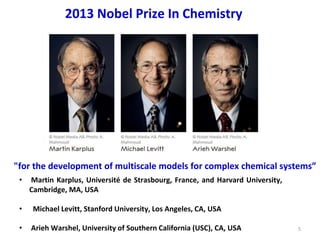
2013 Nobel Prize In Chemistry
"for the development of multiscale models for complex chemical systems”
• Martin Karplus, Université de Strasbourg, France, and Harvard University,
Cambridge, MA, USA
• Michael Levitt, Stanford University, Los Angeles, CA, USA
• Arieh Warshel, University of Southern California (USC), CA, USA
WHY
do theoretical calculations?
WHAT
do we calculate?
HOW
are the calculations carried out?
Computational Chemistry
6
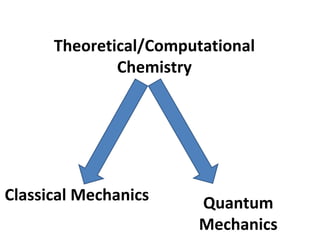
Theoretical/Computational
Chemistry
Classical Mechanics Quantum
Mechanics
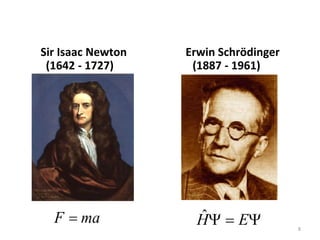
Sir Isaac Newton
(1642 - 1727)
Erwin Schrödinger
(1887 - 1961)
8
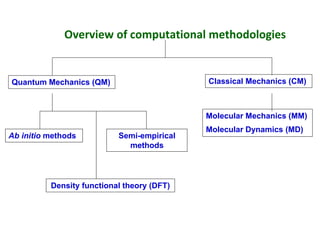
Overview of computational methodologies
Quantum Mechanics (QM) Classical Mechanics (CM)
Molecular Mechanics (MM)
Molecular Dynamics (MD)
Ab initio methods Semi-empirical
methods
Density functional theory (DFT)
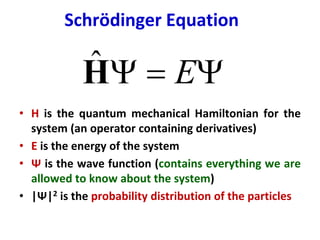
Schrödinger Equation
• H is the quantum mechanical Hamiltonian for the
system (an operator containing derivatives)
• E is the energy of the system
• Ψ is the wave function (contains everything we are
allowed to know about the system)
• |Ψ|2 is the probability distribution of the particles
11
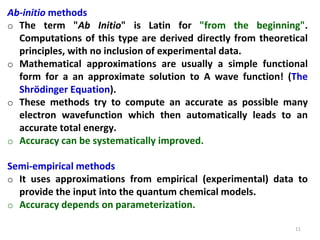
Ab-initio methods
o The term "Ab Initio" is Latin for "from the beginning".
Computations of this type are derived directly from theoretical
principles, with no inclusion of experimental data.
o Mathematical approximations are usually a simple functional
form for a an approximate solution to A wave function! (The
Shrödinger Equation).
o These methods try to compute an accurate as possible many
electron wavefunction which then automatically leads to an
accurate total energy.
o Accuracy can be systematically improved.
Semi-empirical methods
o It uses approximations from empirical (experimental) data to
provide the input into the quantum chemical models.
o Accuracy depends on parameterization.
12
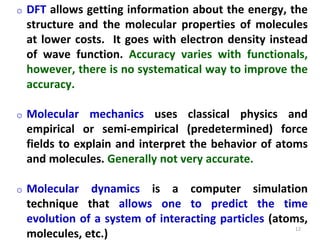
o DFT allows getting information about the energy, the
structure and the molecular properties of molecules
at lower costs. It goes with electron density instead
of wave function. Accuracy varies with functionals,
however, there is no systematical way to improve the
accuracy.
o Molecular mechanics uses classical physics and
empirical or semi-empirical (predetermined) force
fields to explain and interpret the behavior of atoms
and molecules. Generally not very accurate.
o Molecular dynamics is a computer simulation
technique that allows one to predict the time
evolution of a system of interacting particles (atoms,
molecules, etc.)
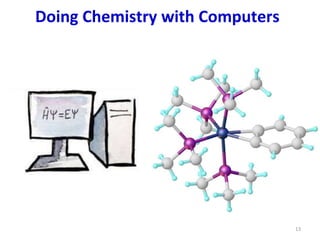
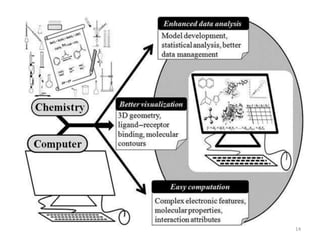
Doing Chemistry with Computers
13
14
15
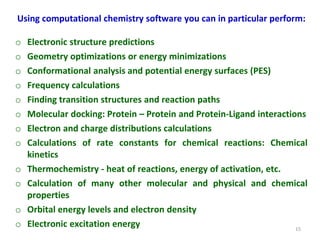
Using computational chemistry software you can in particular perform:
o Electronic structure predictions
o Geometry optimizations or energy minimizations
o Conformational analysis and potential energy surfaces (PES)
o Frequency calculations
o Finding transition structures and reaction paths
o Molecular docking: Protein – Protein and Protein-Ligand interactions
o Electron and charge distributions calculations
o Calculations of rate constants for chemical reactions: Chemical
kinetics
o Thermochemistry - heat of reactions, energy of activation, etc.
o Calculation of many other molecular and physical and chemical
properties
o Orbital energy levels and electron density
o Electronic excitation energy
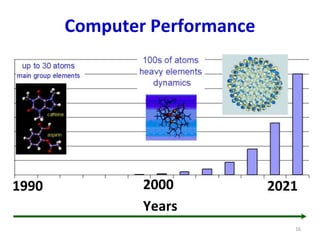
1990 2000 2021
Years
Computer Performance
16
17
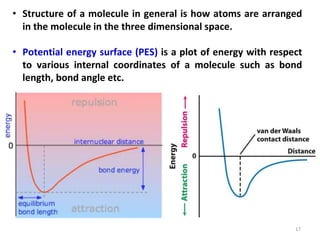
• Structure of a molecule in general is how atoms are arranged
in the molecule in the three dimensional space.
• Potential energy surface (PES) is a plot of energy with respect
to various internal coordinates of a molecule such as bond
length, bond angle etc.
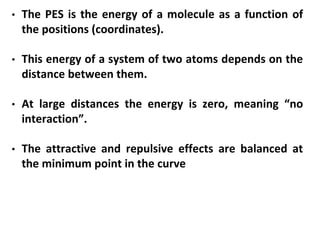
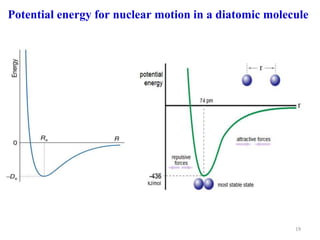
• The PES is the energy of a molecule as a function of
the positions (coordinates).
• This energy of a system of two atoms depends on the
distance between them.
• At large distances the energy is zero, meaning “no
interaction”.
• The attractive and repulsive effects are balanced at
the minimum point in the curve
Potential energy for nuclear motion in a diatomic molecule
19
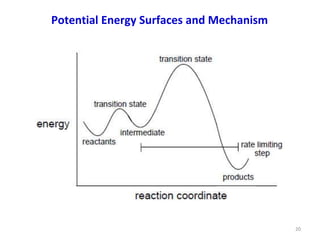
Potential Energy Surfaces and Mechanism
20
21
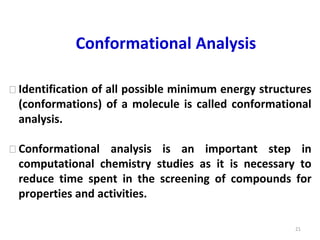
Conformational Analysis
⮚ Identification of all possible minimum energy structures
(conformations) of a molecule is called conformational
analysis.
⮚ Conformational analysis is an important step in
computational chemistry studies as it is necessary to
reduce time spent in the screening of compounds for
properties and activities.
22
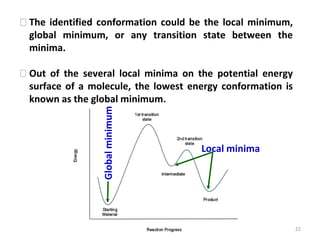
⮚ The identified conformation could be the local minimum,
global minimum, or any transition state between the
minima.
⮚ Out of the several local minima on the potential energy
surface of a molecule, the lowest energy conformation is
known as the global minimum.
Global
minimum
Local minima
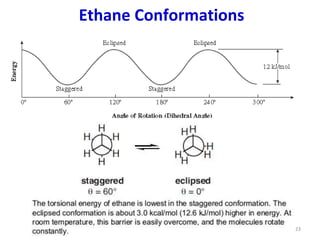
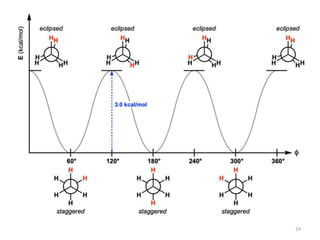
Ethane Conformations
23
24
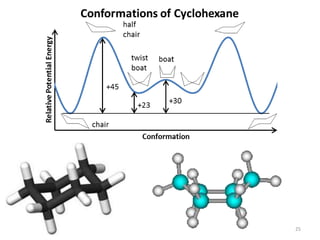
25
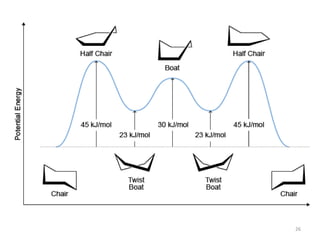
26
27
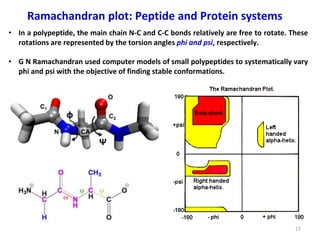
Ramachandran plot: Peptide and Protein systems
• In a polypeptide, the main chain N-C and C-C bonds relatively are free to rotate. These
rotations are represented by the torsion angles phi and psi, respectively.
• G N Ramachandran used computer models of small polypeptides to systematically vary
phi and psi with the objective of finding stable conformations.
Geometry optimization
Or
Energy Minimization
To Find
• Minimum energy geometry
• Lowest energy structure
• Most stable conformation
• Many problems in computational chemistry (and scientific
computing in general!) are optimization problems
• Finding the “stationary points” in multidimensional
system – Difficult Job
Why do we need the stable geometry?
⮚ The most stable geometry is the one which yields
minimum energy
⮚ Objective of geometry optimization is to find an atomic
arrangement(geometry) which makes the molecule most
stable
Geometry optimization
30
Methods of Optimization
Energy only:
• Simple methods
Energy and first derivatives (forces)
• Steepest descents (poor convergence)
• Conjugate gradients (retains information)
• Approximate Hessian update
Energy, first and second derivatives
• Newton-Raphson
• Broyden (BFGS) updating of Hessian (reduces
inversions)
• Rational Function Optimization (for transition states)

Computational chemistry

  • 1.
    1 Computational chemistry isthe use of computers to solve the equations of a theory or model for the properties of a chemical system.
  • 2.
    2 Three “Pillars” ofScientific Investigation ⮚ Experiment ⮚ Theory (analytical equations) ⮚ Computational Simulation ⮚ (“theoretical experiments”)
  • 3.
    3 ⮚Simulation is becominga third pillar of science, along with theory and experiment. ⮚Using theory, we develop models: simplified representations of physical systems. ⮚We test the accuracy of these models in experiment, and use simulation to help refine this feedback loop. ⮚Anything that can be measured can be simulated, including properties related to energetics, structures, and spectra of chemical systems.
  • 4.
    The Nobel Prizein Chemistry 1998 John A. Pople Walter Kohn The Nobel Prize in Chemistry 1998 was divided equally between Walter Kohn "for his development of the density- functional theory" and John A. Pople "for his development of computational methods in quantum chemistry". 4
  • 5.
    5 2013 Nobel PrizeIn Chemistry "for the development of multiscale models for complex chemical systems” • Martin Karplus, Université de Strasbourg, France, and Harvard University, Cambridge, MA, USA • Michael Levitt, Stanford University, Los Angeles, CA, USA • Arieh Warshel, University of Southern California (USC), CA, USA
  • 6.
    WHY do theoretical calculations? WHAT dowe calculate? HOW are the calculations carried out? Computational Chemistry 6
  • 7.
  • 8.
    Sir Isaac Newton (1642- 1727) Erwin Schrödinger (1887 - 1961) 8
  • 9.
    Overview of computationalmethodologies Quantum Mechanics (QM) Classical Mechanics (CM) Molecular Mechanics (MM) Molecular Dynamics (MD) Ab initio methods Semi-empirical methods Density functional theory (DFT)
  • 10.
    Schrödinger Equation • His the quantum mechanical Hamiltonian for the system (an operator containing derivatives) • E is the energy of the system • Ψ is the wave function (contains everything we are allowed to know about the system) • |Ψ|2 is the probability distribution of the particles
  • 11.
    11 Ab-initio methods o Theterm "Ab Initio" is Latin for "from the beginning". Computations of this type are derived directly from theoretical principles, with no inclusion of experimental data. o Mathematical approximations are usually a simple functional form for a an approximate solution to A wave function! (The Shrödinger Equation). o These methods try to compute an accurate as possible many electron wavefunction which then automatically leads to an accurate total energy. o Accuracy can be systematically improved. Semi-empirical methods o It uses approximations from empirical (experimental) data to provide the input into the quantum chemical models. o Accuracy depends on parameterization.
  • 12.
    12 o DFT allowsgetting information about the energy, the structure and the molecular properties of molecules at lower costs. It goes with electron density instead of wave function. Accuracy varies with functionals, however, there is no systematical way to improve the accuracy. o Molecular mechanics uses classical physics and empirical or semi-empirical (predetermined) force fields to explain and interpret the behavior of atoms and molecules. Generally not very accurate. o Molecular dynamics is a computer simulation technique that allows one to predict the time evolution of a system of interacting particles (atoms, molecules, etc.)
  • 13.
  • 14.
  • 15.
    15 Using computational chemistrysoftware you can in particular perform: o Electronic structure predictions o Geometry optimizations or energy minimizations o Conformational analysis and potential energy surfaces (PES) o Frequency calculations o Finding transition structures and reaction paths o Molecular docking: Protein – Protein and Protein-Ligand interactions o Electron and charge distributions calculations o Calculations of rate constants for chemical reactions: Chemical kinetics o Thermochemistry - heat of reactions, energy of activation, etc. o Calculation of many other molecular and physical and chemical properties o Orbital energy levels and electron density o Electronic excitation energy
  • 16.
  • 17.
    17 • Structure ofa molecule in general is how atoms are arranged in the molecule in the three dimensional space. • Potential energy surface (PES) is a plot of energy with respect to various internal coordinates of a molecule such as bond length, bond angle etc.
  • 18.
    • The PESis the energy of a molecule as a function of the positions (coordinates). • This energy of a system of two atoms depends on the distance between them. • At large distances the energy is zero, meaning “no interaction”. • The attractive and repulsive effects are balanced at the minimum point in the curve
  • 19.
    Potential energy fornuclear motion in a diatomic molecule 19
  • 20.
    Potential Energy Surfacesand Mechanism 20
  • 21.
    21 Conformational Analysis ⮚ Identificationof all possible minimum energy structures (conformations) of a molecule is called conformational analysis. ⮚ Conformational analysis is an important step in computational chemistry studies as it is necessary to reduce time spent in the screening of compounds for properties and activities.
  • 22.
    22 ⮚ The identifiedconformation could be the local minimum, global minimum, or any transition state between the minima. ⮚ Out of the several local minima on the potential energy surface of a molecule, the lowest energy conformation is known as the global minimum. Global minimum Local minima
  • 23.
  • 24.
  • 25.
  • 26.
  • 27.
    27 Ramachandran plot: Peptideand Protein systems • In a polypeptide, the main chain N-C and C-C bonds relatively are free to rotate. These rotations are represented by the torsion angles phi and psi, respectively. • G N Ramachandran used computer models of small polypeptides to systematically vary phi and psi with the objective of finding stable conformations.
  • 28.
    Geometry optimization Or Energy Minimization ToFind • Minimum energy geometry • Lowest energy structure • Most stable conformation
  • 29.
    • Many problemsin computational chemistry (and scientific computing in general!) are optimization problems • Finding the “stationary points” in multidimensional system – Difficult Job Why do we need the stable geometry?
  • 30.
    ⮚ The moststable geometry is the one which yields minimum energy ⮚ Objective of geometry optimization is to find an atomic arrangement(geometry) which makes the molecule most stable Geometry optimization 30
  • 31.
    Methods of Optimization Energyonly: • Simple methods Energy and first derivatives (forces) • Steepest descents (poor convergence) • Conjugate gradients (retains information) • Approximate Hessian update Energy, first and second derivatives • Newton-Raphson • Broyden (BFGS) updating of Hessian (reduces inversions) • Rational Function Optimization (for transition states)