MOLECULAR MECHANICS AND DYNAMICS
Presented by
Mr. Chikhale Hemant U.
Guided By-
Dr. Amit G. Nerkar
Founder and Director
Content of the presentation
 Introduction to computational chemistry
 Need to study
 Molecular mechanics
 Basic principle of molecular mechanics
 Semiemperical methods
 Parameterization
 Algorithms
 Molecular dynamics
 Simulation technique in molecular dynamic
 Application of simulation
 Reference
Introduction to computational chemistry:
 Computational chemistry is a branch of chemistry that uses
principles of computer science to assist in solving chemical
problems.
 It uses the results of theoretical chemistry, incorporated into
efficient computer programs, to calculate the structures and
properties of molecules.
 Since chemistry concerns the study of properties of substances
or molecular systems in terms of atoms, the basic challenge
facing computational chemistry is to describe or even predict
1. The structure and stability of a molecular system,
2. The (free) energy of different states of a molecular system,
3. Reaction processes within molecular systems
Need to study:
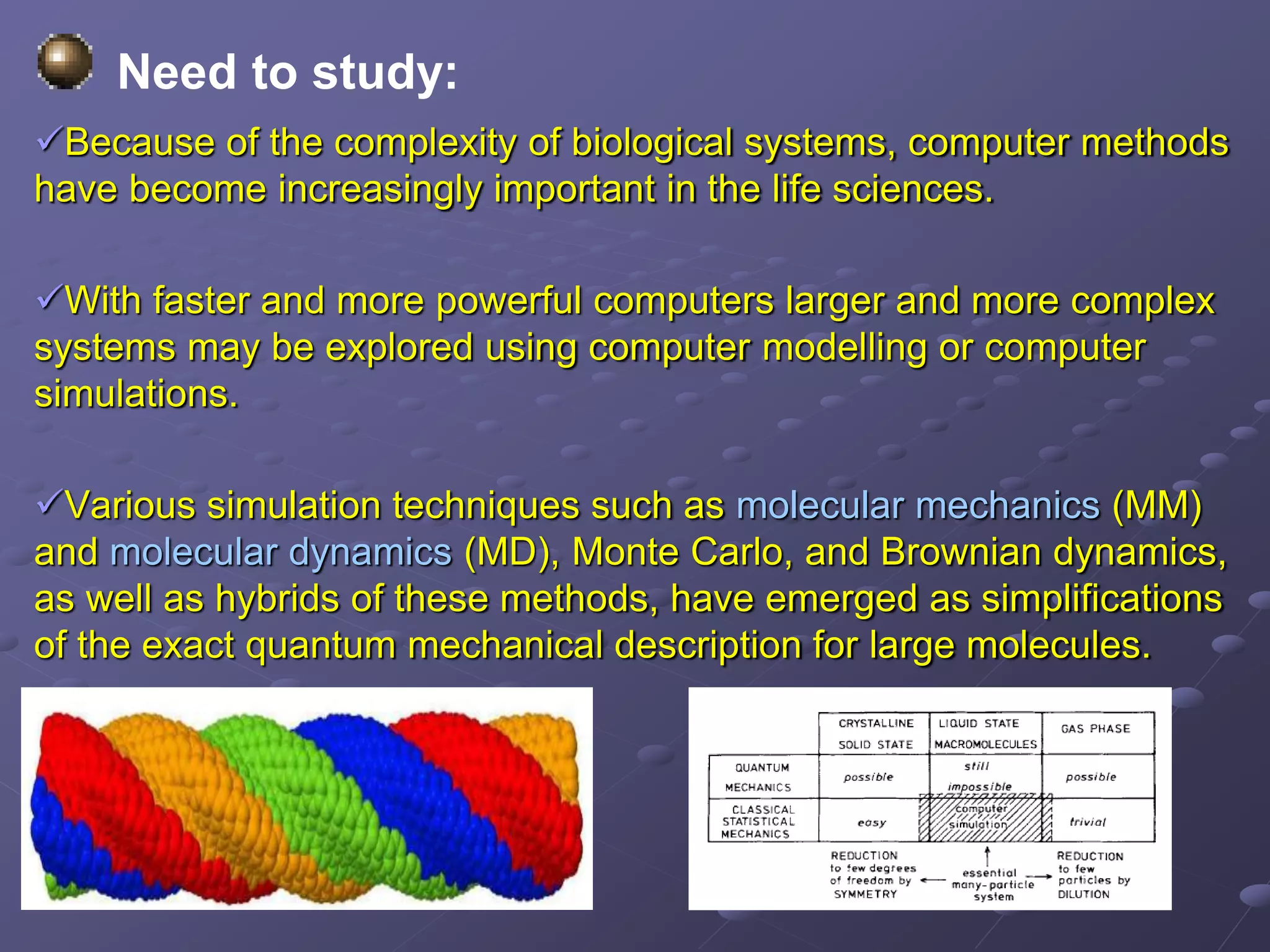
Because of the complexity of biological systems, computer methods
have become increasingly important in the life sciences.
With faster and more powerful computers larger and more complex
systems may be explored using computer modelling or computer
simulations.
Various simulation techniques such as molecular mechanics (MM)
and molecular dynamics (MD), Monte Carlo, and Brownian dynamics,
as well as hybrids of these methods, have emerged as simplifications
of the exact quantum mechanical description for large molecules.
Molecular mechanics:
The "mechanical" model developed to describe molecular structures
and properties in as practical manner as possible
Molecular mechanics methods are based on the following principles:
Nuclei and electrons are lumped into atom-like particles.
Atom-like particles have a net charge
Interactions are based on springs and classical potentials.
Interactions must be pre-assigned to specific sets of atoms.
Interactions determine the spatial distribution of atom-like particles
and their energies.
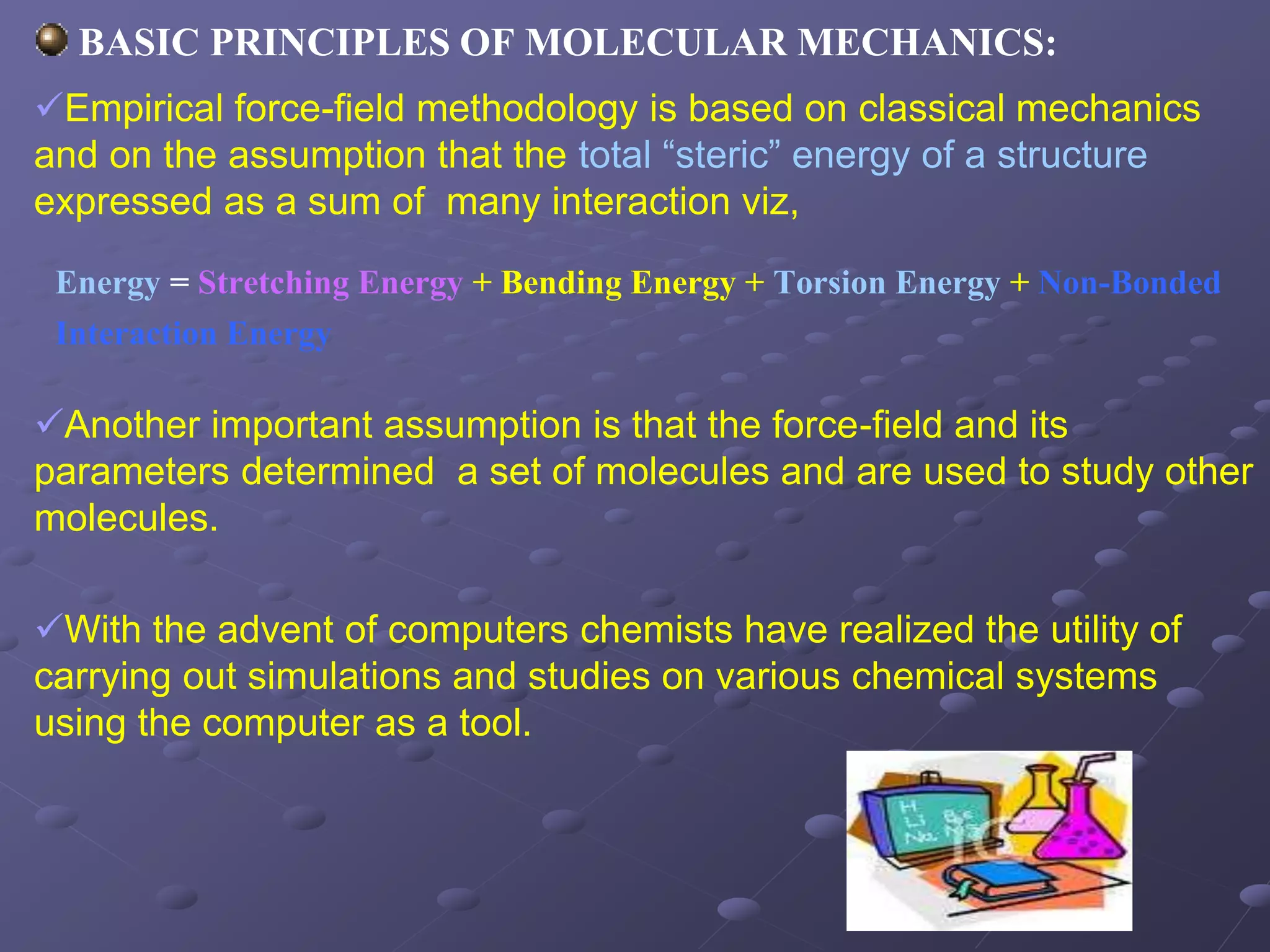
BASIC PRINCIPLES OF MOLECULAR MECHANICS:
Empirical force-field methodology is based on classical mechanics
and on the assumption that the total “steric” energy of a structure
expressed as a sum of many interaction viz,
Another important assumption is that the force-field and its
parameters determined a set of molecules and are used to study other
molecules.
With the advent of computers chemists have realized the utility of
carrying out simulations and studies on various chemical systems
using the computer as a tool.
Energy = Stretching Energy + Bending Energy + Torsion Energy + Non-Bonded
Interaction Energy
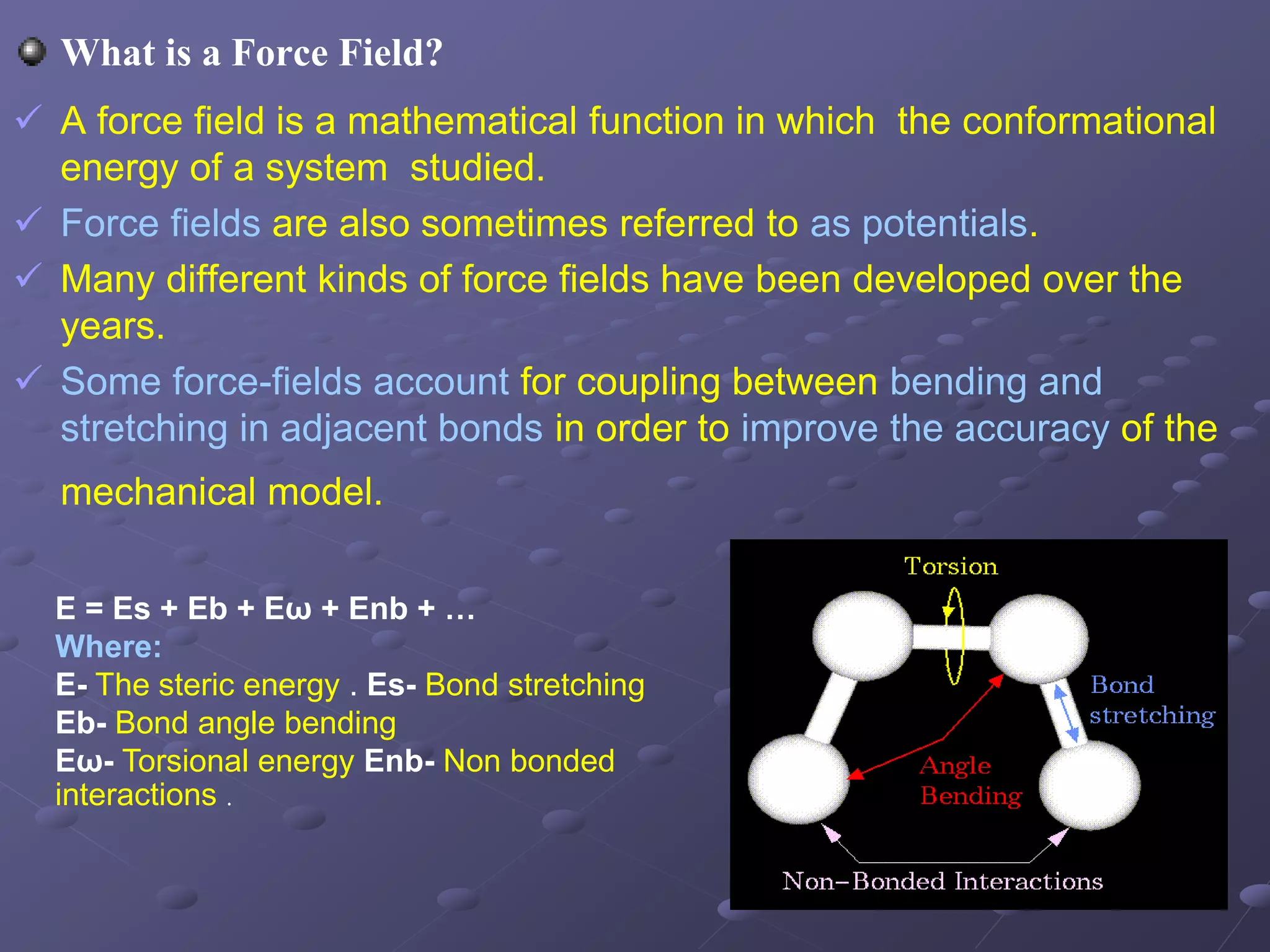
What is a Force Field?
 A force field is a mathematical function in which the conformational
energy of a system studied.
 Force fields are also sometimes referred to as potentials.
 Many different kinds of force fields have been developed over the
years.
 Some force-fields account for coupling between bending and
stretching in adjacent bonds in order to improve the accuracy of the
mechanical model.
E = Es + Eb + Eω + Enb + …
Where:
E- The steric energy . Es- Bond stretching
Eb- Bond angle bending
Eω- Torsional energy Enb- Non bonded
interactions .
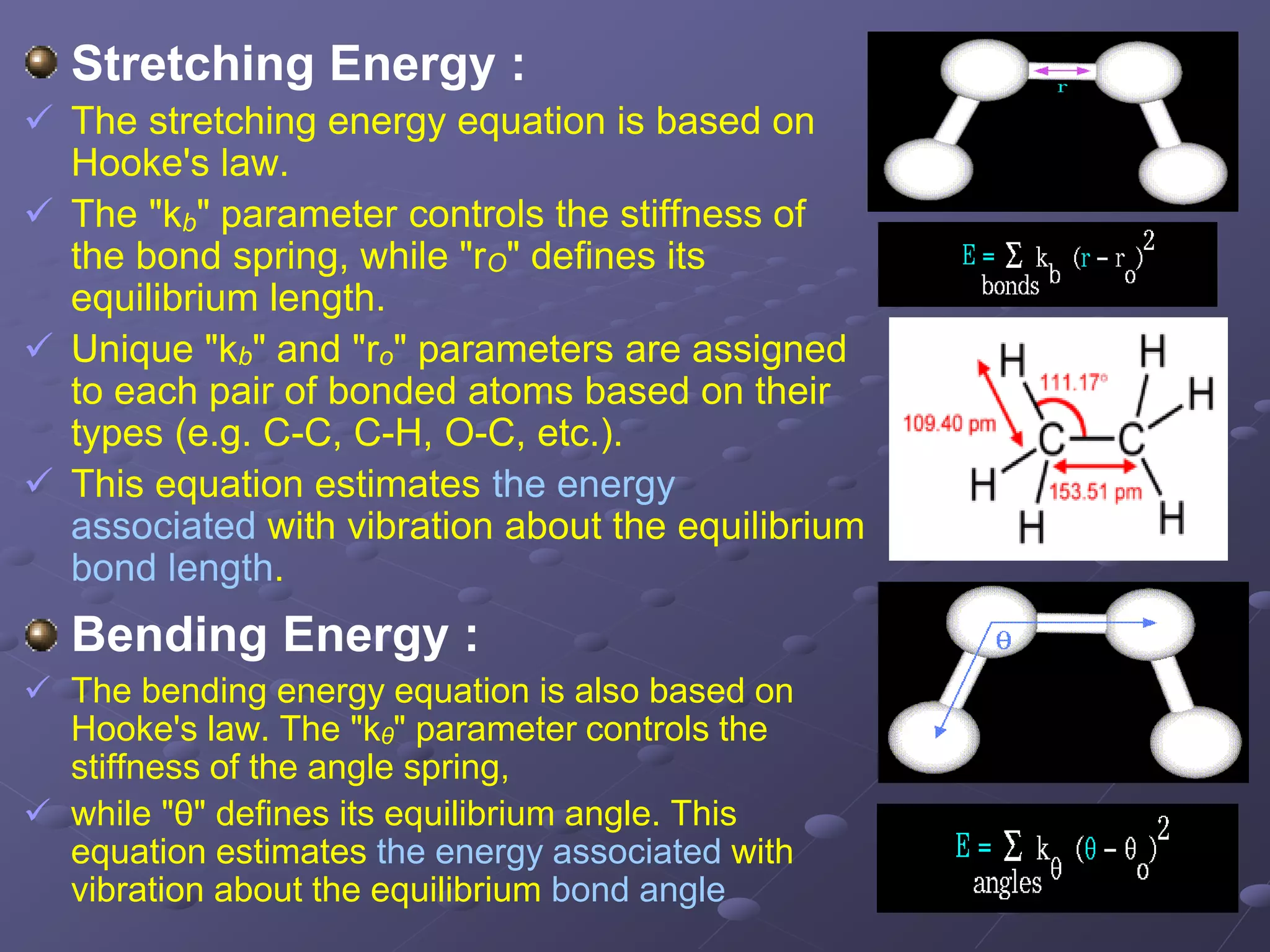
Stretching Energy :
 The stretching energy equation is based on
Hooke's law.
 The "kb" parameter controls the stiffness of
the bond spring, while "rO" defines its
equilibrium length.
 Unique "kb" and "ro" parameters are assigned
to each pair of bonded atoms based on their
types (e.g. C-C, C-H, O-C, etc.).
 This equation estimates the energy
associated with vibration about the equilibrium
bond length.
Bending Energy :
 The bending energy equation is also based on
Hooke's law. The "kθ" parameter controls the
stiffness of the angle spring,
 while "θ" defines its equilibrium angle. This
equation estimates the energy associated with
vibration about the equilibrium bond angle
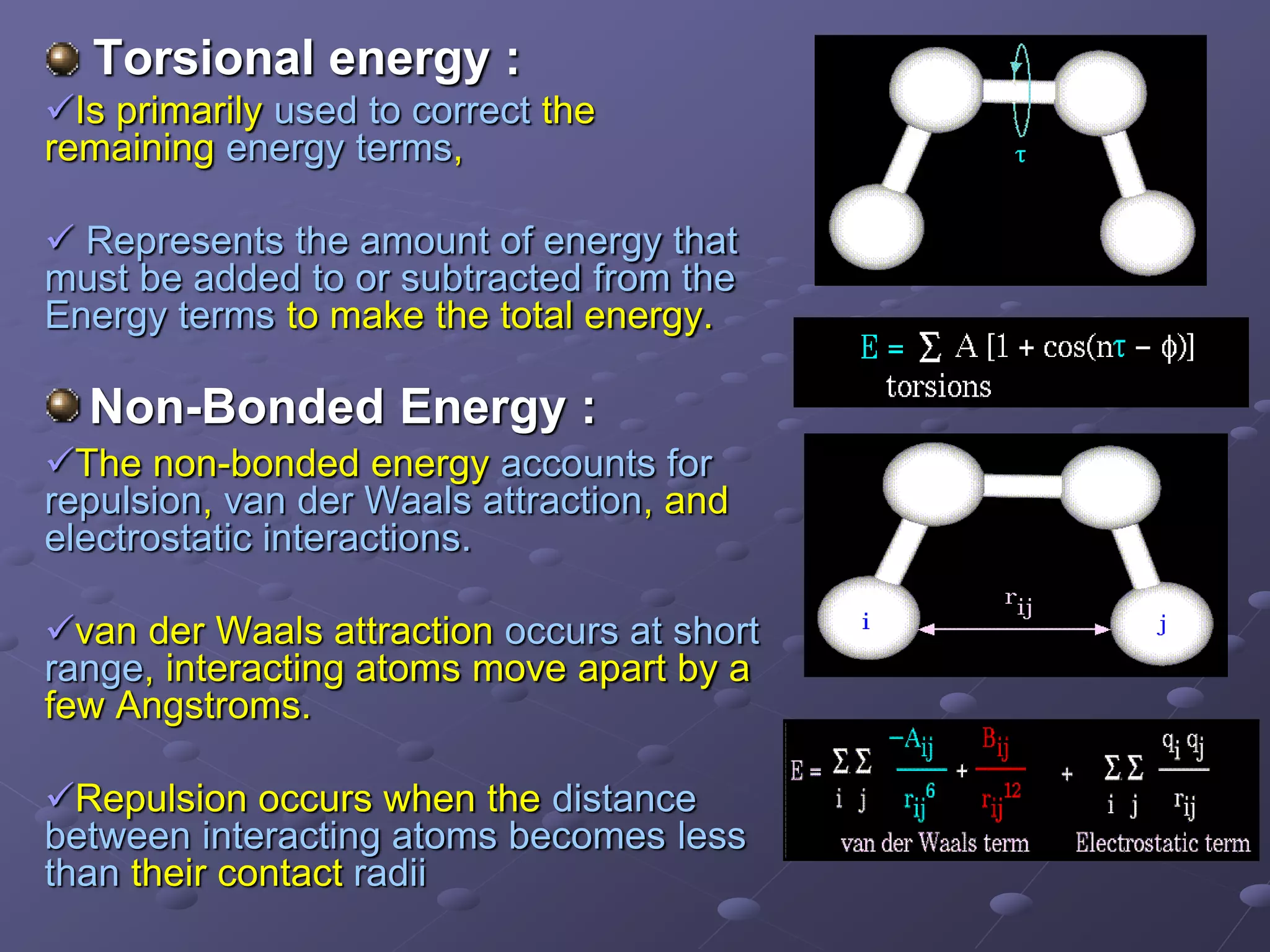
Torsional energy :
Is primarily used to correct the
remaining energy terms,
 Represents the amount of energy that
must be added to or subtracted from the
Energy terms to make the total energy.
Non-Bonded Energy :
The non-bonded energy accounts for
repulsion, van der Waals attraction, and
electrostatic interactions.
van der Waals attraction occurs at short
range, interacting atoms move apart by a
few Angstroms.
Repulsion occurs when the distance
between interacting atoms becomes less
than their contact radii
Chemical effect:-
Mechanical effect, such as stretching, bending, and torsion, electrostatic
interaction are not sufficient to reproduce structural or spectroscopic
phenomena such as the Electro negativity, Anomeric, and Bohmann effect
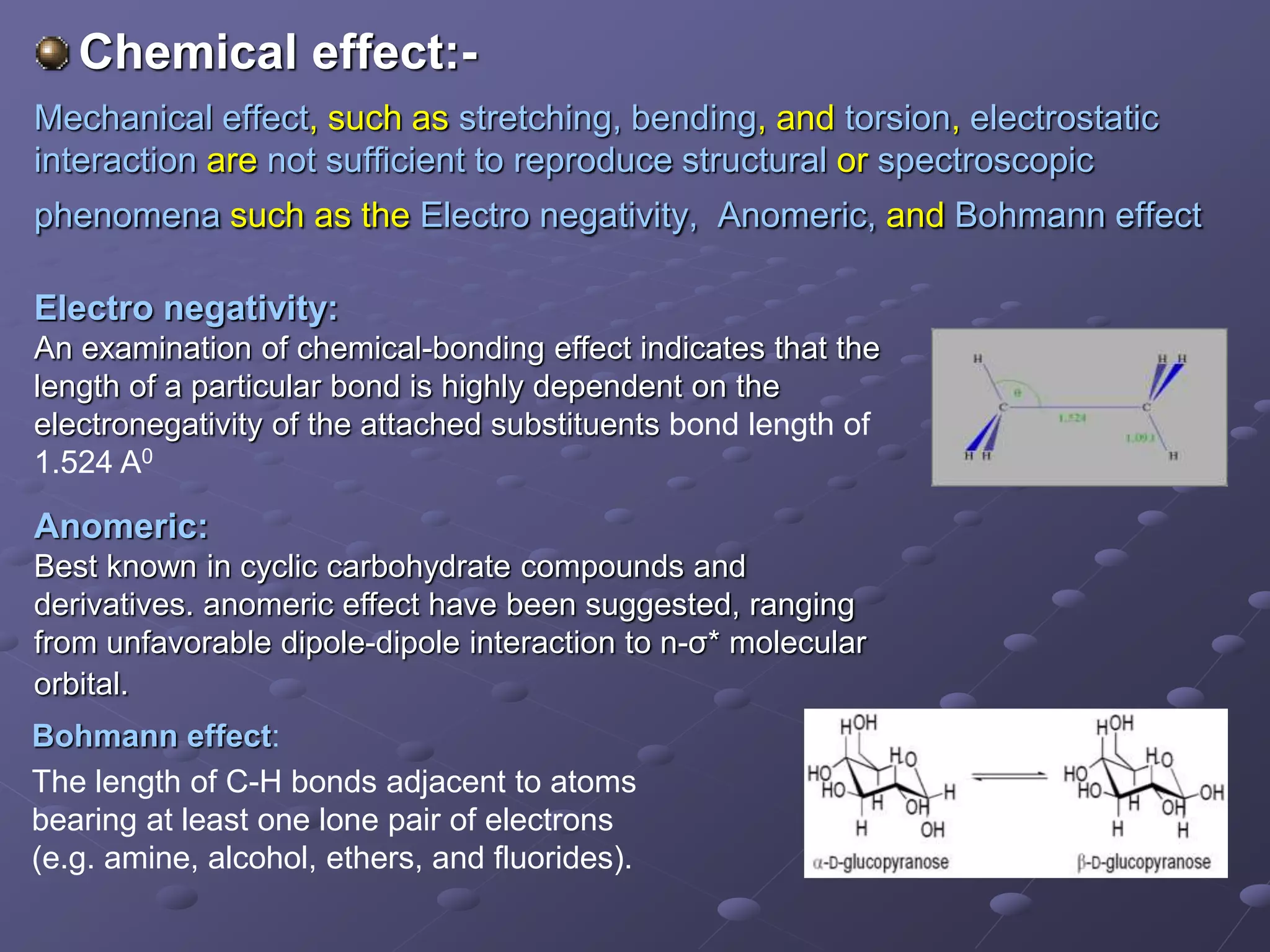
Electro negativity:
An examination of chemical-bonding effect indicates that the
length of a particular bond is highly dependent on the
electronegativity of the attached substituents bond length of
1.524 A0
Anomeric:
Best known in cyclic carbohydrate compounds and
derivatives. anomeric effect have been suggested, ranging
from unfavorable dipole-dipole interaction to n-σ* molecular
orbital.
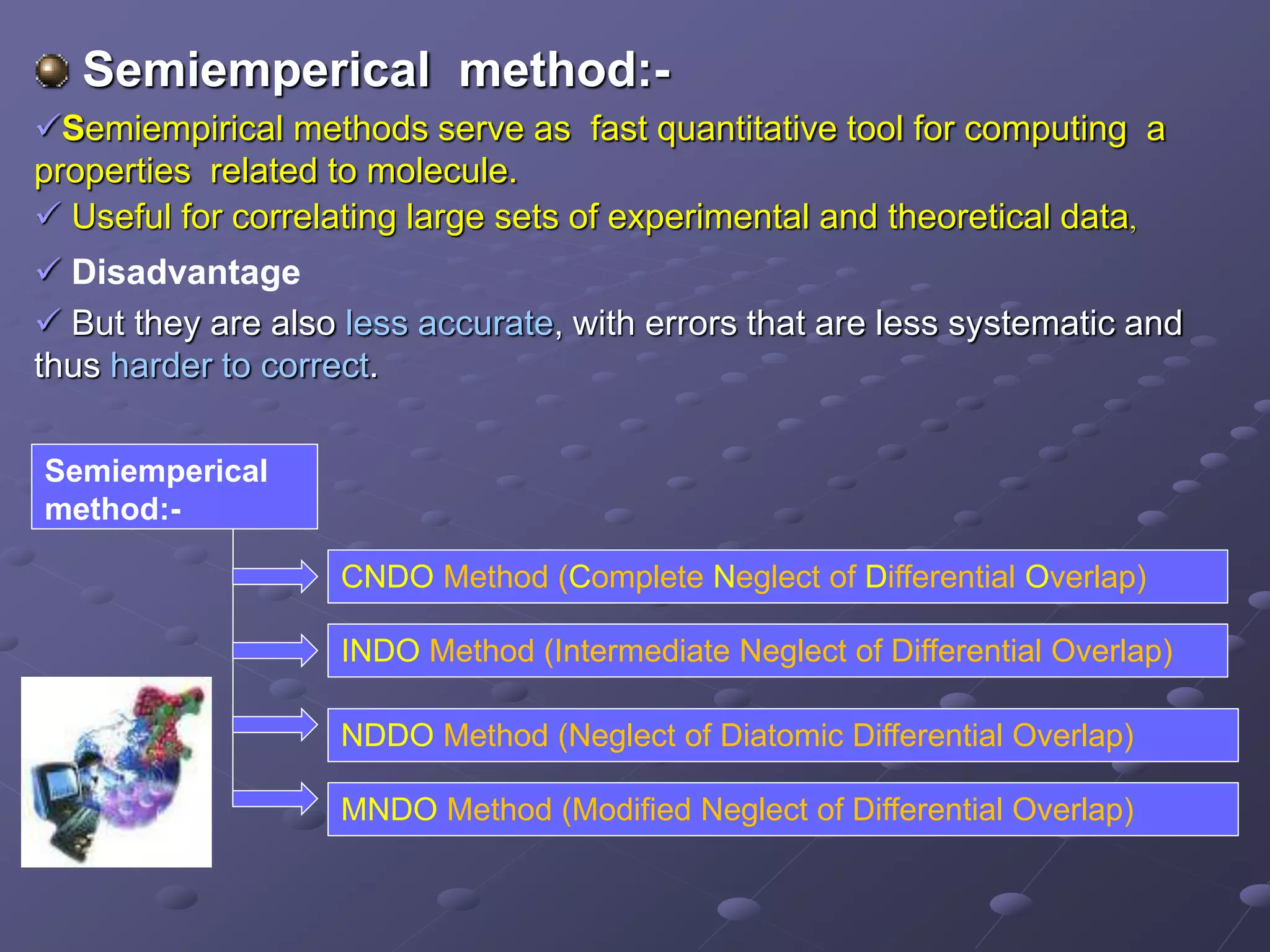
Bohmann effect:
The length of C-H bonds adjacent to atoms
bearing at least one lone pair of electrons
(e.g. amine, alcohol, ethers, and fluorides).
Semiemperical method:-
Semiempirical methods serve as fast quantitative tool for computing a
properties related to molecule.
 Useful for correlating large sets of experimental and theoretical data,
 Disadvantage
 But they are also less accurate, with errors that are less systematic and
thus harder to correct.
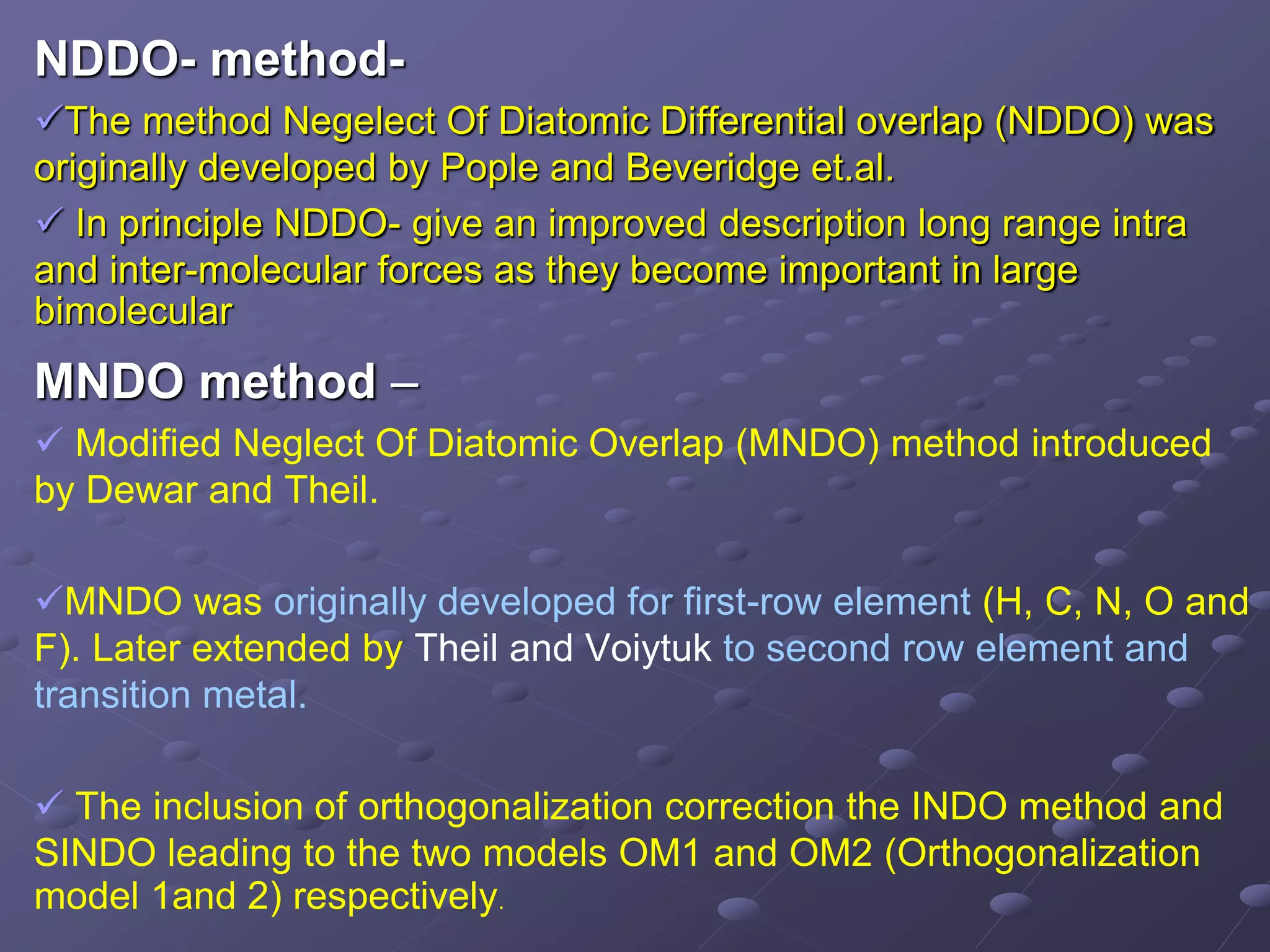
Semiemperical
method:-
CNDO Method (Complete Neglect of Differential Overlap)
INDO Method (Intermediate Neglect of Differential Overlap)
NDDO Method (Neglect of Diatomic Differential Overlap)
MNDO Method (Modified Neglect of Differential Overlap)
CNDO method :-
 The complete neglect of differential overlap method (CNDO) of
pople et.al makes use of the zero differential overlap approximation
(ZDO) for all pairs of atomic functions.
 It treats explicitly all valence electrons (e.g. 2s, 2p), CNDO/S
method that is parameterized to reproduce electronic spectra.
INDO method :-
The intermediate neglect of differential overlap (INDO) method was
at one time used for organic systems.
It gives unsatisfying results for geometries and dissociation
energies and replaced by several improved versions namely,
MINDO/3, INDO/S, and SINDO1.
The first of these newer INDO methods is MINDO/1 and MINDO/2.
NDDO- method-
The method Negelect Of Diatomic Differential overlap (NDDO) was
originally developed by Pople and Beveridge et.al.
 In principle NDDO- give an improved description long range intra
and inter-molecular forces as they become important in large
bimolecular
MNDO method –
 Modified Neglect Of Diatomic Overlap (MNDO) method introduced
by Dewar and Theil.
MNDO was originally developed for first-row element (H, C, N, O and
F). Later extended by Theil and Voiytuk to second row element and
transition metal.
 The inclusion of orthogonalization correction the INDO method and
SINDO leading to the two models OM1 and OM2 (Orthogonalization
model 1and 2) respectively.
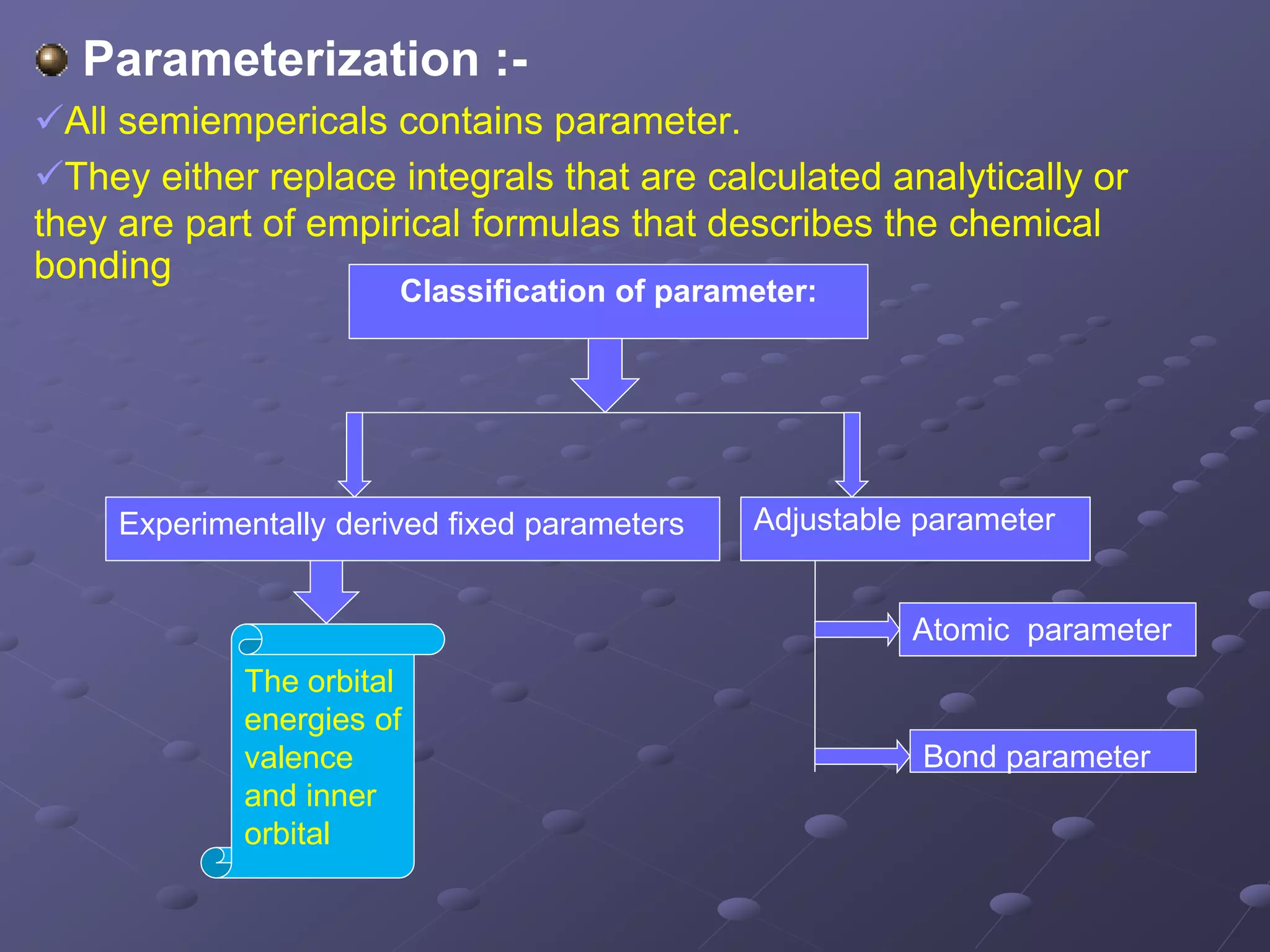
Parameterization :-
All semiempericals contains parameter.
They either replace integrals that are calculated analytically or
they are part of empirical formulas that describes the chemical
bonding
Classification of parameter:
Experimentally derived fixed parameters Adjustable parameter
The orbital
energies of
valence
and inner
orbital
Atomic parameter
Bond parameter
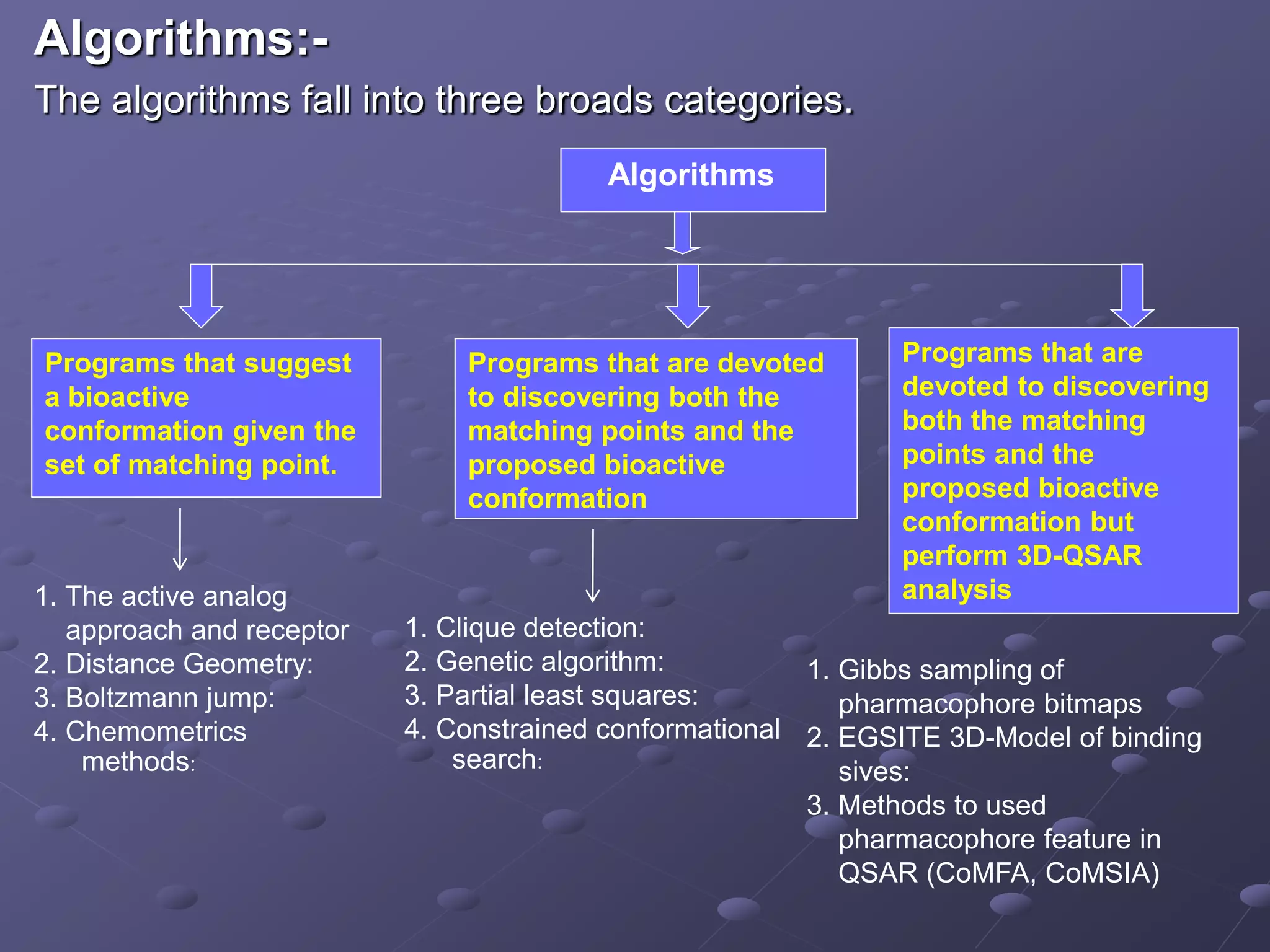
Algorithms:-
The algorithms fall into three broads categories.
1. The active analog
approach and receptor
2. Distance Geometry:
3. Boltzmann jump:
4. Chemometrics
methods:
Programs that suggest
a bioactive
conformation given the
set of matching point.
Programs that are devoted
to discovering both the
matching points and the
proposed bioactive
conformation
Programs that are
devoted to discovering
both the matching
points and the
proposed bioactive
conformation but
perform 3D-QSAR
analysis
Algorithms
1. Clique detection:
2. Genetic algorithm:
3. Partial least squares:
4. Constrained conformational
search:
1. Gibbs sampling of
pharmacophore bitmaps
2. EGSITE 3D-Model of binding
sives:
3. Methods to used
pharmacophore feature in
QSAR (CoMFA, CoMSIA)
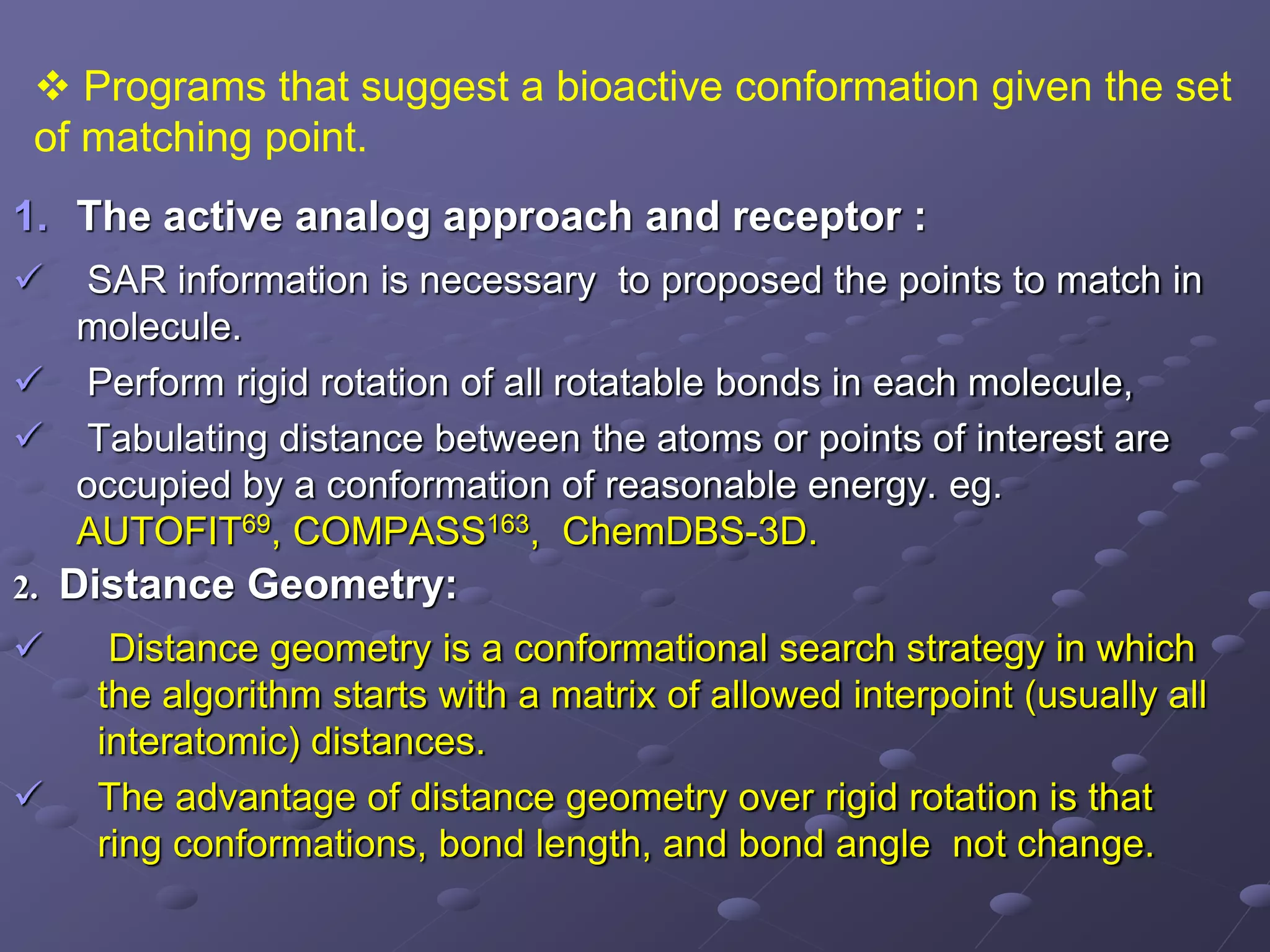
1. The active analog approach and receptor :
 SAR information is necessary to proposed the points to match in
molecule.
 Perform rigid rotation of all rotatable bonds in each molecule,
 Tabulating distance between the atoms or points of interest are
occupied by a conformation of reasonable energy. eg.
AUTOFIT69, COMPASS163, ChemDBS-3D.
2. Distance Geometry:
 Distance geometry is a conformational search strategy in which
the algorithm starts with a matrix of allowed interpoint (usually all
interatomic) distances.
 The advantage of distance geometry over rigid rotation is that
ring conformations, bond length, and bond angle not change.
 Programs that suggest a bioactive conformation given the set
of matching point.
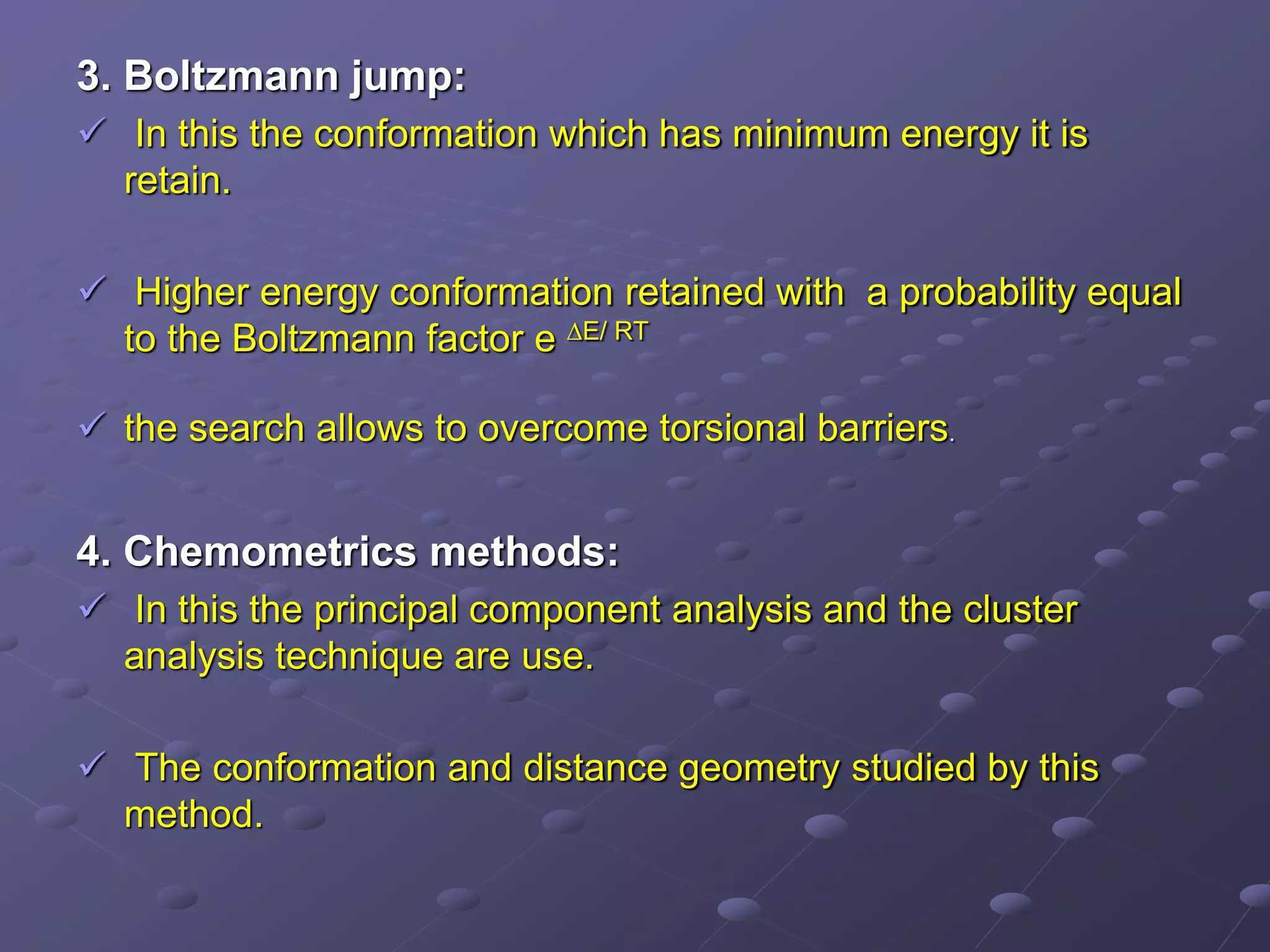
3. Boltzmann jump:
 In this the conformation which has minimum energy it is
retain.
 Higher energy conformation retained with a probability equal
to the Boltzmann factor е ∆E/ RT
 the search allows to overcome torsional barriers.
4. Chemometrics methods:
 In this the principal component analysis and the cluster
analysis technique are use.
 The conformation and distance geometry studied by this
method.
1. Clique detection :
 Identify the maximum common 3D substructure in a set of molecule.
 For pharmacophore mapping required two changes
1. Considering multiple conformations.
2. Defining the points
2. Genetic algorithm:
 Performs its search by analogy to biological evolution.
 Genetic operators of mutation and crossover operate to optimize some
fitness (scoring) function for the whole set of individuals.
3. Partial least squares: (PLS)
 In PLS one provides the potency of each molecule and sets of CoMFA
descriptors for each potential alignment.
 PLS identifies the overlay and conformation of the reference compounds
that best explains the biological potency of the compounds. This overlay
was then used to generate a traditional CoMFA,
Programs that are devoted to discovering both the matching
points and the proposed bioactive conformation
1. Gibbs sampling of pharmacophore bitmaps:
 Bitmap or fingerprint describes the presence or absence of
particular geometric feature
 Advantage of the Gibbs sampling is that it detect binding
modes that is necessary.
2. EGSITE 3D-Model of binding sieves :
 The algorithm start by placing all molecule into an uniform
macromolecular binding site,
 Then fits the ligands into complementary region by changing its
orientation in space and its conformation.
3. Methods to used pharmacophore feature in QSAR:
 To evaluate or use pharmacophore for alignments in 3D-
QSAR such as CoMFA,
 Several program make specific use of pharmacophore feature
in a 3D-QSAR to search for pharmacophore,
Programs that are devoted to discovering both the matching
points and the proposed bioactive conformation but perform 3D-
QSAR analysis
MOLECULAR DYNAMICS: (MD)
 First simulation methods
 The 1970s MD has been used widely to study the
structure and dynamics of macromolecules
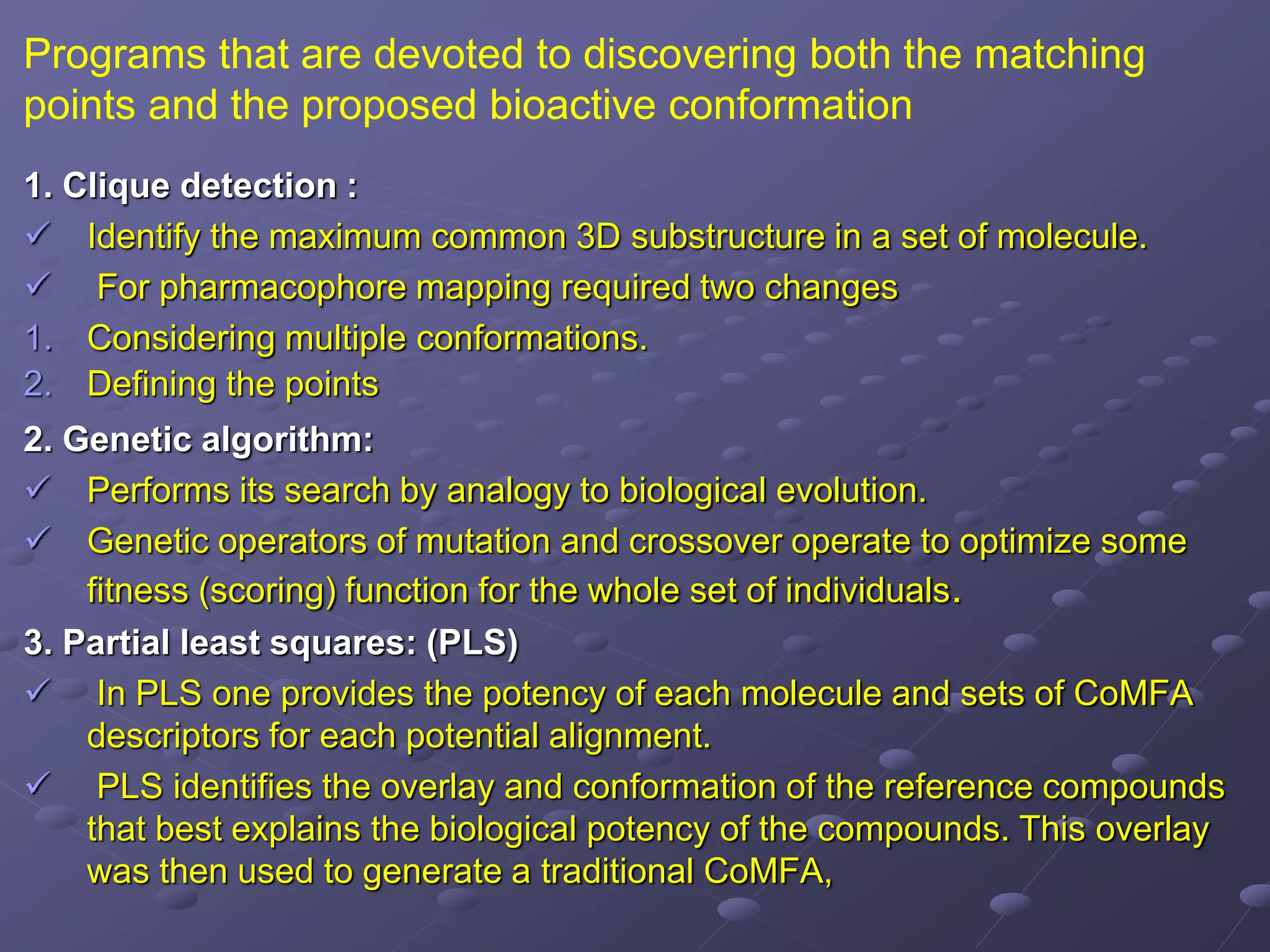
 Resembling very much the ‘ball and stick’ model
 Molecular dynamics is concerned with molecular motion
Simulation technique in molecular dynamic :
 Used to st the behavior study multiple-particles
systems via numerical simulation techniques.
 The principle is to compute positions and velocities of
the atoms
 Simulations has importance in biochemistry and
molecular biology, where they allow functional
observation of proteins, nucleic acids, membranes,
and other building blocks of the cell
 A number of established MD simulation Molecular
dynamic simulation, Monte Carlo, CHARMM, AMBER,
GROMACS used for calculation.
Molecular dynamics simulation
 The time-dependent behavior of a molecular system studied
such as vibrational motion or Brownian motion.
 Compute the energy of the system, most often using a
molecular mechanics calculation.
 This energy expression is used to compute the forces on the
atoms for given geometry.
MONTE CARLO Simulation :
 In which the location, orientation and geometry of a molecule
or group of molecules are chosen according to a statistical
distribution
 Require less computer time to execute each iteration than a
molecular dynamics simulation.
AMBER
 Assisted model building with energy refinement (AMBER)
 It was parameterized specifically for proteins and nucleic acids
CHARMM
 Chemistry at Harvard macromolecular mechanics (CHARMM).
 The academic version of this program is designated CHARMM and the
commercial version is called CHARMm
 It was originally devised for proteins and nucleic acids.
·
GAUSSAIN –
 Able to perform molecular mechanics calculations on single molecules.
 Includes molecular dynamics and structure optimization.
GROMACS –
 GR Oningen MAchine for Chemical Simulation
 GROMACS help in obtaining high throughput. originally developed for
nucleic acid and protein molecule
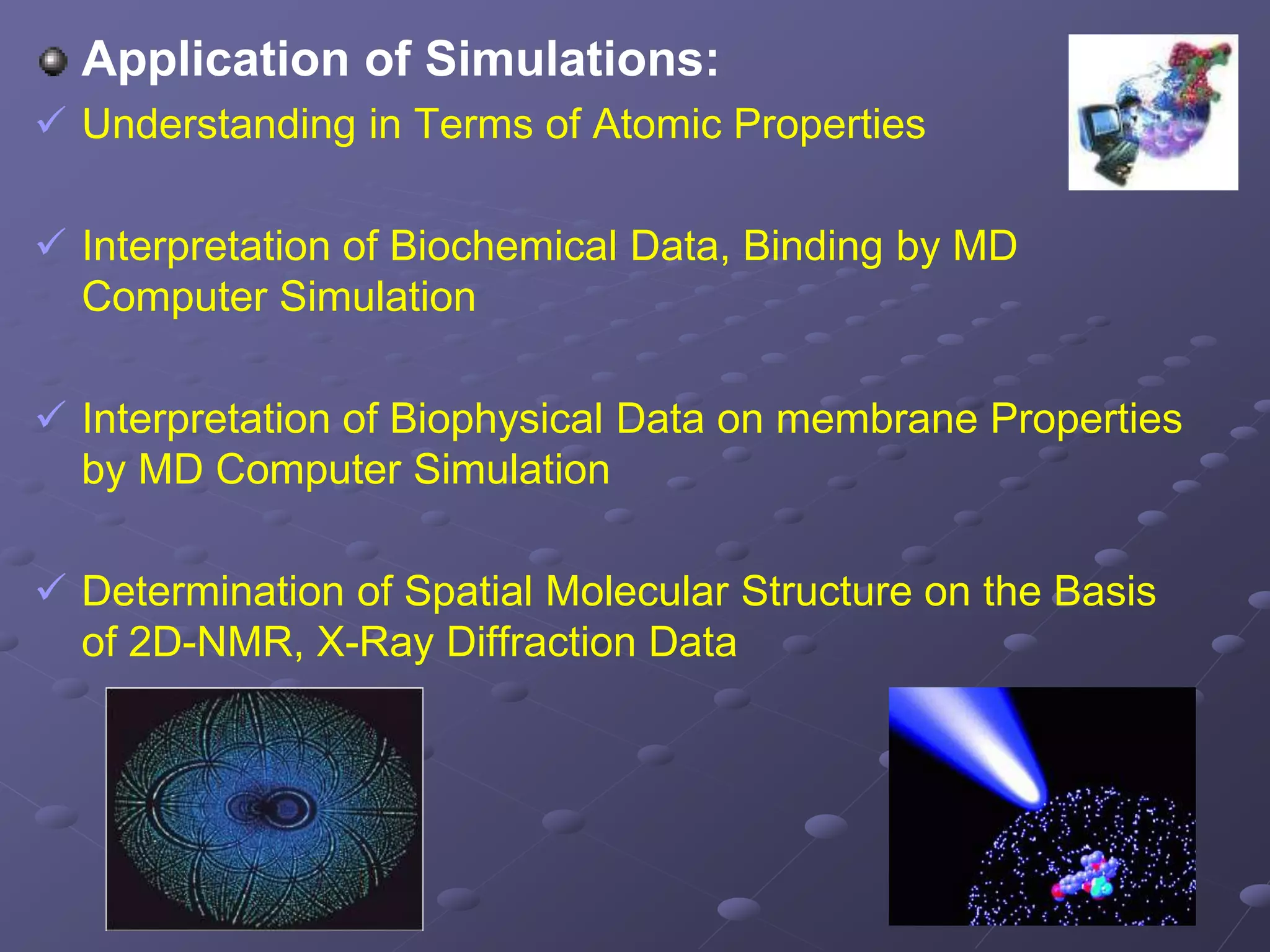
Application of Simulations:
 Understanding in Terms of Atomic Properties
 Interpretation of Biochemical Data, Binding by MD
Computer Simulation
 Interpretation of Biophysical Data on membrane Properties
by MD Computer Simulation
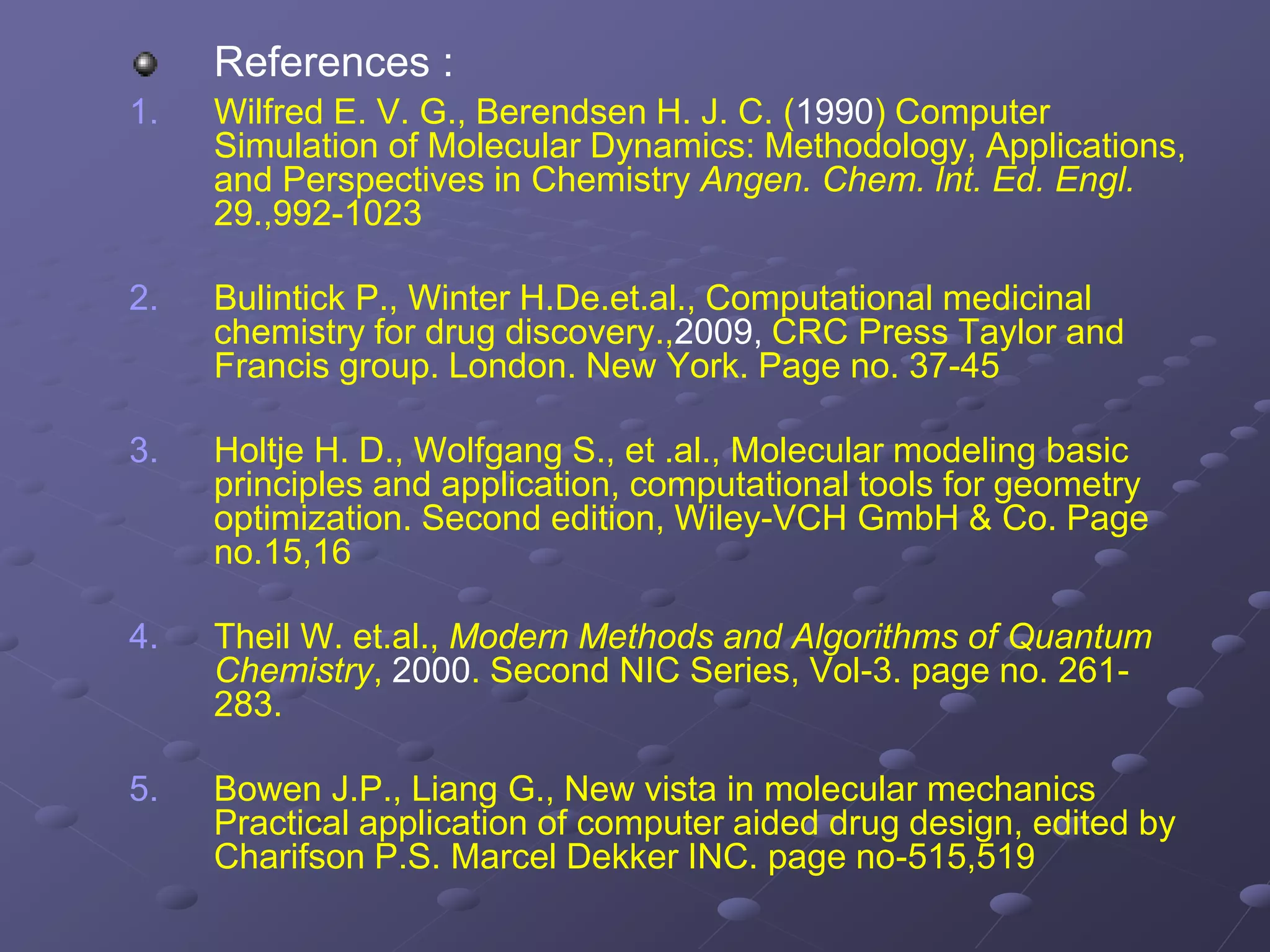
 Determination of Spatial Molecular Structure on the Basis
of 2D-NMR, X-Ray Diffraction Data
References :
1. Wilfred E. V. G., Berendsen H. J. C. (1990) Computer
Simulation of Molecular Dynamics: Methodology, Applications,
and Perspectives in Chemistry Angen. Chem. lnt. Ed. Engl.
29.,992-1023
2. Bulintick P., Winter H.De.et.al., Computational medicinal
chemistry for drug discovery.,2009, CRC Press Taylor and
Francis group. London. New York. Page no. 37-45
3. Holtje H. D., Wolfgang S., et .al., Molecular modeling basic
principles and application, computational tools for geometry
optimization. Second edition, Wiley-VCH GmbH & Co. Page
no.15,16
4. Theil W. et.al., Modern Methods and Algorithms of Quantum
Chemistry, 2000. Second NIC Series, Vol-3. page no. 261-
283.
5. Bowen J.P., Liang G., New vista in molecular mechanics
Practical application of computer aided drug design, edited by
Charifson P.S. Marcel Dekker INC. page no-515,519

Molecular mechanics and dynamics

  • 1.
    MOLECULAR MECHANICS ANDDYNAMICS Presented by Mr. Chikhale Hemant U. Guided By- Dr. Amit G. Nerkar Founder and Director
  • 2.
    Content of thepresentation  Introduction to computational chemistry  Need to study  Molecular mechanics  Basic principle of molecular mechanics  Semiemperical methods  Parameterization  Algorithms  Molecular dynamics  Simulation technique in molecular dynamic  Application of simulation  Reference
  • 3.
    Introduction to computationalchemistry:  Computational chemistry is a branch of chemistry that uses principles of computer science to assist in solving chemical problems.  It uses the results of theoretical chemistry, incorporated into efficient computer programs, to calculate the structures and properties of molecules.  Since chemistry concerns the study of properties of substances or molecular systems in terms of atoms, the basic challenge facing computational chemistry is to describe or even predict 1. The structure and stability of a molecular system, 2. The (free) energy of different states of a molecular system, 3. Reaction processes within molecular systems
  • 4.
    Need to study: Becauseof the complexity of biological systems, computer methods have become increasingly important in the life sciences. With faster and more powerful computers larger and more complex systems may be explored using computer modelling or computer simulations. Various simulation techniques such as molecular mechanics (MM) and molecular dynamics (MD), Monte Carlo, and Brownian dynamics, as well as hybrids of these methods, have emerged as simplifications of the exact quantum mechanical description for large molecules.
  • 5.
    Molecular mechanics: The "mechanical"model developed to describe molecular structures and properties in as practical manner as possible Molecular mechanics methods are based on the following principles: Nuclei and electrons are lumped into atom-like particles. Atom-like particles have a net charge Interactions are based on springs and classical potentials. Interactions must be pre-assigned to specific sets of atoms. Interactions determine the spatial distribution of atom-like particles and their energies.
  • 6.
    BASIC PRINCIPLES OFMOLECULAR MECHANICS: Empirical force-field methodology is based on classical mechanics and on the assumption that the total “steric” energy of a structure expressed as a sum of many interaction viz, Another important assumption is that the force-field and its parameters determined a set of molecules and are used to study other molecules. With the advent of computers chemists have realized the utility of carrying out simulations and studies on various chemical systems using the computer as a tool. Energy = Stretching Energy + Bending Energy + Torsion Energy + Non-Bonded Interaction Energy
  • 7.
    What is aForce Field?  A force field is a mathematical function in which the conformational energy of a system studied.  Force fields are also sometimes referred to as potentials.  Many different kinds of force fields have been developed over the years.  Some force-fields account for coupling between bending and stretching in adjacent bonds in order to improve the accuracy of the mechanical model. E = Es + Eb + Eω + Enb + … Where: E- The steric energy . Es- Bond stretching Eb- Bond angle bending Eω- Torsional energy Enb- Non bonded interactions .
  • 8.
    Stretching Energy : The stretching energy equation is based on Hooke's law.  The "kb" parameter controls the stiffness of the bond spring, while "rO" defines its equilibrium length.  Unique "kb" and "ro" parameters are assigned to each pair of bonded atoms based on their types (e.g. C-C, C-H, O-C, etc.).  This equation estimates the energy associated with vibration about the equilibrium bond length. Bending Energy :  The bending energy equation is also based on Hooke's law. The "kθ" parameter controls the stiffness of the angle spring,  while "θ" defines its equilibrium angle. This equation estimates the energy associated with vibration about the equilibrium bond angle
  • 9.
    Torsional energy : Isprimarily used to correct the remaining energy terms,  Represents the amount of energy that must be added to or subtracted from the Energy terms to make the total energy. Non-Bonded Energy : The non-bonded energy accounts for repulsion, van der Waals attraction, and electrostatic interactions. van der Waals attraction occurs at short range, interacting atoms move apart by a few Angstroms. Repulsion occurs when the distance between interacting atoms becomes less than their contact radii
  • 10.
    Chemical effect:- Mechanical effect,such as stretching, bending, and torsion, electrostatic interaction are not sufficient to reproduce structural or spectroscopic phenomena such as the Electro negativity, Anomeric, and Bohmann effect Electro negativity: An examination of chemical-bonding effect indicates that the length of a particular bond is highly dependent on the electronegativity of the attached substituents bond length of 1.524 A0 Anomeric: Best known in cyclic carbohydrate compounds and derivatives. anomeric effect have been suggested, ranging from unfavorable dipole-dipole interaction to n-σ* molecular orbital. Bohmann effect: The length of C-H bonds adjacent to atoms bearing at least one lone pair of electrons (e.g. amine, alcohol, ethers, and fluorides).
  • 11.
    Semiemperical method:- Semiempirical methodsserve as fast quantitative tool for computing a properties related to molecule.  Useful for correlating large sets of experimental and theoretical data,  Disadvantage  But they are also less accurate, with errors that are less systematic and thus harder to correct. Semiemperical method:- CNDO Method (Complete Neglect of Differential Overlap) INDO Method (Intermediate Neglect of Differential Overlap) NDDO Method (Neglect of Diatomic Differential Overlap) MNDO Method (Modified Neglect of Differential Overlap)
  • 12.
    CNDO method :- The complete neglect of differential overlap method (CNDO) of pople et.al makes use of the zero differential overlap approximation (ZDO) for all pairs of atomic functions.  It treats explicitly all valence electrons (e.g. 2s, 2p), CNDO/S method that is parameterized to reproduce electronic spectra. INDO method :- The intermediate neglect of differential overlap (INDO) method was at one time used for organic systems. It gives unsatisfying results for geometries and dissociation energies and replaced by several improved versions namely, MINDO/3, INDO/S, and SINDO1. The first of these newer INDO methods is MINDO/1 and MINDO/2.
  • 13.
    NDDO- method- The methodNegelect Of Diatomic Differential overlap (NDDO) was originally developed by Pople and Beveridge et.al.  In principle NDDO- give an improved description long range intra and inter-molecular forces as they become important in large bimolecular MNDO method –  Modified Neglect Of Diatomic Overlap (MNDO) method introduced by Dewar and Theil. MNDO was originally developed for first-row element (H, C, N, O and F). Later extended by Theil and Voiytuk to second row element and transition metal.  The inclusion of orthogonalization correction the INDO method and SINDO leading to the two models OM1 and OM2 (Orthogonalization model 1and 2) respectively.
  • 14.
    Parameterization :- All semiempericalscontains parameter. They either replace integrals that are calculated analytically or they are part of empirical formulas that describes the chemical bonding Classification of parameter: Experimentally derived fixed parameters Adjustable parameter The orbital energies of valence and inner orbital Atomic parameter Bond parameter
  • 15.
    Algorithms:- The algorithms fallinto three broads categories. 1. The active analog approach and receptor 2. Distance Geometry: 3. Boltzmann jump: 4. Chemometrics methods: Programs that suggest a bioactive conformation given the set of matching point. Programs that are devoted to discovering both the matching points and the proposed bioactive conformation Programs that are devoted to discovering both the matching points and the proposed bioactive conformation but perform 3D-QSAR analysis Algorithms 1. Clique detection: 2. Genetic algorithm: 3. Partial least squares: 4. Constrained conformational search: 1. Gibbs sampling of pharmacophore bitmaps 2. EGSITE 3D-Model of binding sives: 3. Methods to used pharmacophore feature in QSAR (CoMFA, CoMSIA)
  • 16.
    1. The activeanalog approach and receptor :  SAR information is necessary to proposed the points to match in molecule.  Perform rigid rotation of all rotatable bonds in each molecule,  Tabulating distance between the atoms or points of interest are occupied by a conformation of reasonable energy. eg. AUTOFIT69, COMPASS163, ChemDBS-3D. 2. Distance Geometry:  Distance geometry is a conformational search strategy in which the algorithm starts with a matrix of allowed interpoint (usually all interatomic) distances.  The advantage of distance geometry over rigid rotation is that ring conformations, bond length, and bond angle not change.  Programs that suggest a bioactive conformation given the set of matching point.
  • 17.
    3. Boltzmann jump: In this the conformation which has minimum energy it is retain.  Higher energy conformation retained with a probability equal to the Boltzmann factor е ∆E/ RT  the search allows to overcome torsional barriers. 4. Chemometrics methods:  In this the principal component analysis and the cluster analysis technique are use.  The conformation and distance geometry studied by this method.
  • 18.
    1. Clique detection:  Identify the maximum common 3D substructure in a set of molecule.  For pharmacophore mapping required two changes 1. Considering multiple conformations. 2. Defining the points 2. Genetic algorithm:  Performs its search by analogy to biological evolution.  Genetic operators of mutation and crossover operate to optimize some fitness (scoring) function for the whole set of individuals. 3. Partial least squares: (PLS)  In PLS one provides the potency of each molecule and sets of CoMFA descriptors for each potential alignment.  PLS identifies the overlay and conformation of the reference compounds that best explains the biological potency of the compounds. This overlay was then used to generate a traditional CoMFA, Programs that are devoted to discovering both the matching points and the proposed bioactive conformation
  • 19.
    1. Gibbs samplingof pharmacophore bitmaps:  Bitmap or fingerprint describes the presence or absence of particular geometric feature  Advantage of the Gibbs sampling is that it detect binding modes that is necessary. 2. EGSITE 3D-Model of binding sieves :  The algorithm start by placing all molecule into an uniform macromolecular binding site,  Then fits the ligands into complementary region by changing its orientation in space and its conformation. 3. Methods to used pharmacophore feature in QSAR:  To evaluate or use pharmacophore for alignments in 3D- QSAR such as CoMFA,  Several program make specific use of pharmacophore feature in a 3D-QSAR to search for pharmacophore, Programs that are devoted to discovering both the matching points and the proposed bioactive conformation but perform 3D- QSAR analysis
  • 20.
    MOLECULAR DYNAMICS: (MD) First simulation methods  The 1970s MD has been used widely to study the structure and dynamics of macromolecules  Resembling very much the ‘ball and stick’ model  Molecular dynamics is concerned with molecular motion
  • 21.
    Simulation technique inmolecular dynamic :  Used to st the behavior study multiple-particles systems via numerical simulation techniques.  The principle is to compute positions and velocities of the atoms  Simulations has importance in biochemistry and molecular biology, where they allow functional observation of proteins, nucleic acids, membranes, and other building blocks of the cell  A number of established MD simulation Molecular dynamic simulation, Monte Carlo, CHARMM, AMBER, GROMACS used for calculation.
  • 22.
    Molecular dynamics simulation The time-dependent behavior of a molecular system studied such as vibrational motion or Brownian motion.  Compute the energy of the system, most often using a molecular mechanics calculation.  This energy expression is used to compute the forces on the atoms for given geometry. MONTE CARLO Simulation :  In which the location, orientation and geometry of a molecule or group of molecules are chosen according to a statistical distribution  Require less computer time to execute each iteration than a molecular dynamics simulation.
  • 23.
    AMBER  Assisted modelbuilding with energy refinement (AMBER)  It was parameterized specifically for proteins and nucleic acids CHARMM  Chemistry at Harvard macromolecular mechanics (CHARMM).  The academic version of this program is designated CHARMM and the commercial version is called CHARMm  It was originally devised for proteins and nucleic acids. · GAUSSAIN –  Able to perform molecular mechanics calculations on single molecules.  Includes molecular dynamics and structure optimization. GROMACS –  GR Oningen MAchine for Chemical Simulation  GROMACS help in obtaining high throughput. originally developed for nucleic acid and protein molecule
  • 24.
    Application of Simulations: Understanding in Terms of Atomic Properties  Interpretation of Biochemical Data, Binding by MD Computer Simulation  Interpretation of Biophysical Data on membrane Properties by MD Computer Simulation  Determination of Spatial Molecular Structure on the Basis of 2D-NMR, X-Ray Diffraction Data
  • 25.
    References : 1. WilfredE. V. G., Berendsen H. J. C. (1990) Computer Simulation of Molecular Dynamics: Methodology, Applications, and Perspectives in Chemistry Angen. Chem. lnt. Ed. Engl. 29.,992-1023 2. Bulintick P., Winter H.De.et.al., Computational medicinal chemistry for drug discovery.,2009, CRC Press Taylor and Francis group. London. New York. Page no. 37-45 3. Holtje H. D., Wolfgang S., et .al., Molecular modeling basic principles and application, computational tools for geometry optimization. Second edition, Wiley-VCH GmbH & Co. Page no.15,16 4. Theil W. et.al., Modern Methods and Algorithms of Quantum Chemistry, 2000. Second NIC Series, Vol-3. page no. 261- 283. 5. Bowen J.P., Liang G., New vista in molecular mechanics Practical application of computer aided drug design, edited by Charifson P.S. Marcel Dekker INC. page no-515,519