


Topic: Sponges
Submitted to: Dr. Muhammad Wajid
Presented by: Muhammad Ahmad
BS (Hons) Zoology
UNIVERSITY OF OKARA
07-Dec-2016 Sponges 1
What is a sponge?
Sponges are
asymmetrical aquatic
animals that have a
variety of colors, shapes,
and sizes.
07-Dec-2016 Sponges 2
What is a sponge?
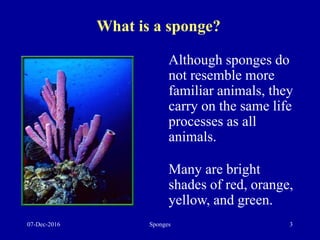
Although sponges do
not resemble more
familiar animals, they
carry on the same life
processes as all
animals.
Many are bright
shades of red, orange,
yellow, and green.
07-Dec-2016 Sponges 3
Sponges are pore-bearers
Sponges are classified in the
invertebrate phylum Porifera, which
means “pore bearer.”
Most live in marine biomes, but about
150 species can be found in freshwater
environments.
07-Dec-2016 Sponges 4
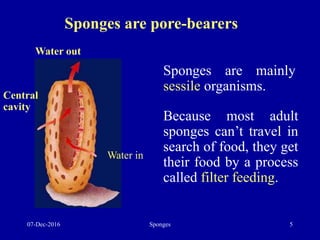
Sponges are mainly
sessile organisms.
Water out
Central
cavity
Water in
Because most adult
sponges can’t travel in
search of food, they get
their food by a process
called filter feeding.
Sponges are pore-bearers
07-Dec-2016 Sponges 5
Sponges are pore-bearers
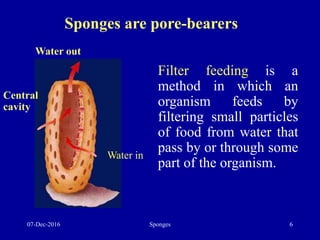
Water out
Central
cavity
Water in
Filter feeding is a
method in which an
organism feeds by
filtering small particles
of food from water that
pass by or through some
part of the organism.
07-Dec-2016 Sponges 6
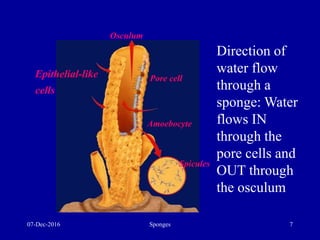
Osculum
Epithelial-like
cells
Pore cell
Amoebocyte
Spicules
Direction of
water flow
through a
sponge: Water
flows IN
through the
pore cells and
OUT through
the osculum
07-Dec-2016 Sponges 7
Pinacocytes: ‘skin cells’, thin, leathery and tightly packed.
Choanocytes: Striking resemblance to choanoflagellates (a single-
celled protist). Their function is to create active pumping of water
and major site of nutrient uptake.
Archaeocytes: These cells are “totipotent”. They can change into
all of the other types of cells. Ingest and digest food caught by
choanocyte collars.
Schlerocytes: Create and excrete spicules.
General physiology
07-Dec-2016 Sponges 8
Feeding
 Sponges feed on fine particulate material in the inflowing
water.
 Food particles generally range from 5 to 50 µm and are
phagocytized by archeocytes.
 After digestion is complete, the archeocytes and associated
wastes are expelled into the water.
07-Dec-2016 Sponges 9
Cell organization in sponges
For some sponge species, if you took a
living sponge and put it through a sieve,
not only would the sponge’s cells be alive
and separated out, but these cells would
come together to form new sponges.
It can take several weeks for the sponge’s
cells to reorganize themselves.
07-Dec-2016 Sponges 10
Types of cells
CELLTYPES, BODY WALL AND SKELETONS
 Sponges have simple bodies. But still sponges are more than
colonies of independent cells. The sponges also have
specialized cells. Therefore, division of labour is present in
them. Following types of cells are present in phylum porifera.
 1. Pinacocytes: Pinacocytes are thin walled and flat cells. They line
the outer surface of a sponge. Pinacocytes are slightly
contractile. Their contraction can change the shape of some
sponges. Some pinacocytes forms tube like
contractile porocytes. Porocytes regulate water circulation. The
openings of the porocytes are pathways tiw water movement of
water through the body wall.
 2. Mesohyl: Mesohyl is a jelly like layer present below the
pinacocytes. Amoeboid cells are present in it. These cells are
called mesenchyma cells. The mesenchyma cells freely move
in the mesohyl. These cells are specialized for reproduction,
secreting, skeletal elements, transporting and storing food and
forming contractile rings around openings in the sponge wall.07-Dec-2016 Sponges 11
Types of Cells
 3. Choanocytes: Choanocytes or collar cells are present below the
mesohyl. They form the lining of the inner chamber.
Choanocytes are flagellated cells. They have a collar like ring of
microvilli surrounding a flagellum. Microfilaments connect the
microvilli. It forms a netlike structure within the collar. The
flagellum creates water currents through the sponge. The collar
filters microscopic food particles from the water.
Collar cells are also present in a group of protists called
choanoflagellates. Choanocytes are present in sponges and
choanoflagellates. It suggests an evolutionary link between
these groups.
07-Dec-2016 Sponges 12
Cell organization in sponges
Many biologists hypothesize that sponges
evolved directly from colonial, flagellated
protists, such as Volvox.
Volvox
07-Dec-2016 Sponges 13
Cell organization in sponges
More importantly,
sponges exhibit a major
step in the evolution of
animals—the change
from unicellular life
to a division of labor
among groups of
organized cells.
07-Dec-2016 Sponges 14
Reproduction in sponges
Most sponges reproduce sexually.
Some sponges have
separate sexes, but most
sponges are
hermaphrodites.
A hermaphrodite is an
animal that can produce
both eggs and sperm.
07-Dec-2016 Sponges 15
Reproduction in sponges
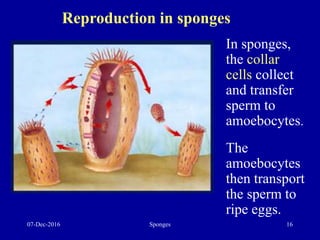
In sponges,
the collar
cells collect
and transfer
sperm to
amoebocytes.
The
amoebocytes
then transport
the sperm to
ripe eggs.
07-Dec-2016 Sponges 16
Support and defense systems in sponges
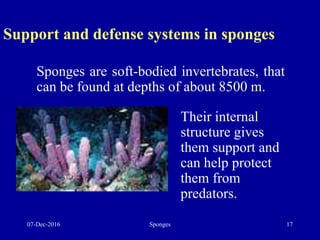
Sponges are soft-bodied invertebrates, that
can be found at depths of about 8500 m.
Their internal
structure gives
them support and
can help protect
them from
predators.
07-Dec-2016 Sponges 17
Support and defense systems in sponges
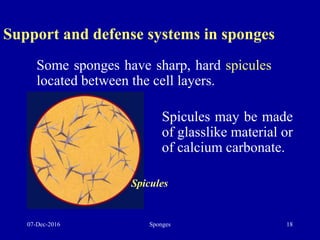
Some sponges have sharp, hard spicules
located between the cell layers.
Spicules may be made
of glasslike material or
of calcium carbonate.
Spicules
07-Dec-2016 Sponges 18
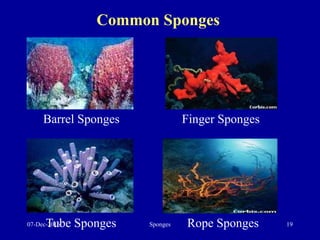
Common Sponges
Barrel Sponges Finger Sponges
Tube Sponges Rope Sponges07-Dec-2016 Sponges 19
THANKS
07-Dec-2016 Sponges 20

Sponges

  • 1.
    Topic: Sponges Submitted to:Dr. Muhammad Wajid Presented by: Muhammad Ahmad BS (Hons) Zoology UNIVERSITY OF OKARA 07-Dec-2016 Sponges 1
  • 2.
    What is asponge? Sponges are asymmetrical aquatic animals that have a variety of colors, shapes, and sizes. 07-Dec-2016 Sponges 2
  • 3.
    What is asponge? Although sponges do not resemble more familiar animals, they carry on the same life processes as all animals. Many are bright shades of red, orange, yellow, and green. 07-Dec-2016 Sponges 3
  • 4.
    Sponges are pore-bearers Spongesare classified in the invertebrate phylum Porifera, which means “pore bearer.” Most live in marine biomes, but about 150 species can be found in freshwater environments. 07-Dec-2016 Sponges 4
  • 5.
    Sponges are mainly sessileorganisms. Water out Central cavity Water in Because most adult sponges can’t travel in search of food, they get their food by a process called filter feeding. Sponges are pore-bearers 07-Dec-2016 Sponges 5
  • 6.
    Sponges are pore-bearers Waterout Central cavity Water in Filter feeding is a method in which an organism feeds by filtering small particles of food from water that pass by or through some part of the organism. 07-Dec-2016 Sponges 6
  • 7.
    Osculum Epithelial-like cells Pore cell Amoebocyte Spicules Direction of waterflow through a sponge: Water flows IN through the pore cells and OUT through the osculum 07-Dec-2016 Sponges 7
  • 8.
    Pinacocytes: ‘skin cells’,thin, leathery and tightly packed. Choanocytes: Striking resemblance to choanoflagellates (a single- celled protist). Their function is to create active pumping of water and major site of nutrient uptake. Archaeocytes: These cells are “totipotent”. They can change into all of the other types of cells. Ingest and digest food caught by choanocyte collars. Schlerocytes: Create and excrete spicules. General physiology 07-Dec-2016 Sponges 8
  • 9.
    Feeding  Sponges feedon fine particulate material in the inflowing water.  Food particles generally range from 5 to 50 µm and are phagocytized by archeocytes.  After digestion is complete, the archeocytes and associated wastes are expelled into the water. 07-Dec-2016 Sponges 9
  • 10.
    Cell organization insponges For some sponge species, if you took a living sponge and put it through a sieve, not only would the sponge’s cells be alive and separated out, but these cells would come together to form new sponges. It can take several weeks for the sponge’s cells to reorganize themselves. 07-Dec-2016 Sponges 10
  • 11.
    Types of cells CELLTYPES,BODY WALL AND SKELETONS  Sponges have simple bodies. But still sponges are more than colonies of independent cells. The sponges also have specialized cells. Therefore, division of labour is present in them. Following types of cells are present in phylum porifera.  1. Pinacocytes: Pinacocytes are thin walled and flat cells. They line the outer surface of a sponge. Pinacocytes are slightly contractile. Their contraction can change the shape of some sponges. Some pinacocytes forms tube like contractile porocytes. Porocytes regulate water circulation. The openings of the porocytes are pathways tiw water movement of water through the body wall.  2. Mesohyl: Mesohyl is a jelly like layer present below the pinacocytes. Amoeboid cells are present in it. These cells are called mesenchyma cells. The mesenchyma cells freely move in the mesohyl. These cells are specialized for reproduction, secreting, skeletal elements, transporting and storing food and forming contractile rings around openings in the sponge wall.07-Dec-2016 Sponges 11
  • 12.
    Types of Cells 3. Choanocytes: Choanocytes or collar cells are present below the mesohyl. They form the lining of the inner chamber. Choanocytes are flagellated cells. They have a collar like ring of microvilli surrounding a flagellum. Microfilaments connect the microvilli. It forms a netlike structure within the collar. The flagellum creates water currents through the sponge. The collar filters microscopic food particles from the water. Collar cells are also present in a group of protists called choanoflagellates. Choanocytes are present in sponges and choanoflagellates. It suggests an evolutionary link between these groups. 07-Dec-2016 Sponges 12
  • 13.
    Cell organization insponges Many biologists hypothesize that sponges evolved directly from colonial, flagellated protists, such as Volvox. Volvox 07-Dec-2016 Sponges 13
  • 14.
    Cell organization insponges More importantly, sponges exhibit a major step in the evolution of animals—the change from unicellular life to a division of labor among groups of organized cells. 07-Dec-2016 Sponges 14
  • 15.
    Reproduction in sponges Mostsponges reproduce sexually. Some sponges have separate sexes, but most sponges are hermaphrodites. A hermaphrodite is an animal that can produce both eggs and sperm. 07-Dec-2016 Sponges 15
  • 16.
    Reproduction in sponges Insponges, the collar cells collect and transfer sperm to amoebocytes. The amoebocytes then transport the sperm to ripe eggs. 07-Dec-2016 Sponges 16
  • 17.
    Support and defensesystems in sponges Sponges are soft-bodied invertebrates, that can be found at depths of about 8500 m. Their internal structure gives them support and can help protect them from predators. 07-Dec-2016 Sponges 17
  • 18.
    Support and defensesystems in sponges Some sponges have sharp, hard spicules located between the cell layers. Spicules may be made of glasslike material or of calcium carbonate. Spicules 07-Dec-2016 Sponges 18
  • 19.
    Common Sponges Barrel SpongesFinger Sponges Tube Sponges Rope Sponges07-Dec-2016 Sponges 19
  • 20.