BIOLOGY OF SPONGE
T. RAMESH
Assistant Professor of Zoology
Vivekananda College
Salient features of phylum Porifera
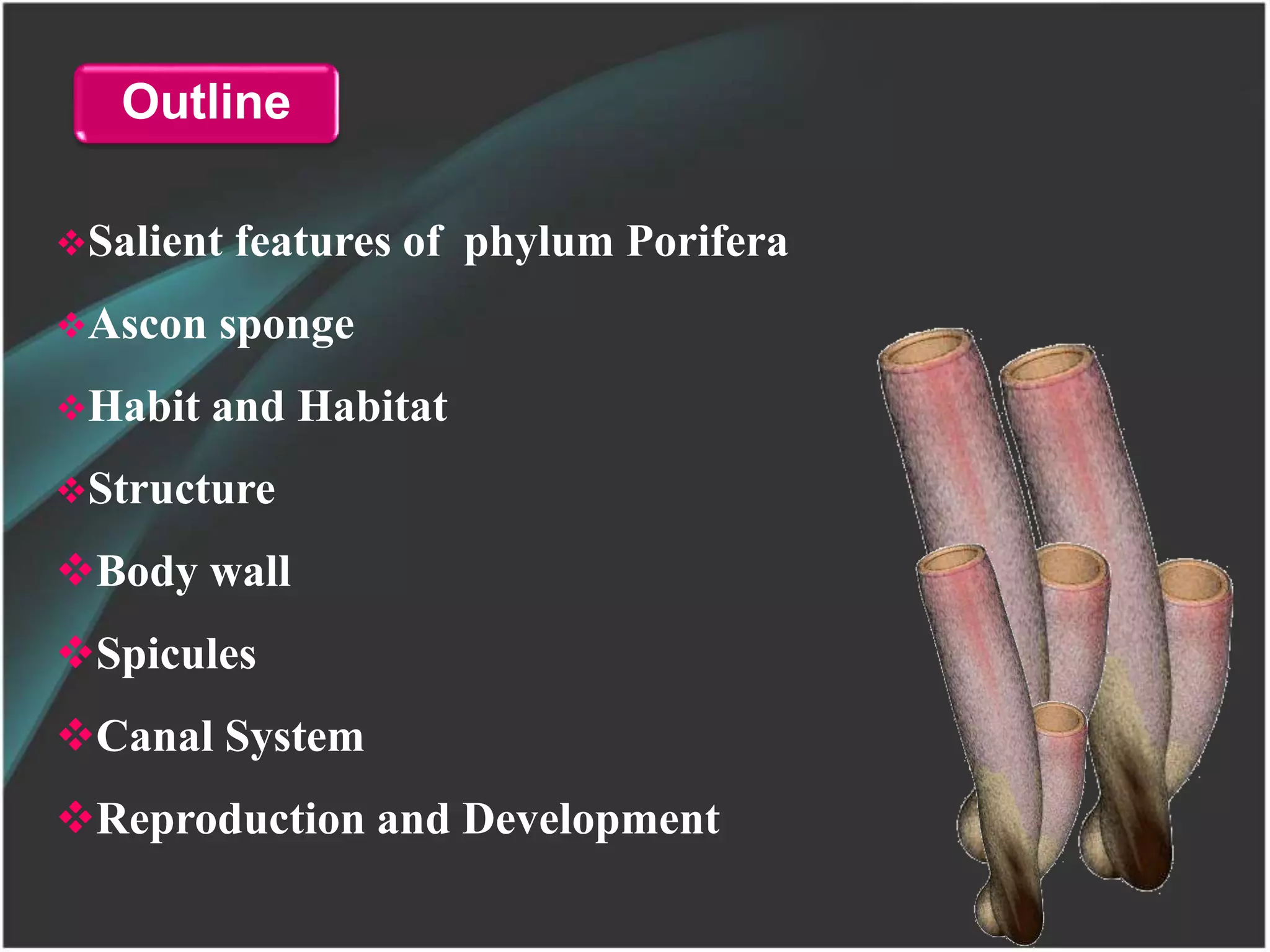
Ascon sponge
Habit and Habitat
Structure
Body wall
Spicules
Canal System
Reproduction and Development
Outline
Phylum Porifera
 Pronounced (po-rif'-er-a)
 The name means “bearing pores animal”
 First multi cellular organisms
 Sponges are made up of a system of tiny pores and canals
that make up a intricate filter feeding system.
 They are sessile/sedentary- meaning they have a
stationary, less mobile, inactive lifestyle.
 Diploblastic- ectoderm and endoderm- mesenchyme
 Their bodies are made up of thousands of cells mixed
together in a gel-like mixture, supported by small
structures called spicules made of calcium carbonate or
silica and collagen.
 They are sedentary, they are highly dependent on
ocean currents to bring food to them and eliminate
waste products.
 They have no organs or true tissues.
 Digestion is intracellular.
 Respiration and excretion occurs by simple diffusion.
No nervous system.
 Sponges are asymmetrical.
 There are three main classes of sponges; Calcarea,
Hexactinellida, and Demospongiae.
 Reproduction- Sexual and asexual (budding-gemmule)
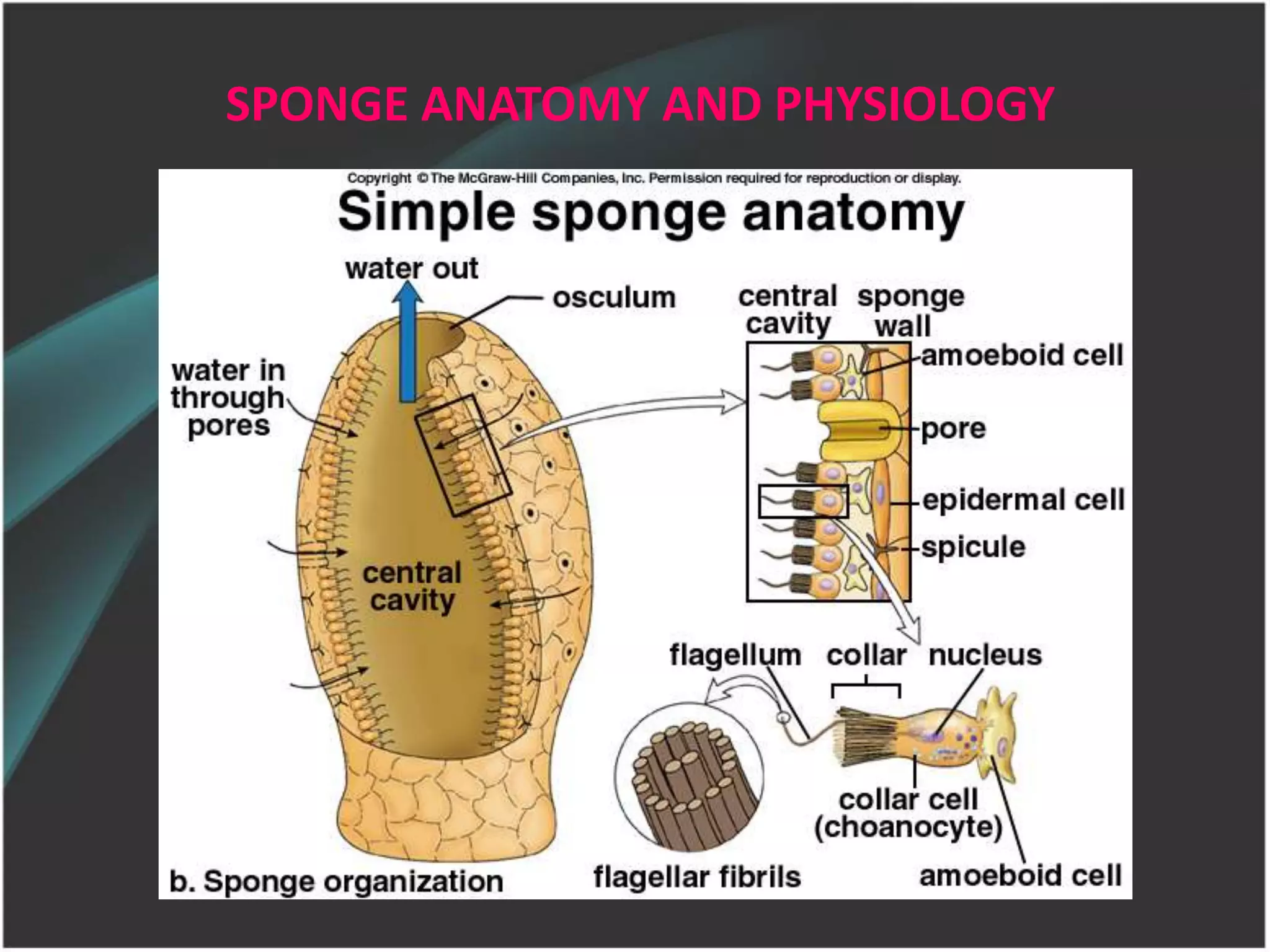
SPONGE ANATOMY AND PHYSIOLOGY
 Their bodies are made of numerous tiny pores called
Ostia that allow water to flow into a sponge.
 One to several large openings that allow water to flow
out of a sponge are called Oscula.
 A singular Oscula is called an Osculum.
 Small cells that line the canals of a sponge with
whiplike flagella are called Choanocytes.
 The flagella on the choanocytes maintain the flow of
water through the canals.
 The choanocytes also trap food particles.
SPONGE ANATOMY AND PHYSIOLOGY
Sponge Ecology
 There are about 5000 sponge species.
 About 97% are marine, 3% freshwater.
 Embryos are free-swimming.
 Adults are always attached to other objects.
(rocks, corals, submerged objects etc.)
 Many other organisms such as crab and fish
live symbiotically in or on sponges.
 Some sponges live on other organisms like
molluscs and corals.
Sponge Reproduction
 Sponges reproduce both sexually and
asexually.
 Most sponges are monoecious. Meaning a
single sponge can have both male and female
sex cells.
 Sperm cells develop from choanocytes. Egg
cells can develop from choanocytes in some
species and from archaeocytes in others.
 Asexual reproduction can also occur by the
formation of internal buds called gemmules.
 Gemmules are internal buds that are usually
inactive and contain archaeocytes.
 Gemmules are formed during unfavorable
conditions like drought, freezing temperatures,
and anoxia for long periods of time.
 After the unfavorable conditions pass, the
archaeocytes can then be released from the
gemmules to regenerate into a new sponge.
It is simple type of sponge- Asconoid sponge
Primitive multi cellular organisms
 Body has numerous pores
They are small and tube shaped.
Water enters the ostia into a large cavity called the
Spongocoel.
The choanocytes then expel the water out the osculum.
Asconoids are found only in the class Calcarea.
ASCON SPONGE
It is marine sponge
They are living in colony form
Mostly they found on rocks (attached) and seashores
High tidal region – Very Common
Habit and Habitat
Structure
1. Leucosolenia is branched colony
2. Horizontal and Vertical tubes
3. Horizontal tubes are branched - Dehesive Disc
4. Vertical tubes are unbranched – Formed individual
colony- vase shaped- size 2.5 cm height- Consists many
pores is called Ostia- inside opening is Spongocoel-
Outside large opening is Osculum
Structure
Spicules of Ascon sponge
Various forms of Spicules embedded in the body wall
They are made up of Silica or Calcium Carbonate
Three kinds of spicules
Monaxon Triaxon Tetraxon
Nutrition
Water current flows into the Spongocoel through the
epidermal Ostia
Water current has three main functions- nutrition,
excretion and respiration
Water current brings prey- captured by Choanocytes
and Amoebocytes
Digestion- Intracellular
Reproduction
Asexual reproduction- Budding (buds are developed
from base)
Sexual reproduction- Gonads are not formed (gametes -
archaeocytes)
Parenchymula larva
Free swimming larva
Oval shape
It is formed flagellated cell
It is filled with mass of round cells - Amoebocytes
References
http://cronodon.com/BioTech/Sponges.html
N.C. Nair et al. Text book of Invertebrates- Saras publication, Tamil
Nadu
Thank you

Biology of sponge

  • 1.
    BIOLOGY OF SPONGE T.RAMESH Assistant Professor of Zoology Vivekananda College
  • 2.
    Salient features ofphylum Porifera Ascon sponge Habit and Habitat Structure Body wall Spicules Canal System Reproduction and Development Outline
  • 3.
    Phylum Porifera  Pronounced(po-rif'-er-a)  The name means “bearing pores animal”  First multi cellular organisms  Sponges are made up of a system of tiny pores and canals that make up a intricate filter feeding system.  They are sessile/sedentary- meaning they have a stationary, less mobile, inactive lifestyle.  Diploblastic- ectoderm and endoderm- mesenchyme  Their bodies are made up of thousands of cells mixed together in a gel-like mixture, supported by small structures called spicules made of calcium carbonate or silica and collagen.
  • 4.
     They aresedentary, they are highly dependent on ocean currents to bring food to them and eliminate waste products.  They have no organs or true tissues.  Digestion is intracellular.  Respiration and excretion occurs by simple diffusion. No nervous system.  Sponges are asymmetrical.  There are three main classes of sponges; Calcarea, Hexactinellida, and Demospongiae.  Reproduction- Sexual and asexual (budding-gemmule)
  • 5.
    SPONGE ANATOMY ANDPHYSIOLOGY  Their bodies are made of numerous tiny pores called Ostia that allow water to flow into a sponge.  One to several large openings that allow water to flow out of a sponge are called Oscula.  A singular Oscula is called an Osculum.  Small cells that line the canals of a sponge with whiplike flagella are called Choanocytes.  The flagella on the choanocytes maintain the flow of water through the canals.  The choanocytes also trap food particles.
  • 6.
  • 7.
    Sponge Ecology  Thereare about 5000 sponge species.  About 97% are marine, 3% freshwater.  Embryos are free-swimming.  Adults are always attached to other objects. (rocks, corals, submerged objects etc.)  Many other organisms such as crab and fish live symbiotically in or on sponges.  Some sponges live on other organisms like molluscs and corals.
  • 8.
    Sponge Reproduction  Spongesreproduce both sexually and asexually.  Most sponges are monoecious. Meaning a single sponge can have both male and female sex cells.  Sperm cells develop from choanocytes. Egg cells can develop from choanocytes in some species and from archaeocytes in others.  Asexual reproduction can also occur by the formation of internal buds called gemmules.
  • 9.
     Gemmules areinternal buds that are usually inactive and contain archaeocytes.  Gemmules are formed during unfavorable conditions like drought, freezing temperatures, and anoxia for long periods of time.  After the unfavorable conditions pass, the archaeocytes can then be released from the gemmules to regenerate into a new sponge.
  • 10.
    It is simpletype of sponge- Asconoid sponge Primitive multi cellular organisms  Body has numerous pores They are small and tube shaped. Water enters the ostia into a large cavity called the Spongocoel. The choanocytes then expel the water out the osculum. Asconoids are found only in the class Calcarea. ASCON SPONGE
  • 11.
    It is marinesponge They are living in colony form Mostly they found on rocks (attached) and seashores High tidal region – Very Common Habit and Habitat
  • 12.
    Structure 1. Leucosolenia isbranched colony 2. Horizontal and Vertical tubes 3. Horizontal tubes are branched - Dehesive Disc 4. Vertical tubes are unbranched – Formed individual colony- vase shaped- size 2.5 cm height- Consists many pores is called Ostia- inside opening is Spongocoel- Outside large opening is Osculum
  • 13.
  • 14.
    Spicules of Asconsponge Various forms of Spicules embedded in the body wall They are made up of Silica or Calcium Carbonate Three kinds of spicules Monaxon Triaxon Tetraxon
  • 15.
    Nutrition Water current flowsinto the Spongocoel through the epidermal Ostia Water current has three main functions- nutrition, excretion and respiration Water current brings prey- captured by Choanocytes and Amoebocytes Digestion- Intracellular
  • 16.
    Reproduction Asexual reproduction- Budding(buds are developed from base) Sexual reproduction- Gonads are not formed (gametes - archaeocytes)
  • 17.
    Parenchymula larva Free swimminglarva Oval shape It is formed flagellated cell It is filled with mass of round cells - Amoebocytes
  • 18.
    References http://cronodon.com/BioTech/Sponges.html N.C. Nair etal. Text book of Invertebrates- Saras publication, Tamil Nadu
  • 19.