SKELETAL &
SPICULES
STRUCTURES IN
PORIFERA
Dr. K. Rama ao
M.Sc (Zoo); M. Sc (Psy) M.Ed; Ph. D; PDF (DST); PDF (DBT)
Skeletal structures of sponges
are spicules and spongin fibres.
Spicules are formed by
carbonates of lime or silica in
the form of needle like pieces.
Spongin fibres are composed of
a silk-like scleroprotein.
Meaning of Spicules:
The spicules or sclerites are definite
bodies, having a crystalline appearance
and consisting in general of simple
spines or of spines radiating from a
point.
They have an axis of organic material
around which is deposited the inorganic
substance, either calcium carbonate or
hydrated silica.
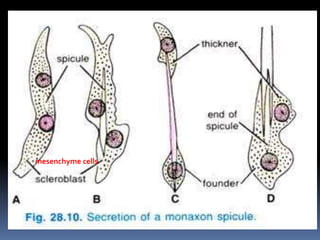
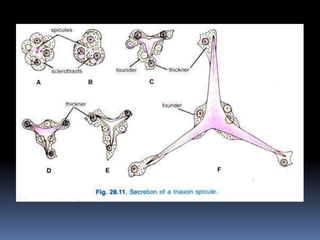
mesenchyme cells
Development of Spicules:
Spicules are secreted by mesenchyme
cells, called scleroblasts. Very little is
known about the formation of various
kinds of spicules. The process is best
known for calcareous spicules.
On the basis of development, the
spicules may be primary which owe their
first origin from a single mother cell or
scleroblast, or secondary which arise
from more than one scleroblast.
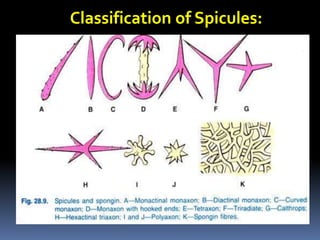
Classification of Spicules:
First, spicules are of two general
kinds — megascleres and
microscleres.
The spicules are further classified
according to the number of their
axes and rays. Words designating
the number of axes end in axons,
number of rays.
1. Megascleres:
The megascleres are the larger
skeletal spicules that constitute the
chief supporting framework of the
sponge.
There are five general types of
megasclere spicules, viz., monaxons,
tetraxons, triaxons, polyaxons and
spheres.
(i) Monaxons:
These are formed by growth in one or
both directions along a single axis,
which may be straight or curved.
When growth has occurred in one
direction only, the spicule is called
monactinal monaxon or style.
Styles are typically rounded
(strongylote) at one end and pointed
(oxeote) at the other.
(ii)Tetraxons:
Tetraxon spicules are also called
tetractines and quadri radiates. They
consist typically of four rays, not in
the same plane, radiating from a
common point.
The four rays of the tetraxon spicule
may be more or less equal, in which
case the spicule is called a calthrops.
(iii)Triaxons:
The triaxon or hexactinal spicule
consists fundamentally of three axes
crossing at right angles, producing
six rays extending at right angles
from a central point.
From this basic type all possible
modifications arise by reduction or
loss of rays, branching and curving of
the rays, and the development of
spines, knobs, etc.,
(v) Spheres:
These are rounded bodies in which
growth is concentric around a centre.
(vi) Desma:
A special type of megasclere known as
desma occur in a number of sponges. A
desma consists of an ordinary minute
monaxon, triradiate,or tetraxon spicule,
on which layers of silica have been
deposited irregularly.
2. Microscleres:
The microscleres are the smaller
flesh spicules that occur strewn
throughout the mesenchyme.
However, they do not form the
supporting framework.
The microspheres are of two
types, viz., spires and asters.
(i) Spires:
Spires are curved in one plane or
spirally twisted and exhibits many
shapes.
The most common types are the C-
shaped forms, called sigmas; the
bow-shaped ones and the chelas
with recurved hooks, plates or
flukes at each end.
(ii) Asters:
Asters include types with small
centres and long rays and large
centres and small rays.
Among the small centred forms are
oxyasters with pointed rays,
strongylaster with rounded ends and
tylasters with knobbed rays.
SPONGIN FIBRES
Spongin is an organic horny, elastic
substance consisting of scleroprotein
that is rich in sulphur and is chemically
similar to collagen and sericin. It
contains hydroxyproline and glycine in
large proportions and also contains
glucosamine, glucose, galactosamine
and galactose mannose, fucose,
arabinose and uronic acid.
Spongin is insoluble in water and
acids but soluble in KOH. It is
chemically inert and cannot be
digested by the digestive
enzymes.
Spongin contains a large amount
of iodine, up to 14% in certain
tropical species.

Porifera Spicules.pptx

  • 1.
    SKELETAL & SPICULES STRUCTURES IN PORIFERA Dr.K. Rama ao M.Sc (Zoo); M. Sc (Psy) M.Ed; Ph. D; PDF (DST); PDF (DBT)
  • 2.
    Skeletal structures ofsponges are spicules and spongin fibres. Spicules are formed by carbonates of lime or silica in the form of needle like pieces. Spongin fibres are composed of a silk-like scleroprotein.
  • 3.
    Meaning of Spicules: Thespicules or sclerites are definite bodies, having a crystalline appearance and consisting in general of simple spines or of spines radiating from a point. They have an axis of organic material around which is deposited the inorganic substance, either calcium carbonate or hydrated silica.
  • 4.
  • 5.
    Development of Spicules: Spiculesare secreted by mesenchyme cells, called scleroblasts. Very little is known about the formation of various kinds of spicules. The process is best known for calcareous spicules. On the basis of development, the spicules may be primary which owe their first origin from a single mother cell or scleroblast, or secondary which arise from more than one scleroblast.
  • 6.
  • 7.
    First, spicules areof two general kinds — megascleres and microscleres. The spicules are further classified according to the number of their axes and rays. Words designating the number of axes end in axons, number of rays.
  • 8.
    1. Megascleres: The megascleresare the larger skeletal spicules that constitute the chief supporting framework of the sponge. There are five general types of megasclere spicules, viz., monaxons, tetraxons, triaxons, polyaxons and spheres.
  • 9.
    (i) Monaxons: These areformed by growth in one or both directions along a single axis, which may be straight or curved. When growth has occurred in one direction only, the spicule is called monactinal monaxon or style. Styles are typically rounded (strongylote) at one end and pointed (oxeote) at the other.
  • 10.
    (ii)Tetraxons: Tetraxon spicules arealso called tetractines and quadri radiates. They consist typically of four rays, not in the same plane, radiating from a common point. The four rays of the tetraxon spicule may be more or less equal, in which case the spicule is called a calthrops.
  • 11.
    (iii)Triaxons: The triaxon orhexactinal spicule consists fundamentally of three axes crossing at right angles, producing six rays extending at right angles from a central point. From this basic type all possible modifications arise by reduction or loss of rays, branching and curving of the rays, and the development of spines, knobs, etc.,
  • 12.
    (v) Spheres: These arerounded bodies in which growth is concentric around a centre. (vi) Desma: A special type of megasclere known as desma occur in a number of sponges. A desma consists of an ordinary minute monaxon, triradiate,or tetraxon spicule, on which layers of silica have been deposited irregularly.
  • 13.
    2. Microscleres: The microscleresare the smaller flesh spicules that occur strewn throughout the mesenchyme. However, they do not form the supporting framework. The microspheres are of two types, viz., spires and asters.
  • 14.
    (i) Spires: Spires arecurved in one plane or spirally twisted and exhibits many shapes. The most common types are the C- shaped forms, called sigmas; the bow-shaped ones and the chelas with recurved hooks, plates or flukes at each end.
  • 15.
    (ii) Asters: Asters includetypes with small centres and long rays and large centres and small rays. Among the small centred forms are oxyasters with pointed rays, strongylaster with rounded ends and tylasters with knobbed rays.
  • 17.
    SPONGIN FIBRES Spongin isan organic horny, elastic substance consisting of scleroprotein that is rich in sulphur and is chemically similar to collagen and sericin. It contains hydroxyproline and glycine in large proportions and also contains glucosamine, glucose, galactosamine and galactose mannose, fucose, arabinose and uronic acid.
  • 18.
    Spongin is insolublein water and acids but soluble in KOH. It is chemically inert and cannot be digested by the digestive enzymes. Spongin contains a large amount of iodine, up to 14% in certain tropical species.