The Middle Ages
500–1450
Important historical events
• Fall of Roman Empire (c. 476)
• Dark Ages (500–1000)—all power flowed from the king
with the approval of Roman Catholic Church and its
bishops.
• Rise of monasteries.
• Late Middle Ages (1000–1450)—construction of great
cathedrals and founding of universities throughout
Europe.
• Time of Crusades and knights—Crusades to conquer the
Holy Land from the Muslims.
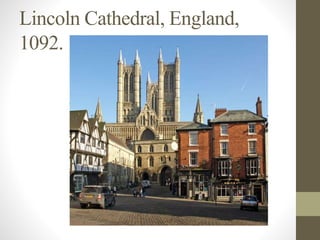
Lincoln Cathedral, England,
1092.
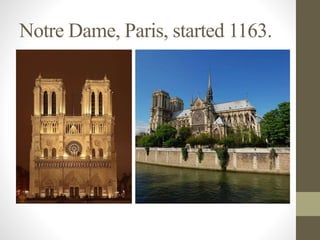
Notre Dame, Paris, started 1163.
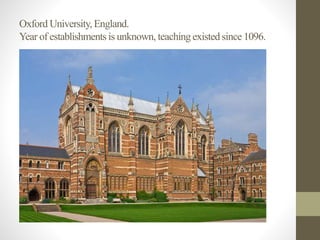
Oxford University, England.
Year of establishments is unknown, teaching existed since 1096.
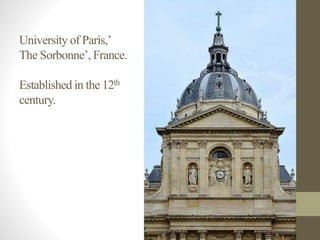
University of Paris,’
The Sorbonne’, France.
Established in the 12th
century.
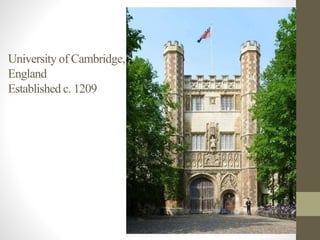
University of Cambridge,
England
Established c. 1209
Pythagoras (born between 580 and 572 BC, died
between 500 and 490 BC ).
Pythagoras was very interested in music, and so were his
followers. Pythagoras wanted to improve the music of his day,
which he believed was not harmonious enough and was too
hectic.
According to legend, the way Pythagoras discovered that
musical notes could be translated into mathematical equations
was when one day he passed blacksmiths at work, and
thought that the sounds emanating from their anvils being hit
were beautiful and harmonious and decided that whatever
scientific law caused this to happen must be mathematical and
could be applied to music. He went to the blacksmiths to learn
how this had happened by looking at their tools, he discovered
that it was because the anvils were "simple ratios of each
other, one was half the size of the first, another was 2/3 the
size, and so on."
Pythagoras
Please watch segments 3, 4, and 5 from the movie “Equal
Temperament”. You could either click on the link below or
access this movie from the TCC Library Website at Online
Videos, Films on Demand. You will need you Blackboard
credentials to login.
http://digital.films.com.ezproxy.vccs.edu:2048/PortalViewVideo.
aspx?xtid=10879&psid=0&sid=0&State=&title=Equal%20Temper
ament&IsSearch=N&parentSeriesID=#
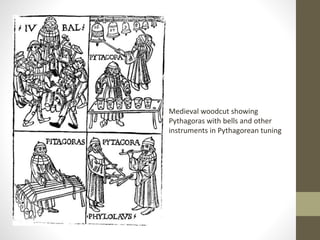
Medieval woodcut showing
Pythagoras with bells and other
instruments in Pythagorean tuning
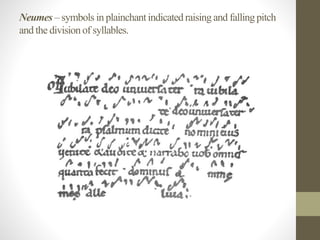
Neumes – symbols in plainchantindicatedraisingand fallingpitch
and the divisionof syllables.
From Neumes to Notes
Watch segments 3 – 6 from the movie “Notation: The Thin Red
Line”. You could either click on the link below or access this
movie from the TCC Library Website at Online Videos, Films on
Demand. You will need you Blackboard credentials to login.
http://digital.films.com.ezproxy.vccs.edu:2048/PortalViewVideo.
aspx?xtid=10877&psid=0&sid=0&State=&title=Notation:%20The
%20Thin%20Red%20Line&IsSearch=N&parentSeriesID=#
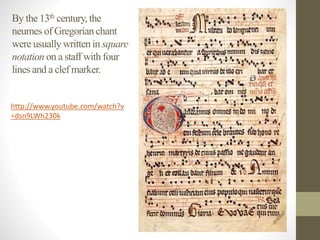
By the 13th century, the
neumes of Gregorianchant
were usuallywrittenin square
notation on a staff with four
lines and a clef marker.
http://www.youtube.com/watch?v
=dsn9LWh230k
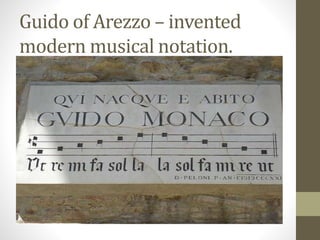
Guido of Arezzo – invented
modern musical notation.
Modes
Major / minor tonality system was not established until the Baroque
era. The following modes were used in Medieval and Renaissance
music.
You can play these on the virtual piano:
http://www.bgfl.org/bgfl/custom/resources_ftp/client_ftp/ks2/music/pi
ano/index.htm
• Dorian: D E F G A B C D
• Hypodorian: A B C D E F G A
• Phrygian: E F G A B C D E
• Hypophrygian: B C D E F G A B
• Lydian: F G A B C D E F
• Hypolydian: C D E F G A B C
• Mixolydian: G A B C D E F G
• Hypomixolydian: D E F G A B C D
Play examples of the modes on the following page:
http://www.teoria.com/reference/g/gregorian.php
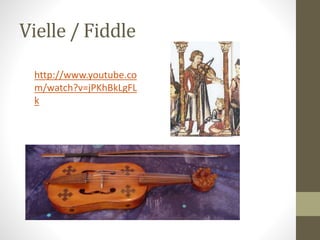
Vielle / Fiddle
http://www.youtube.co
m/watch?v=jPKhBkLgFL
k
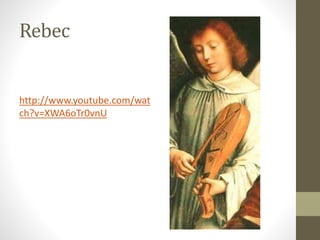
Rebec
http://www.youtube.com/wat
ch?v=XWA6oTr0vnU
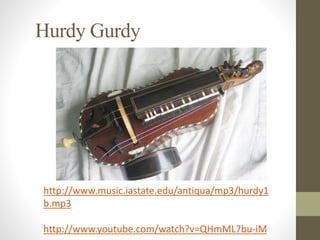
Hurdy Gurdy
http://www.music.iastate.edu/antiqua/mp3/hurdy1
b.mp3
http://www.youtube.com/watch?v=QHmML7bu-iM
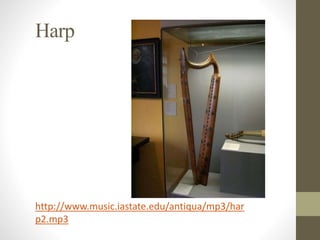
Harp
http://www.music.iastate.edu/antiqua/mp3/har
p2.mp3
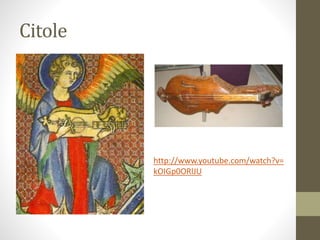
Citole
http://www.youtube.com/watch?v=
kOIGp0ORlJU
Psaltery
http://www.music.iastate.edu/antiqua/psaltery
.wav
http://www.youtube.com/watch?v=0NafOksjV
Gk
Percussion Instruments
• Tambourine
• Bells
• Tabor
• Nackers
http://www.music.ias
tate.edu/antiqua/per
cuss.htm
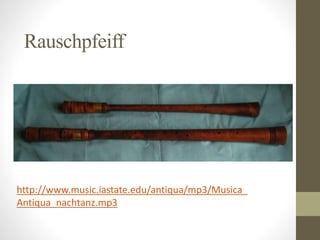
Rauschpfeiff
http://www.music.iastate.edu/antiqua/mp3/Musica_
Antiqua_nachtanz.mp3
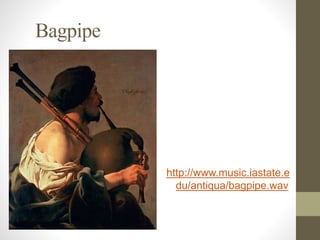
Bagpipe
http://www.music.iastate.e
du/antiqua/bagpipe.wav
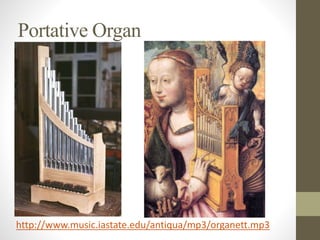
Portative Organ
http://www.music.iastate.edu/antiqua/mp3/organett.mp3
Plucked, Keyboard and
Percussion Instruments
Please watch the following. You will need your credentials to
access the TCC Library website.
Plucked Instruments – segments 1 – 4.
http://digital.films.com.ezproxy.vccs.edu:2048/PortalViewVideo.
aspx?xtid=923&psid=0&sid=0&State=&title=Plucked%20Instrum
ents&IsSearch=N&parentSeriesID=
Keyboard and Percussion – segments 1 – 4.
http://digital.films.com.ezproxy.vccs.edu:2048/PortalViewVideo.
aspx?xtid=925&psid=0&sid=0&State=&title=Keyboard%20and%
20Percussion&IsSearch=N&parentSeriesID=
Brass and Bowed Instruments
Please watch the following. You will need your credentials to
access the TCC Library website.
Brass Instruments – segments 1 – 4.
http://digital.films.com.ezproxy.vccs.edu:2048/PortalViewVideo.
aspx?xtid=926&psid=0&sid=0&State=&title=Brass%20Instrumen
ts&IsSearch=N&parentSeriesID=
Bowed Instruments – segments 1 – 4.
http://digital.films.com.ezproxy.vccs.edu:2048/PortalViewVideo.
aspx?xtid=924&psid=0&sid=0&State=&title=Bowed%20Instrum
ents&IsSearch=N&parentSeriesID=
Sacred Music
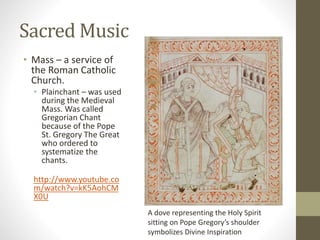
• Mass – a service of
the Roman Catholic
Church.
• Plainchant – was used
during the Medieval
Mass. Was called
Gregorian Chant
because of the Pope
St. Gregory The Great
who ordered to
systematize the
chants.
http://www.youtube.co
m/watch?v=kK5AohCM
X0U
A dove representing the Holy Spirit
sitting on Pope Gregory’s shoulder
symbolizes Divine Inspiration
Video Assignments
Watch segments 2 and 3.
http://digital.films.com.ezproxy.vccs.edu:2048/Portal
ViewVideo.aspx?xtid=716&psid=0&sid=0&State=&titl
e=The%20First%20Secular%20Music&IsSearch=N&pa
rentSeriesID=#
Watch segment 2, Plain Chant.
http://digital.films.com.ezproxy.vccs.edu:2048/Portal
ViewVideo.aspx?xtid=10877&psid=0&sid=0&State=&
title=Notation:%20The%20Thin%20Red%20Line&IsSe
arch=N&parentSeriesID=#
The Structure of the Mass
• Ordinary chants – texts are the same every mass.
• Kyrie:
Machaut, Messe de Nostre Dame
http://www.youtube.com/watch?v=1Y1O-BcZQwY
• Gloria:
Machaut, Messe de Nostre Dame
http://www.youtube.com/watch?v=6rf5uAnoQYc&list=PL0006DCE1DC5
6A64A
• Credo
• Sanctus
• Benedictus
• Agnus Dei
• Proper chants – texts change every mass.
• Hildegard of Bingen, Alleluia, o virga mediatrix (Alleluia, O
mediating branch), a chant from the Proper of the Mass
http://www.youtube.com/watch?v=27ol_QffDhE
Early Polyphony
• Polyphonic music – two simultaneous melodic lines.
• Organum - singers in monasteries began experimenting with
adding another part to the chant, generally a voice in parallel
motion. This is how polyphonic music started evolving.
http://www.youtube.com/watch?v=KR9xkGmUjIo
http://www.youtube.com/watch?v=Fj_jXG7TqVs
Hildegard of Bingen
(1098 - 1179)
• A German composer, philosopher, writer, abbess.
• Was given to the church to serve by her parents as a tithe.
• Experienced religious visions.
• Wrote theological, botanical and medicinal texts, as well as letters,
liturgical songs, and poems.
• “Illuminations” - art work.
• Ordo Virtutum – an allegorical morality play.
http://www.youtube.com/watch?v=O2aKyH2NhW0
• Three books of visions.
• A text on herbal medicine.
Ars Nova
• A late Middle Ages musical style in France.
• Greater independence of rhythm, use of
syncopation.
• Polyphony was used in secular music.
• New forms – motet, chanson, ballade.
Watch segment 8:
http://digital.films.com.ezproxy.vccs.edu:2048/PortalViewVideo.asp
x?xtid=716&psid=0&sid=0&State=&title=The%20First%20Secular%2
0Music&IsSearch=N&parentSeriesID=#
Guillaume de Machaut
(1300 – 1377)
• The first composer to create a polyphonic setting of the Ordinary of
the Catholic Mass.
• Wrote in a wide range of styles and forms.
• Helped develop motet and secular song forms.
Watch segment 9:
http://digital.films.com.ezproxy.vccs.edu:2048/PortalViewVideo.aspx?
xtid=716&psid=0&sid=0&State=&title=The%20First%20Secular%20M
usic&IsSearch=N&parentSeriesID=#
Chanson “Puis pu’en oubli” (Since I am forgotten)
http://www.youtube.com/watch?v=FHjWbgRZSrQ
Motet “Quant en moy”
http://www.youtube.com/watch?v=bZxAqWV7a0A
Secular Music
• Troubadours, trouveres, minnesingers – poet-musicians, some of
them were noble, who wrote mostly about chivalry and courtly love.
Watch segment 7:
http://digital.films.com.ezproxy.vccs.edu:2048/PortalViewVideo.aspx?
xtid=716&psid=0&sid=0&State=&title=The%20First%20Secular%20Mu
sic&IsSearch=N&parentSeriesID=#
• Summer is Coming – a 13th century English round. Please open both
links and listen looking at the music. An early example of polyphonic
music.
http://www.bl.uk/learning/images/medieval/artmusicliterature/large9
6674.html
http://www.youtube.com/watch?v=ZWWEHAswpFI
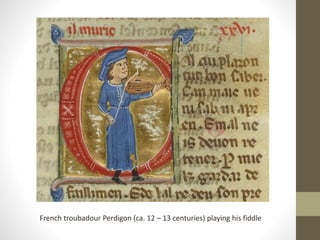
French troubadour Perdigon (ca. 12 – 13 centuries) playing his fiddle
Required readings:
• http://en.wikipedia.org/wiki/Medieval_music
• http://en.wikipedia.org/wiki/Mass_(music)
• http://www.saylor.org/site/wp-content/uploads/2011/07/MUS101-
Unit-4.1.1-CHANT_FINAL.pdf
• http://www.saylor.org/site/wp-content/uploads/2011/07/MUS-101-
ASSIGNMENT-4-1-3-SECULAR-MUSIC-IN-THE-MIDDLE-
AGES_FINAL.pdf
• http://en.wikipedia.org/wiki/Hildegard_Of_Bingen
• http://en.wikipedia.org/wiki/Guido_d%27arezzo
Optional video assignment:
http://digital.films.com.ezproxy.vccs.edu:2048/PortalViewVideo.aspx?
xtid=716&psid=0&sid=0&State=&title=The%20First%20Secular%20Mu
sic&IsSearch=N&parentSeriesID=#

The Middle Ages

  • 1.
  • 2.
    Important historical events •Fall of Roman Empire (c. 476) • Dark Ages (500–1000)—all power flowed from the king with the approval of Roman Catholic Church and its bishops. • Rise of monasteries. • Late Middle Ages (1000–1450)—construction of great cathedrals and founding of universities throughout Europe. • Time of Crusades and knights—Crusades to conquer the Holy Land from the Muslims.
  • 3.
  • 4.
    Notre Dame, Paris,started 1163.
  • 5.
    Oxford University, England. Yearof establishments is unknown, teaching existed since 1096.
  • 6.
    University of Paris,’ TheSorbonne’, France. Established in the 12th century.
  • 7.
  • 8.
    Pythagoras (born between580 and 572 BC, died between 500 and 490 BC ). Pythagoras was very interested in music, and so were his followers. Pythagoras wanted to improve the music of his day, which he believed was not harmonious enough and was too hectic. According to legend, the way Pythagoras discovered that musical notes could be translated into mathematical equations was when one day he passed blacksmiths at work, and thought that the sounds emanating from their anvils being hit were beautiful and harmonious and decided that whatever scientific law caused this to happen must be mathematical and could be applied to music. He went to the blacksmiths to learn how this had happened by looking at their tools, he discovered that it was because the anvils were "simple ratios of each other, one was half the size of the first, another was 2/3 the size, and so on."
  • 9.
    Pythagoras Please watch segments3, 4, and 5 from the movie “Equal Temperament”. You could either click on the link below or access this movie from the TCC Library Website at Online Videos, Films on Demand. You will need you Blackboard credentials to login. http://digital.films.com.ezproxy.vccs.edu:2048/PortalViewVideo. aspx?xtid=10879&psid=0&sid=0&State=&title=Equal%20Temper ament&IsSearch=N&parentSeriesID=#
  • 10.
    Medieval woodcut showing Pythagoraswith bells and other instruments in Pythagorean tuning
  • 11.
    Neumes – symbolsin plainchantindicatedraisingand fallingpitch and the divisionof syllables.
  • 12.
    From Neumes toNotes Watch segments 3 – 6 from the movie “Notation: The Thin Red Line”. You could either click on the link below or access this movie from the TCC Library Website at Online Videos, Films on Demand. You will need you Blackboard credentials to login. http://digital.films.com.ezproxy.vccs.edu:2048/PortalViewVideo. aspx?xtid=10877&psid=0&sid=0&State=&title=Notation:%20The %20Thin%20Red%20Line&IsSearch=N&parentSeriesID=#
  • 13.
    By the 13thcentury, the neumes of Gregorianchant were usuallywrittenin square notation on a staff with four lines and a clef marker. http://www.youtube.com/watch?v =dsn9LWh230k
  • 14.
    Guido of Arezzo– invented modern musical notation.
  • 15.
    Modes Major / minortonality system was not established until the Baroque era. The following modes were used in Medieval and Renaissance music. You can play these on the virtual piano: http://www.bgfl.org/bgfl/custom/resources_ftp/client_ftp/ks2/music/pi ano/index.htm • Dorian: D E F G A B C D • Hypodorian: A B C D E F G A • Phrygian: E F G A B C D E • Hypophrygian: B C D E F G A B • Lydian: F G A B C D E F • Hypolydian: C D E F G A B C • Mixolydian: G A B C D E F G • Hypomixolydian: D E F G A B C D Play examples of the modes on the following page: http://www.teoria.com/reference/g/gregorian.php
  • 16.
  • 17.
  • 18.
  • 19.
  • 20.
  • 21.
  • 22.
    Percussion Instruments • Tambourine •Bells • Tabor • Nackers http://www.music.ias tate.edu/antiqua/per cuss.htm
  • 23.
  • 24.
  • 25.
  • 26.
    Plucked, Keyboard and PercussionInstruments Please watch the following. You will need your credentials to access the TCC Library website. Plucked Instruments – segments 1 – 4. http://digital.films.com.ezproxy.vccs.edu:2048/PortalViewVideo. aspx?xtid=923&psid=0&sid=0&State=&title=Plucked%20Instrum ents&IsSearch=N&parentSeriesID= Keyboard and Percussion – segments 1 – 4. http://digital.films.com.ezproxy.vccs.edu:2048/PortalViewVideo. aspx?xtid=925&psid=0&sid=0&State=&title=Keyboard%20and% 20Percussion&IsSearch=N&parentSeriesID=
  • 27.
    Brass and BowedInstruments Please watch the following. You will need your credentials to access the TCC Library website. Brass Instruments – segments 1 – 4. http://digital.films.com.ezproxy.vccs.edu:2048/PortalViewVideo. aspx?xtid=926&psid=0&sid=0&State=&title=Brass%20Instrumen ts&IsSearch=N&parentSeriesID= Bowed Instruments – segments 1 – 4. http://digital.films.com.ezproxy.vccs.edu:2048/PortalViewVideo. aspx?xtid=924&psid=0&sid=0&State=&title=Bowed%20Instrum ents&IsSearch=N&parentSeriesID=
  • 28.
    Sacred Music • Mass– a service of the Roman Catholic Church. • Plainchant – was used during the Medieval Mass. Was called Gregorian Chant because of the Pope St. Gregory The Great who ordered to systematize the chants. http://www.youtube.co m/watch?v=kK5AohCM X0U A dove representing the Holy Spirit sitting on Pope Gregory’s shoulder symbolizes Divine Inspiration
  • 29.
    Video Assignments Watch segments2 and 3. http://digital.films.com.ezproxy.vccs.edu:2048/Portal ViewVideo.aspx?xtid=716&psid=0&sid=0&State=&titl e=The%20First%20Secular%20Music&IsSearch=N&pa rentSeriesID=# Watch segment 2, Plain Chant. http://digital.films.com.ezproxy.vccs.edu:2048/Portal ViewVideo.aspx?xtid=10877&psid=0&sid=0&State=& title=Notation:%20The%20Thin%20Red%20Line&IsSe arch=N&parentSeriesID=#
  • 30.
    The Structure ofthe Mass • Ordinary chants – texts are the same every mass. • Kyrie: Machaut, Messe de Nostre Dame http://www.youtube.com/watch?v=1Y1O-BcZQwY • Gloria: Machaut, Messe de Nostre Dame http://www.youtube.com/watch?v=6rf5uAnoQYc&list=PL0006DCE1DC5 6A64A • Credo • Sanctus • Benedictus • Agnus Dei • Proper chants – texts change every mass. • Hildegard of Bingen, Alleluia, o virga mediatrix (Alleluia, O mediating branch), a chant from the Proper of the Mass http://www.youtube.com/watch?v=27ol_QffDhE
  • 31.
    Early Polyphony • Polyphonicmusic – two simultaneous melodic lines. • Organum - singers in monasteries began experimenting with adding another part to the chant, generally a voice in parallel motion. This is how polyphonic music started evolving. http://www.youtube.com/watch?v=KR9xkGmUjIo http://www.youtube.com/watch?v=Fj_jXG7TqVs
  • 32.
    Hildegard of Bingen (1098- 1179) • A German composer, philosopher, writer, abbess. • Was given to the church to serve by her parents as a tithe. • Experienced religious visions. • Wrote theological, botanical and medicinal texts, as well as letters, liturgical songs, and poems. • “Illuminations” - art work. • Ordo Virtutum – an allegorical morality play. http://www.youtube.com/watch?v=O2aKyH2NhW0 • Three books of visions. • A text on herbal medicine.
  • 33.
    Ars Nova • Alate Middle Ages musical style in France. • Greater independence of rhythm, use of syncopation. • Polyphony was used in secular music. • New forms – motet, chanson, ballade. Watch segment 8: http://digital.films.com.ezproxy.vccs.edu:2048/PortalViewVideo.asp x?xtid=716&psid=0&sid=0&State=&title=The%20First%20Secular%2 0Music&IsSearch=N&parentSeriesID=#
  • 34.
    Guillaume de Machaut (1300– 1377) • The first composer to create a polyphonic setting of the Ordinary of the Catholic Mass. • Wrote in a wide range of styles and forms. • Helped develop motet and secular song forms. Watch segment 9: http://digital.films.com.ezproxy.vccs.edu:2048/PortalViewVideo.aspx? xtid=716&psid=0&sid=0&State=&title=The%20First%20Secular%20M usic&IsSearch=N&parentSeriesID=# Chanson “Puis pu’en oubli” (Since I am forgotten) http://www.youtube.com/watch?v=FHjWbgRZSrQ Motet “Quant en moy” http://www.youtube.com/watch?v=bZxAqWV7a0A
  • 35.
    Secular Music • Troubadours,trouveres, minnesingers – poet-musicians, some of them were noble, who wrote mostly about chivalry and courtly love. Watch segment 7: http://digital.films.com.ezproxy.vccs.edu:2048/PortalViewVideo.aspx? xtid=716&psid=0&sid=0&State=&title=The%20First%20Secular%20Mu sic&IsSearch=N&parentSeriesID=# • Summer is Coming – a 13th century English round. Please open both links and listen looking at the music. An early example of polyphonic music. http://www.bl.uk/learning/images/medieval/artmusicliterature/large9 6674.html http://www.youtube.com/watch?v=ZWWEHAswpFI
  • 36.
    French troubadour Perdigon(ca. 12 – 13 centuries) playing his fiddle
  • 37.
    Required readings: • http://en.wikipedia.org/wiki/Medieval_music •http://en.wikipedia.org/wiki/Mass_(music) • http://www.saylor.org/site/wp-content/uploads/2011/07/MUS101- Unit-4.1.1-CHANT_FINAL.pdf • http://www.saylor.org/site/wp-content/uploads/2011/07/MUS-101- ASSIGNMENT-4-1-3-SECULAR-MUSIC-IN-THE-MIDDLE- AGES_FINAL.pdf • http://en.wikipedia.org/wiki/Hildegard_Of_Bingen • http://en.wikipedia.org/wiki/Guido_d%27arezzo Optional video assignment: http://digital.films.com.ezproxy.vccs.edu:2048/PortalViewVideo.aspx? xtid=716&psid=0&sid=0&State=&title=The%20First%20Secular%20Mu sic&IsSearch=N&parentSeriesID=#