MOLECULAR AND DNA BASED MARKERS (
RFLP, RAPD, AFLP, SSR,SNP’S, EST’S)
SUBMITTED TO
Dr. Ajit Singh Gautam
Principal Scientist, Plant Breeding
Dept. of Crop Improvement
PREPARED BY
Heresh Puren
M.Sc. 1st Year, Genetics & Plant Breeding
Dept. of Crop Improvement
Marker..
• Key points
 Any genetic element (locus, allele, DNA
sequence or chromosome feature) which can be
readily detected by phenotype, cytological or
molecular techniques.
 Markers are “characters” whose pattern of
inheritance can be followed at the morphological
(e.g. flower color), biochemical (e.g. protein and
isozymes) or molecular (DNA) levels.
 A marker is a signpost linked to the trait of
interest and is co-inherited along with the trait.
They are so called as because they can be used to elicit,
albeit, indirectly, information concerning the inheritance
of “real” traits.
A genetic marker is any visible character or otherwise
assayable phenotype, for which alleles at individual loci
segregate in a mendelian manner.
The development of the discipline of genetics would not
have been possible without genetic marker such as the
visible characters in peas and drosophila.
A marker must be polymorphic, that is, it must exists in
different forms so that chromosomes with normal gene by
the form of marker it also carries, this polymorphism in
marker can be detected at three levels-
• 1. Phenotype ( morphological)
• 2. Differences in proteins ( biochemical)
• 3. Differences in the nucleotide sequences of DNA
( Molecular).
 In the early part of the 20th century, scientist discovered
that Mendelian factors controlling inheritance, which we
now call genes, were organized in linear order on
chromosomes.
 Clues to the location of a gene can come from comparing
the inheritance of a mutant gene with the inheritance of
markers of known chromosomal location.
Properties for ideal markers
1. Polymorphic, i.e. reveal high levels of allelic variability
2. Co-dominant inheritance (determination of homozygous and heterozygous
states of diploid organisms)
3. Highly robust and repeatable across different tissue types and different
laboratories i.e. Frequent occurrence in genome
4. Selective neutral behavior (the DNA sequences of any organism are neutral to
environmental conditions or management practices)
5. Easy access (availability)
6. Easy and fast assay
7. High reproducibility
8. In expensive to develop and apply
9. Unaffected by environmental and developmental variation
MORPHOLOGICAL MARKERS
 These are qualitative traits that can be scored visually. They are
generally dominant or recessive.
e.g. flower colour, seed shape,
growth habits or pigmentation etc.
Merits:
 Easy to score, not costly, etc.
Demerits:
 They are highly influenced by the environment, etc.
 Their effect may be undesirable in breeding programs.
 They may mask the effects of linked genes making it nearly
impossible to identify desirable linkages for selection.
 They are insufficiently polymorphic and are generally
dominant. Besides, they often interfere with other traits.
Biochemical markers
 Biochemical markers are proteins (enzymes)
produced by gene expression.
 These proteins can be isolated and identified by
electrophoresis and staining.
 Most of the biochemical makers are polymorphic and
insensitive to environment just like molecular markers.
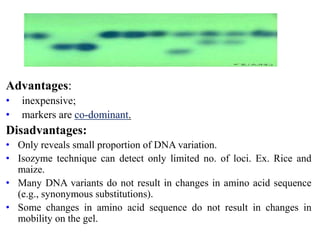
 Isozyme - a molecular marker system based on the
staining of proteins with identical function, but different
electrophoretic mobilities.
Monomer and dimer isozymes are often used
because analysis of their segregation is easier.
Isozymes are usually codominant.
Enzyme polymorphisms have been used
successfully to identify cultivars in various
fruit species.
Isozymes, as genetic markers, have been
proven to be reliable, consistent, However
their phenotypic expressions are affected by
environmental conditions, stages of
development and tissues.
Advantages:
• inexpensive;
• markers are co-dominant.
Disadvantages:
• Only reveals small proportion of DNA variation.
• Isozyme technique can detect only limited no. of loci. Ex. Rice and
maize.
• Many DNA variants do not result in changes in amino acid sequence
(e.g., synonymous substitutions).
• Some changes in amino acid sequence do not result in changes in
mobility on the gel.
DNA Based Markers
 These DNA based makers differentiate the organisms at DNA
level and are inherited in simple Mendelian fashion.
 A DNA segment of known or unknown structure and function,
which can be used to detect the presence of specific sequence
of nucleotides in another DNA or RNA molecule.
 This is particularly important for genetic resource
management, as well as for the rational use of genetic
resources in selection programs.
 DNA markers can detect differences in genetic information
carried by two or more individuals.
BASIS OF DNA POLYMORPHISM
• Base substitution
• Insertion/Deletion – single or multiple nucleotides
• Transposition – Transposons/Retro-transposons
• Duplication
• Inversion
• Translocation
• Recombination – unequal crossing over
• Replication slippage
• Altered methylation pattern
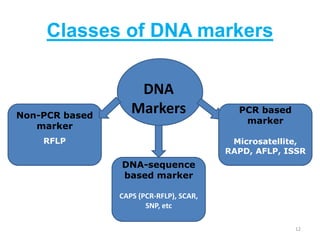
Classes of DNA markers
12
DNA
Markers
Non-PCR based
marker
RFLP
PCR based
marker
Microsatellite,
RAPD, AFLP, ISSR
DNA-sequence
based marker
CAPS (PCR-RFLP), SCAR,
SNP, etc
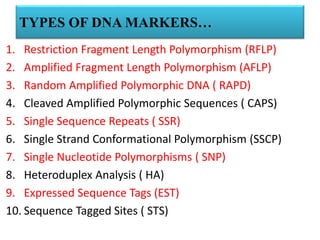
TYPES OF DNA MARKERS…
1. Restriction Fragment Length Polymorphism (RFLP)
2. Amplified Fragment Length Polymorphism (AFLP)
3. Random Amplified Polymorphic DNA ( RAPD)
4. Cleaved Amplified Polymorphic Sequences ( CAPS)
5. Single Sequence Repeats ( SSR)
6. Single Strand Conformational Polymorphism (SSCP)
7. Single Nucleotide Polymorphisms ( SNP)
8. Heteroduplex Analysis ( HA)
9. Expressed Sequence Tags (EST)
10. Sequence Tagged Sites ( STS)
RESTRICTION FRAGMENT LENGTH
POLYMORPHISM
 The term restriction fragment length polymorphism, or
RFLP, (commonly pronounced “rif-lip”) refers to a difference
between two or more samples of homologous DNA molecules
arising from differing locations of restriction sites.(Botstein et al.
1980)
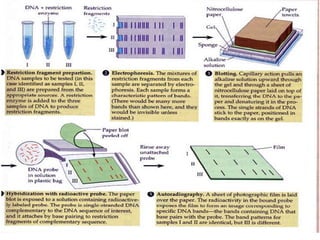
 In RFLP analysis the DNA sample is broken into pieces
(digested) by restriction enzymes and the resulting restriction
fragments are separated according to their lengths by gel
electrophoresis.
 Although now largely obsolete, RFLP analysis was the first
DNA profiling technique inexpensive enough to see widespread
application.
Advantage of RFLP
I. It is simple and cheaper technique of DNA sequencing.
II. It does not require special instrumentation.
III. The majority of RFLP markers are codominant and highly locus specific.
IV. RFLP markers are powerful tools for comparative and synteny mapping.
V. Other markers such as CAPS can be derived from RFLP probe.
VI. RFLP genotypes for single or low copy number genes can be easily
interpreted and scored.
Disadvantage of RFLP
I. It is labor intensive.
II. This technique require large amount of high quality DNA.
III. The multiplex ratio is low.( one per gel).
IV. The genotyping throughput is low.
V. Mostly genotyping is done using radioactive method, despite
availability of non-radioactive methods.
VI. RFLP fingerprinting for multigene families are often difficult to score.
VII. RFLP probes must be maintained physically and are thus a hassle to
share between laboratories.
USES OF RFLP
1. It permits direct identification of a genotype or cultivar in any
tissue at any developmental stage in an environmental
independent manner.
2. RFLP are codominant markers, enabling heterozygotes to be
distinguished from homozygotes.
3. It has a discriminating power that can be at the
species/population ( single locus probe) or individual level (
multi locus probe).
4. The method is simple as no sequence specific information is
required.
5. Indirect selection using qualitative traits.
6. Tagging of monogenic traits with RFLP markers.
7. Indirect selection using quantitative trait loci( QTL).
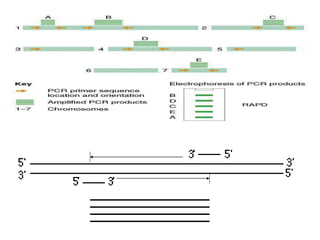
RANDOM AMPLIFIED POLYMORPHIC DNA
 RAPD refers to polymorphism ( variation) found within a
species in the randomly amplified fragments of DNA generated
by restriction endonuclease enzymes.
 This technique was proposed by William et al 1990.
 These are PCR based molecular marker where single short
oligonucleotide is arbitrarily selected to amplify a set of DNA
segments distributed randomly throughout the genome.
 The RAPD markers are dominant.
Principle of RAPD analysis
(I)
• RAPD amplification is performed through PCR.
• Genomic DNA from the species of interest and single
short oligonucleotide (usually 10bp) primer is used.
• Region flanked by a part of 10 bp priming site is
amplified.
• Genomic DNA from two different individuals often
produces different amplification pattern.
• A particular fragment generated for one individual but
not for the other represents DNA polymorphism and can
be used as genetic marker
Principle of RAPD analysis (II)
• Using different combinations of nucleotides, many
random primers can be designed and use.
• No sequence information is required from the plant to
be studied.
• Since each primer will anneal to a different region of
DNA, many different loci can be used.
ADVANTAGE OF RAPD
I. This technique is simple and quick as compared to RFLP.
II. RAPD primers are readily available being universal.
III. It can be performed with any species using universal primers.
IV. It provides more polymorphism than RFLP.
V. It does not need special equipment. Only PCR is required.
VI. The startup cost is low.
VII.RAPD marker assays can be performed using very small DNA
samples (5-25mg per individual).
VIII.RAPD markers are universal, can be commercially purchased,
and are easily shared between laboratories.
IX. RAPD techniques permits development of locus specific co-
dominant PCR based markers from RAPD markers.
X. Large no. of bands are produced per primer.
DISADVANTAGE OF RAPD
I. RAPD polymorphism are inherited as dominant- recessive
characters. This causes a loss of information relative to markers
which show codominance.
II. RAPD primers are relatively short, a mismatch of even a single
nucleotide can often prevent the primers from annealing. Hence
there is a loss of band.
III. The reproducibility of results across laboratories is low or
inconsistent.
IV. It is not feasible for use in marker assisted breeding programme.
V. RAPD is sensitive to changes in PCR conditions, resulting in
changes to some of the amplified fragments.
VI. The homology of fragments across genotypes cannot be
ascertained without mapping.
USES OF RAPD
I. For assessment of genetic variation in breeding population,
germplasm and different species of a crop.
II. To study phylogenetic relationship among species and sub
species.
III. For gene tagging and construction of linkage maps.
IV. For varietal identification.
V. For DNA fingerprinting of cultivars and germplasm.
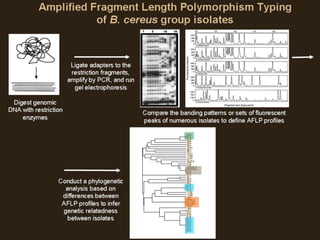
Amplified Fragment Length Polymorphism
(AFLP)
Principle
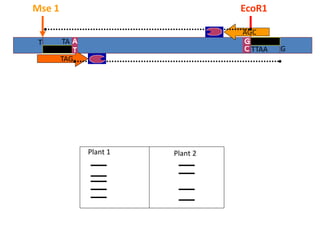
• It involves cleavage of DNA with two different restriction
enzymes (frequent cutter, rare cutter).
• Ligation of specific double stranded adapter pairs to the digested
DNA
• Subsets of the DNA are then amplified by PCR using AFLP
primers and labeling of amplified products.
• The PCR products are then separated on by gel electrophoresis
• acrylamide gel
AT
AATT
G
TA
T
TAG
AGC
TTAA
Mse 1 EcoR1
Plant 1 Plant 2
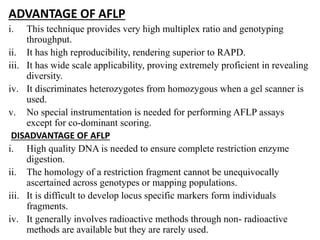
ADVANTAGE OF AFLP
i. This technique provides very high multiplex ratio and genotyping
throughput.
ii. It has high reproducibility, rendering superior to RAPD.
iii. It has wide scale applicability, proving extremely proficient in revealing
diversity.
iv. It discriminates heterozygotes from homozygous when a gel scanner is
used.
v. No special instrumentation is needed for performing AFLP assays
except for co-dominant scoring.
DISADVANTAGE OF AFLP
i. High quality DNA is needed to ensure complete restriction enzyme
digestion.
ii. The homology of a restriction fragment cannot be unequivocally
ascertained across genotypes or mapping populations.
iii. It is difficult to develop locus specific markers form individuals
fragments.
iv. It generally involves radioactive methods through non- radioactive
methods are available but they are rarely used.
• In species with large genomes such as barley and sunflower
AFLP markers often densely cluster in telomeric regions.
• The maximum polymorphic information content for any bi-
allele marker is 0.5.
USES OF AFLP
This technique has been widely used in the construction of
genetic maps containing high densities of DNA marker. In plant
breeding and genetics AFLP markers are used in varietal
identification, characterization of germplasm, gene tagging and
marker assisted selection.
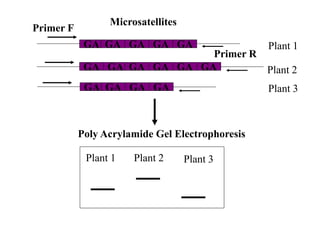
Simple Sequence Repeats (SSR)
(microsatellites)
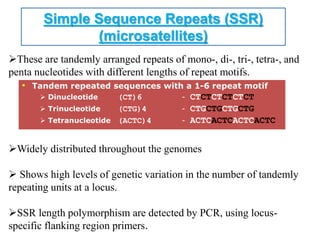
These are tandemly arranged repeats of mono-, di-, tri-, tetra-, and
penta nucleotides with different lengths of repeat motifs.
Widely distributed throughout the genomes
 Shows high levels of genetic variation in the number of tandemly
repeating units at a locus.
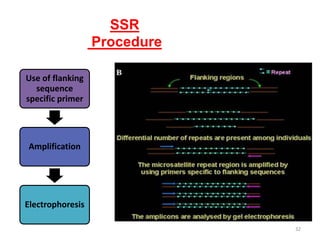
SSR length polymorphism are detected by PCR, using locus-
specific flanking region primers.
• Tandem repeated sequences with a 1-6 repeat motif
 Dinucleotide (CT)6 - CTCTCTCTCTCT
 Trinucleotide (CTG)4 - CTGCTGCTGCTG
 Tetranucleotide (ACTC)4 - ACTCACTCACTCACTC
GA GA GA GA
GA GA GA GA GA GA
GA GA GA GA GA Plant 1
Plant 3
Plant 2
Plant 1 Plant 2 Plant 3
Primer F
Primer R
Microsatellites
Poly Acrylamide Gel Electrophoresis
SSR
Procedure
32
Use of flanking
sequence
specific primer
Amplification
Electrophoresis
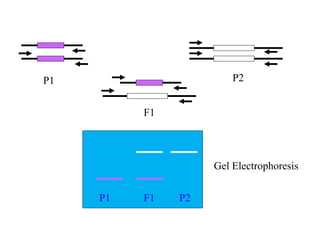
P1 F1 P2
Gel Electrophoresis
P2
P1
F1
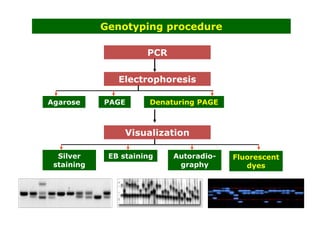
Genotyping procedure
PCR
Electrophoresis
Agarose Denaturing PAGE
PAGE
Visualization
Silver
staining
EB staining Autoradio-
graphy
Fluorescent
dyes
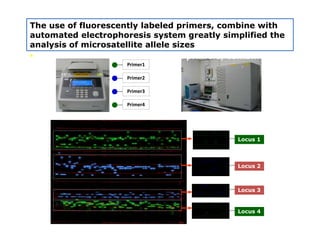
The use of fluorescently labeled primers, combine with
automated electrophoresis system greatly simplified the
analysis of microsatellite allele sizes
• The use of fluorescently labeled primers, combine with
automated electrophoresis
Primer1
Primer2
Primer4
Primer3
10 2 10 4 10 6 10 8 11 0 11 2 11 4 11 6 11 8 12 0 12 2 12 4 12 6 12 8 13 0 13 2 13 4 13 6 13 8 14 0 14 2 14 4 14 6 14 8 15 0
29_1 0.fs a 1 0 Green
20 00
40 00
60 00
12 2.29
30_1 2.fs a 1 2 Green
10 00
20 00
30 00
40 00
11 9.09 12 2.28
31_1 4.fs a 1 4 Green
10 00
20 00
12 0.24 12 4.18
32_1 6.fs a 1 6 Green
10 00
20 00
30 00
12 3.34 13 1.42
33_0 1.fs a 1 Green
10 00
20 00
12 0.23 12 6.40
34_0 3.fs a 3 Green
20 00
40 00
12 0.24 12 4.33
35_0 5.fs a 5 Green
10 00
20 00
12 0.24 12 2.29
Locus 1
P
e
a
k
: S
c
a
n 2
9
4
6 S
i
z
e 1
0
6
.
6
7 H
e
i
g
h
t 1
0
8 A
r
e
a 7
7
5
92 94 96 98 10 0 10 2 10 4 10 6 10 8 11 0 11 2 11 4 11 6 11 8 12 0 12 2 12 4 12 6 12 8 13 0 13 2 13 4 13 6 13 8 14
017_ 01.fsa 1 Blu e
10 7.62 11 1.87
018_ 03.fsa 3 Blu e
10 9.75 11 6.16
019_ 05.fsa 5 Blu e
10 7.69
020_ 07.fsa 7 Blu e
10 9.78
021_ 09.fsa 9 Blu e
10 9.78 11 1.88
022_ 11.fsa 1 1 Blu e
10 9.69 11 8.45
023_ 13.fsa 1 3 Blu e
10 3.36 10 7.59
Locus 2
P
e
a
k
: S
c
a
n 3
1
0
0 S
i
z
e 2
5
7
.
2
5 H
e
i
g
h
t 1
1
0 A
r
e
a 6
6
8
24 2 24 4 24 6 24 8 25 0 25 2 25 4 25 6 25 8 26 0 26 2 26 4 26 6 26 8 27 0 27 2 27 4 27 6 27 8 28 0 28 2 28 4 28 6 28 8 29 0
1a.fsa 3 4 Blu e
10 00
20 00
26 0.20
2a.fsa 2 6 Blu e
10 00
20 00
26 0.20
26 1.18
3a.fsa 3 1 Blu e
20 0
40 0
60 0
80 0
26 1.18
4a.fsa 2 0 Blu e
30 0
60 0
90 0
26 0.20 26 6.10
5a.fsa 8 Blu e
30 0
60 0
90 0
26 6.10
6a.fsa 3 5 Blu e
50 0
10 00
15 00
20 00
26 6.04
26 7.01
7a.fsa 3 6 Blu e
50 0
10 00
15 00
26 7.06
Locus 3
Peak: Scan 1919 Size 149.07 Height 67 Area 309
13 2 13 4 13 6 13 8 14 0 14 2 14 4 14 6 14 8 15 0 15 2 15 4 15 6 15 8 16 0 16 2 16 4 16 6 16 8 17 0 17 2 17 4 17 6 17 8 18 0 18 2 18 4 18 6 18 8 19 0
04b.fsa 1 0 Green
10 00
20 00
30 00
15 0.93 15 5.07
05b.fsa 1 3 Green
10 00
20 00
30 00
15 5.07 16 3.02
06b.fsa 1 6 Green
10 00
20 00
30 00
15 5.02 16 3.02
07b.fsa 1 9 Green
10 00
20 00
30 00
15 5.13 16 3.02
08b.fsa 2 2 Green
10 00
20 00
30 00
40 00
15 0.94 15 8.96
09b.fsa 2 Green
10 00
20 00
30 00
40 00
15 5.02 16 3.00
10b.fsa 5 Green
10 00
20 00
30 00
40 00
15 0.94 15 5.02
11b.fsa 8 Green
10 00
20 00
30 00
40 00
15 5.07
Locus 4
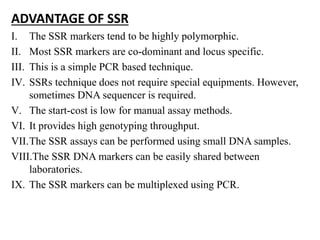
ADVANTAGE OF SSR
I. The SSR markers tend to be highly polymorphic.
II. Most SSR markers are co-dominant and locus specific.
III. This is a simple PCR based technique.
IV. SSRs technique does not require special equipments. However,
sometimes DNA sequencer is required.
V. The start-cost is low for manual assay methods.
VI. It provides high genotyping throughput.
VII.The SSR assays can be performed using small DNA samples.
VIII.The SSR DNA markers can be easily shared between
laboratories.
IX. The SSR markers can be multiplexed using PCR.
DISADVANTAGE OF SSR
I. The development of SSRs is Labor intensive.
II. The cost developing SSR markers is very high.
III. The SSR markers are specific to plant species.
IV. The startup cost is high for automated methods of SSR
assays.
V. The development of PCR multiplex is difficult and
expensive.
USES OF SSR
The use of microsatellites as genetic markers has been
proposed for genetic mapping of eukaryotes.
SINGLE NUCLEOTIDE
POLYMORPHISM (SNPs)
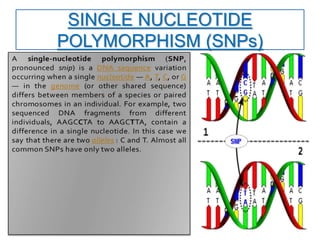
 The differences which are found at single nucleotide
position are refereed to as Single Nucleotide
Polymorphism or SNPs (snips- as pronounced).
 This type of polymorphism results due to substitution,
deletion or insertions.
 This is mostly biallelic in nature and most abundant in
genomes of all organisms
 SNP markers can be used to pinpoint functional
polymorphisms.
ADVANTAGE OF SNP
1) These are useful in gene mapping.
2) SNPs help in detection of mutations at molecular level.
3) SNPs are useful in positional cloning of a mutant locus.
4) SNPs are useful in identification of disease causing genes.
DISADVANTAGE OF SNPs
1) Most SNPs are biallelic and thus less informative than SSRs.
2) Multiplexing is not possible for all loci.
3) Some SNP assay techniques are costly.
4) Large quantity of markers is required in genetic mapping.
5) Development of SNP is laborious.
USES
1. It is used in generating genetic maps. SNPs have been used in
preparing human genetic maps.
2. In plants, SNPs have not been extensively used so far.
Derived markers
• DNA markers which are derived either from
RFLP, RAPD or AFLP
41
• Problems in reproducibility (e.g.
RAPD)
• Marker technique is complicated,
time-consuming or expensive
(e.g. RFLPs or AFLPs)
Need
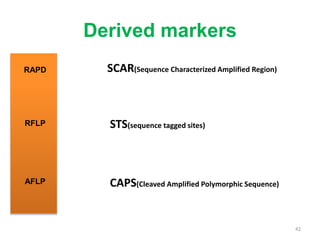
Derived markers
42
RAPD
RFLP
AFLP
STS(sequence tagged sites)
SCAR(Sequence Characterized Amplified Region)
CAPS(Cleaved Amplified Polymorphic Sequence)
EST(Expressed Sequence
Tag)
• It is a short DNA sequence usually 200-300 nucleotides
long from cDNA clone that corresponds to a mRNA
• These contains only exons, which is the base pair
sequence of a gene that is expressed
• In rice, Arabidopsis etc., thousands of functional cDNA
clones are being converted in to EST markers
• Used to developing markers like SSR and SNP
• EST-SSRs and EST-SNPs have been identified in several
crops to facilitated mapping of ESTs
• This term was first used by Venter and his colleagues in
1991.
43
ADVANTAGES OF ESTs
1. These are useful in discovering new genes particularly genes that
are involved in genetic diseases.
2. It is rapid and inexpensive technique of locating gene.
3. It provides information about gene expression.
4. It generates a large no. of sequences quickly.
5. More useful to obtain information in QTL mapping.
DISADVANTAGE OF ESTs
1. It has lack of primer specificity
2. It is time consuming and laborious
3. The error is higher than the conventional approaches
4. It is difficult to obtain large transcripts
USES
1. ESTs are commonly used to map genes of known
function.
2. These are used for phylogenetic studies.
3. It can be used to produce DNA arrays, a powerful tool
for the analysis of the whole expression pattern of a
tissue.
SIGNIFICANCE OF MARKERS…
• Describing mating systems, levels of inbreeding, and
temporal and spatial patterns of genetic variation within
stands
• Describing geographic patterns of genetic variation
• Inferring taxonomic and phylogenetic relationships among
species
• Evaluating the impacts of domestication practices,
including forest management and tree improvement, on
genetic diversity
• Fingerprinting and germplasm identification in breeding
and propagation populations
• Constructing genetic linkage maps
• Marker assisted breeding
• Genetic markers can be used to study the relationship between
an inherited disease and its genetic cause (for example, a
particular mutation of a gene that results in a defective protein). It
is known that pieces of DNA that lie near each other on a
chromosome tend to be inherited together. This property enables
the use of a marker, which can then be used to determine the
precise inheritance pattern of the gene that has not yet been exactly
localized
• Genetic markers are employed in Geneological DNA
testing for genetic genealogy to determine genetic distance
between individuals or populations. Uniparental markers (on
mitochondrial or Y chromosomal DNA) are studied for assessing
maternal or paternal lineages. Autosomal markers are used for all
ancestry
• Genetic markers have to be easily identifiable, associated with a
specific locus, and highly polymorphic, because homozygotes do
not provide any information. Detection of the marker can be direct
by RNA sequencing, or indirect using allozymes
48
•Varietal Identification
•Genetic Diversity
•Genetic Maps
•Marker-assisted Selection
•High-resolution mapping
•Map-based Cloning
•Novel allele detection
•Seed purity testing
•Marker assisted gene pyramiding
Use of Markers in
Plant Breeding
REFERENCE…
1. Introduction to Plant Biotechnology
– H.S. CHAWLA, (page no. 356-387)
2. Plant Biotechnology
– Phundan Singh ( pp 39-54)
3. Internet
a. http//dendrome.ucdavis.edu/
b. Genetic marker- wikipedia
50

molecular markers.pptx

  • 1.
    MOLECULAR AND DNABASED MARKERS ( RFLP, RAPD, AFLP, SSR,SNP’S, EST’S) SUBMITTED TO Dr. Ajit Singh Gautam Principal Scientist, Plant Breeding Dept. of Crop Improvement PREPARED BY Heresh Puren M.Sc. 1st Year, Genetics & Plant Breeding Dept. of Crop Improvement
  • 2.
    Marker.. • Key points Any genetic element (locus, allele, DNA sequence or chromosome feature) which can be readily detected by phenotype, cytological or molecular techniques.  Markers are “characters” whose pattern of inheritance can be followed at the morphological (e.g. flower color), biochemical (e.g. protein and isozymes) or molecular (DNA) levels.  A marker is a signpost linked to the trait of interest and is co-inherited along with the trait.
  • 3.
    They are socalled as because they can be used to elicit, albeit, indirectly, information concerning the inheritance of “real” traits. A genetic marker is any visible character or otherwise assayable phenotype, for which alleles at individual loci segregate in a mendelian manner. The development of the discipline of genetics would not have been possible without genetic marker such as the visible characters in peas and drosophila. A marker must be polymorphic, that is, it must exists in different forms so that chromosomes with normal gene by the form of marker it also carries, this polymorphism in marker can be detected at three levels-
  • 4.
    • 1. Phenotype( morphological) • 2. Differences in proteins ( biochemical) • 3. Differences in the nucleotide sequences of DNA ( Molecular).  In the early part of the 20th century, scientist discovered that Mendelian factors controlling inheritance, which we now call genes, were organized in linear order on chromosomes.  Clues to the location of a gene can come from comparing the inheritance of a mutant gene with the inheritance of markers of known chromosomal location.
  • 5.
    Properties for idealmarkers 1. Polymorphic, i.e. reveal high levels of allelic variability 2. Co-dominant inheritance (determination of homozygous and heterozygous states of diploid organisms) 3. Highly robust and repeatable across different tissue types and different laboratories i.e. Frequent occurrence in genome 4. Selective neutral behavior (the DNA sequences of any organism are neutral to environmental conditions or management practices) 5. Easy access (availability) 6. Easy and fast assay 7. High reproducibility 8. In expensive to develop and apply 9. Unaffected by environmental and developmental variation
  • 6.
    MORPHOLOGICAL MARKERS  Theseare qualitative traits that can be scored visually. They are generally dominant or recessive. e.g. flower colour, seed shape, growth habits or pigmentation etc. Merits:  Easy to score, not costly, etc. Demerits:  They are highly influenced by the environment, etc.  Their effect may be undesirable in breeding programs.  They may mask the effects of linked genes making it nearly impossible to identify desirable linkages for selection.  They are insufficiently polymorphic and are generally dominant. Besides, they often interfere with other traits.
  • 7.
    Biochemical markers  Biochemicalmarkers are proteins (enzymes) produced by gene expression.  These proteins can be isolated and identified by electrophoresis and staining.  Most of the biochemical makers are polymorphic and insensitive to environment just like molecular markers.  Isozyme - a molecular marker system based on the staining of proteins with identical function, but different electrophoretic mobilities.
  • 8.
    Monomer and dimerisozymes are often used because analysis of their segregation is easier. Isozymes are usually codominant. Enzyme polymorphisms have been used successfully to identify cultivars in various fruit species. Isozymes, as genetic markers, have been proven to be reliable, consistent, However their phenotypic expressions are affected by environmental conditions, stages of development and tissues.
  • 9.
    Advantages: • inexpensive; • markersare co-dominant. Disadvantages: • Only reveals small proportion of DNA variation. • Isozyme technique can detect only limited no. of loci. Ex. Rice and maize. • Many DNA variants do not result in changes in amino acid sequence (e.g., synonymous substitutions). • Some changes in amino acid sequence do not result in changes in mobility on the gel.
  • 10.
    DNA Based Markers These DNA based makers differentiate the organisms at DNA level and are inherited in simple Mendelian fashion.  A DNA segment of known or unknown structure and function, which can be used to detect the presence of specific sequence of nucleotides in another DNA or RNA molecule.  This is particularly important for genetic resource management, as well as for the rational use of genetic resources in selection programs.  DNA markers can detect differences in genetic information carried by two or more individuals.
  • 11.
    BASIS OF DNAPOLYMORPHISM • Base substitution • Insertion/Deletion – single or multiple nucleotides • Transposition – Transposons/Retro-transposons • Duplication • Inversion • Translocation • Recombination – unequal crossing over • Replication slippage • Altered methylation pattern
  • 12.
    Classes of DNAmarkers 12 DNA Markers Non-PCR based marker RFLP PCR based marker Microsatellite, RAPD, AFLP, ISSR DNA-sequence based marker CAPS (PCR-RFLP), SCAR, SNP, etc
  • 13.
    TYPES OF DNAMARKERS… 1. Restriction Fragment Length Polymorphism (RFLP) 2. Amplified Fragment Length Polymorphism (AFLP) 3. Random Amplified Polymorphic DNA ( RAPD) 4. Cleaved Amplified Polymorphic Sequences ( CAPS) 5. Single Sequence Repeats ( SSR) 6. Single Strand Conformational Polymorphism (SSCP) 7. Single Nucleotide Polymorphisms ( SNP) 8. Heteroduplex Analysis ( HA) 9. Expressed Sequence Tags (EST) 10. Sequence Tagged Sites ( STS)
  • 14.
    RESTRICTION FRAGMENT LENGTH POLYMORPHISM The term restriction fragment length polymorphism, or RFLP, (commonly pronounced “rif-lip”) refers to a difference between two or more samples of homologous DNA molecules arising from differing locations of restriction sites.(Botstein et al. 1980)  In RFLP analysis the DNA sample is broken into pieces (digested) by restriction enzymes and the resulting restriction fragments are separated according to their lengths by gel electrophoresis.  Although now largely obsolete, RFLP analysis was the first DNA profiling technique inexpensive enough to see widespread application.
  • 16.
    Advantage of RFLP I.It is simple and cheaper technique of DNA sequencing. II. It does not require special instrumentation. III. The majority of RFLP markers are codominant and highly locus specific. IV. RFLP markers are powerful tools for comparative and synteny mapping. V. Other markers such as CAPS can be derived from RFLP probe. VI. RFLP genotypes for single or low copy number genes can be easily interpreted and scored. Disadvantage of RFLP I. It is labor intensive. II. This technique require large amount of high quality DNA. III. The multiplex ratio is low.( one per gel). IV. The genotyping throughput is low. V. Mostly genotyping is done using radioactive method, despite availability of non-radioactive methods. VI. RFLP fingerprinting for multigene families are often difficult to score. VII. RFLP probes must be maintained physically and are thus a hassle to share between laboratories.
  • 17.
    USES OF RFLP 1.It permits direct identification of a genotype or cultivar in any tissue at any developmental stage in an environmental independent manner. 2. RFLP are codominant markers, enabling heterozygotes to be distinguished from homozygotes. 3. It has a discriminating power that can be at the species/population ( single locus probe) or individual level ( multi locus probe). 4. The method is simple as no sequence specific information is required. 5. Indirect selection using qualitative traits. 6. Tagging of monogenic traits with RFLP markers. 7. Indirect selection using quantitative trait loci( QTL).
  • 18.
    RANDOM AMPLIFIED POLYMORPHICDNA  RAPD refers to polymorphism ( variation) found within a species in the randomly amplified fragments of DNA generated by restriction endonuclease enzymes.  This technique was proposed by William et al 1990.  These are PCR based molecular marker where single short oligonucleotide is arbitrarily selected to amplify a set of DNA segments distributed randomly throughout the genome.  The RAPD markers are dominant.
  • 19.
    Principle of RAPDanalysis (I) • RAPD amplification is performed through PCR. • Genomic DNA from the species of interest and single short oligonucleotide (usually 10bp) primer is used. • Region flanked by a part of 10 bp priming site is amplified. • Genomic DNA from two different individuals often produces different amplification pattern. • A particular fragment generated for one individual but not for the other represents DNA polymorphism and can be used as genetic marker
  • 20.
    Principle of RAPDanalysis (II) • Using different combinations of nucleotides, many random primers can be designed and use. • No sequence information is required from the plant to be studied. • Since each primer will anneal to a different region of DNA, many different loci can be used.
  • 22.
    ADVANTAGE OF RAPD I.This technique is simple and quick as compared to RFLP. II. RAPD primers are readily available being universal. III. It can be performed with any species using universal primers. IV. It provides more polymorphism than RFLP. V. It does not need special equipment. Only PCR is required. VI. The startup cost is low. VII.RAPD marker assays can be performed using very small DNA samples (5-25mg per individual). VIII.RAPD markers are universal, can be commercially purchased, and are easily shared between laboratories. IX. RAPD techniques permits development of locus specific co- dominant PCR based markers from RAPD markers. X. Large no. of bands are produced per primer.
  • 23.
    DISADVANTAGE OF RAPD I.RAPD polymorphism are inherited as dominant- recessive characters. This causes a loss of information relative to markers which show codominance. II. RAPD primers are relatively short, a mismatch of even a single nucleotide can often prevent the primers from annealing. Hence there is a loss of band. III. The reproducibility of results across laboratories is low or inconsistent. IV. It is not feasible for use in marker assisted breeding programme. V. RAPD is sensitive to changes in PCR conditions, resulting in changes to some of the amplified fragments. VI. The homology of fragments across genotypes cannot be ascertained without mapping.
  • 24.
    USES OF RAPD I.For assessment of genetic variation in breeding population, germplasm and different species of a crop. II. To study phylogenetic relationship among species and sub species. III. For gene tagging and construction of linkage maps. IV. For varietal identification. V. For DNA fingerprinting of cultivars and germplasm.
  • 25.
    Amplified Fragment LengthPolymorphism (AFLP) Principle • It involves cleavage of DNA with two different restriction enzymes (frequent cutter, rare cutter). • Ligation of specific double stranded adapter pairs to the digested DNA • Subsets of the DNA are then amplified by PCR using AFLP primers and labeling of amplified products. • The PCR products are then separated on by gel electrophoresis • acrylamide gel
  • 27.
  • 28.
    ADVANTAGE OF AFLP i.This technique provides very high multiplex ratio and genotyping throughput. ii. It has high reproducibility, rendering superior to RAPD. iii. It has wide scale applicability, proving extremely proficient in revealing diversity. iv. It discriminates heterozygotes from homozygous when a gel scanner is used. v. No special instrumentation is needed for performing AFLP assays except for co-dominant scoring. DISADVANTAGE OF AFLP i. High quality DNA is needed to ensure complete restriction enzyme digestion. ii. The homology of a restriction fragment cannot be unequivocally ascertained across genotypes or mapping populations. iii. It is difficult to develop locus specific markers form individuals fragments. iv. It generally involves radioactive methods through non- radioactive methods are available but they are rarely used.
  • 29.
    • In specieswith large genomes such as barley and sunflower AFLP markers often densely cluster in telomeric regions. • The maximum polymorphic information content for any bi- allele marker is 0.5. USES OF AFLP This technique has been widely used in the construction of genetic maps containing high densities of DNA marker. In plant breeding and genetics AFLP markers are used in varietal identification, characterization of germplasm, gene tagging and marker assisted selection.
  • 30.
    Simple Sequence Repeats(SSR) (microsatellites) These are tandemly arranged repeats of mono-, di-, tri-, tetra-, and penta nucleotides with different lengths of repeat motifs. Widely distributed throughout the genomes  Shows high levels of genetic variation in the number of tandemly repeating units at a locus. SSR length polymorphism are detected by PCR, using locus- specific flanking region primers. • Tandem repeated sequences with a 1-6 repeat motif  Dinucleotide (CT)6 - CTCTCTCTCTCT  Trinucleotide (CTG)4 - CTGCTGCTGCTG  Tetranucleotide (ACTC)4 - ACTCACTCACTCACTC
  • 31.
    GA GA GAGA GA GA GA GA GA GA GA GA GA GA GA Plant 1 Plant 3 Plant 2 Plant 1 Plant 2 Plant 3 Primer F Primer R Microsatellites Poly Acrylamide Gel Electrophoresis
  • 32.
    SSR Procedure 32 Use of flanking sequence specificprimer Amplification Electrophoresis
  • 33.
    P1 F1 P2 GelElectrophoresis P2 P1 F1
  • 34.
    Genotyping procedure PCR Electrophoresis Agarose DenaturingPAGE PAGE Visualization Silver staining EB staining Autoradio- graphy Fluorescent dyes
  • 35.
    The use offluorescently labeled primers, combine with automated electrophoresis system greatly simplified the analysis of microsatellite allele sizes • The use of fluorescently labeled primers, combine with automated electrophoresis Primer1 Primer2 Primer4 Primer3 10 2 10 4 10 6 10 8 11 0 11 2 11 4 11 6 11 8 12 0 12 2 12 4 12 6 12 8 13 0 13 2 13 4 13 6 13 8 14 0 14 2 14 4 14 6 14 8 15 0 29_1 0.fs a 1 0 Green 20 00 40 00 60 00 12 2.29 30_1 2.fs a 1 2 Green 10 00 20 00 30 00 40 00 11 9.09 12 2.28 31_1 4.fs a 1 4 Green 10 00 20 00 12 0.24 12 4.18 32_1 6.fs a 1 6 Green 10 00 20 00 30 00 12 3.34 13 1.42 33_0 1.fs a 1 Green 10 00 20 00 12 0.23 12 6.40 34_0 3.fs a 3 Green 20 00 40 00 12 0.24 12 4.33 35_0 5.fs a 5 Green 10 00 20 00 12 0.24 12 2.29 Locus 1 P e a k : S c a n 2 9 4 6 S i z e 1 0 6 . 6 7 H e i g h t 1 0 8 A r e a 7 7 5 92 94 96 98 10 0 10 2 10 4 10 6 10 8 11 0 11 2 11 4 11 6 11 8 12 0 12 2 12 4 12 6 12 8 13 0 13 2 13 4 13 6 13 8 14 017_ 01.fsa 1 Blu e 10 7.62 11 1.87 018_ 03.fsa 3 Blu e 10 9.75 11 6.16 019_ 05.fsa 5 Blu e 10 7.69 020_ 07.fsa 7 Blu e 10 9.78 021_ 09.fsa 9 Blu e 10 9.78 11 1.88 022_ 11.fsa 1 1 Blu e 10 9.69 11 8.45 023_ 13.fsa 1 3 Blu e 10 3.36 10 7.59 Locus 2 P e a k : S c a n 3 1 0 0 S i z e 2 5 7 . 2 5 H e i g h t 1 1 0 A r e a 6 6 8 24 2 24 4 24 6 24 8 25 0 25 2 25 4 25 6 25 8 26 0 26 2 26 4 26 6 26 8 27 0 27 2 27 4 27 6 27 8 28 0 28 2 28 4 28 6 28 8 29 0 1a.fsa 3 4 Blu e 10 00 20 00 26 0.20 2a.fsa 2 6 Blu e 10 00 20 00 26 0.20 26 1.18 3a.fsa 3 1 Blu e 20 0 40 0 60 0 80 0 26 1.18 4a.fsa 2 0 Blu e 30 0 60 0 90 0 26 0.20 26 6.10 5a.fsa 8 Blu e 30 0 60 0 90 0 26 6.10 6a.fsa 3 5 Blu e 50 0 10 00 15 00 20 00 26 6.04 26 7.01 7a.fsa 3 6 Blu e 50 0 10 00 15 00 26 7.06 Locus 3 Peak: Scan 1919 Size 149.07 Height 67 Area 309 13 2 13 4 13 6 13 8 14 0 14 2 14 4 14 6 14 8 15 0 15 2 15 4 15 6 15 8 16 0 16 2 16 4 16 6 16 8 17 0 17 2 17 4 17 6 17 8 18 0 18 2 18 4 18 6 18 8 19 0 04b.fsa 1 0 Green 10 00 20 00 30 00 15 0.93 15 5.07 05b.fsa 1 3 Green 10 00 20 00 30 00 15 5.07 16 3.02 06b.fsa 1 6 Green 10 00 20 00 30 00 15 5.02 16 3.02 07b.fsa 1 9 Green 10 00 20 00 30 00 15 5.13 16 3.02 08b.fsa 2 2 Green 10 00 20 00 30 00 40 00 15 0.94 15 8.96 09b.fsa 2 Green 10 00 20 00 30 00 40 00 15 5.02 16 3.00 10b.fsa 5 Green 10 00 20 00 30 00 40 00 15 0.94 15 5.02 11b.fsa 8 Green 10 00 20 00 30 00 40 00 15 5.07 Locus 4
  • 36.
    ADVANTAGE OF SSR I.The SSR markers tend to be highly polymorphic. II. Most SSR markers are co-dominant and locus specific. III. This is a simple PCR based technique. IV. SSRs technique does not require special equipments. However, sometimes DNA sequencer is required. V. The start-cost is low for manual assay methods. VI. It provides high genotyping throughput. VII.The SSR assays can be performed using small DNA samples. VIII.The SSR DNA markers can be easily shared between laboratories. IX. The SSR markers can be multiplexed using PCR.
  • 37.
    DISADVANTAGE OF SSR I.The development of SSRs is Labor intensive. II. The cost developing SSR markers is very high. III. The SSR markers are specific to plant species. IV. The startup cost is high for automated methods of SSR assays. V. The development of PCR multiplex is difficult and expensive. USES OF SSR The use of microsatellites as genetic markers has been proposed for genetic mapping of eukaryotes.
  • 38.
  • 39.
     The differenceswhich are found at single nucleotide position are refereed to as Single Nucleotide Polymorphism or SNPs (snips- as pronounced).  This type of polymorphism results due to substitution, deletion or insertions.  This is mostly biallelic in nature and most abundant in genomes of all organisms  SNP markers can be used to pinpoint functional polymorphisms.
  • 40.
    ADVANTAGE OF SNP 1)These are useful in gene mapping. 2) SNPs help in detection of mutations at molecular level. 3) SNPs are useful in positional cloning of a mutant locus. 4) SNPs are useful in identification of disease causing genes. DISADVANTAGE OF SNPs 1) Most SNPs are biallelic and thus less informative than SSRs. 2) Multiplexing is not possible for all loci. 3) Some SNP assay techniques are costly. 4) Large quantity of markers is required in genetic mapping. 5) Development of SNP is laborious. USES 1. It is used in generating genetic maps. SNPs have been used in preparing human genetic maps. 2. In plants, SNPs have not been extensively used so far.
  • 41.
    Derived markers • DNAmarkers which are derived either from RFLP, RAPD or AFLP 41 • Problems in reproducibility (e.g. RAPD) • Marker technique is complicated, time-consuming or expensive (e.g. RFLPs or AFLPs) Need
  • 42.
    Derived markers 42 RAPD RFLP AFLP STS(sequence taggedsites) SCAR(Sequence Characterized Amplified Region) CAPS(Cleaved Amplified Polymorphic Sequence)
  • 43.
    EST(Expressed Sequence Tag) • Itis a short DNA sequence usually 200-300 nucleotides long from cDNA clone that corresponds to a mRNA • These contains only exons, which is the base pair sequence of a gene that is expressed • In rice, Arabidopsis etc., thousands of functional cDNA clones are being converted in to EST markers • Used to developing markers like SSR and SNP • EST-SSRs and EST-SNPs have been identified in several crops to facilitated mapping of ESTs • This term was first used by Venter and his colleagues in 1991. 43
  • 44.
    ADVANTAGES OF ESTs 1.These are useful in discovering new genes particularly genes that are involved in genetic diseases. 2. It is rapid and inexpensive technique of locating gene. 3. It provides information about gene expression. 4. It generates a large no. of sequences quickly. 5. More useful to obtain information in QTL mapping. DISADVANTAGE OF ESTs 1. It has lack of primer specificity 2. It is time consuming and laborious 3. The error is higher than the conventional approaches 4. It is difficult to obtain large transcripts
  • 45.
    USES 1. ESTs arecommonly used to map genes of known function. 2. These are used for phylogenetic studies. 3. It can be used to produce DNA arrays, a powerful tool for the analysis of the whole expression pattern of a tissue.
  • 46.
    SIGNIFICANCE OF MARKERS… •Describing mating systems, levels of inbreeding, and temporal and spatial patterns of genetic variation within stands • Describing geographic patterns of genetic variation • Inferring taxonomic and phylogenetic relationships among species • Evaluating the impacts of domestication practices, including forest management and tree improvement, on genetic diversity • Fingerprinting and germplasm identification in breeding and propagation populations • Constructing genetic linkage maps • Marker assisted breeding
  • 47.
    • Genetic markerscan be used to study the relationship between an inherited disease and its genetic cause (for example, a particular mutation of a gene that results in a defective protein). It is known that pieces of DNA that lie near each other on a chromosome tend to be inherited together. This property enables the use of a marker, which can then be used to determine the precise inheritance pattern of the gene that has not yet been exactly localized • Genetic markers are employed in Geneological DNA testing for genetic genealogy to determine genetic distance between individuals or populations. Uniparental markers (on mitochondrial or Y chromosomal DNA) are studied for assessing maternal or paternal lineages. Autosomal markers are used for all ancestry • Genetic markers have to be easily identifiable, associated with a specific locus, and highly polymorphic, because homozygotes do not provide any information. Detection of the marker can be direct by RNA sequencing, or indirect using allozymes
  • 48.
    48 •Varietal Identification •Genetic Diversity •GeneticMaps •Marker-assisted Selection •High-resolution mapping •Map-based Cloning •Novel allele detection •Seed purity testing •Marker assisted gene pyramiding Use of Markers in Plant Breeding
  • 49.
    REFERENCE… 1. Introduction toPlant Biotechnology – H.S. CHAWLA, (page no. 356-387) 2. Plant Biotechnology – Phundan Singh ( pp 39-54) 3. Internet a. http//dendrome.ucdavis.edu/ b. Genetic marker- wikipedia
  • 50.