
11/22/2019
The Nature and The Functional Complexity
of Retrograde Signals
Antre Suresh H.
1st Year Ph. D.
PALB 8086
Plant Biotechnology
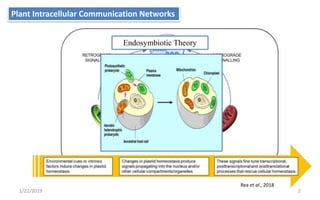
Plant Intracellular Communication Networks
21/22/2019
Rea et al., 2018
Endosymbiotic Theory
1/22/2019 3
Plant organelles produce retrograde signals to alter nuclear gene expression in order
to
 Coordinate their biogenesis
 Maintain homeostasis
 Optimize their performance under adverse conditions
Estavillo et al., 2013 I Frontiers in Plant Science
The term retrograde signaling refers to the fact that chloroplasts and
mitochondria utilize specific signaling molecules to convey
information on their developmental and physiological states to the
nucleus and modulate the expression of nuclear genes accordingly.
1/22/2019 4
Signals emanating from plastids have been associated with two
main networks:
 Biogenic Signals - Active during early stages of chloroplast
development.
 Operational Signals - Control functions in response to
environmental fluctuations such as excessive light, drought, or
heat.
1/22/2019 5
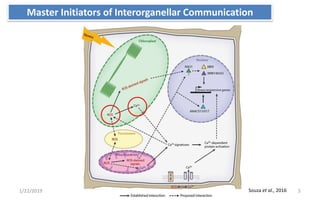
Master Initiators of Interorganellar Communication
Souza et al., 2016
1/22/2019 6
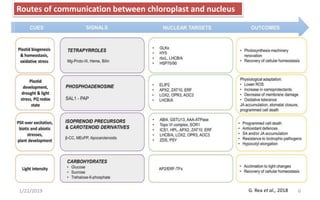
Routes of communication between chloroplast and nucleus
G. Rea et al., 2018
1/22/2019 7
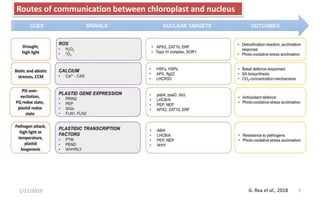
Routes of communication between chloroplast and nucleus
G. Rea et al., 2018
1/22/2019 8
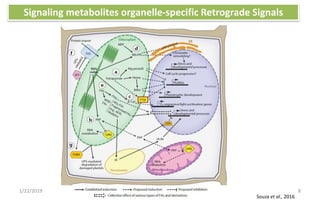
Signaling metabolites organelle-specific Retrograde Signals
Souza et al., 2016
1/22/2019 11
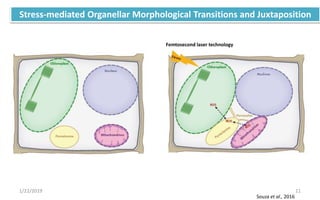
Stress-mediated Organellar Morphological Transitions and Juxtaposition
Souza et al., 2016
Femtosecond laser technology
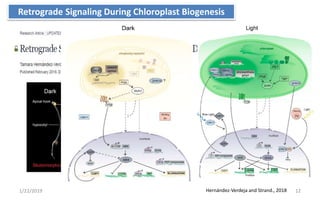
1/22/2019 12Hernández-Verdeja and Strand., 2018
Retrograde Signaling During Chloroplast Biogenesis
1/22/2019 13
1/22/2019 14
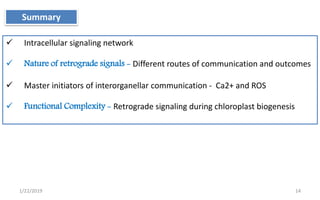
Summary
 Intracellular signaling network
 Nature of retrograde signals - Different routes of communication and outcomes
 Master initiators of interorganellar communication - Ca2+ and ROS
 Functional Complexity - Retrograde signaling during chloroplast biogenesis
1/22/2019 15
Hernández-Verdeja, T. and Strand, A, 2018. Retrograde signals navigate the path to
chloroplast development. Plant physiology, 176(2), pp.967-976.
De Souza, A., Wang, J.Z. and Dehesh, K., 2017. Retrograde signals: integrators of
interorganellar communication and orchestrators of plant development. Annual review
of plant biology, 68, pp.85-108.
Rea, G., Antonacci, A., Lambreva, M.D. and Mattoo, A.K., 2018. Features of cues and
processes during chloroplast-mediated retrograde signaling in the alga
Chlamydomonas.Plant science.
Kacprzak, S.M., Mochizuki, N., Naranjo, B., Xu, D., Leister, D., Kleine, T., Okamoto, H. and
Terry, M.J., 2019. Plastid-to-nucleus retrograde signalling during chloroplast biogenesis
does not require ABI4. Plant physiology, 179(1), pp.18-23.
References

Retrograde signalling

  • 1.
    11/22/2019 The Nature andThe Functional Complexity of Retrograde Signals Antre Suresh H. 1st Year Ph. D. PALB 8086 Plant Biotechnology
  • 2.
    Plant Intracellular CommunicationNetworks 21/22/2019 Rea et al., 2018 Endosymbiotic Theory
  • 3.
    1/22/2019 3 Plant organellesproduce retrograde signals to alter nuclear gene expression in order to  Coordinate their biogenesis  Maintain homeostasis  Optimize their performance under adverse conditions Estavillo et al., 2013 I Frontiers in Plant Science The term retrograde signaling refers to the fact that chloroplasts and mitochondria utilize specific signaling molecules to convey information on their developmental and physiological states to the nucleus and modulate the expression of nuclear genes accordingly.
  • 4.
    1/22/2019 4 Signals emanatingfrom plastids have been associated with two main networks:  Biogenic Signals - Active during early stages of chloroplast development.  Operational Signals - Control functions in response to environmental fluctuations such as excessive light, drought, or heat.
  • 5.
    1/22/2019 5 Master Initiatorsof Interorganellar Communication Souza et al., 2016
  • 6.
    1/22/2019 6 Routes ofcommunication between chloroplast and nucleus G. Rea et al., 2018
  • 7.
    1/22/2019 7 Routes ofcommunication between chloroplast and nucleus G. Rea et al., 2018
  • 8.
    1/22/2019 8 Signaling metabolitesorganelle-specific Retrograde Signals Souza et al., 2016
  • 9.
    1/22/2019 11 Stress-mediated OrganellarMorphological Transitions and Juxtaposition Souza et al., 2016 Femtosecond laser technology
  • 10.
    1/22/2019 12Hernández-Verdeja andStrand., 2018 Retrograde Signaling During Chloroplast Biogenesis
  • 11.
  • 12.
    1/22/2019 14 Summary  Intracellularsignaling network  Nature of retrograde signals - Different routes of communication and outcomes  Master initiators of interorganellar communication - Ca2+ and ROS  Functional Complexity - Retrograde signaling during chloroplast biogenesis
  • 13.
    1/22/2019 15 Hernández-Verdeja, T.and Strand, A, 2018. Retrograde signals navigate the path to chloroplast development. Plant physiology, 176(2), pp.967-976. De Souza, A., Wang, J.Z. and Dehesh, K., 2017. Retrograde signals: integrators of interorganellar communication and orchestrators of plant development. Annual review of plant biology, 68, pp.85-108. Rea, G., Antonacci, A., Lambreva, M.D. and Mattoo, A.K., 2018. Features of cues and processes during chloroplast-mediated retrograde signaling in the alga Chlamydomonas.Plant science. Kacprzak, S.M., Mochizuki, N., Naranjo, B., Xu, D., Leister, D., Kleine, T., Okamoto, H. and Terry, M.J., 2019. Plastid-to-nucleus retrograde signalling during chloroplast biogenesis does not require ABI4. Plant physiology, 179(1), pp.18-23. References

Editor's Notes

  • #3 Fig. 1. Schematic illustration of plant intracellular communication networks. Imbalance of plastid homeostasis induced by either environmental or intrinsic cues determines which signaling molecules will be synthesized or called upon to transmit information to the nucleus. As a consequence, remodeling of gene expression patterns, and activation of posttranscriptional and posttranslational processes takes place. Anterograde signaling (nucleus to organelle) is represented by orange arrows; retrograde signaling (organelle to nucleus) by blue arrows, and intra-organellar communication by yellow dashed arrows.
  • #6 Ca2+ and ROS as the master initiators of interorganellar communications. Shown here are both confirmed and proposed connections between Ca2+ and ROS signals and the transducing regulatory components of stress-responsive genes. Selected proteins involved in signal transduction are shown, including RBOH, RAO1, ANAC013 and ANAC017, ABI4, and the transcription factors WRKY40 and WRKY63. Abbreviations: ABI4, ABSCISIC ACID INSENSITIVE 4; ANAC013/017, NO APICAL MERISTEM/ ARABIDOPSIS TRANSCRIPTION ACTIVATION FACTOR/CUP-SHAPED COTYLEDON 013/017; RAO1, REGULATOR OF ALTERNATIVE OXIDASE 1; RBOH, respiratory burst oxidase homolog; ROS, reactive oxygen species.
  • #7 GLKs: GOLDEN2-LIKE; HY5: hypocotyl elongated 5; rbcL: ribulose-1,5-bisphosphate carboxylase/oxygenase; LHCB/A: light-harvesting Chl a/b-binding; HSP70/90: Heat Shock Protein 70 and 90; ELIP2: EARLY LIGHT-INDUCIBLE PROTEIN 2; APX2: cytosolic ascorbate peroxidase 2; ZAT10: zinc finger transcription factor; ERF: ethylene response factor; LOX2: lipoxygenase 2; OPR3: 12-oxophytodienoate reductase; AOC3: amino oxidase, copper containing 3; ABI4: transcription factor Abscisic Acid Insensitive 4; GSTU13: glutathione-S-transferase TAU 13; AAA-ATPase: 1O2-responsive gene AAA-ATPase; Topo VI complex: topoisomerase VI complex; SOR1: Singlet Oxygen–Resistant 1; CS1: isochorismate synthase; HPL: hydroperoxide lyase; ZDS: ζ-carotene desaturase; PSY: phytoene synthetase; AP2/ERF-TFs: Apetala 2/Ethylene Response Factor transcription factors; HSFs: heat shock transcription factors; HSPs: heat shock proteins; flg22: flagellin22; LHCRS3: light-harvesting complex stress-related protein 3; psbA: D1 protein gene; psbD: D2 protein gene; PEP: plastid-encoded RNA polymerase; NEP: nuclear-encoded plastid protein; WHY: transgenic WHIRLY1
  • #8 GLKs: GOLDEN2-LIKE; HY5: hypocotyl elongated 5; rbcL: ribulose-1,5-bisphosphate carboxylase/oxygenase; LHCB/A: light-harvesting Chl a/b-binding; HSP70/90: Heat Shock Protein 70 and 90; ELIP2: EARLY LIGHT-INDUCIBLE PROTEIN 2; APX2: cytosolic ascorbate peroxidase 2; ZAT10: zinc finger transcription factor; ERF: ethylene response factor; LOX2: lipoxygenase 2; OPR3: 12-oxophytodienoate reductase; AOC3: amino oxidase, copper containing 3; ABI4: transcription factor Abscisic Acid Insensitive 4; GSTU13: glutathione-S-transferase TAU 13; AAA-ATPase: 1O2-responsive gene AAA-ATPase; Topo VI complex: topoisomerase VI complex; SOR1: Singlet Oxygen–Resistant 1; CS1: isochorismate synthase; HPL: hydroperoxide lyase; ZDS: ζ-carotene desaturase; PSY: phytoene synthetase; AP2/ERF-TFs: Apetala 2/Ethylene Response Factor transcription factors; HSFs: heat shock transcription factors; HSPs: heat shock proteins; flg22: flagellin22; LHCRS3: light-harvesting complex stress-related protein 3; psbA: D1 protein gene; psbD: D2 protein gene; PEP: plastid-encoded RNA polymerase; NEP: nuclear-encoded plastid protein; WHY: transgenic WHIRLY1
  • #9 AZA, azelaic acid; β-cyc, β-cyclocitral; ER, endoplasmic reticulum; FA, fatty acid; FFA, free fatty acid; JA, jasmonic acid; JA-Ile, jasmonoyl-L-isoleucine; MEcPP, 2-C-methyl-D-erythritol 2,4-cyclodiphosphate; MEP, methylerythritol phosphate; Mg-protoIX, Mg–protoporphyrin IX; MOD FA, modified fatty acid; 1O2, singlet oxygen; ORN, oligoribonuclease; PAP, 3-phosphoadenosine 5-phosphate; PhANG, photosynthesis-associated nuclear gene; PTM, PLANT HOMEODOMAIN–TYPE TRANSCRIPTION FACTOR WITH TRANSMEMBRANE DOMAINS; PUB4, U-BOX DOMAIN–CONTAINING PROTEIN 4; ROS, reactive oxygen species; SP1, SUPPRESSOR OF PPI1 LOCUS 1; TOC, translocon at the outer envelope membrane of chloroplasts; UPR, unfolded protein response; UPS, ubiquitin-proteasome system; XRN, 5-3 exoribonuclease.
  • #11 Chloroplast biogenesis and development in dicotyledonous seedlings alongside germination. Here illustrating epigaeic seedlings. Fig. 2. Chloroplast biogenesis and development in monocotyledonous seedlings. Example shown for a maize plant. P: proplastid; m: mesophyll cell; bs: bundle sheath cell (TEM pictures generously provided by Klaas vanWijk).
  • #12 This technology enabled analyses of adhesion between organelles and demonstrated the light-dependent adhesion between peroxisomes, chloroplasts, and mitochondria as a mechanism for ensuring efficient metabolite flow during photorespiration (83). The physical connection, together with biochemical evidence during photorespiration, demonstrates the central role of organellar homeostasis in responses to metabolic perturbation (136). Thus, there must exist a tightly regulated communication avenue to align proximity and the optimal interdependent functional status of organelles.
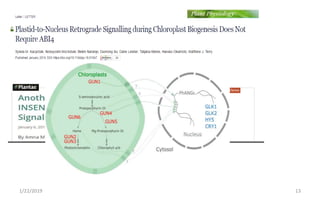
  • #13 Figure 1. Model of retrograde signaling during chloroplast biogenesis. Chloroplasts develop from etioplasts or proplastids in response to light. In the dark and in the etioplasts/proplastids, the plastid-encoded genes are mainly transcribed by NEP, and PET and TBP are not functional (dashed line boxes). During the greening process, activation of PEP plays a major role. PEP activity requires the rpo core components, SIGMA factors (SIG), PEP-associated proteins (PAPs, like pTAC12), and other proteins located in the nucleoid, like PRIN2. PRIN2 is involved in the light regulation of PEPactivity. The disruption of PET, TBP, or PGE generates a signal that is transduced by GUN1. It is to date unknown if the retrograde signal is of a positive nature that is interrupted in the case of chloroplast disruption (for example, by GUN1) or if the disrupted chloroplasts emit a negative signal (that can be mediated by GUN1). In response to chloroplast signals, PTM is cleaved, and the N-PTM form is translocated to the nucleus where it activates ABI4 expression, inhibiting LHCB expression and promoting the expression of COP1 and genes involved in hypocotyl elongation. In the dark, HY5 is degraded by COP1, which also degrades ABI4. The PIFs repress a set of PhANGs, the GLKs, and genes encoding the nuclear-encoded PEP components. In the light, the light perception by the photoreceptors CRY1 and PHYs causes exclusion of COP1 from the nucleus and degradation of the PIFs. The chloroplast-localized pTAC12 is an essential part of the PEP complex, but also is processed and translocated to the nucleus. The nuclear pTAC12 interacts with the active form of PHYs (Pfr) and contributes to PIF degradation. The exclusion of COP1 allows for accumulation of HY5. Degradation of PIFs releases the transcription of the GLKs and other sets of genes, like the genes encoding the PEP component. HY5 and GLKs induce PhANG LHCBs and genes coding TBPenzymes, among others) expression, and repress COP1 and the elongation-related genes. Figure by Daria Chrobok.