MODERN BIOLOGICAL
TOOLS AND TECHNIQUES
PREPARED BY CHARLES PAUL BAUTISTA AND MA. FATIMA
CARINO
MODERN BIOLOGICAL TOOLS AND
TECHNIQUES
Microscope
Most popular tool in Biology. Used to
examine objects too small to be seen with
the naked eye.
Developed by Anton van Leeuwenhoek in
1670s.
The most common type is Compound
Microscope.
MODERN BIOLOGICAL TOOLS AND
TECHNIQUES
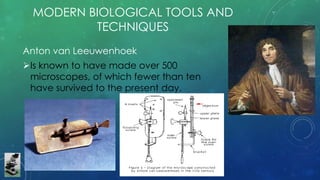
Anton van Leeuwenhoek
Is known to have made over 500
microscopes, of which fewer than ten
have survived to the present day.
MODERN BIOLOGICAL TOOLS AND
TECHNIQUES
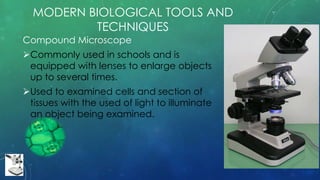
Compound Microscope
Commonly used in schools and is
equipped with lenses to enlarge objects
up to several times.
Used to examined cells and section of
tissues with the used of light to illuminate
an object being examined.
MODERN BIOLOGICAL TOOLS AND
TECHNIQUES
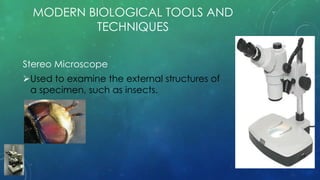
Stereo Microscope
Used to examine the external structures of
a specimen, such as insects.
MODERN BIOLOGICAL TOOLS AND
TECHNIQUES
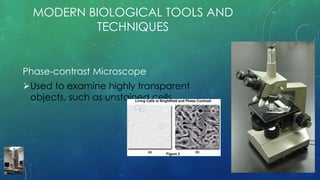
Phase-contrast Microscope
Used to examine highly transparent
objects, such as unstained cells.
MODERN BIOLOGICAL TOOLS AND
TECHNIQUES
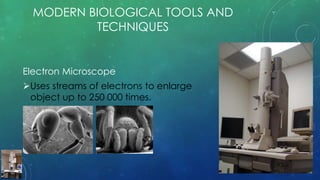
Electron Microscope
Uses streams of electrons to enlarge
object up to 250 000 times.
MODERN BIOLOGICAL TOOLS AND
TECHNIQUES
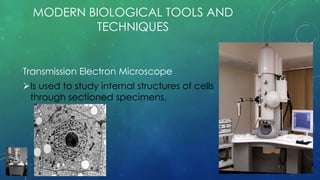
Transmission Electron Microscope
Is used to study internal structures of cells
through sectioned specimens.
MODERN BIOLOGICAL TOOLS AND
TECHNIQUES
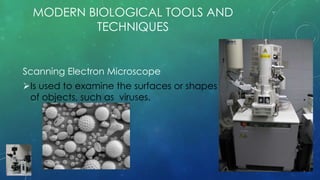
Scanning Electron Microscope
Is used to examine the surfaces or shapes
of objects, such as viruses.
MODERN BIOLOGICAL TOOLS AND
TECHNIQUES
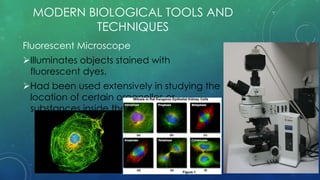
Fluorescent Microscope
Illuminates objects stained with
fluorescent dyes.
Had been used extensively in studying the
location of certain organelles or
substances inside the cell.
MODERN BIOLOGICAL TOOLS AND
TECHNIQUES
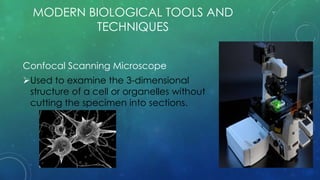
Confocal Scanning Microscope
Used to examine the 3-dimensional
structure of a cell or organelles without
cutting the specimen into sections.
MODERN BIOLOGICAL TOOLS AND
TECHNIQUES
Due to technological advancements in
image processing, objects examined using
the different microscopes can be
photographed or be viewed on TV or
computer screens. This process is called
video microscopy.
CELL AND TISSUE CULTUREThe use of cultured cells or tissues has an
advantage over using whole animals because of
ease of manipulation and simplicity of the system
without the complications of other cells or
substances in a whole organism.
Is achieved with the use of a medium containing
all the food requirements for a cell to survive grow
and multiply.
Is done under very strict, sterile(germ free)
conditions.
Is important in the production of monoclonal
antibodies called hybrid technology.
CENTRIFUGATION
Centrifuges
Are instruments used to separate cells or
cell organelles using centrifugal force.
Ordinary table-top centrifuges are used in
cell cultures to isolate whole cells from
culture media.
High-speed centrifuges or ultracentrifuges
are used to isolate different shapes and
sizes settle at the bottom of a centrifuge
tube at different sedimentation rates.
These are capable of spinning up to 75
000 revolutions per minute (rpm),
producing forces equivalent to around
500 000 times that of Earth’s gravity.
Chromatography
• It refers to a variety of techniques used
to purify biological molecules, such as
proteins and nucleic acids.
• A substance to be purified is suspended
in a liquid medium (mobile phase) and
is passed on to a column of matrix, such
as beads (immobile phase). The
substance to be purified interacts with
the matrix and the interaction is used as
a basis of separation.
Ion Exchange Chromatography
• Ionic charge of a substance is
used as the basis for purification.
Gel Filtration Chromatography
• Makes use of the size of the
molecule as the basis of
purification.
Affinity Chromatography
• Uses very special and very
specific interaction between
two molecules.
Gas Electrophoresis
is a powerful technique used to separate
and visualize proteins or nucleic acids.
Substances to be analyzed are driven
along a gel of cross- linked molecular
sieves using an electric current.
Substances to be analyzed are driven
along a gel of cross- linked molecular
sieves using an electric current.
MODERN BIOLOGICAL TOOLS AND
TECHNIQUES
Sodium dodecyl sulfate-
polyacrylamide gel electrophoresis
(SDS-PAGE)
-It is therefore used to analyze the
molecular weight of a given protein.
-is used to analyze proteins based on
its molecular mass. It is therefore used
to analyze the molecular weight of a
given protein.
Isoelectric focusing
is a type of electrophoresis that
separates proteins according to
isoelectric pH.
Two-dimensional gel electrophoresis
An electrophoresis that combines
both SDS-PAGE and isoelectric
focusing
Agarose gel electrophoresis
is used to analyze and determine the
molecular weights of nucleic acids,
MODERN BIOLOGICAL TOOLS AND
TECHNIQUES
TYPES OF ELECTROPHORESIS
Spectrophotometry
Is an instrument used to determine the
concentration of proteins or nucleic
acids in a solution.
Used in bacterial cell cultures to estimate
the amount of cells present in a given
volume of cell culture medium.
Measure the amount of light at a
specific wavelength that is absorbed by
the solution, which is proportional to the
concentration of substances present in
the solution or the number of cells in a
medium.
MODERN BIOLOGICAL TOOLS AND
TECHNIQUES
Polymerase Chain Reaction (PCR)
 Is a method used to amplify or make copies of a given DNA fragment
using an enzyme called DNA polymerase.
 Based on a principle that a double-stranded DNA molecule breaks into
two individual strands at high temperatures and with the use of PCR
primers (short DNA strands), the DNA polymerase can synthesize two
double-stranded DNA using two separated individual strands as
templates. When the process is repeated over and over again, there is
an exponential increase in the number of double- stranded DNA that is
produced: from one copy to two copies to four to eight to sixteen to
thirty-two, and so on, depending on how many times the cycle is
repeated.
 Widely used as a tool in DNA cloning, analysis of genetic diseases,
forensics, legal cases such as paternity testing and many more.
MODERN BIOLOGICAL TOOLS AND
TECHNIQUES
DNA Sequencing
Is used to determine the sequence of nucleic
acids present in a given gene or DNA fragment.
This technology was independently developed
by Fredrick Sanger and Walter Gilbert.
Most automated DNA sequencers used today
are developed by Sanger.
Used to prepare the DNA sample to be
sequenced, followed by gel electrophoresis.
The results are tabulated and analyzed by a
computer.
MODERN BIOLOGICAL TOOLS AND
TECHNIQUES
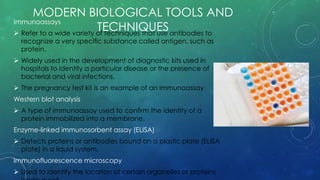
Immunoassays
 Refer to a wide variety of techniques that use antibodies to
recognize a very specific substance called antigen, such as
protein.
 Widely used in the development of diagnostic kits used in
hospitals to identify a particular disease or the presence of
bacterial and viral infections.
 The pregnancy test kit is an example of an immunoassay
Western blot analysis
 A type of immunoassay used to confirm the identity of a
protein immobilized into a membrane.
Enzyme-linked immunosorbent assay (ELISA)
 Detects proteins or antibodies bound on a plastic plate (ELISA
plate) in a liquid system.
Immunofluorescence microscopy
 Used to identify the location of certain organelles or proteins
MODERN BIOLOGICAL TOOLS AND
TECHNIQUES
DNA Cloning
Is a technique used to produce large quantities
of specific DNA fragments. The process involves
the ligation or linking of a gene of interest into a
cloning vector, such as bacterial plasmid, that
will serve as a carrier of the gene of interest.
Is used in a variety of applications including
gene analysis, DNA Sequencing, production of
recombinant proteins and industrial and medical
purpose, and the generation of transgenic
animals and plants.
MODERN BIOLOGICAL TOOLS AND
TECHNIQUES
The fused gene and
cloning vector called
recombinant DNA, is then
forced to enter a suitable
host cell such as the
bacterium E. coli.
The E. coli will then
produce several
copies of the
recombinant DNA.
The recombinant DNA
becomes a part of the E.
coli cell and is then
transmitted to the
daughter cell every time
the E. coli undergoes cell
division.
Since E. coli divides at a
very fast rate (~20
minutes), large amounts
of the recombinant
DNA can also be
reproduced.
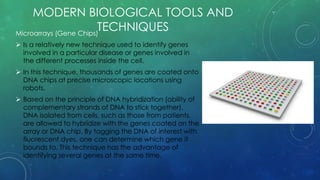
Microarrays (Gene Chips)
 Is a relatively new technique used to identify genes
involved in a particular disease or genes involved in
the different processes inside the cell.
 In this technique, thousands of genes are coated onto
DNA chips at precise microscopic locations using
robots.
 Based on the principle of DNA hybridization (ability of
complementary strands of DNA to stick together),
DNA isolated from cells, such as those from patients,
are allowed to hybridize with the genes coated on the
array or DNA chip. By tagging the DNA of interest with
fluorescent dyes, one can determine which gene it
bounds to. This technique has the advantage of
identifying several genes at the same time.
MODERN BIOLOGICAL TOOLS AND
TECHNIQUES

Modern Biological Tools and Techniques

  • 1.
    MODERN BIOLOGICAL TOOLS ANDTECHNIQUES PREPARED BY CHARLES PAUL BAUTISTA AND MA. FATIMA CARINO
  • 2.
    MODERN BIOLOGICAL TOOLSAND TECHNIQUES Microscope Most popular tool in Biology. Used to examine objects too small to be seen with the naked eye. Developed by Anton van Leeuwenhoek in 1670s. The most common type is Compound Microscope.
  • 3.
    MODERN BIOLOGICAL TOOLSAND TECHNIQUES Anton van Leeuwenhoek Is known to have made over 500 microscopes, of which fewer than ten have survived to the present day.
  • 4.
    MODERN BIOLOGICAL TOOLSAND TECHNIQUES Compound Microscope Commonly used in schools and is equipped with lenses to enlarge objects up to several times. Used to examined cells and section of tissues with the used of light to illuminate an object being examined.
  • 5.
    MODERN BIOLOGICAL TOOLSAND TECHNIQUES Stereo Microscope Used to examine the external structures of a specimen, such as insects.
  • 6.
    MODERN BIOLOGICAL TOOLSAND TECHNIQUES Phase-contrast Microscope Used to examine highly transparent objects, such as unstained cells.
  • 7.
    MODERN BIOLOGICAL TOOLSAND TECHNIQUES Electron Microscope Uses streams of electrons to enlarge object up to 250 000 times.
  • 8.
    MODERN BIOLOGICAL TOOLSAND TECHNIQUES Transmission Electron Microscope Is used to study internal structures of cells through sectioned specimens.
  • 9.
    MODERN BIOLOGICAL TOOLSAND TECHNIQUES Scanning Electron Microscope Is used to examine the surfaces or shapes of objects, such as viruses.
  • 10.
    MODERN BIOLOGICAL TOOLSAND TECHNIQUES Fluorescent Microscope Illuminates objects stained with fluorescent dyes. Had been used extensively in studying the location of certain organelles or substances inside the cell.
  • 11.
    MODERN BIOLOGICAL TOOLSAND TECHNIQUES Confocal Scanning Microscope Used to examine the 3-dimensional structure of a cell or organelles without cutting the specimen into sections.
  • 12.
    MODERN BIOLOGICAL TOOLSAND TECHNIQUES Due to technological advancements in image processing, objects examined using the different microscopes can be photographed or be viewed on TV or computer screens. This process is called video microscopy.
  • 13.
    CELL AND TISSUECULTUREThe use of cultured cells or tissues has an advantage over using whole animals because of ease of manipulation and simplicity of the system without the complications of other cells or substances in a whole organism. Is achieved with the use of a medium containing all the food requirements for a cell to survive grow and multiply. Is done under very strict, sterile(germ free) conditions. Is important in the production of monoclonal antibodies called hybrid technology.
  • 14.
    CENTRIFUGATION Centrifuges Are instruments usedto separate cells or cell organelles using centrifugal force. Ordinary table-top centrifuges are used in cell cultures to isolate whole cells from culture media. High-speed centrifuges or ultracentrifuges are used to isolate different shapes and sizes settle at the bottom of a centrifuge tube at different sedimentation rates. These are capable of spinning up to 75 000 revolutions per minute (rpm), producing forces equivalent to around 500 000 times that of Earth’s gravity.
  • 15.
    Chromatography • It refersto a variety of techniques used to purify biological molecules, such as proteins and nucleic acids. • A substance to be purified is suspended in a liquid medium (mobile phase) and is passed on to a column of matrix, such as beads (immobile phase). The substance to be purified interacts with the matrix and the interaction is used as a basis of separation.
  • 16.
    Ion Exchange Chromatography •Ionic charge of a substance is used as the basis for purification. Gel Filtration Chromatography • Makes use of the size of the molecule as the basis of purification. Affinity Chromatography • Uses very special and very specific interaction between two molecules.
  • 17.
    Gas Electrophoresis is apowerful technique used to separate and visualize proteins or nucleic acids. Substances to be analyzed are driven along a gel of cross- linked molecular sieves using an electric current. Substances to be analyzed are driven along a gel of cross- linked molecular sieves using an electric current. MODERN BIOLOGICAL TOOLS AND TECHNIQUES
  • 18.
    Sodium dodecyl sulfate- polyacrylamidegel electrophoresis (SDS-PAGE) -It is therefore used to analyze the molecular weight of a given protein. -is used to analyze proteins based on its molecular mass. It is therefore used to analyze the molecular weight of a given protein.
  • 19.
    Isoelectric focusing is atype of electrophoresis that separates proteins according to isoelectric pH. Two-dimensional gel electrophoresis An electrophoresis that combines both SDS-PAGE and isoelectric focusing Agarose gel electrophoresis is used to analyze and determine the molecular weights of nucleic acids, MODERN BIOLOGICAL TOOLS AND TECHNIQUES TYPES OF ELECTROPHORESIS
  • 20.
    Spectrophotometry Is an instrumentused to determine the concentration of proteins or nucleic acids in a solution. Used in bacterial cell cultures to estimate the amount of cells present in a given volume of cell culture medium. Measure the amount of light at a specific wavelength that is absorbed by the solution, which is proportional to the concentration of substances present in the solution or the number of cells in a medium. MODERN BIOLOGICAL TOOLS AND TECHNIQUES
  • 21.
    Polymerase Chain Reaction(PCR)  Is a method used to amplify or make copies of a given DNA fragment using an enzyme called DNA polymerase.  Based on a principle that a double-stranded DNA molecule breaks into two individual strands at high temperatures and with the use of PCR primers (short DNA strands), the DNA polymerase can synthesize two double-stranded DNA using two separated individual strands as templates. When the process is repeated over and over again, there is an exponential increase in the number of double- stranded DNA that is produced: from one copy to two copies to four to eight to sixteen to thirty-two, and so on, depending on how many times the cycle is repeated.  Widely used as a tool in DNA cloning, analysis of genetic diseases, forensics, legal cases such as paternity testing and many more. MODERN BIOLOGICAL TOOLS AND TECHNIQUES
  • 22.
    DNA Sequencing Is usedto determine the sequence of nucleic acids present in a given gene or DNA fragment. This technology was independently developed by Fredrick Sanger and Walter Gilbert. Most automated DNA sequencers used today are developed by Sanger. Used to prepare the DNA sample to be sequenced, followed by gel electrophoresis. The results are tabulated and analyzed by a computer. MODERN BIOLOGICAL TOOLS AND TECHNIQUES
  • 23.
    Immunoassays  Refer toa wide variety of techniques that use antibodies to recognize a very specific substance called antigen, such as protein.  Widely used in the development of diagnostic kits used in hospitals to identify a particular disease or the presence of bacterial and viral infections.  The pregnancy test kit is an example of an immunoassay Western blot analysis  A type of immunoassay used to confirm the identity of a protein immobilized into a membrane. Enzyme-linked immunosorbent assay (ELISA)  Detects proteins or antibodies bound on a plastic plate (ELISA plate) in a liquid system. Immunofluorescence microscopy  Used to identify the location of certain organelles or proteins MODERN BIOLOGICAL TOOLS AND TECHNIQUES
  • 24.
    DNA Cloning Is atechnique used to produce large quantities of specific DNA fragments. The process involves the ligation or linking of a gene of interest into a cloning vector, such as bacterial plasmid, that will serve as a carrier of the gene of interest. Is used in a variety of applications including gene analysis, DNA Sequencing, production of recombinant proteins and industrial and medical purpose, and the generation of transgenic animals and plants. MODERN BIOLOGICAL TOOLS AND TECHNIQUES
  • 25.
    The fused geneand cloning vector called recombinant DNA, is then forced to enter a suitable host cell such as the bacterium E. coli. The E. coli will then produce several copies of the recombinant DNA. The recombinant DNA becomes a part of the E. coli cell and is then transmitted to the daughter cell every time the E. coli undergoes cell division. Since E. coli divides at a very fast rate (~20 minutes), large amounts of the recombinant DNA can also be reproduced.
  • 26.
    Microarrays (Gene Chips) Is a relatively new technique used to identify genes involved in a particular disease or genes involved in the different processes inside the cell.  In this technique, thousands of genes are coated onto DNA chips at precise microscopic locations using robots.  Based on the principle of DNA hybridization (ability of complementary strands of DNA to stick together), DNA isolated from cells, such as those from patients, are allowed to hybridize with the genes coated on the array or DNA chip. By tagging the DNA of interest with fluorescent dyes, one can determine which gene it bounds to. This technique has the advantage of identifying several genes at the same time. MODERN BIOLOGICAL TOOLS AND TECHNIQUES

Editor's Notes