Dr. Vikas J. Dongre
HOD Electronics &Telecommunication
Government Polytechnic Washim (MS)
Email: dongrevj1@gmail.com
The modern discipline of Electronic engineering was born
out of telephone, radio, and television equipment
development.
Large amount of electronic systems development
during World War II of radar, sonar, communication
systems, and advanced munitions and weapon systems.
Initially the subject was known as radio engineering and it
was only in the late 1950s that the term electronic
engineering started to emerge.
Electrical
Engg.
Electronics
Engg
Computer
Engg
Information
Technology
Evolution
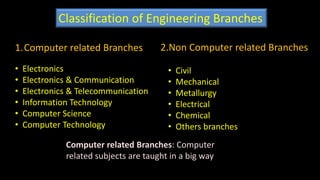
Classification of Engineering Branches
1.Computer related Branches 2.Non Computer related Branches
• Electronics
• Electronics & Communication
• Electronics & Telecommunication
• Information Technology
• Computer Science
• Computer Technology
• Civil
• Mechanical
• Metallurgy
• Electrical
• Chemical
• Others branches
Computer related Branches: Computer
related subjects are taught in a big way
Technological area in Electronics Engineering
• Robotics
• Drowns
• Sound, Image
Processing
• Automation
• Global Positioning
System(GPS)
• Bluetooth, WiFi
• Mobile Communication
• Smart Sensors
• Driverless Car
• Internet of Things (IoT)
• Medical
Instrumentation
• Avionics
• App based device
control
• LCD LED Displays
• CCTV security Systems
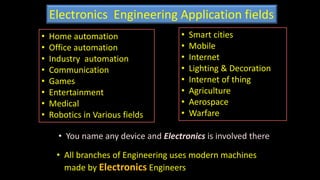
• Home automation
• Office automation
• Industry automation
• Communication
• Games
• Entertainment
• Medical
• Robotics in Various fields
Electronics Engineering Application fields
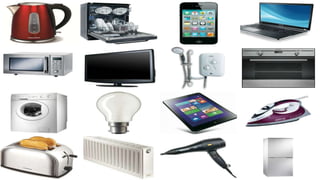
• You name any device and Electronics is involved there
• All branches of Engineering uses modern machines
made by Electronics Engineers
• Smart cities
• Mobile
• Internet
• Lighting & Decoration
• Internet of thing
• Agriculture
• Aerospace
• Warfare
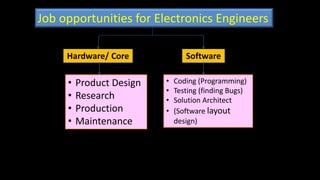
Job opportunities for Electronics Engineers
• Coding (Programming)
• Testing (finding Bugs)
• Solution Architect
• (Software layout
design)
Hardware/ Core Software
• Product Design
• Research
• Production
• Maintenance
Job opportunities for Electronics Engineers
Government Sector
(H/W + S/W)
Private Sector (H/W + S/W)Public Sector
( Mostly H/W)
• ISRO
• DRDO
• Banks
• NIC
• Railways
• Merchant Navy
• Indian Army
• Navy
• Airforce
• UPSC
• MPSC
• RAW
• Salary: good but
Stagnant
• BEL
• ECIL
• BSNL
• IOCL
• HPCL
• BHEL
• NTPC
• Power Grid Corp.
• RCF
• BHEL
• SAIL
• Electricity Boards
• HAL
• C-DAC
• DMRC
• Salary: good but
Stagnant
• Sony
• Samsung
• Honeywel
• Fanuc
• Mitsubishi
• Reliance
• IBM
• Apple
• Google
• Microsoft
• Oracle
• Intel
• HP
• Infosys
• ABB
• Salary: increases
as you grow
• Cisco
• LG
• Videocon
• Panasonic
• Vodafone
• Airtel
• Tata Teleservices
• Tata Motors
• Phillips
• Siemens
• Toshiba
• Syntel
• Dell
• Toshiba
• Canon
• Salary: increases
as you grow
• Wipro
• Tech Mahindra
• HCL
• Jio
• TCS
• Godrej
• Micromax
• Intex
• Iball
• Kenstar
• Moserbaer
• Onida
• Voltas
• Sterlite
• Many more….
• Salary: increases
as you grow
Entrepreneurship Possibilities
1. Solar panel manufacturing and maintenance
2. LED lighting production
3. Automation related solution provider
4. Production of Electronic components, instruments, Gadgets,
Adopters, Connectors ,Cables
5. Marketing of various Electronics Equipments
6. Service centers
7. Testing and Consulting services
8. Hardware and Software solution provider for industry
9. Mobile Application design (App)
10. Smart automation provider
Many more possibilities…
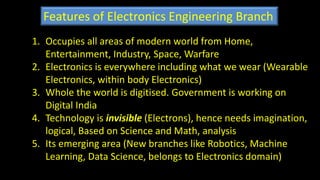
Features of Electronics Engineering Branch
1. Occupies all areas of modern world from Home,
Entertainment, Industry, Space, Warfare
2. Electronics is everywhere including what we wear (Wearable
Electronics, within body Electronics)
3. Whole the world is digitised. Government is working on
Digital India
4. Technology is invisible (Electrons), hence needs imagination,
logical, Based on Science and Math, analysis
5. Its emerging area (New branches like Robotics, Machine
Learning, Data Science, belongs to Electronics domain)
Training for Electronics & Communication Engineers
1. Focus on hands on Skills
2. Software like C, Matlab, Jawa, Ptyhon, R
3. Embedded Systems
4. Youtube Courses
5. Summer Internships
6. Practicals using actual instruments and
Simulation
7. Thorough reading
8. Knowledge updating using Internet
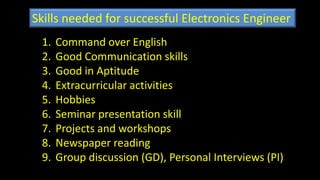
Skills needed for successful Electronics Engineer
1. Command over English
2. Good Communication skills
3. Good in Aptitude
4. Extracurricular activities
5. Hobbies
6. Seminar presentation skill
7. Projects and workshops
8. Newspaper reading
9. Group discussion (GD), Personal Interviews (PI)
To improve Resume
How to select College?
1. Recognized, accredited
2. Teaching faculties
3. Equipments
4. Computers and softwares
5. Extracurricular activities like various competitions, Sports, events,
seminars, workshops, Quizzes, Alumni meets, Industry
collaborations, Industry visits
6. Campus Placements
(Check institution website, ask old students, do your own research)
Final Comments
1. Engineering is best profession
2. Good Engineers are always is demand. There is shortage of good
engineers
3. Engineering is not a joke. It needs lot of hard work to meet the
industry expectation
4. There will be many traps which will try to pull you down. (too much
of computer games, movies, friends, parties, affairs, bunks). Use
your time consciously.
5. Do some online courses, do practicals yourself, increase your hands
on and soft skills, participate in various college activities to improve
soft skills. Listen to your teachers, not your seniors
Best wishes for your bright future
Thanks for Patient listening
Dr. Vikas J. Dongre
HOD Electronics & Telecommunication
Government Polytechnic Washim (MS)
Email: dongrevj1@gmail.com
M: 9370668979

Job opportunities for electronics engineering

  • 1.
    Dr. Vikas J.Dongre HOD Electronics &Telecommunication Government Polytechnic Washim (MS) Email: dongrevj1@gmail.com
  • 6.
    The modern disciplineof Electronic engineering was born out of telephone, radio, and television equipment development. Large amount of electronic systems development during World War II of radar, sonar, communication systems, and advanced munitions and weapon systems. Initially the subject was known as radio engineering and it was only in the late 1950s that the term electronic engineering started to emerge.
  • 7.
  • 8.
    Classification of EngineeringBranches 1.Computer related Branches 2.Non Computer related Branches • Electronics • Electronics & Communication • Electronics & Telecommunication • Information Technology • Computer Science • Computer Technology • Civil • Mechanical • Metallurgy • Electrical • Chemical • Others branches Computer related Branches: Computer related subjects are taught in a big way
  • 9.
    Technological area inElectronics Engineering • Robotics • Drowns • Sound, Image Processing • Automation • Global Positioning System(GPS) • Bluetooth, WiFi • Mobile Communication • Smart Sensors • Driverless Car • Internet of Things (IoT) • Medical Instrumentation • Avionics • App based device control • LCD LED Displays • CCTV security Systems
  • 10.
    • Home automation •Office automation • Industry automation • Communication • Games • Entertainment • Medical • Robotics in Various fields Electronics Engineering Application fields • You name any device and Electronics is involved there • All branches of Engineering uses modern machines made by Electronics Engineers • Smart cities • Mobile • Internet • Lighting & Decoration • Internet of thing • Agriculture • Aerospace • Warfare
  • 11.
    Job opportunities forElectronics Engineers • Coding (Programming) • Testing (finding Bugs) • Solution Architect • (Software layout design) Hardware/ Core Software • Product Design • Research • Production • Maintenance
  • 12.
    Job opportunities forElectronics Engineers Government Sector (H/W + S/W) Private Sector (H/W + S/W)Public Sector ( Mostly H/W) • ISRO • DRDO • Banks • NIC • Railways • Merchant Navy • Indian Army • Navy • Airforce • UPSC • MPSC • RAW • Salary: good but Stagnant • BEL • ECIL • BSNL • IOCL • HPCL • BHEL • NTPC • Power Grid Corp. • RCF • BHEL • SAIL • Electricity Boards • HAL • C-DAC • DMRC • Salary: good but Stagnant • Sony • Samsung • Honeywel • Fanuc • Mitsubishi • Reliance • IBM • Apple • Google • Microsoft • Oracle • Intel • HP • Infosys • ABB • Salary: increases as you grow • Cisco • LG • Videocon • Panasonic • Vodafone • Airtel • Tata Teleservices • Tata Motors • Phillips • Siemens • Toshiba • Syntel • Dell • Toshiba • Canon • Salary: increases as you grow • Wipro • Tech Mahindra • HCL • Jio • TCS • Godrej • Micromax • Intex • Iball • Kenstar • Moserbaer • Onida • Voltas • Sterlite • Many more…. • Salary: increases as you grow
  • 13.
    Entrepreneurship Possibilities 1. Solarpanel manufacturing and maintenance 2. LED lighting production 3. Automation related solution provider 4. Production of Electronic components, instruments, Gadgets, Adopters, Connectors ,Cables 5. Marketing of various Electronics Equipments 6. Service centers 7. Testing and Consulting services 8. Hardware and Software solution provider for industry 9. Mobile Application design (App) 10. Smart automation provider Many more possibilities…
  • 14.
    Features of ElectronicsEngineering Branch 1. Occupies all areas of modern world from Home, Entertainment, Industry, Space, Warfare 2. Electronics is everywhere including what we wear (Wearable Electronics, within body Electronics) 3. Whole the world is digitised. Government is working on Digital India 4. Technology is invisible (Electrons), hence needs imagination, logical, Based on Science and Math, analysis 5. Its emerging area (New branches like Robotics, Machine Learning, Data Science, belongs to Electronics domain)
  • 15.
    Training for Electronics& Communication Engineers 1. Focus on hands on Skills 2. Software like C, Matlab, Jawa, Ptyhon, R 3. Embedded Systems 4. Youtube Courses 5. Summer Internships 6. Practicals using actual instruments and Simulation 7. Thorough reading 8. Knowledge updating using Internet
  • 16.
    Skills needed forsuccessful Electronics Engineer 1. Command over English 2. Good Communication skills 3. Good in Aptitude 4. Extracurricular activities 5. Hobbies 6. Seminar presentation skill 7. Projects and workshops 8. Newspaper reading 9. Group discussion (GD), Personal Interviews (PI) To improve Resume
  • 17.
    How to selectCollege? 1. Recognized, accredited 2. Teaching faculties 3. Equipments 4. Computers and softwares 5. Extracurricular activities like various competitions, Sports, events, seminars, workshops, Quizzes, Alumni meets, Industry collaborations, Industry visits 6. Campus Placements (Check institution website, ask old students, do your own research)
  • 18.
    Final Comments 1. Engineeringis best profession 2. Good Engineers are always is demand. There is shortage of good engineers 3. Engineering is not a joke. It needs lot of hard work to meet the industry expectation 4. There will be many traps which will try to pull you down. (too much of computer games, movies, friends, parties, affairs, bunks). Use your time consciously. 5. Do some online courses, do practicals yourself, increase your hands on and soft skills, participate in various college activities to improve soft skills. Listen to your teachers, not your seniors
  • 19.
    Best wishes foryour bright future Thanks for Patient listening Dr. Vikas J. Dongre HOD Electronics & Telecommunication Government Polytechnic Washim (MS) Email: dongrevj1@gmail.com M: 9370668979