Presented By:
Roshan Mani
11ECTEC047
B.Tech. VIII Sem
E.C.E. Deptt.
GCET Bikaner
7-May-15 1Roshan Mani
OUTLINE
 Introduction
 Basic OLED Structure
 Materials for flexible electronics
 Technologies involved in processing
 Technologies for Flexible Displays
 Degree of flexibility
 Applications
 Advantages and Limitations
 Conclusion
7-May-15 2Roshan Mani
INTRODUCTION
Ever evolving advances in thin-film
materials and devices have fueled many of
the developments in the field of flexible
electronics.
7-May-15 3Roshan Mani
Basic OLED structure
7-May-15 4Roshan Mani
Materials for Flexible Electronics
A generic large-area electronic structure is
composed of :
Substrate
Back-plane
Front-plane
Encapsulation
7-May-15 5Roshan Mani
Substrates
Flexible substrates that are to serve as drop-in
replacements for plate glass substrates must meet
many requirements:
Optical properties
Surface roughness
 Thermal and thermo-mechanical properties
Chemical properties
Mechanical properties
Electrical and magnetic properties
7-May-15 6Roshan Mani
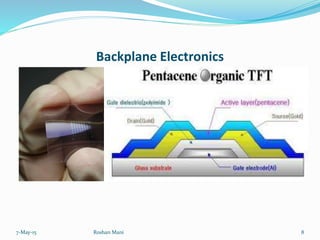
Backplane electronics
Backplanes provide or collect power and signal to or
from front-planes. Backplanes may be passive or
active.
Silicon Thin-Film Transistors
Organic Thin-Film Transistors
Materials for Interconnects and Contacts
7-May-15 7Roshan Mani
Backplane Electronics
7-May-15 8Roshan Mani
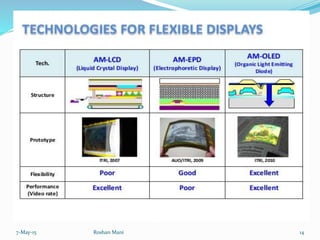
Front plane technologies
Front plane carry the specific optoelectronic
application.
Liquid Crystal Displays
 Electro-phoretic Displays
Organic Light-Emitting Displays
Sensors
7-May-15 9Roshan Mani
TECHNOLOGIES AND INTEGRATION
PROCESSES
Any manufacturable device has four essential
characteristics:
 Superior and pre-specified performance, with
reproducibility, uniformity, and reliability
 High yield to acceptable tolerance
 Simulations exist for both reverse engineering during
development and right-first-time design
Proven adequate in-service lifetime.
7-May-15 10Roshan Mani
7-May-15 11Roshan Mani
FABRICATION TECHNOLOGY FOR FLEXIBLE
ELECTRONICS
 Fabrication on sheets by Batch Processing..
 On a rigid carrier, facing up and loose;
 In a tensioning frame, facing up or down;
 In a frame, facing down and loose
 Fabrication On Web by roll-to-roll Processing
 Additive Printing
7-May-15 12Roshan Mani
Batch and roll to roll fabrication
7-May-15 13Roshan Mani
7-May-15 14Roshan Mani
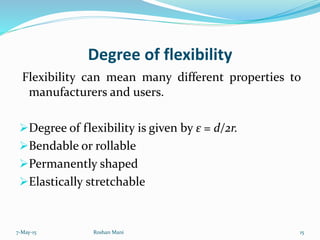
Degree of flexibility
Flexibility can mean many different properties to
manufacturers and users.
Degree of flexibility is given by ε = d/2r.
Bendable or rollable
Permanently shaped
Elastically stretchable
7-May-15 15Roshan Mani
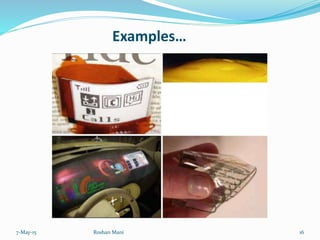
Examples…
7-May-15 16Roshan Mani
APPLICATIONS
Holistic system design
7-May-15 17Roshan Mani
Health Care
7-May-15 18Roshan Mani
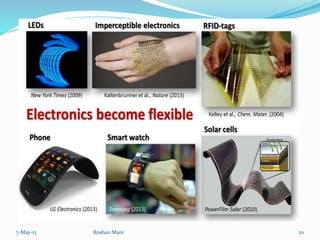
Other applications
Automotive Industries
Displays and Human- machine interaction
Energy management and mobile devices
Wireless systems
Electronics Embedded in the living environment
Electronics for hostile environment etc..,
7-May-15 19Roshan Mani
7-May-15 20Roshan Mani
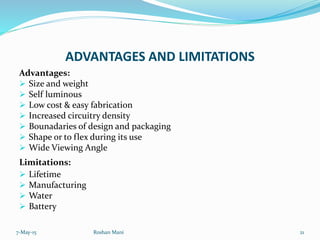
ADVANTAGES AND LIMITATIONS
Advantages:
 Size and weight
 Self luminous
 Low cost & easy fabrication
 Increased circuitry density
 Bounadaries of design and packaging
 Shape or to flex during its use
 Wide Viewing Angle
Limitations:
 Lifetime
 Manufacturing
 Water
 Battery
7-May-15 21Roshan Mani
CONCLUSION
Based on the current socio-economic trends, we
outlined some of the most likely technological future
needs and discussed the potential exploits of thin-film
flexible electronics in various market sectors.
7-May-15 22Roshan Mani
7-May-15 23Roshan Mani

Flexible Electronics

  • 1.
    Presented By: Roshan Mani 11ECTEC047 B.Tech.VIII Sem E.C.E. Deptt. GCET Bikaner 7-May-15 1Roshan Mani
  • 2.
    OUTLINE  Introduction  BasicOLED Structure  Materials for flexible electronics  Technologies involved in processing  Technologies for Flexible Displays  Degree of flexibility  Applications  Advantages and Limitations  Conclusion 7-May-15 2Roshan Mani
  • 3.
    INTRODUCTION Ever evolving advancesin thin-film materials and devices have fueled many of the developments in the field of flexible electronics. 7-May-15 3Roshan Mani
  • 4.
  • 5.
    Materials for FlexibleElectronics A generic large-area electronic structure is composed of : Substrate Back-plane Front-plane Encapsulation 7-May-15 5Roshan Mani
  • 6.
    Substrates Flexible substrates thatare to serve as drop-in replacements for plate glass substrates must meet many requirements: Optical properties Surface roughness  Thermal and thermo-mechanical properties Chemical properties Mechanical properties Electrical and magnetic properties 7-May-15 6Roshan Mani
  • 7.
    Backplane electronics Backplanes provideor collect power and signal to or from front-planes. Backplanes may be passive or active. Silicon Thin-Film Transistors Organic Thin-Film Transistors Materials for Interconnects and Contacts 7-May-15 7Roshan Mani
  • 8.
  • 9.
    Front plane technologies Frontplane carry the specific optoelectronic application. Liquid Crystal Displays  Electro-phoretic Displays Organic Light-Emitting Displays Sensors 7-May-15 9Roshan Mani
  • 10.
    TECHNOLOGIES AND INTEGRATION PROCESSES Anymanufacturable device has four essential characteristics:  Superior and pre-specified performance, with reproducibility, uniformity, and reliability  High yield to acceptable tolerance  Simulations exist for both reverse engineering during development and right-first-time design Proven adequate in-service lifetime. 7-May-15 10Roshan Mani
  • 11.
  • 12.
    FABRICATION TECHNOLOGY FORFLEXIBLE ELECTRONICS  Fabrication on sheets by Batch Processing..  On a rigid carrier, facing up and loose;  In a tensioning frame, facing up or down;  In a frame, facing down and loose  Fabrication On Web by roll-to-roll Processing  Additive Printing 7-May-15 12Roshan Mani
  • 13.
    Batch and rollto roll fabrication 7-May-15 13Roshan Mani
  • 14.
  • 15.
    Degree of flexibility Flexibilitycan mean many different properties to manufacturers and users. Degree of flexibility is given by ε = d/2r. Bendable or rollable Permanently shaped Elastically stretchable 7-May-15 15Roshan Mani
  • 16.
  • 17.
  • 18.
  • 19.
    Other applications Automotive Industries Displaysand Human- machine interaction Energy management and mobile devices Wireless systems Electronics Embedded in the living environment Electronics for hostile environment etc.., 7-May-15 19Roshan Mani
  • 20.
  • 21.
    ADVANTAGES AND LIMITATIONS Advantages: Size and weight  Self luminous  Low cost & easy fabrication  Increased circuitry density  Bounadaries of design and packaging  Shape or to flex during its use  Wide Viewing Angle Limitations:  Lifetime  Manufacturing  Water  Battery 7-May-15 21Roshan Mani
  • 22.
    CONCLUSION Based on thecurrent socio-economic trends, we outlined some of the most likely technological future needs and discussed the potential exploits of thin-film flexible electronics in various market sectors. 7-May-15 22Roshan Mani
  • 23.