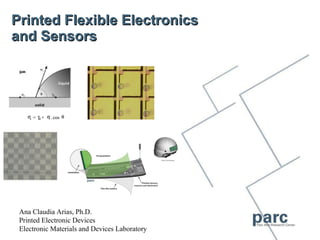
Printed Flexible Electronics  and Sensors Ana Claudia Arias, Ph.D. Printed Electronic Devices Electronic Materials and Devices Laboratory  s =   sl +   l  . cos   s =   sl +   l  . cos 
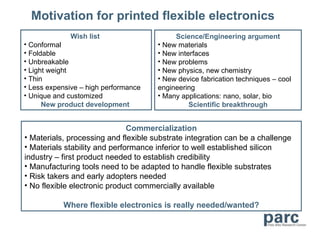
Motivation for printed flexible electronics Wish list  Conformal Foldable  Unbreakable Light weight Thin Less expensive – high performance Unique and customized New product development  Science/Engineering argument New materials New interfaces New problems New physics, new chemistry New device fabrication techniques – cool engineering Many applications: nano, solar, bio Scientific breakthrough Commercialization Materials, processing and flexible substrate integration can be a challenge Materials stability and performance inferior to well established silicon industry – first product needed to establish credibility Manufacturing tools need to be adapted to handle flexible substrates Risk takers and early adopters needed  No flexible electronic product commercially available Where flexible electronics is really needed/wanted?
Amazon Kindle A lot of activity on displays: products on the market Several products available All rigid products Backplane based on a-Si  technology Display media from E-ink Low power consumption Content oriented business model most successful
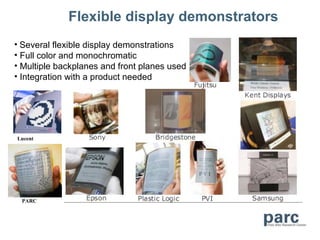
Several flexible display demonstrations Full color and monochromatic Multiple backplanes and front planes used Integration with a product needed Flexible display demonstrators PARC Lucent
Printed electronics applications Some examples Duracell: Battery tester Cypak: Intelligent  Pharmaceutical  Packaging PolyIC: RFID CSG: via etching Plastic Logic: e-paper CDT: OLED displays Konarka: Solar cell Pelikon: EL displays Power Paper: battery
Approaches: From inorganic rigid materials to flexible systems Courtesy of Prof. John Rogers Inorganic-based flexible structures: New processing methods allow  fabrication of flexible structures Control of materials performance under low temperature processing Stamping and pick and place allow large area fabrication High performance systems
Approaches: Organic and inorganic materials  Processed at low temperature Many materials sputtered at room temperature  Others can be processed from solution  Organic materials are inherently flexible Compatible with flexible substrates Opens up new manufacturing opportunities
New and unique science problems Lower capital investment Large area capability Rigid or flexible substrates Extremely thin Environmentally friendly Less photolithography, vacuum Short turnaround/cycle time Customization ease PARC’s approach: Solution-based electronics  Electronic components printed like documents are printed
From photolithography to  additive processing Many processing steps and a lot of materials waste One step for patterning and deposition Additive printing Photo - lithography resist Deposit film resist Deposit film
Thin-film transistors are the building blocks  for electronics TFT is a switch! high I on  (~mA) low I off  (~pA) semiconductor Display pixel via layer drain pad gate line media dielectric data line Top view gate line data line pixel  pad ~ 300 mm TFT
All additive printed arrays PEN substrate Printed nanoparticle metals Polymer dielectric Polymer semiconductor (PQT + others) Reflective display format Gate line Data line Semiconductor Pixel pad 340 um 680 um PARC has demonstrated all-printed TFT backplanes for displays
Technology platform creation: Working with clients to accelerate their entry to market
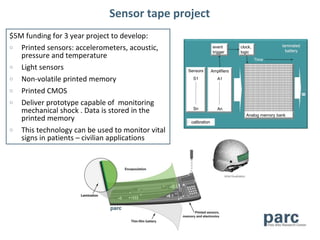
Sensor tape project $5M funding for 3 year project to develop: Printed sensors: accelerometers, acoustic, pressure and temperature Light sensors Non-volatile printed memory Printed CMOS Deliver prototype capable of  monitoring mechanical shock . Data is stored in the printed memory  This technology can be used to monitor vital signs in patients – civilian applications
Circuit integration with printed sensors MEMS sensors Printed organic amplifiers After write V sd = -5,-20V Pressure signal after amplifier Pressure signal without amplifier Use printed amplifier to boost write voltage into memory cell V DD V out V in bias Switch TFTs memory TFT
To subscribe to the PARC Innovations Update e-newsletter or blog, or to follow us on Twitter, go to  http://www.parc.com/about/subscribe.html   For more information, please contact: Ana Arias  ana.arias@ parc.com   Jennifer Ernst, Business Development [email_address]

Flexible Electronics

  • 1.
    Printed Flexible Electronics and Sensors Ana Claudia Arias, Ph.D. Printed Electronic Devices Electronic Materials and Devices Laboratory  s =  sl +  l . cos   s =  sl +  l . cos 
  • 2.
    Motivation for printedflexible electronics Wish list Conformal Foldable Unbreakable Light weight Thin Less expensive – high performance Unique and customized New product development Science/Engineering argument New materials New interfaces New problems New physics, new chemistry New device fabrication techniques – cool engineering Many applications: nano, solar, bio Scientific breakthrough Commercialization Materials, processing and flexible substrate integration can be a challenge Materials stability and performance inferior to well established silicon industry – first product needed to establish credibility Manufacturing tools need to be adapted to handle flexible substrates Risk takers and early adopters needed No flexible electronic product commercially available Where flexible electronics is really needed/wanted?
  • 3.
    Amazon Kindle Alot of activity on displays: products on the market Several products available All rigid products Backplane based on a-Si technology Display media from E-ink Low power consumption Content oriented business model most successful
  • 4.
    Several flexible displaydemonstrations Full color and monochromatic Multiple backplanes and front planes used Integration with a product needed Flexible display demonstrators PARC Lucent
  • 5.
    Printed electronics applicationsSome examples Duracell: Battery tester Cypak: Intelligent Pharmaceutical Packaging PolyIC: RFID CSG: via etching Plastic Logic: e-paper CDT: OLED displays Konarka: Solar cell Pelikon: EL displays Power Paper: battery
  • 6.
    Approaches: From inorganicrigid materials to flexible systems Courtesy of Prof. John Rogers Inorganic-based flexible structures: New processing methods allow fabrication of flexible structures Control of materials performance under low temperature processing Stamping and pick and place allow large area fabrication High performance systems
  • 7.
    Approaches: Organic andinorganic materials Processed at low temperature Many materials sputtered at room temperature Others can be processed from solution Organic materials are inherently flexible Compatible with flexible substrates Opens up new manufacturing opportunities
  • 8.
    New and uniquescience problems Lower capital investment Large area capability Rigid or flexible substrates Extremely thin Environmentally friendly Less photolithography, vacuum Short turnaround/cycle time Customization ease PARC’s approach: Solution-based electronics Electronic components printed like documents are printed
  • 9.
    From photolithography to additive processing Many processing steps and a lot of materials waste One step for patterning and deposition Additive printing Photo - lithography resist Deposit film resist Deposit film
  • 10.
    Thin-film transistors arethe building blocks for electronics TFT is a switch! high I on (~mA) low I off (~pA) semiconductor Display pixel via layer drain pad gate line media dielectric data line Top view gate line data line pixel pad ~ 300 mm TFT
  • 11.
    All additive printedarrays PEN substrate Printed nanoparticle metals Polymer dielectric Polymer semiconductor (PQT + others) Reflective display format Gate line Data line Semiconductor Pixel pad 340 um 680 um PARC has demonstrated all-printed TFT backplanes for displays
  • 12.
    Technology platform creation:Working with clients to accelerate their entry to market
  • 13.
    Sensor tape project$5M funding for 3 year project to develop: Printed sensors: accelerometers, acoustic, pressure and temperature Light sensors Non-volatile printed memory Printed CMOS Deliver prototype capable of monitoring mechanical shock . Data is stored in the printed memory This technology can be used to monitor vital signs in patients – civilian applications
  • 14.
    Circuit integration withprinted sensors MEMS sensors Printed organic amplifiers After write V sd = -5,-20V Pressure signal after amplifier Pressure signal without amplifier Use printed amplifier to boost write voltage into memory cell V DD V out V in bias Switch TFTs memory TFT
  • 15.
    To subscribe tothe PARC Innovations Update e-newsletter or blog, or to follow us on Twitter, go to http://www.parc.com/about/subscribe.html For more information, please contact: Ana Arias ana.arias@ parc.com Jennifer Ernst, Business Development [email_address]