Colloquially, the term "artificial intelligence" is
applied when a machine mimics "cognitive" functions
that humans associate with other human minds, such
as "learning" and "problem solving".
Machine learning is a field of computer science that
gives computers the ability to learn without being
explicitly programmed.
Artificial neural networks (ANNs) or
Connectionist systems are computing systems inspired
by the Biological neural networks that constitute
animal brains. Such systems learn (progressively
improve performance on) tasks by considering
examples, generally without task-specific
programming.
Deep learning is also known as
Deep structured learning or
Hierarchical learning
Commerce websites, and it is increasingly present in
consumer products such as cameras and smartphones.
Machine-learning systems are used to identify objects in
images, transcribe speech into text, match news items,
posts or products with users’ interests, and select
relevant results of search.
Increasingly, these applications make use of a class of
techniques
Deep learning is a subset of a more general field of artificial
intelligence called machine learning.
“neural network with more than two layers.”
More neurons than previous networks
More complex ways of connecting layers/neurons in NNs
Explosion in the amount of computing power available to train
Automatic feature extraction
Deep learning as neural networks with a large number of
parameters and layers in one of four fundamental network
architectures:
Unsupervised pretrained networks
Convolutional neural networks
Recurrent neural networks
Recursive neural networks
Inspired by Bio model
Artificial Intelligence which contains
Machine Learning
Artificial Neural network
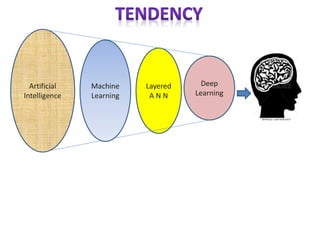
Artificial
Intelligence
Layered
A N N
Deep
Learning
Machine
Learning
Deep learning as neural networks with a large number
of parameters and layers in one of four fundamental
network architectures:
Unsupervised pretrained networks
Convolutional neural networks
Recurrent neural networks
Recursive neural networks
“neural network with more than two layers.”
More neurons than previous networks
More complex ways of connecting layers/neurons in NNs
Explosion in the amount of computing power available to
train
Automatic feature extraction
Generative deep architectures, which are intended to characterize the
high-order correlation properties of the observed or visible data for
pattern analysis or synthesis purposes, and/or characterize the joint
statistical distributions of the visible data and their associated classes. In the
latter case, the use of Bayes rule can turn this type of architecture into a
discriminative one.
Discriminative deep architectures, which are intended to directly provide
discriminative power for pattern classification, often by characterizing the
posterior distributions of classes conditioned on the visible data; and
Hybrid deep architectures, where the goal is discrimination but is
assisted (often in a significant way) with the outcomes of generative
architectures via better optimization or/and regularization, or
discriminative criteria are used to learn the parameters in any of the
deep generative models in category 1) above.
Despite the complex categorization of the deep learning
architectures,theone’s that are in practice are deep feed-forward networks,
Convolution networks and Recurrent Networks.
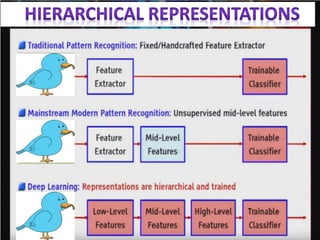
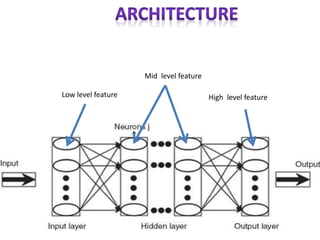
Low level feature
Mid level feature
High level feature
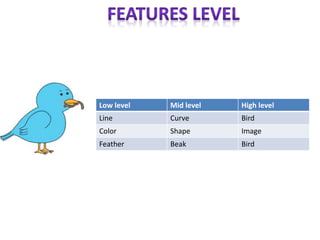
Low level Mid level High level
Line Curve Bird
Color Shape Image
Feather Beak Bird
Large layer of ANN,
High computational
spped,
Large memory size.
Input and output layers
Analog signal
Machine learning tasks are typically classified into two
broad categories, depending on whether there is a
learning "signal" or "feedback" available to a learning
system:
•Supervised learning
•Semi-supervised learning
•Active learning
•Reinforcement learning
•Unsupervised learning
•Feature learning
•Support vector machine
•Classification
•Clustering
•Density estimation
•Dimensionality reduction
Deep learning as neural networks with a large number
of parameters and layers in one of four fundamental
network architectures:
Unsupervised pretrained networks
Convolutional neural networks
Recurrent neural networks
Recursive neural networks
•Examine the foundations of machine learning and neural
networks
•Learn how to train feed-forward neural networks
•Use software to implement your first neural network
•Manage problems that arise as you begin to make
networks deeper
•Build neural networks that analyze complex images
•Perform effective dimensionality reduction using
autoencoders
•Dive deep into sequence analysis to examine language
•Understand the fundamentals of reinforcement learning
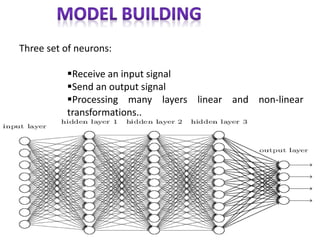
Three set of neurons:
Receive an input signal
Send an output signal
Processing many layers linear and non-linear
transformations..
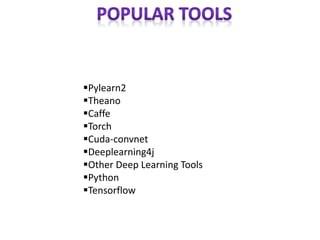
Pylearn2
Theano
Caffe
Torch
Cuda-convnet
Deeplearning4j
Other Deep Learning Tools
Python
Tensorflow
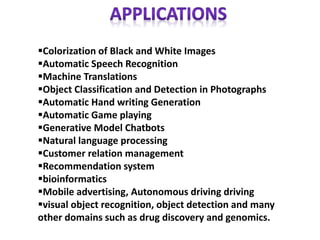
Colorization of Black and White Images
Automatic Speech Recognition
Machine Translations
Object Classification and Detection in Photographs
Automatic Hand writing Generation
Automatic Game playing
Generative Model Chatbots
Natural language processing
Customer relation management
Recommendation system
bioinformatics
Mobile advertising, Autonomous driving driving
visual object recognition, object detection and many
other domains such as drug discovery and genomics.
Common issues are
Over fitting
Learning Rate and
Computation time.
Deep Learning =
Data Science + cloud storage + Soft Computing
Deep Learning is
Large network
Large Data
Large Model
Efficient Algorithm
Large Computation
Large insights
Improved Performance
Nearer to Human Brain

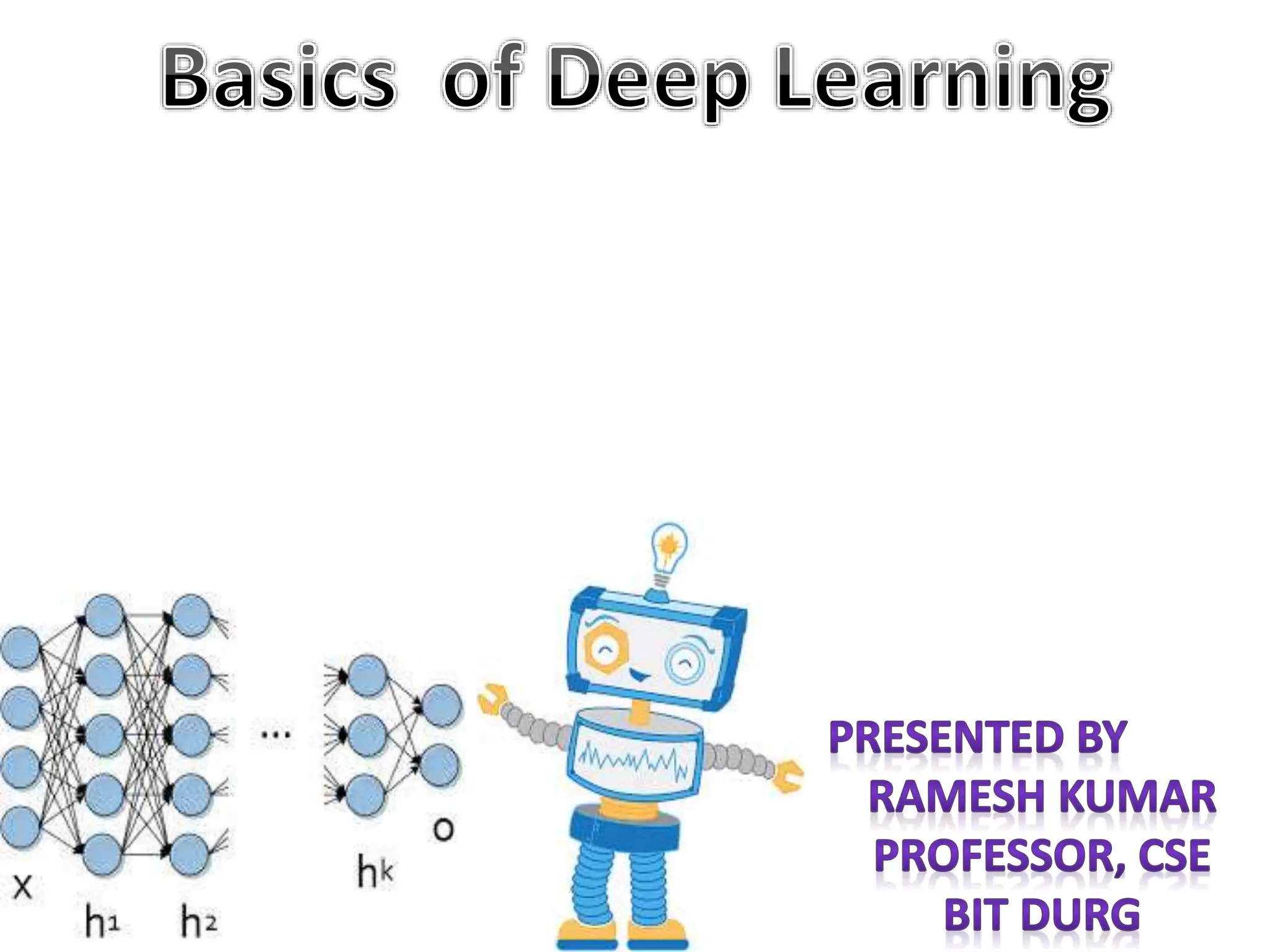
Basics of Deep learning

  • 2.
    Colloquially, the term"artificial intelligence" is applied when a machine mimics "cognitive" functions that humans associate with other human minds, such as "learning" and "problem solving".
  • 3.
    Machine learning isa field of computer science that gives computers the ability to learn without being explicitly programmed.
  • 4.
    Artificial neural networks(ANNs) or Connectionist systems are computing systems inspired by the Biological neural networks that constitute animal brains. Such systems learn (progressively improve performance on) tasks by considering examples, generally without task-specific programming.
  • 5.
    Deep learning isalso known as Deep structured learning or Hierarchical learning
  • 6.
    Commerce websites, andit is increasingly present in consumer products such as cameras and smartphones. Machine-learning systems are used to identify objects in images, transcribe speech into text, match news items, posts or products with users’ interests, and select relevant results of search. Increasingly, these applications make use of a class of techniques
  • 7.
    Deep learning isa subset of a more general field of artificial intelligence called machine learning. “neural network with more than two layers.” More neurons than previous networks More complex ways of connecting layers/neurons in NNs Explosion in the amount of computing power available to train Automatic feature extraction Deep learning as neural networks with a large number of parameters and layers in one of four fundamental network architectures: Unsupervised pretrained networks Convolutional neural networks Recurrent neural networks Recursive neural networks
  • 8.
    Inspired by Biomodel Artificial Intelligence which contains Machine Learning Artificial Neural network
  • 9.
  • 12.
    Deep learning asneural networks with a large number of parameters and layers in one of four fundamental network architectures: Unsupervised pretrained networks Convolutional neural networks Recurrent neural networks Recursive neural networks “neural network with more than two layers.” More neurons than previous networks More complex ways of connecting layers/neurons in NNs Explosion in the amount of computing power available to train Automatic feature extraction
  • 13.
    Generative deep architectures,which are intended to characterize the high-order correlation properties of the observed or visible data for pattern analysis or synthesis purposes, and/or characterize the joint statistical distributions of the visible data and their associated classes. In the latter case, the use of Bayes rule can turn this type of architecture into a discriminative one. Discriminative deep architectures, which are intended to directly provide discriminative power for pattern classification, often by characterizing the posterior distributions of classes conditioned on the visible data; and Hybrid deep architectures, where the goal is discrimination but is assisted (often in a significant way) with the outcomes of generative architectures via better optimization or/and regularization, or discriminative criteria are used to learn the parameters in any of the deep generative models in category 1) above. Despite the complex categorization of the deep learning architectures,theone’s that are in practice are deep feed-forward networks, Convolution networks and Recurrent Networks.
  • 14.
    Low level feature Midlevel feature High level feature
  • 15.
    Low level Midlevel High level Line Curve Bird Color Shape Image Feather Beak Bird
  • 16.
    Large layer ofANN, High computational spped, Large memory size. Input and output layers Analog signal
  • 17.
    Machine learning tasksare typically classified into two broad categories, depending on whether there is a learning "signal" or "feedback" available to a learning system: •Supervised learning •Semi-supervised learning •Active learning •Reinforcement learning •Unsupervised learning •Feature learning •Support vector machine •Classification •Clustering •Density estimation •Dimensionality reduction
  • 18.
    Deep learning asneural networks with a large number of parameters and layers in one of four fundamental network architectures: Unsupervised pretrained networks Convolutional neural networks Recurrent neural networks Recursive neural networks
  • 19.
    •Examine the foundationsof machine learning and neural networks •Learn how to train feed-forward neural networks •Use software to implement your first neural network •Manage problems that arise as you begin to make networks deeper •Build neural networks that analyze complex images •Perform effective dimensionality reduction using autoencoders •Dive deep into sequence analysis to examine language •Understand the fundamentals of reinforcement learning
  • 20.
    Three set ofneurons: Receive an input signal Send an output signal Processing many layers linear and non-linear transformations..
  • 21.
  • 22.
    Colorization of Blackand White Images Automatic Speech Recognition Machine Translations Object Classification and Detection in Photographs Automatic Hand writing Generation Automatic Game playing Generative Model Chatbots Natural language processing Customer relation management Recommendation system bioinformatics Mobile advertising, Autonomous driving driving visual object recognition, object detection and many other domains such as drug discovery and genomics.
  • 23.
    Common issues are Overfitting Learning Rate and Computation time.
  • 24.
    Deep Learning = DataScience + cloud storage + Soft Computing
  • 25.
    Deep Learning is Largenetwork Large Data Large Model Efficient Algorithm Large Computation Large insights Improved Performance Nearer to Human Brain