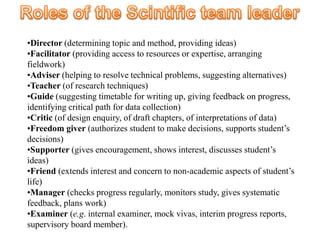
•Director (determining topic and method, providing ideas)
•Facilitator (providing access to resources or expertise, arranging
fieldwork)
•Adviser (helping to resolve technical problems, suggesting alternatives)
•Teacher (of research techniques)
•Guide (suggesting timetable for writing up, giving feedback on progress,
identifying critical path for data collection)
•Critic (of design enquiry, of draft chapters, of interpretations of data)
•Freedom giver (authorizes student to make decisions, supports student’s
decisions)
•Supporter (gives encouragement, shows interest, discusses student’s
ideas)
•Friend (extends interest and concern to non-academic aspects of student’s
life)
•Manager (checks progress regularly, monitors study, gives systematic
feedback, plans work)
•Examiner (e.g. internal examiner, mock vivas, interim progress reports,
supervisory board member).
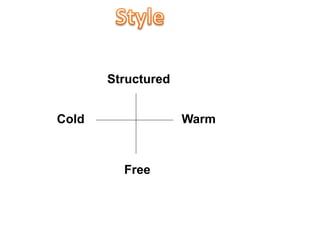
Structured
Free
Cold Warm
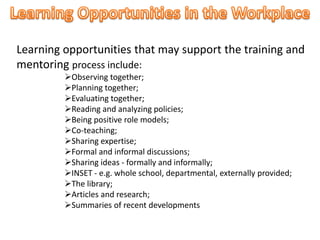
Learning opportunities that may support the training and
mentoring process include:
Observing together;
Planning together;
Evaluating together;
Reading and analyzing policies;
Being positive role models;
Co-teaching;
Sharing expertise;
Formal and informal discussions;
Sharing ideas - formally and informally;
INSET - e.g. whole school, departmental, externally provided;
The library;
Articles and research;
Summaries of recent developments
Magazines;
Having a 'buddy';
Working in a team;
The Internet;
Data, inspection reports;
Parents;
Being 'open';
Demonstrations;
Visiting other classes and other Institutes;
Self-reflection;
Up-to-date information and training from co-ordinators
Mentor
Supervisor
Guide
The Mentor has a vital role in ensuring
the high quality teacher training of the
Trainee. It is therefore important that Mentors
carry out their responsibilities appropriately.
Mentors are expected to visit the Trainee formally at least once
per fortnight. The focus of this visit may be:
To observe a lesson formally and feed back to the Trainee;
To discuss any issues that have arisen for the Trainee;
To check the Trainee's Reflective Journal of Evidence and Audit
Booklet;
To provide specific training for the Trainee in an identified
area.
Usually, a visit will combine different focuses.
being a teacher to the Trainee;
being professional;
setting ground rules;
being enthusiastic;
understanding how adults learn;
offering appropriate training;
advising and giving debriefs on a regular basis;
praising genuinely and challenging when appropriate;
coaching the Trainee to diagnose and resolve problems;
encouraging the Trainee to learn from mistakes;
probing to help the Trainee learn more from their experiences;
directing the Trainee towards examples of high quality teaching;
opening up avenues of enquiry;
defines the relationship;
achieves mutual respect;
balances professionalism and friendship;
knows about the course;
is committed to the process of mentoring and identifies appropriate
training needs;
empowering the Trainee and encouraging independence;
encouraging reflection;
monitoring and evaluating;
nurturing;
helping the Trainee to network;
offering pragmatic suggestions;
recognising that the mentor process offers benefits for all parties;
transmitting organisational values;
identifying areas that the Trainee needs to work on further and
teaching and providing training to enable the Trainee to improve.
is action oriented;
is non-threatening and approachable;
offers time;
has excellent interpersonal skills and communicates
clearly;
knows what good quality teaching is;
empathises, encourages and motivates;
engenders respect and trust;
can give negative feedback constructively;
celebrates successes;
genuinely wants to help others;
represents the Trainee's interests;
responds to individual circumstances;
understands what teaching and learning are about;
believes in a continuous learning environment;
has a vision about helping the Trainee to develop;
1. The Education Mentor
2. The Induction Mentor
3. The Training Mentor
4. The Professional Qualification or Vocational Qualification Mentor
5. The Mainstream Mentor
6. The Board-level or Executive Mentor
Manage learning experiences in the workplace for the mentee
Manage the development of the relationship with the mentee
Recognize and assist with appropriate learning strategies for the
individual workplace and the mentee
Facilitate learning in the workplace
Invest time and effort in the mentee and the program
Maintain regular contact wit the mentee
The workplace is committed to the programme.
Explicit links are between the taught programme and the workplace.
Support systems exist within the workplace and at the University.
The whole process is professionally set up.
Ground rules are established
Issues related to confidentiality have been addressed.
There is recognition of and allowance for the time required to make
the process successful.
There is a rapport between the Mentor, the Trainee and the tutors.
Regular debriefing meetings are established, and minutes of these kept as
evidence.
The Trainee is clear about targets.
There is clarity about the Standards for QTS and the requirements for ITT.
The Mentor is a trainer and model teacher.
The mentoring processes require maintenance and need to be reviewed
regularly.
There are good communication links amongst all those involved.
Roles are clear.
There is a climate of trust.
Training is offered to Mentors and teachers involved in the process.
There is an understanding that every mentoring relationship is unique.
Different learning processes that a learner may use
How workplace environments affect learning
How mentoring can affect workplace learning
Guided learning techniques and strategies
Good communication skills
Good counseling skills
Outcomes expected of the mentee in the learning program
Subject matter expertise.
There are numerous benefits for the mentor in being involved with
a mentoring program. These include:
Enhanced self esteem
Enhanced status in the organization
Career advancement
Job enrichment
Motivation
Recognition as a developer of people
Rekindled interest and motivation in work
Close relationship with the mentee
Own developmental needs met
Extra resource (the mentee)
A supervisor is a member of the academic staff who is responsible
for providing help, support and mentoring to a postgraduate student
in order to enable the student to complete the research and produce
a thesis to the best of the student's ability.
For creating new knowledge, and can create, critique, and appraise
new and significant knowledge
The supervisor's input is crucial and progress in achieving this
quality is documented in successive reviews of progress.
A supervisor’s role is to:
•provide academic guidance
•give you feedback and advice
•facilitate your work.
Your supervisors will expect you to show the qualities of a researcher. A
a PhD student, you will be expected to:
•work independently
•develop your own approach to the research problems that concern you
•argue for and defend your own position
make intellectual progress in your discipline
Once you have been accepted as a PhD student,
you will be given atleast two supervisors by your
institute. You will have one academic supervisors
(one will be the primary supervisor) plus an
administrative supervisor (normally your Head of
School/Programme).
Your supervisors will expect your knowledge to
grow as you work through your PhD project. At
some stage, you should know more about your area
than your supervisors do: you will become the expert
in the field.
Your supervisors will probably want to have fairly
relaxed discussions with you and to call you by your
given name. You may end up being a colleague and
friend of your supervisors. This will not, of course,
happen on every occasion: apart from anything else,
questions of personality will determine the final
relationship you have with your supervisors
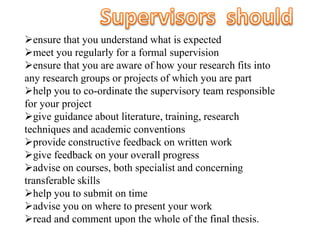
ensure that you understand what is expected
meet you regularly for a formal supervision
ensure that you are aware of how your research fits into
any research groups or projects of which you are part
help you to co-ordinate the supervisory team responsible
for your project
give guidance about literature, training, research
techniques and academic conventions
provide constructive feedback on written work
give feedback on your overall progress
advise on courses, both specialist and concerning
transferable skills
help you to submit on time
advise you on where to present your work
read and comment upon the whole of the final thesis.
Contact with supervisors may involve face-to-face
meetings, mail, telephone, email, or a combination of
these
Statement of Agreement
Reviews of progress
Feedback
Grievance process
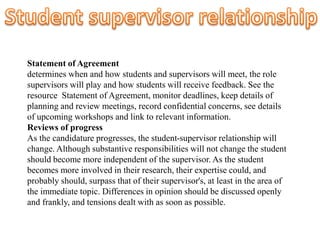
Statement of Agreement
determines when and how students and supervisors will meet, the role
supervisors will play and how students will receive feedback. See the
resource Statement of Agreement, monitor deadlines, keep details of
planning and review meetings, record confidential concerns, see details
of upcoming workshops and link to relevant information.
Reviews of progress
As the candidature progresses, the student-supervisor relationship will
change. Although substantive responsibilities will not change the student
should become more independent of the supervisor. As the student
becomes more involved in their research, their expertise could, and
probably should, surpass that of their supervisor's, at least in the area of
the immediate topic. Differences in opinion should be discussed openly
and frankly, and tensions dealt with as soon as possible.
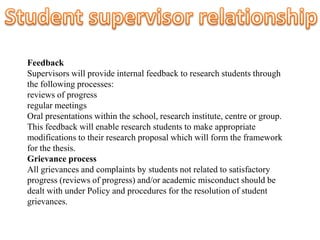
Feedback
Supervisors will provide internal feedback to research students through
the following processes:
reviews of progress
regular meetings
Oral presentations within the school, research institute, centre or group.
This feedback will enable research students to make appropriate
modifications to their research proposal which will form the framework
for the thesis.
Grievance process
All grievances and complaints by students not related to satisfactory
progress (reviews of progress) and/or academic misconduct should be
dealt with under Policy and procedures for the resolution of student
grievances.
On campus and online resources
regularity and structure of meetings,
standard of work required to achieve the degree
students are provided with information about important procedures,
regulations, services and support, including authorship, intellectual
property, copyright requirements and information on plagiarism
the supervisor is supportive of the student, and encourages open and
constructive communication
the student's development as an independent researcher is facilitated
so that students can have control over their own research programs
students are involved in a collaborative and scholarly research
culture both in their respective disciplines.
Supervisors are the most significant resource the University provides to support
HDR students in their research. HDR students will be appointed a principal and at
least one associate supervisor.
Principal supervisor: has prime responsibility for overseeing a student's progress
and should have the expertise, time and resources to provide ongoing support. The
principal supervisor must be a member of the Register of Current Higher Degree by
Research Supervisors
Associate supervisor: supports the principal supervisor and ensures the student
has continuity of supervision if the principal supervisor is away. The associate
supervisor can be a person external to the University who has specialist knowledge
in a particular aspect of the student's research. See the Code of Good Practice:
Research Degrees Management and Supervision for more details. generally from
industry or at other Universities
Co-supervision: may be established for a student in lieu of a principal and associate
supervisor. Co-supervision occurs where two academic staff members share
responsibility for the principal supervision of a student. See the Academic
regulations for higher degrees by research for more details.
Supervisory Panels
In some cases (eg. where the topic is multi-disciplinary or staff are inexperienced) a
panel could be formed to advise the student
a person with special knowledge or ability who performs skillfully
direct the course
Someone who shows the way by leading or advising
someone employed to conduct others
 something that offers basic information or instruction
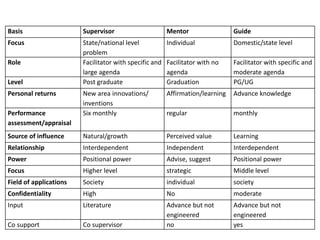
Basis Supervisor Mentor Guide
Focus State/national level
problem
Individual Domestic/state level
Role Facilitator with specific and
large agenda
Facilitator with no
agenda
Facilitator with specific and
moderate agenda
Level Post graduate Graduation PG/UG
Personal returns New area innovations/
inventions
Affirmation/learning Advance knowledge
Performance
assessment/appraisal
Six monthly regular monthly
Source of influence Natural/growth Perceived value Learning
Relationship Interdependent Independent Interdependent
Power Positional power Advise, suggest Positional power
Focus Higher level strategic Middle level
Field of applications Society individual society
Confidentiality High No moderate
Input Literature Advance but not
engineered
Advance but not
engineered
Co support Co supervisor no yes
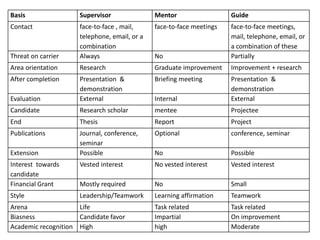
Basis Supervisor Mentor Guide
Contact face-to-face , mail,
telephone, email, or a
combination
face-to-face meetings face-to-face meetings,
mail, telephone, email, or
a combination of these
Threat on carrier Always No Partially
Area orientation Research Graduate improvement Improvement + research
After completion Presentation &
demonstration
Briefing meeting Presentation &
demonstration
Evaluation External Internal External
Candidate Research scholar mentee Projectee
End Thesis Report Project
Publications Journal, conference,
seminar
Optional conference, seminar
Extension Possible No Possible
Interest towards
candidate
Vested interest No vested interest Vested interest
Financial Grant Mostly required No Small
Style Leadership/Teamwork Learning affirmation Teamwork
Arena Life Task related Task related
Biasness Candidate favor Impartial On improvement
Academic recognition High high Moderate

Guide

  • 2.
    •Director (determining topicand method, providing ideas) •Facilitator (providing access to resources or expertise, arranging fieldwork) •Adviser (helping to resolve technical problems, suggesting alternatives) •Teacher (of research techniques) •Guide (suggesting timetable for writing up, giving feedback on progress, identifying critical path for data collection) •Critic (of design enquiry, of draft chapters, of interpretations of data) •Freedom giver (authorizes student to make decisions, supports student’s decisions) •Supporter (gives encouragement, shows interest, discusses student’s ideas) •Friend (extends interest and concern to non-academic aspects of student’s life) •Manager (checks progress regularly, monitors study, gives systematic feedback, plans work) •Examiner (e.g. internal examiner, mock vivas, interim progress reports, supervisory board member).
  • 3.
  • 4.
    Learning opportunities thatmay support the training and mentoring process include: Observing together; Planning together; Evaluating together; Reading and analyzing policies; Being positive role models; Co-teaching; Sharing expertise; Formal and informal discussions; Sharing ideas - formally and informally; INSET - e.g. whole school, departmental, externally provided; The library; Articles and research; Summaries of recent developments
  • 5.
    Magazines; Having a 'buddy'; Workingin a team; The Internet; Data, inspection reports; Parents; Being 'open'; Demonstrations; Visiting other classes and other Institutes; Self-reflection; Up-to-date information and training from co-ordinators
  • 6.
  • 7.
    The Mentor hasa vital role in ensuring the high quality teacher training of the Trainee. It is therefore important that Mentors carry out their responsibilities appropriately.
  • 8.
    Mentors are expectedto visit the Trainee formally at least once per fortnight. The focus of this visit may be: To observe a lesson formally and feed back to the Trainee; To discuss any issues that have arisen for the Trainee; To check the Trainee's Reflective Journal of Evidence and Audit Booklet; To provide specific training for the Trainee in an identified area. Usually, a visit will combine different focuses.
  • 9.
    being a teacherto the Trainee; being professional; setting ground rules; being enthusiastic; understanding how adults learn; offering appropriate training; advising and giving debriefs on a regular basis; praising genuinely and challenging when appropriate; coaching the Trainee to diagnose and resolve problems; encouraging the Trainee to learn from mistakes; probing to help the Trainee learn more from their experiences; directing the Trainee towards examples of high quality teaching; opening up avenues of enquiry;
  • 10.
    defines the relationship; achievesmutual respect; balances professionalism and friendship; knows about the course; is committed to the process of mentoring and identifies appropriate training needs; empowering the Trainee and encouraging independence; encouraging reflection; monitoring and evaluating; nurturing; helping the Trainee to network; offering pragmatic suggestions; recognising that the mentor process offers benefits for all parties; transmitting organisational values; identifying areas that the Trainee needs to work on further and teaching and providing training to enable the Trainee to improve.
  • 11.
    is action oriented; isnon-threatening and approachable; offers time; has excellent interpersonal skills and communicates clearly; knows what good quality teaching is; empathises, encourages and motivates; engenders respect and trust; can give negative feedback constructively; celebrates successes; genuinely wants to help others; represents the Trainee's interests; responds to individual circumstances; understands what teaching and learning are about; believes in a continuous learning environment; has a vision about helping the Trainee to develop;
  • 12.
    1. The EducationMentor 2. The Induction Mentor 3. The Training Mentor 4. The Professional Qualification or Vocational Qualification Mentor 5. The Mainstream Mentor 6. The Board-level or Executive Mentor
  • 13.
    Manage learning experiencesin the workplace for the mentee Manage the development of the relationship with the mentee Recognize and assist with appropriate learning strategies for the individual workplace and the mentee Facilitate learning in the workplace Invest time and effort in the mentee and the program Maintain regular contact wit the mentee The workplace is committed to the programme. Explicit links are between the taught programme and the workplace. Support systems exist within the workplace and at the University. The whole process is professionally set up. Ground rules are established Issues related to confidentiality have been addressed. There is recognition of and allowance for the time required to make the process successful.
  • 14.
    There is arapport between the Mentor, the Trainee and the tutors. Regular debriefing meetings are established, and minutes of these kept as evidence. The Trainee is clear about targets. There is clarity about the Standards for QTS and the requirements for ITT. The Mentor is a trainer and model teacher. The mentoring processes require maintenance and need to be reviewed regularly. There are good communication links amongst all those involved. Roles are clear. There is a climate of trust. Training is offered to Mentors and teachers involved in the process. There is an understanding that every mentoring relationship is unique.
  • 15.
    Different learning processesthat a learner may use How workplace environments affect learning How mentoring can affect workplace learning Guided learning techniques and strategies Good communication skills Good counseling skills Outcomes expected of the mentee in the learning program Subject matter expertise.
  • 16.
    There are numerousbenefits for the mentor in being involved with a mentoring program. These include: Enhanced self esteem Enhanced status in the organization Career advancement Job enrichment Motivation Recognition as a developer of people Rekindled interest and motivation in work Close relationship with the mentee Own developmental needs met Extra resource (the mentee)
  • 17.
    A supervisor isa member of the academic staff who is responsible for providing help, support and mentoring to a postgraduate student in order to enable the student to complete the research and produce a thesis to the best of the student's ability. For creating new knowledge, and can create, critique, and appraise new and significant knowledge The supervisor's input is crucial and progress in achieving this quality is documented in successive reviews of progress.
  • 18.
    A supervisor’s roleis to: •provide academic guidance •give you feedback and advice •facilitate your work. Your supervisors will expect you to show the qualities of a researcher. A a PhD student, you will be expected to: •work independently •develop your own approach to the research problems that concern you •argue for and defend your own position make intellectual progress in your discipline
  • 19.
    Once you havebeen accepted as a PhD student, you will be given atleast two supervisors by your institute. You will have one academic supervisors (one will be the primary supervisor) plus an administrative supervisor (normally your Head of School/Programme).
  • 20.
    Your supervisors willexpect your knowledge to grow as you work through your PhD project. At some stage, you should know more about your area than your supervisors do: you will become the expert in the field. Your supervisors will probably want to have fairly relaxed discussions with you and to call you by your given name. You may end up being a colleague and friend of your supervisors. This will not, of course, happen on every occasion: apart from anything else, questions of personality will determine the final relationship you have with your supervisors
  • 21.
    ensure that youunderstand what is expected meet you regularly for a formal supervision ensure that you are aware of how your research fits into any research groups or projects of which you are part help you to co-ordinate the supervisory team responsible for your project give guidance about literature, training, research techniques and academic conventions provide constructive feedback on written work give feedback on your overall progress advise on courses, both specialist and concerning transferable skills help you to submit on time advise you on where to present your work read and comment upon the whole of the final thesis.
  • 22.
    Contact with supervisorsmay involve face-to-face meetings, mail, telephone, email, or a combination of these
  • 23.
    Statement of Agreement Reviewsof progress Feedback Grievance process
  • 24.
    Statement of Agreement determineswhen and how students and supervisors will meet, the role supervisors will play and how students will receive feedback. See the resource Statement of Agreement, monitor deadlines, keep details of planning and review meetings, record confidential concerns, see details of upcoming workshops and link to relevant information. Reviews of progress As the candidature progresses, the student-supervisor relationship will change. Although substantive responsibilities will not change the student should become more independent of the supervisor. As the student becomes more involved in their research, their expertise could, and probably should, surpass that of their supervisor's, at least in the area of the immediate topic. Differences in opinion should be discussed openly and frankly, and tensions dealt with as soon as possible.
  • 25.
    Feedback Supervisors will provideinternal feedback to research students through the following processes: reviews of progress regular meetings Oral presentations within the school, research institute, centre or group. This feedback will enable research students to make appropriate modifications to their research proposal which will form the framework for the thesis. Grievance process All grievances and complaints by students not related to satisfactory progress (reviews of progress) and/or academic misconduct should be dealt with under Policy and procedures for the resolution of student grievances.
  • 26.
    On campus andonline resources
  • 27.
    regularity and structureof meetings, standard of work required to achieve the degree students are provided with information about important procedures, regulations, services and support, including authorship, intellectual property, copyright requirements and information on plagiarism the supervisor is supportive of the student, and encourages open and constructive communication the student's development as an independent researcher is facilitated so that students can have control over their own research programs students are involved in a collaborative and scholarly research culture both in their respective disciplines.
  • 28.
    Supervisors are themost significant resource the University provides to support HDR students in their research. HDR students will be appointed a principal and at least one associate supervisor. Principal supervisor: has prime responsibility for overseeing a student's progress and should have the expertise, time and resources to provide ongoing support. The principal supervisor must be a member of the Register of Current Higher Degree by Research Supervisors Associate supervisor: supports the principal supervisor and ensures the student has continuity of supervision if the principal supervisor is away. The associate supervisor can be a person external to the University who has specialist knowledge in a particular aspect of the student's research. See the Code of Good Practice: Research Degrees Management and Supervision for more details. generally from industry or at other Universities Co-supervision: may be established for a student in lieu of a principal and associate supervisor. Co-supervision occurs where two academic staff members share responsibility for the principal supervision of a student. See the Academic regulations for higher degrees by research for more details. Supervisory Panels In some cases (eg. where the topic is multi-disciplinary or staff are inexperienced) a panel could be formed to advise the student
  • 29.
    a person withspecial knowledge or ability who performs skillfully direct the course Someone who shows the way by leading or advising someone employed to conduct others  something that offers basic information or instruction
  • 31.
    Basis Supervisor MentorGuide Focus State/national level problem Individual Domestic/state level Role Facilitator with specific and large agenda Facilitator with no agenda Facilitator with specific and moderate agenda Level Post graduate Graduation PG/UG Personal returns New area innovations/ inventions Affirmation/learning Advance knowledge Performance assessment/appraisal Six monthly regular monthly Source of influence Natural/growth Perceived value Learning Relationship Interdependent Independent Interdependent Power Positional power Advise, suggest Positional power Focus Higher level strategic Middle level Field of applications Society individual society Confidentiality High No moderate Input Literature Advance but not engineered Advance but not engineered Co support Co supervisor no yes
  • 32.
    Basis Supervisor MentorGuide Contact face-to-face , mail, telephone, email, or a combination face-to-face meetings face-to-face meetings, mail, telephone, email, or a combination of these Threat on carrier Always No Partially Area orientation Research Graduate improvement Improvement + research After completion Presentation & demonstration Briefing meeting Presentation & demonstration Evaluation External Internal External Candidate Research scholar mentee Projectee End Thesis Report Project Publications Journal, conference, seminar Optional conference, seminar Extension Possible No Possible Interest towards candidate Vested interest No vested interest Vested interest Financial Grant Mostly required No Small Style Leadership/Teamwork Learning affirmation Teamwork Arena Life Task related Task related Biasness Candidate favor Impartial On improvement Academic recognition High high Moderate