PREPARED BY:
Uttam Pudasaini

1/21/2014

1
TABLE OF CONTENTS









Background
Introduction
Launch Objectives
Design Concepts
Focal Plane
Major Band Of MODIS Sensor
MODIS PRODUCTS
Receiving station of MODIS

 Receiving station at ICIMOD ,NEPAL
1/21/2014

2
A SHORT HISTORY
 1983 – NASA began to explore the concept of a polar-orbiting platform to
complement a manned polar-orbiting space station
 Beginning as System Z, gained momentum with NASA’s proposed “Global
Habitability” program
 After Challenger disaster, polar space station disappeared as did manned
servicing requirement
 System Z became EOS – Earth Observing System
 Several instrument suites were developed
 Surface Imaging and Sounding Package (SISP) included the Moderate
Resolution Imaging Spectrometer
 MODIS soon split into 2 concepts
 MODIS-N focused primarily on land and atmosphere sensing but included
some ocean bands
 MODIS-T (tilting) focused on ocean
 Due to budget constraints, MODIS-T vanished, replaced by MODIS-N
1/21/2014

3
INTRODUCTION
 The Moderate Resolution Imaging Spectroradiometer
(MODIS), one of the key instruments for NASA’s Earth
Observing System (EOS), was built by Raytheon Santa
Barbara Remote Sensing (SBRS)
 MODIS Proto Flight Model (PFM) was launched on board
Terra spacecraft on 12/18/99 (first light on 02/24/00).
 http://terra.nasa.gov
 MODIS Flight Model 1 (FM1) on Aqua spacecraft was
launched on 05/04/02 (first light on 06/24/02)
 http://eos-pm.gsfc.nasa.gov
1/21/2014

4
Contd…
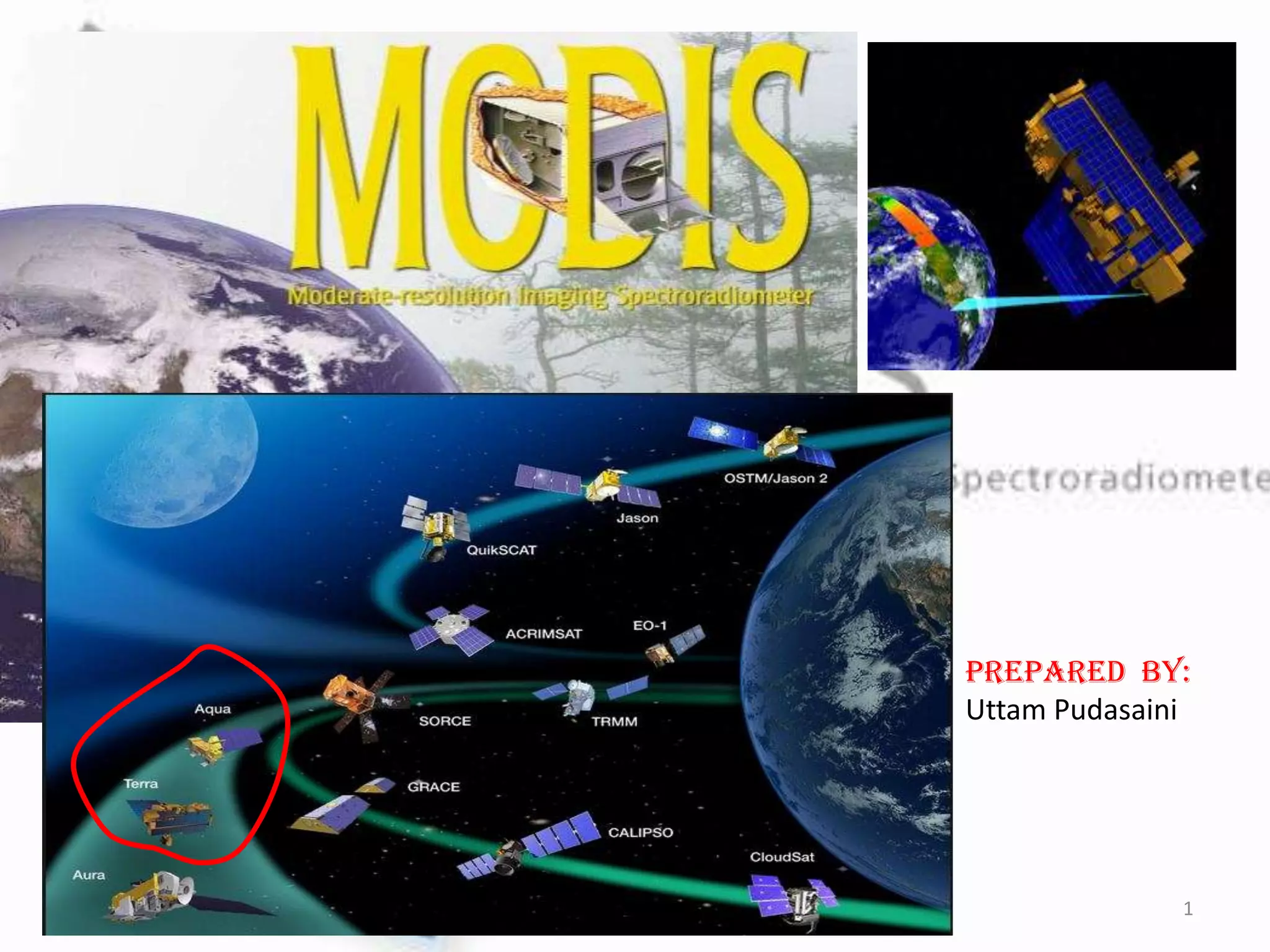
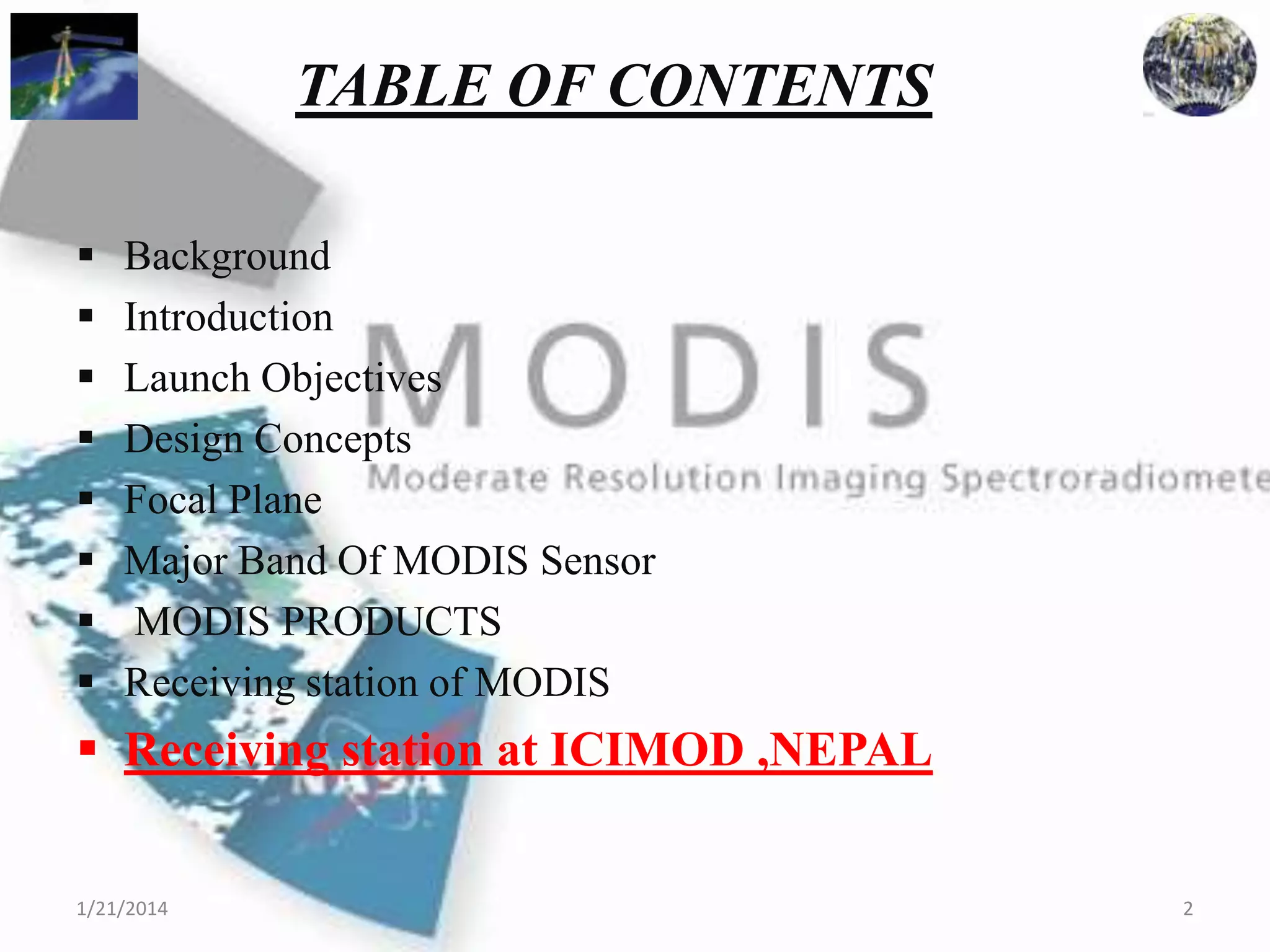
 MODIS (Moderate Resolution Imaging Spectrometer) is an
imaging instrument flying at an altitude of 705 km on two
satellites in NASA’s Earth Observing System: Terra and Aqua.
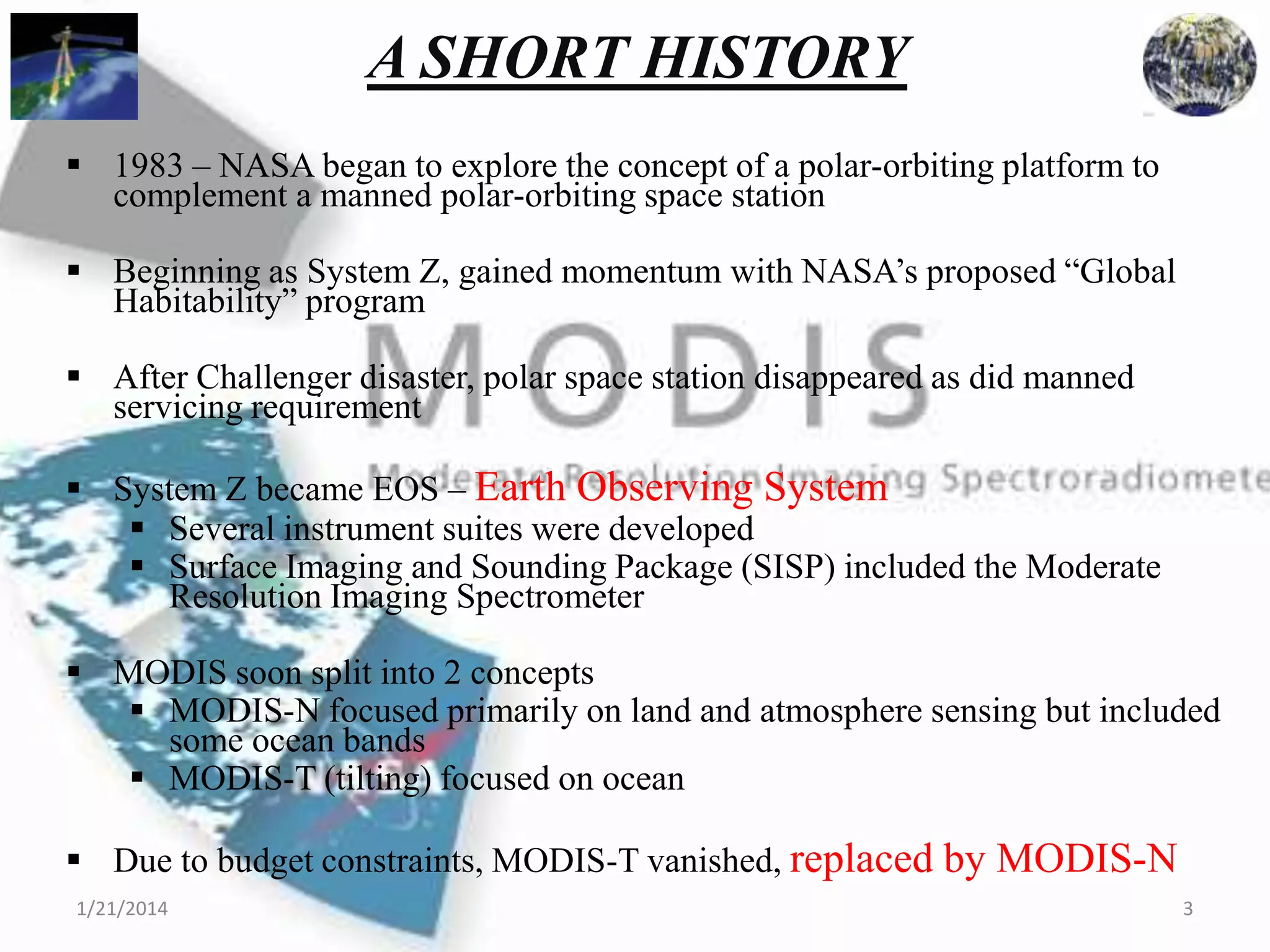
 Two sun-synchronous, near-polar orbiting satellites called Terra
(EOS AM-1) and Aqua (EOS PM-1) each carry a MODIS sensor
 Terra orbits from south to north with a morning equatorial crossing.
 Aqua orbits from north to south with an afternoon equatorial crossing

 Flying on two satellites allows it to image the same area at
different times of the day as well as cover the entire earth in
one or two days.
1/21/2014

5
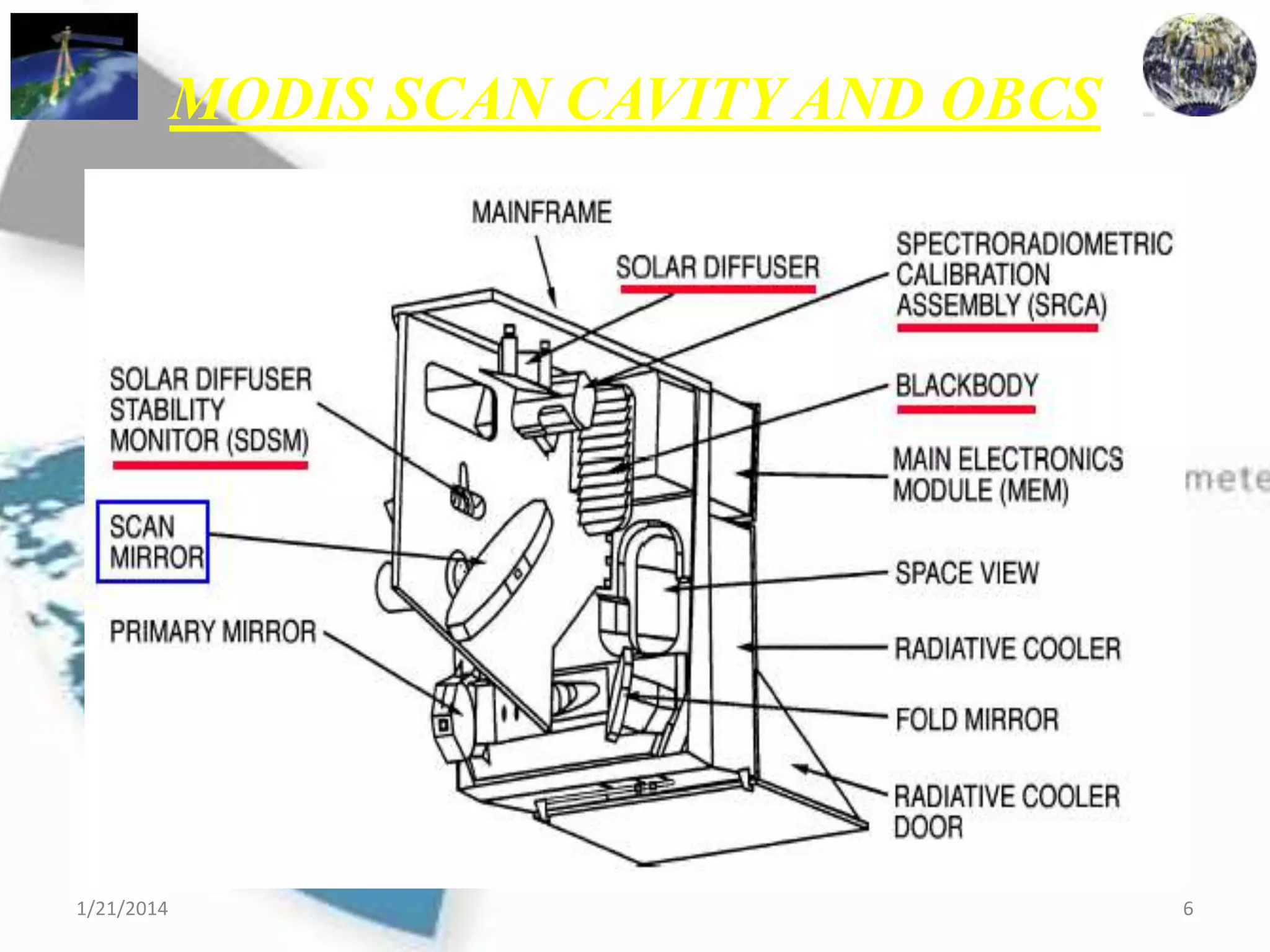
MODIS SCAN CAVITY AND OBCS

1/21/2014

6
LAUNCH OBJECTIVES

 Unprecedented look at

terrestrial, atmospheric,

ocean

and
phenomenology for a wide and diverse
community of users throughout the world.
 To develop a valid global, interactive Earth system models able to
predict global change accurately enough to assist policy makers
in making sound decisions concerning the protection of our
environment

1/21/2014

7
1/21/2014

8
DESIGN CONCEPTS
 The Scan Mirror Assembly uses a continuously rotating double-sided
scan mirror to scan 55-degrees
 The MODIS instrument consists of a cross-track scan mirror,
collecting optics and individual detector elements.
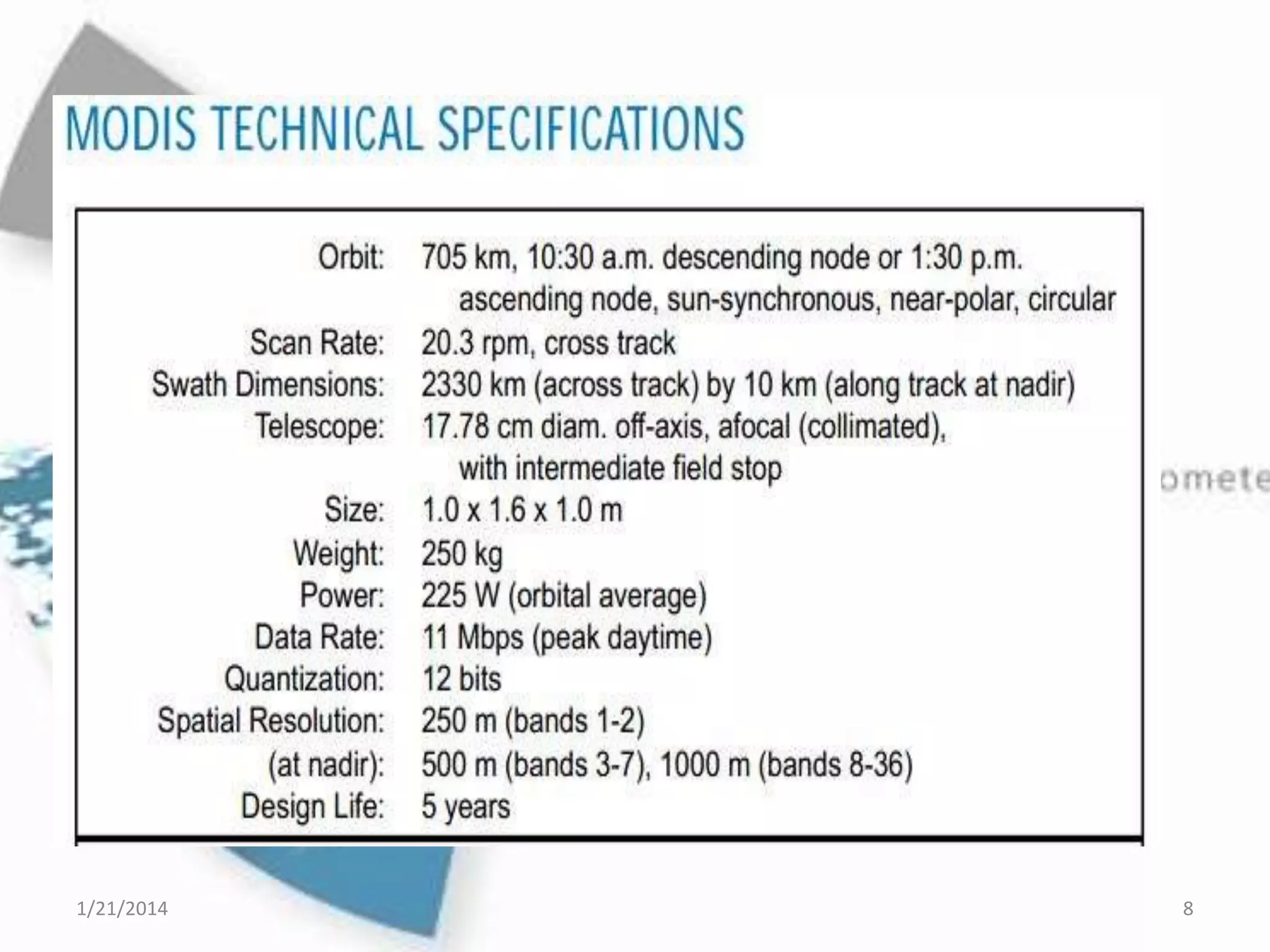
 The swath dimensions of MODIS are 2330km (across track) by 10km
(along track at nadir).
 The along track swath dimension is due to the optical set-up as well
as the scanning mechanism of MODIS.

 In contrast to other scanning sensors like e.g. AVHRR, MODIS is
observing within one scan ten lines of 1km spatial resolution (40 lines
of 250m resolution and 20 lines of 500m resolution, respectively).
1/21/2014

9
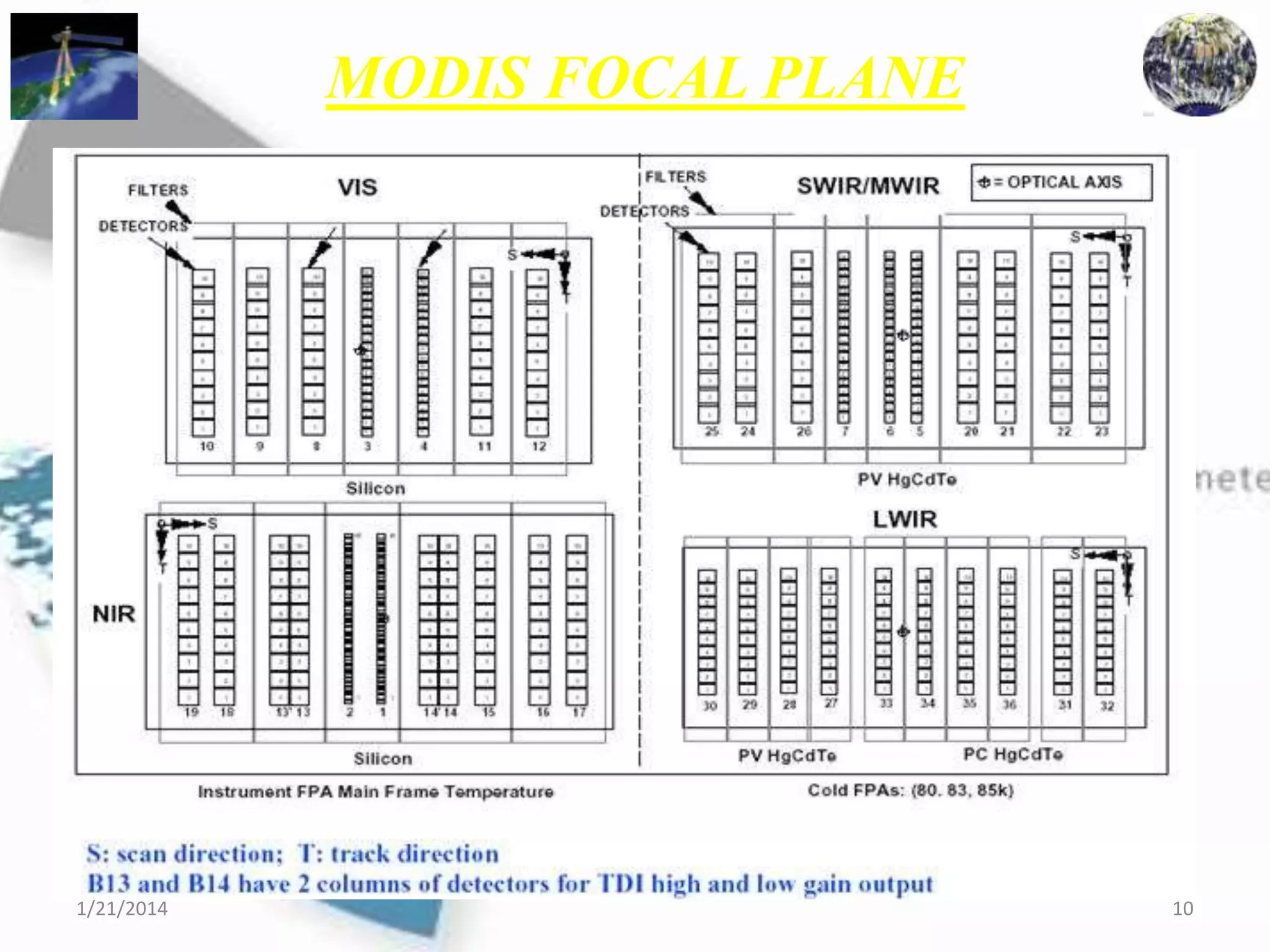
MODIS FOCAL PLANE

1/21/2014

10
Major Bands of MODIS Sensors
 MODIS reflectance products focuses on Red, Blue, NIR AND MIR
 Red band highly related with plant growth- to calculate EVI(enhanced)
AND NDVI
 Blue band
 Shortest and nosiest band to monitor atmospheric dust and other
particles travelling across the globe
 Eliminating atmospheric noise on the calculation of vegetation
indices
 The bands help monitor changes in vegetation ,soil and atmosphere
that can influence in calculation of ecosystem variables like
vegetation indices


NIR to visualize land and water (land reflects it while water bodies
almost absorb it all)



MIR band to determine cloud properties vegetation and soil moisture

1/21/2014

11
1/21/2014

12
CONTD…
 Its coarse spatial resolution is designed to observe land, ocean,
and atmospheric conditions at a regional and global scale.
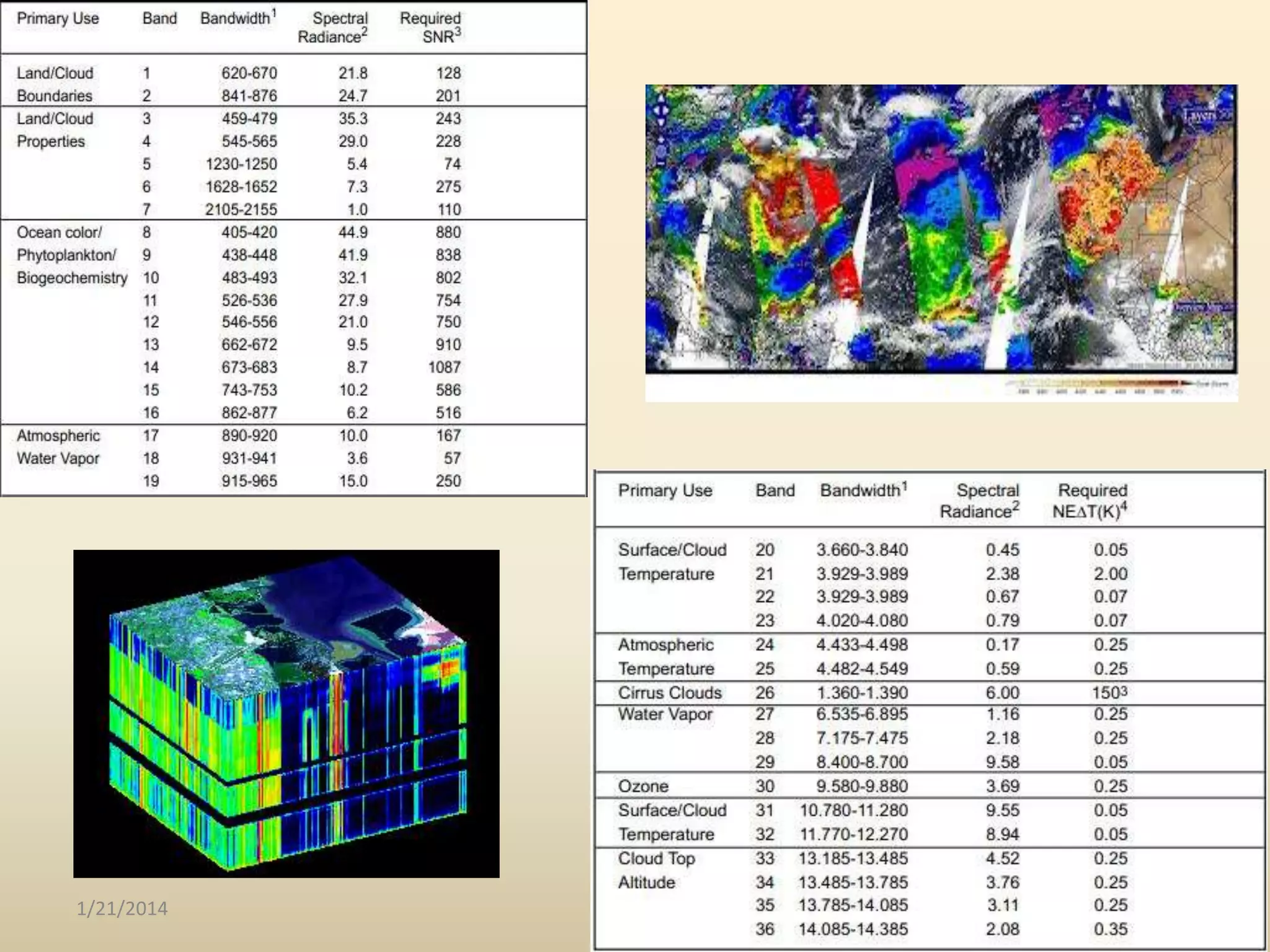
 The MODIS instrument provides high radiometric sensitivity (12
bit) in 36 spectral bands ranging in wavelength from 0.4 µm to
14.4 over a 2330 km swath.

 20 Reflective Solar Bands (RSB): 0.4 - 2.2 microns
 16 Thermal Emissive Bands (TEB) 3.5 - 14.5 microns

 Bands are imaged at a nominal resolution of 250 m at nadir, with
five bands at 500 m, and the remaining 29 bands at 1 km.
1/21/2014

13
MODIS PRODUCTS
 Availability of a suite of products ranging from raw images to
highly processed products such as vegetation indices.
 Products are made on varying temporal schedules, some of
which are made as often as daily and every 8 days.
 Products are all archived and available, usually at no charge.
 MODIS products are organized into different processing
levels.
 Level 0 products are raw digital number images.
 Level 1 products include raw radiance and calibrated
radiance images. .
 Level 2 and 3 products have more processing and are
derived from lower level products.
1/21/2014

14
WHERE TO GET MODIS PRODUCTS???
 Level 1 and atmosphere products are available through the
Level 1 and Atmospheric Archive and Distribution System
(LAADS). http://ladsweb.nascom.nasa.gov/
 Level 2 and 3 Land Products are available through Nasa’s
Warehouse Inventory Search Too (WIST) and the Land
Processes Distributed Active Archive Center (LPDAAC) Data
Pool at the U. S. Geological Survey EROS Data Center
(EDC). https://lpdaac.usgs.gov/get_data

1/21/2014

15
RECEIVING STATION
 MODIS on board the Terra and Aqua spacecraft have the
feature of Direct Broadcast capability together with an on
board data storage and a transmission capability initiated by a
ground command.
 Direct Broadcast means that all raw data collected on board
are immediately transmitted to ground.
 Everybody on the world can listen to the downloaded data
whenever the satellite is above their horizon assuming
appropriate hard- and software equipment.
 An Overpass Predictor delivered by NASA can be used to
determine when there will be a TERRA / AQUA spacecraft
overpass. More than 50 stations world-wide are now in
operation for receiving MODIS data by Direct Broadcast.
1/21/2014

16
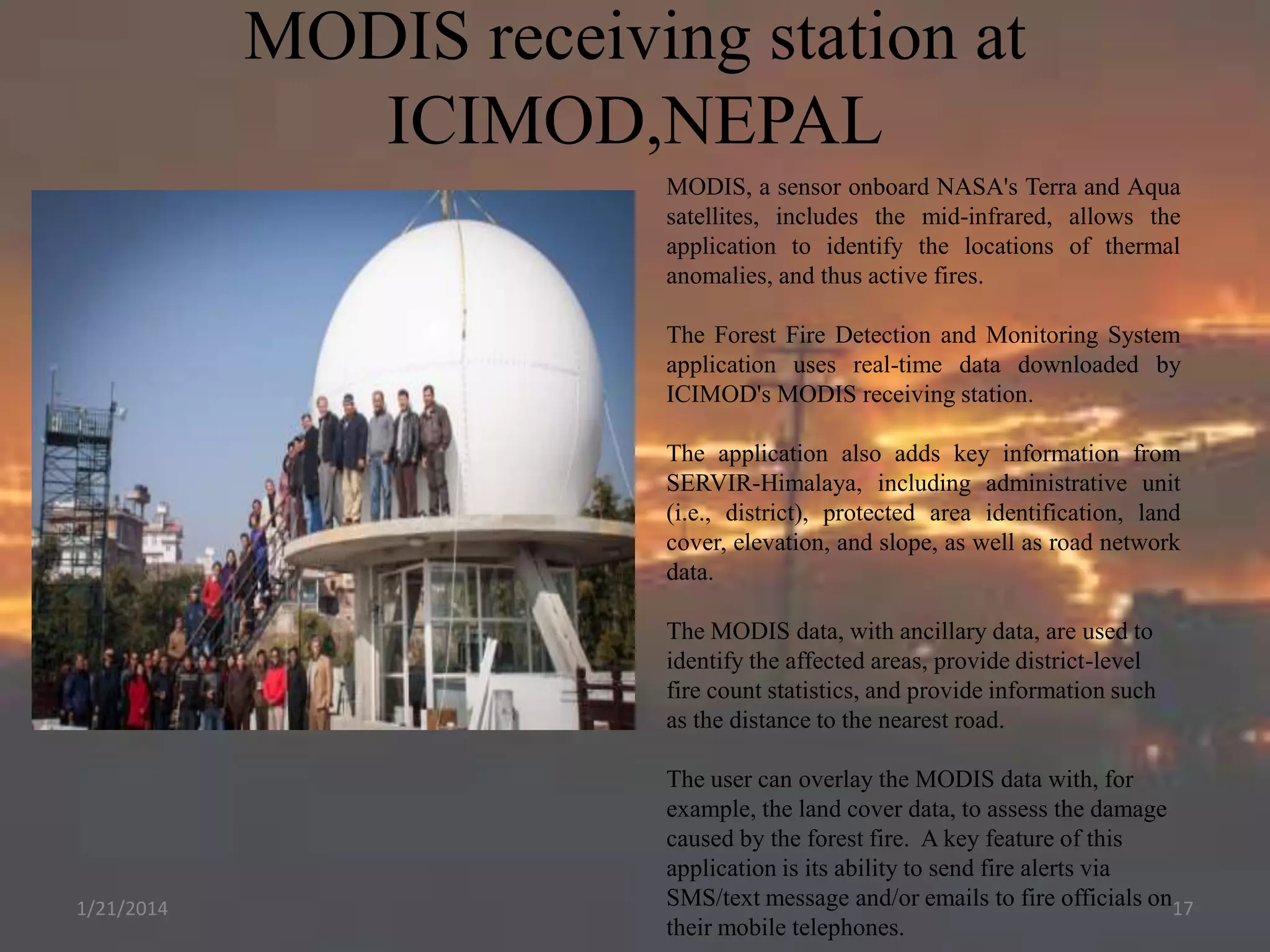
MODIS receiving station at
ICIMOD,NEPAL
MODIS, a sensor onboard NASA's Terra and Aqua
satellites, includes the mid-infrared, allows the
application to identify the locations of thermal
anomalies, and thus active fires.
The Forest Fire Detection and Monitoring System
application uses real-time data downloaded by
ICIMOD's MODIS receiving station.
The application also adds key information from
SERVIR-Himalaya, including administrative unit
(i.e., district), protected area identification, land
cover, elevation, and slope, as well as road network
data.
The MODIS data, with ancillary data, are used to
identify the affected areas, provide district-level
fire count statistics, and provide information such
as the distance to the nearest road.

1/21/2014

The user can overlay the MODIS data with, for
example, the land cover data, to assess the damage
caused by the forest fire. A key feature of this
application is its ability to send fire alerts via
SMS/text message and/or emails to fire officials on17
their mobile telephones.
References
 http://modis.gsfc.nasa.gov/
 http://www.icimod.org/?q=10092

 Images used in my slides are snapshots from presentation slides of
different individuals

1/21/2014

18
1/21/2014

19

MODIS (Moderate Resolution Imaging Spectrometer)

  • 1.
  • 2.
    TABLE OF CONTENTS         Background Introduction LaunchObjectives Design Concepts Focal Plane Major Band Of MODIS Sensor MODIS PRODUCTS Receiving station of MODIS  Receiving station at ICIMOD ,NEPAL 1/21/2014 2
  • 3.
    A SHORT HISTORY 1983 – NASA began to explore the concept of a polar-orbiting platform to complement a manned polar-orbiting space station  Beginning as System Z, gained momentum with NASA’s proposed “Global Habitability” program  After Challenger disaster, polar space station disappeared as did manned servicing requirement  System Z became EOS – Earth Observing System  Several instrument suites were developed  Surface Imaging and Sounding Package (SISP) included the Moderate Resolution Imaging Spectrometer  MODIS soon split into 2 concepts  MODIS-N focused primarily on land and atmosphere sensing but included some ocean bands  MODIS-T (tilting) focused on ocean  Due to budget constraints, MODIS-T vanished, replaced by MODIS-N 1/21/2014 3
  • 4.
    INTRODUCTION  The ModerateResolution Imaging Spectroradiometer (MODIS), one of the key instruments for NASA’s Earth Observing System (EOS), was built by Raytheon Santa Barbara Remote Sensing (SBRS)  MODIS Proto Flight Model (PFM) was launched on board Terra spacecraft on 12/18/99 (first light on 02/24/00).  http://terra.nasa.gov  MODIS Flight Model 1 (FM1) on Aqua spacecraft was launched on 05/04/02 (first light on 06/24/02)  http://eos-pm.gsfc.nasa.gov 1/21/2014 4
  • 5.
    Contd…  MODIS (ModerateResolution Imaging Spectrometer) is an imaging instrument flying at an altitude of 705 km on two satellites in NASA’s Earth Observing System: Terra and Aqua.  Two sun-synchronous, near-polar orbiting satellites called Terra (EOS AM-1) and Aqua (EOS PM-1) each carry a MODIS sensor  Terra orbits from south to north with a morning equatorial crossing.  Aqua orbits from north to south with an afternoon equatorial crossing  Flying on two satellites allows it to image the same area at different times of the day as well as cover the entire earth in one or two days. 1/21/2014 5
  • 6.
    MODIS SCAN CAVITYAND OBCS 1/21/2014 6
  • 7.
    LAUNCH OBJECTIVES  Unprecedentedlook at terrestrial, atmospheric, ocean and phenomenology for a wide and diverse community of users throughout the world.  To develop a valid global, interactive Earth system models able to predict global change accurately enough to assist policy makers in making sound decisions concerning the protection of our environment 1/21/2014 7
  • 8.
  • 9.
    DESIGN CONCEPTS  TheScan Mirror Assembly uses a continuously rotating double-sided scan mirror to scan 55-degrees  The MODIS instrument consists of a cross-track scan mirror, collecting optics and individual detector elements.  The swath dimensions of MODIS are 2330km (across track) by 10km (along track at nadir).  The along track swath dimension is due to the optical set-up as well as the scanning mechanism of MODIS.  In contrast to other scanning sensors like e.g. AVHRR, MODIS is observing within one scan ten lines of 1km spatial resolution (40 lines of 250m resolution and 20 lines of 500m resolution, respectively). 1/21/2014 9
  • 10.
  • 11.
    Major Bands ofMODIS Sensors  MODIS reflectance products focuses on Red, Blue, NIR AND MIR  Red band highly related with plant growth- to calculate EVI(enhanced) AND NDVI  Blue band  Shortest and nosiest band to monitor atmospheric dust and other particles travelling across the globe  Eliminating atmospheric noise on the calculation of vegetation indices  The bands help monitor changes in vegetation ,soil and atmosphere that can influence in calculation of ecosystem variables like vegetation indices  NIR to visualize land and water (land reflects it while water bodies almost absorb it all)  MIR band to determine cloud properties vegetation and soil moisture 1/21/2014 11
  • 12.
  • 13.
    CONTD…  Its coarsespatial resolution is designed to observe land, ocean, and atmospheric conditions at a regional and global scale.  The MODIS instrument provides high radiometric sensitivity (12 bit) in 36 spectral bands ranging in wavelength from 0.4 µm to 14.4 over a 2330 km swath.  20 Reflective Solar Bands (RSB): 0.4 - 2.2 microns  16 Thermal Emissive Bands (TEB) 3.5 - 14.5 microns  Bands are imaged at a nominal resolution of 250 m at nadir, with five bands at 500 m, and the remaining 29 bands at 1 km. 1/21/2014 13
  • 14.
    MODIS PRODUCTS  Availabilityof a suite of products ranging from raw images to highly processed products such as vegetation indices.  Products are made on varying temporal schedules, some of which are made as often as daily and every 8 days.  Products are all archived and available, usually at no charge.  MODIS products are organized into different processing levels.  Level 0 products are raw digital number images.  Level 1 products include raw radiance and calibrated radiance images. .  Level 2 and 3 products have more processing and are derived from lower level products. 1/21/2014 14
  • 15.
    WHERE TO GETMODIS PRODUCTS???  Level 1 and atmosphere products are available through the Level 1 and Atmospheric Archive and Distribution System (LAADS). http://ladsweb.nascom.nasa.gov/  Level 2 and 3 Land Products are available through Nasa’s Warehouse Inventory Search Too (WIST) and the Land Processes Distributed Active Archive Center (LPDAAC) Data Pool at the U. S. Geological Survey EROS Data Center (EDC). https://lpdaac.usgs.gov/get_data 1/21/2014 15
  • 16.
    RECEIVING STATION  MODISon board the Terra and Aqua spacecraft have the feature of Direct Broadcast capability together with an on board data storage and a transmission capability initiated by a ground command.  Direct Broadcast means that all raw data collected on board are immediately transmitted to ground.  Everybody on the world can listen to the downloaded data whenever the satellite is above their horizon assuming appropriate hard- and software equipment.  An Overpass Predictor delivered by NASA can be used to determine when there will be a TERRA / AQUA spacecraft overpass. More than 50 stations world-wide are now in operation for receiving MODIS data by Direct Broadcast. 1/21/2014 16
  • 17.
    MODIS receiving stationat ICIMOD,NEPAL MODIS, a sensor onboard NASA's Terra and Aqua satellites, includes the mid-infrared, allows the application to identify the locations of thermal anomalies, and thus active fires. The Forest Fire Detection and Monitoring System application uses real-time data downloaded by ICIMOD's MODIS receiving station. The application also adds key information from SERVIR-Himalaya, including administrative unit (i.e., district), protected area identification, land cover, elevation, and slope, as well as road network data. The MODIS data, with ancillary data, are used to identify the affected areas, provide district-level fire count statistics, and provide information such as the distance to the nearest road. 1/21/2014 The user can overlay the MODIS data with, for example, the land cover data, to assess the damage caused by the forest fire. A key feature of this application is its ability to send fire alerts via SMS/text message and/or emails to fire officials on17 their mobile telephones.
  • 18.
    References  http://modis.gsfc.nasa.gov/  http://www.icimod.org/?q=10092 Images used in my slides are snapshots from presentation slides of different individuals 1/21/2014 18
  • 19.