Literary criticism
Theory of deconstruction
Mam Fariha Shafqat
Huma Nawaz(1060)
M.A English (B)
2014-2016
University of education
Bank road campus
Lahore
Subject
Topic
Submitted to
Submitted by
Class
session
Theory of
deconstruction
Huma Nawaz
Hafsa zaheer
Iqra batool
Javerya
Kausar kanwal
Structuralism
• Structuralism argues that
• “there must be a structure in every text, which explains why it is easier for
experienced readers than for non-experienced readers to interpret a text.
Hence, everything that is written seems to be governed by specific rules, or a
"grammar of literature", that one learns in educational institutions and that
are to be unmasked.”
Post structuralism
• Post-structuralism is defined by its coming after structuralism.
• an intellectual movement developed in Europe from the early to mid-20th
century which argued that human culture may be understood by means of a
structure—modeled on language.
• There are two theories that can be discussed in this order
• Psychoanalytical theory
• Lacanian theory
Psychoanalytic theory
• Psychoanalytic theory is a method of investigating and treating personality
disorders and is used in psychotherapy. Included in this theory is the idea
that things that happen to people during childhood can contribute to the way
they later function as adults.
• For example if we see the play “The long days journey into night” by
O'Neil. This play is a reflection of his personal life. And can also be called a
autobiographical play
Lacanian theory
Proponents of the theory
• Proponents of these theories are;
• Derrida
• Kristeva
• Foucault
• Lacan
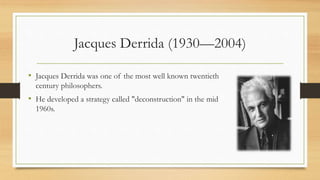
Jacques Derrida (1930—2004)
• Jacques Derrida was one of the most well known twentieth
century philosophers.
• He developed a strategy called "deconstruction" in the mid
1960s.
Theory of deconstruction
• According to Derrida:
• “Deconstruction seems to center around the idea that language and meaning
are often inadequate in trying to convey the message or idea a communicator
is trying to express. Since the confusion stems from the language and not the
object then one should break down or deconstruct the language to see if we
can better understand where the confusion stems.”
Aspects of Deconstruction
• Deconstruction has at least two aspects
• Literary aspect
• Philosophical aspect
Literary aspect
• The literary aspect concerns the textual interpretation, where invention is
essential to finding hidden alternative meanings in the text.
Philosophical aspect
• The philosophical aspect concerns the “metaphysics of presence,” or simply
metaphysics.
• Metaphysics:
• Metaphysics of presence is the desire for immediate access to meaning, the
privileging of presence over absence.
Logo centrism
• According to Derrida, “logocentrism” is the attitude that logos (the Greek
term for speech, thought, law, or reason) is the central principle of language
and philosophy.
• Logocentrism is the view that speech, and not writing, is central to language.
• According to logocentrist theory, says Derrida, speech is the original
signifier of meaning, and the written word is derived from the spoken word.
•
Logocentrism
• The written word is thus a representation of the spoken word.
• If writing is only a representation of speech, then writing is only a ‘signifier
of a signifier.’
• according to logocentrist theory, writing is merely a derivative form of
language which draws its meaning from speech
• Logocentrism is described by Derrida as a “metaphysics of presence,” which
is motivated by a desire for a “transcendental signified.”
Metaphysics of presence
• Derrida describe the task of deconstruction as the identification of
metaphysics of presence.
• Metaphysics of presence is the desire for immediate access to meaning, the
privileging of presence over absence.
• This means that there is an assumed bias in certain binary oppositions where
one side is placed in a position of one over another, such as good over bad.
Speech/Writing
• Saussure argues that
• "language and writing are two distinct systems of signs: the second
exists for the sole purpose of representing the first".
• Language, has an oral tradition that is independent of writing, and it is this
independence that makes a pure science of speech possible.
• Derrida disagrees with this hierarchy and argues that all that can be claimed
of writing – e.g., that it is derivative and merely refers to other signs - is
equally true of speech.
Arche-writing
• Arche-writing refers to a more generalized notion of writing that insists that
the breach that the written introduces between what is intended to be
conveyed and what is actually conveyed.
• According to Derrida, all writing must be able to function in the absence of
every empirically determined addressee
Différance
• Différance is an important idea within deconstruction.
• it is the observation that the meanings of words come from their synchrony
with other words within the language and their diachronic between
contemporary and historical definitions of a word.
• Understanding language according Derrida required an understanding of
both viewpoints of linguistic analysis.
Différance
• For example, the word "house" derives its meaning more as a function of
how it differs from "shed", "mansion", "hotel", "building", etc.
• than how the word "house" may be tied to a certain image of a traditional
house with each term being established in reciprocal determination with the
other terms than by an ostensive description or definition
Michel Foucault
• Born 15 October 1926 (Poitiers, France)
• Died 25 June 1984 (aged 57) Paris, France
• Era 20th-century philosophy
• Region Western philosophy
• Main interests
• History of ideas, epistemology, ethics, political philosophy, philosophy of literature, philosophy of
technology
• Notable ideas
• disciplinary institution, épistème, "Genealogy", governmentality, power-knowledge, discursive formation
Foucault idea of power
• Foucault argues a number of points in relation to power and offers definitions that are
directly opposed to more traditional liberal and Marxist theories of power.
• Definitions
• power is not a thing but a relation
• power is not simply repressive but it is productive
• power is not simply a property of the State. Power is not something that is exclusively
localized in government and the State. Rather, power is exercised throughout the social
body.
• power operates at the most micro levels of social relations. Power is omnipresent at every
level of the social body.
Types of power
• sovereign power
• disciplinary power
• pastoral power
Idea of knowledge
• Foucault believed that knowledge is always a form of power, but he took it a step
further and told us that knowledge can be gained from power; producing it, not
preventing it.
• Here we can give the example of Dr. Faustus who get the knowledge of black
magic for the sake of power
• Through observation, new knowledge is produced.
• In his view, knowledge is forever connected to power, and often wrote them in this
way: power/knowledge. Foucault's theory states that knowledge is power:
Cont.…
• “Knowledge linked to power, not only assumes the authority of 'the truth'
but has the power to make itself true. All knowledge, once applied in the real
world, has effects, and in that sense at least, 'becomes true.' Knowledge, once
used to regulate the conduct of others, entails constraint, regulation and the
disciplining of practice. Thus, 'there is no power relation without the
correlative constitution of a field of knowledge, nor any knowledge that
does not presuppose and constitute at the same time, power relations”
•
(Foucault 1977,27).
history and historiography
• Foucault's entire philosophy is based on the assumption that human
knowledge and existence are profoundly historical.
• He argues that what is most human about man is his history.
• He discusses the notions of history, change and historical method at some
length at various points in his career.
• He uses history as a means of demonstrating that there is no such thing as
historical necessity, that things could have been and could be otherwise
history of the present
• Foucault describes his work on a number of occasions as the history or the
diagnosis of the present, as the analysis of 'what today is'.
• He notes that our own times and lives are not the beginning or end of some
'historical' process, but a period like, but at the same time unlike, any other.
The question should simply be 'how is today different from yesterday?'
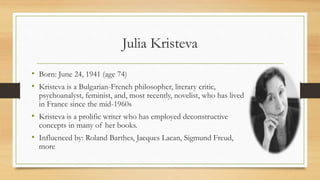
Julia Kristeva
• Born: June 24, 1941 (age 74)
• Kristeva is a Bulgarian-French philosopher, literary critic,
psychoanalyst, feminist, and, most recently, novelist, who has lived
in France since the mid-1960s
• Kristeva is a prolific writer who has employed deconstructive
concepts in many of her books.
• Influenced by: Roland Barthes, Jacques Lacan, Sigmund Freud,
more
What is intertextuality
• The shaping of texts’ meanings by other texts
• Kristeva argued against the concept of a text as a isolated entity which
operates in a self-contained manner and states that:
• “any text is the absorption and transformation of another”
Intertextuality
• Intertextuality seems such a useful term because it foregrounds notions of
rationality, interconnectedness and interdependence in modern cultural life.
In the Postmodern epoch, theorists often claim, it is not possible any longer
to speak of originality or the uniqueness of the artistic object, be it a
painting or novel, since every artistic object is so clearly assembled from bits
and pieces of already existent art."
• (Graham Allen, Intertextuality. Routledge, 2000)
Examples of intertextuality
• We can give the example of “Hedda Gabler” and “The long days journey
into night”
• In both of the play we see almost same family conflicts.
• Second example we can quote the play “Alchemist” and “Importance of
being earnest” in both of the plays we seen the same monomania of
earning wealth by hook or by crook
Conclusion
• Deconstruction’s reception was colored by its intellectual predecessors, most
notably structuralism and New Criticism.
• Structuralism methods were soon applied to other areas of the social
sciences and humanities, including literary studies.
• Deconstruction offered a powerful critique of the possibility of creating
detached, scientific metalanguages and was thus categorized (along with
kindred efforts) as “post-structuralist.”
Conclusion
• Deconstructive readings, treated works of art not as the harmonious fusion
of literal and figurative meanings but as instances of the intractable conflicts
between meanings of different types.
• They generally examined the individual work not as a self-contained artifact
but as a product of relations with other texts or discourses, literary and
nonliterary.
• deconstruction also prompted an exploration of fundamental oppositions
and critical terms and a reexamination of ultimate goals.

theory of deconstruction

  • 1.
    Literary criticism Theory ofdeconstruction Mam Fariha Shafqat Huma Nawaz(1060) M.A English (B) 2014-2016 University of education Bank road campus Lahore Subject Topic Submitted to Submitted by Class session
  • 2.
    Theory of deconstruction Huma Nawaz Hafsazaheer Iqra batool Javerya Kausar kanwal
  • 3.
    Structuralism • Structuralism arguesthat • “there must be a structure in every text, which explains why it is easier for experienced readers than for non-experienced readers to interpret a text. Hence, everything that is written seems to be governed by specific rules, or a "grammar of literature", that one learns in educational institutions and that are to be unmasked.”
  • 4.
    Post structuralism • Post-structuralismis defined by its coming after structuralism. • an intellectual movement developed in Europe from the early to mid-20th century which argued that human culture may be understood by means of a structure—modeled on language. • There are two theories that can be discussed in this order • Psychoanalytical theory • Lacanian theory
  • 5.
    Psychoanalytic theory • Psychoanalytictheory is a method of investigating and treating personality disorders and is used in psychotherapy. Included in this theory is the idea that things that happen to people during childhood can contribute to the way they later function as adults. • For example if we see the play “The long days journey into night” by O'Neil. This play is a reflection of his personal life. And can also be called a autobiographical play
  • 6.
  • 7.
    Proponents of thetheory • Proponents of these theories are; • Derrida • Kristeva • Foucault • Lacan
  • 8.
    Jacques Derrida (1930—2004) •Jacques Derrida was one of the most well known twentieth century philosophers. • He developed a strategy called "deconstruction" in the mid 1960s.
  • 9.
    Theory of deconstruction •According to Derrida: • “Deconstruction seems to center around the idea that language and meaning are often inadequate in trying to convey the message or idea a communicator is trying to express. Since the confusion stems from the language and not the object then one should break down or deconstruct the language to see if we can better understand where the confusion stems.”
  • 10.
    Aspects of Deconstruction •Deconstruction has at least two aspects • Literary aspect • Philosophical aspect
  • 11.
    Literary aspect • Theliterary aspect concerns the textual interpretation, where invention is essential to finding hidden alternative meanings in the text.
  • 12.
    Philosophical aspect • Thephilosophical aspect concerns the “metaphysics of presence,” or simply metaphysics. • Metaphysics: • Metaphysics of presence is the desire for immediate access to meaning, the privileging of presence over absence.
  • 13.
    Logo centrism • Accordingto Derrida, “logocentrism” is the attitude that logos (the Greek term for speech, thought, law, or reason) is the central principle of language and philosophy. • Logocentrism is the view that speech, and not writing, is central to language. • According to logocentrist theory, says Derrida, speech is the original signifier of meaning, and the written word is derived from the spoken word. •
  • 14.
    Logocentrism • The writtenword is thus a representation of the spoken word. • If writing is only a representation of speech, then writing is only a ‘signifier of a signifier.’ • according to logocentrist theory, writing is merely a derivative form of language which draws its meaning from speech • Logocentrism is described by Derrida as a “metaphysics of presence,” which is motivated by a desire for a “transcendental signified.”
  • 15.
    Metaphysics of presence •Derrida describe the task of deconstruction as the identification of metaphysics of presence. • Metaphysics of presence is the desire for immediate access to meaning, the privileging of presence over absence. • This means that there is an assumed bias in certain binary oppositions where one side is placed in a position of one over another, such as good over bad.
  • 16.
    Speech/Writing • Saussure arguesthat • "language and writing are two distinct systems of signs: the second exists for the sole purpose of representing the first". • Language, has an oral tradition that is independent of writing, and it is this independence that makes a pure science of speech possible. • Derrida disagrees with this hierarchy and argues that all that can be claimed of writing – e.g., that it is derivative and merely refers to other signs - is equally true of speech.
  • 17.
    Arche-writing • Arche-writing refersto a more generalized notion of writing that insists that the breach that the written introduces between what is intended to be conveyed and what is actually conveyed. • According to Derrida, all writing must be able to function in the absence of every empirically determined addressee
  • 18.
    Différance • Différance isan important idea within deconstruction. • it is the observation that the meanings of words come from their synchrony with other words within the language and their diachronic between contemporary and historical definitions of a word. • Understanding language according Derrida required an understanding of both viewpoints of linguistic analysis.
  • 19.
    Différance • For example,the word "house" derives its meaning more as a function of how it differs from "shed", "mansion", "hotel", "building", etc. • than how the word "house" may be tied to a certain image of a traditional house with each term being established in reciprocal determination with the other terms than by an ostensive description or definition
  • 20.
    Michel Foucault • Born15 October 1926 (Poitiers, France) • Died 25 June 1984 (aged 57) Paris, France • Era 20th-century philosophy • Region Western philosophy • Main interests • History of ideas, epistemology, ethics, political philosophy, philosophy of literature, philosophy of technology • Notable ideas • disciplinary institution, épistème, "Genealogy", governmentality, power-knowledge, discursive formation
  • 21.
    Foucault idea ofpower • Foucault argues a number of points in relation to power and offers definitions that are directly opposed to more traditional liberal and Marxist theories of power. • Definitions • power is not a thing but a relation • power is not simply repressive but it is productive • power is not simply a property of the State. Power is not something that is exclusively localized in government and the State. Rather, power is exercised throughout the social body. • power operates at the most micro levels of social relations. Power is omnipresent at every level of the social body.
  • 22.
    Types of power •sovereign power • disciplinary power • pastoral power
  • 23.
    Idea of knowledge •Foucault believed that knowledge is always a form of power, but he took it a step further and told us that knowledge can be gained from power; producing it, not preventing it. • Here we can give the example of Dr. Faustus who get the knowledge of black magic for the sake of power • Through observation, new knowledge is produced. • In his view, knowledge is forever connected to power, and often wrote them in this way: power/knowledge. Foucault's theory states that knowledge is power:
  • 24.
    Cont.… • “Knowledge linkedto power, not only assumes the authority of 'the truth' but has the power to make itself true. All knowledge, once applied in the real world, has effects, and in that sense at least, 'becomes true.' Knowledge, once used to regulate the conduct of others, entails constraint, regulation and the disciplining of practice. Thus, 'there is no power relation without the correlative constitution of a field of knowledge, nor any knowledge that does not presuppose and constitute at the same time, power relations” • (Foucault 1977,27).
  • 25.
    history and historiography •Foucault's entire philosophy is based on the assumption that human knowledge and existence are profoundly historical. • He argues that what is most human about man is his history. • He discusses the notions of history, change and historical method at some length at various points in his career. • He uses history as a means of demonstrating that there is no such thing as historical necessity, that things could have been and could be otherwise
  • 26.
    history of thepresent • Foucault describes his work on a number of occasions as the history or the diagnosis of the present, as the analysis of 'what today is'. • He notes that our own times and lives are not the beginning or end of some 'historical' process, but a period like, but at the same time unlike, any other. The question should simply be 'how is today different from yesterday?'
  • 27.
    Julia Kristeva • Born:June 24, 1941 (age 74) • Kristeva is a Bulgarian-French philosopher, literary critic, psychoanalyst, feminist, and, most recently, novelist, who has lived in France since the mid-1960s • Kristeva is a prolific writer who has employed deconstructive concepts in many of her books. • Influenced by: Roland Barthes, Jacques Lacan, Sigmund Freud, more
  • 28.
    What is intertextuality •The shaping of texts’ meanings by other texts • Kristeva argued against the concept of a text as a isolated entity which operates in a self-contained manner and states that: • “any text is the absorption and transformation of another”
  • 29.
    Intertextuality • Intertextuality seemssuch a useful term because it foregrounds notions of rationality, interconnectedness and interdependence in modern cultural life. In the Postmodern epoch, theorists often claim, it is not possible any longer to speak of originality or the uniqueness of the artistic object, be it a painting or novel, since every artistic object is so clearly assembled from bits and pieces of already existent art." • (Graham Allen, Intertextuality. Routledge, 2000)
  • 30.
    Examples of intertextuality •We can give the example of “Hedda Gabler” and “The long days journey into night” • In both of the play we see almost same family conflicts. • Second example we can quote the play “Alchemist” and “Importance of being earnest” in both of the plays we seen the same monomania of earning wealth by hook or by crook
  • 31.
    Conclusion • Deconstruction’s receptionwas colored by its intellectual predecessors, most notably structuralism and New Criticism. • Structuralism methods were soon applied to other areas of the social sciences and humanities, including literary studies. • Deconstruction offered a powerful critique of the possibility of creating detached, scientific metalanguages and was thus categorized (along with kindred efforts) as “post-structuralist.”
  • 32.
    Conclusion • Deconstructive readings,treated works of art not as the harmonious fusion of literal and figurative meanings but as instances of the intractable conflicts between meanings of different types. • They generally examined the individual work not as a self-contained artifact but as a product of relations with other texts or discourses, literary and nonliterary. • deconstruction also prompted an exploration of fundamental oppositions and critical terms and a reexamination of ultimate goals.