Aristotle's 'Poetics' is a foundational text in literary criticism that responds to Plato's views on poetry, focusing on the nature and purpose of tragedy. The work outlines key concepts such as plot, character, thought, diction, and spectacle, defining tragedy as an imitation of serious action that arouses fear and pity. Aristotle argues for the importance of unity of action in tragedy, contrasts it with epic poetry, and establishes the characteristics of the ideal tragic hero.
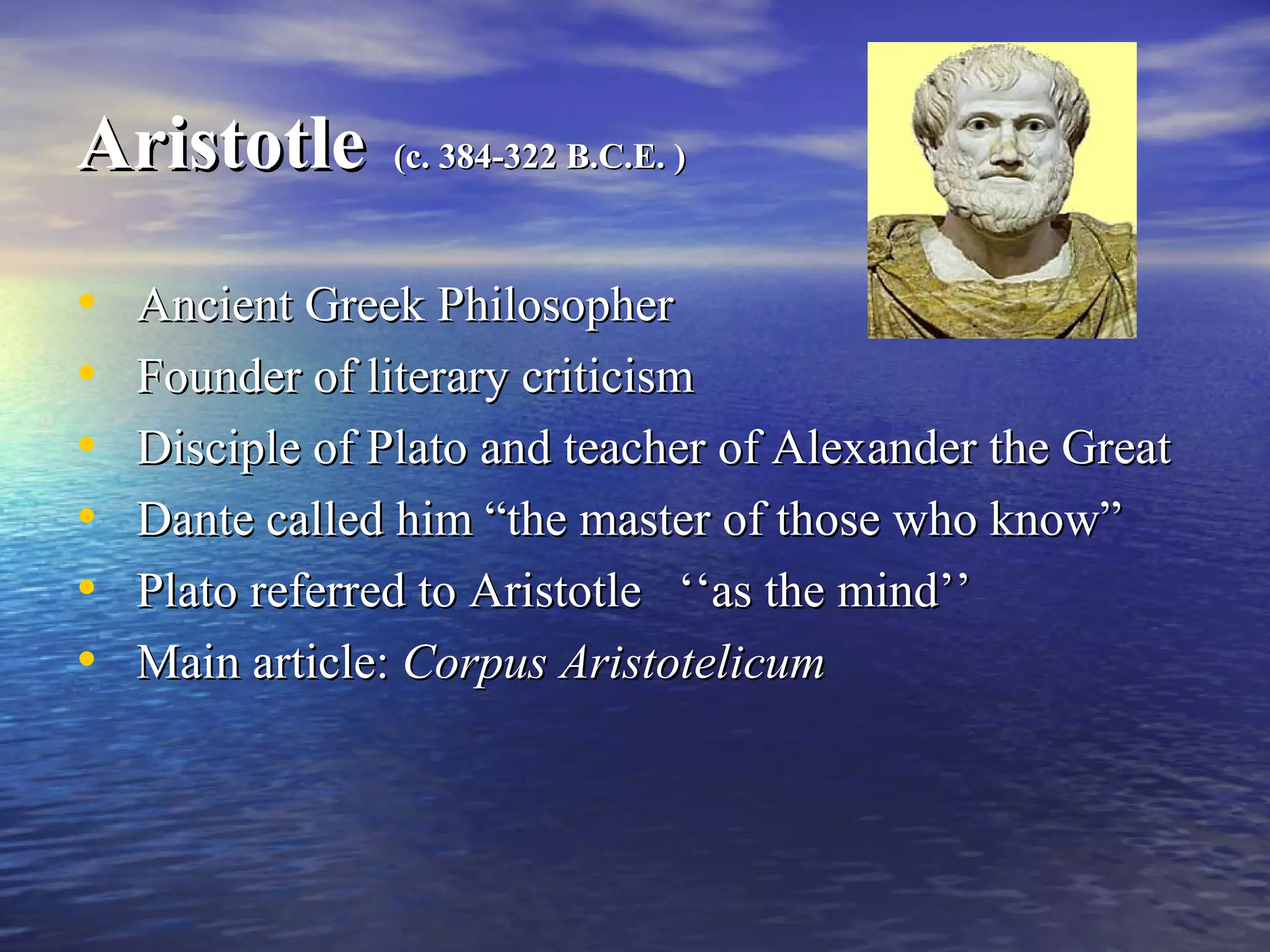
AristotleAristotle (c. 384-322B.C.E. )(c. 384-322 B.C.E. )
• Ancient Greek PhilosopherAncient Greek Philosopher
• Founder of literary criticismFounder of literary criticism
• Disciple of Plato and teacher of Alexander the GreatDisciple of Plato and teacher of Alexander the Great
• Dante called him “the master of those who know”Dante called him “the master of those who know”
• Plato referred to Aristotle ‘‘as the mind’’Plato referred to Aristotle ‘‘as the mind’’
• Main article:Main article: Corpus AristotelicumCorpus Aristotelicum
3.
Reasons for PoetryReasonsfor Poetry
• Poetics was the objections to dramatic poetryPoetics was the objections to dramatic poetry
expressed by his teacher Plato in hisexpressed by his teacher Plato in his Republic.Republic.
• It is a reply to his master Plato.It is a reply to his master Plato.
• Plato considered imitation merely as mimicry or aPlato considered imitation merely as mimicry or a
servile copy of nature.servile copy of nature.
• Plato compared poetry to painting.Plato compared poetry to painting.
• Poetry presents a copy of nature as it is. PoetryPoetry presents a copy of nature as it is. Poetry
twice removed from reality and it’s a ‘shadow oftwice removed from reality and it’s a ‘shadow of
shadows’.shadows’.
4.
Poetics (c.335 B.C.)Poetics(c.335 B.C.)
Short treatise of twenty-six chapters, forty-six pages, sixShort treatise of twenty-six chapters, forty-six pages, six
parts.parts.
• 1-5 :Introductory remarks on poetry and its1-5 :Introductory remarks on poetry and its
classificationclassification
• 6-19 :Tragedy6-19 :Tragedy
• 20-22 :Poetic diction20-22 :Poetic diction
• 23 :Narrative poetry and tragedy23 :Narrative poetry and tragedy
• 24-26 :Epic is compared with tragedy24-26 :Epic is compared with tragedy
• 25 :Objections are answered25 :Objections are answered
5.
Theory of imitationTheoryof imitation
Three ways of imitationThree ways of imitation
• Means or medium of imitation (serious action).Means or medium of imitation (serious action).
sound, form, coloursound, form, colour
• Objects of imitation (men in action).Objects of imitation (men in action).
• Manner of imitation (verse in dialogue).Manner of imitation (verse in dialogue).
ΔΔ narrativenarrative
ΔΔ dramaticdramatic
6.
TragedyTragedy
Definition of TragedyDefinitionof Tragedy
““Tragedy is the imitation of an action that is serious,Tragedy is the imitation of an action that is serious,
complete, and of a certain magnitude, in a languagecomplete, and of a certain magnitude, in a language
embellished with each kind of artistic ornament, eachembellished with each kind of artistic ornament, each
kind brought separately in separate parts of the work,kind brought separately in separate parts of the work,
in the form of action and not in the narrative form,in the form of action and not in the narrative form,
with incidents arousing fear and pity and wherewithwith incidents arousing fear and pity and wherewith
to accomplish the catharsis of such emotions”.to accomplish the catharsis of such emotions”.
7.
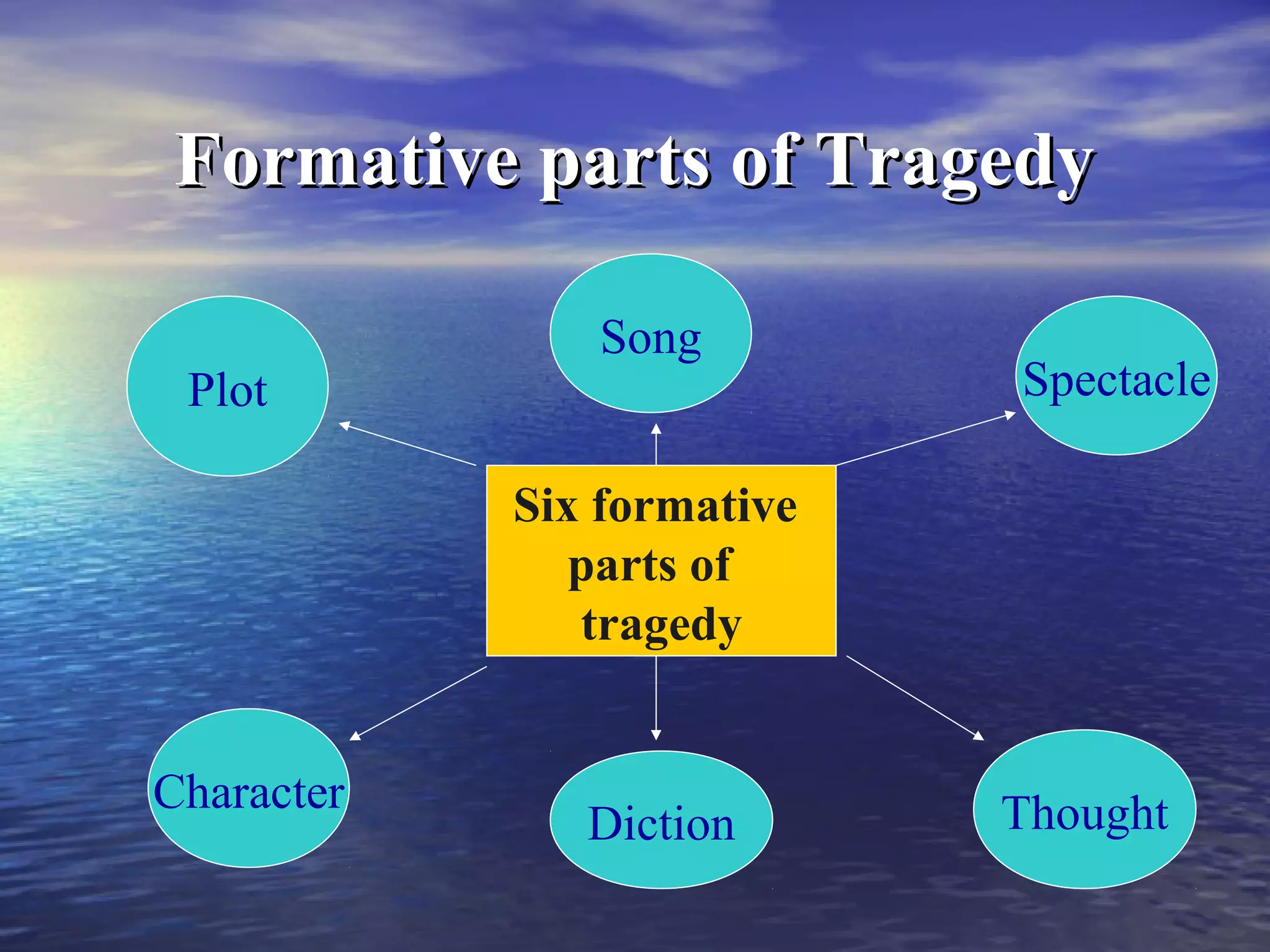
Formative parts ofTragedyFormative parts of Tragedy
Six formative
parts of
tragedy
Plot
Character Thought
Song
Spectacle
Diction
8.
PlotPlot
Plot is theordering of incidents.Plot is the ordering of incidents.
• SimpleSimple
Plot is simple when the change in the fortunes ofPlot is simple when the change in the fortunes of
the hero takes place without peripety and discovery.the hero takes place without peripety and discovery.
• ComplexComplex
The plot is complex when it involves one or theThe plot is complex when it involves one or the
other both. The peripety is the change in the fortunesother both. The peripety is the change in the fortunes
of the hero and the discovery is a change fromof the hero and the discovery is a change from
ignorance to knowledge.ignorance to knowledge.
9.
Characteristics of PlotCharacteristicsof Plot
Plot should be whole It should have a magnitude
Probability and Necessity Willing suspension of disbelief
Organic unity
10.
Formative elements ofPlotFormative elements of Plot
Peripetia- reversal of fortune
Anagnorisis-recognition or discovery of truth
Suffering-destructive or painful action
11.
CharacterCharacter
Characters are theagents for moving according to theCharacters are the agents for moving according to the
plot.plot.
Essential features of characterisationEssential features of characterisation
• Characters should be good.Characters should be good.
• Characters should be appropriate.Characters should be appropriate.
• Characters should be true to life.Characters should be true to life.
• Characters should be consistent.Characters should be consistent.
12.
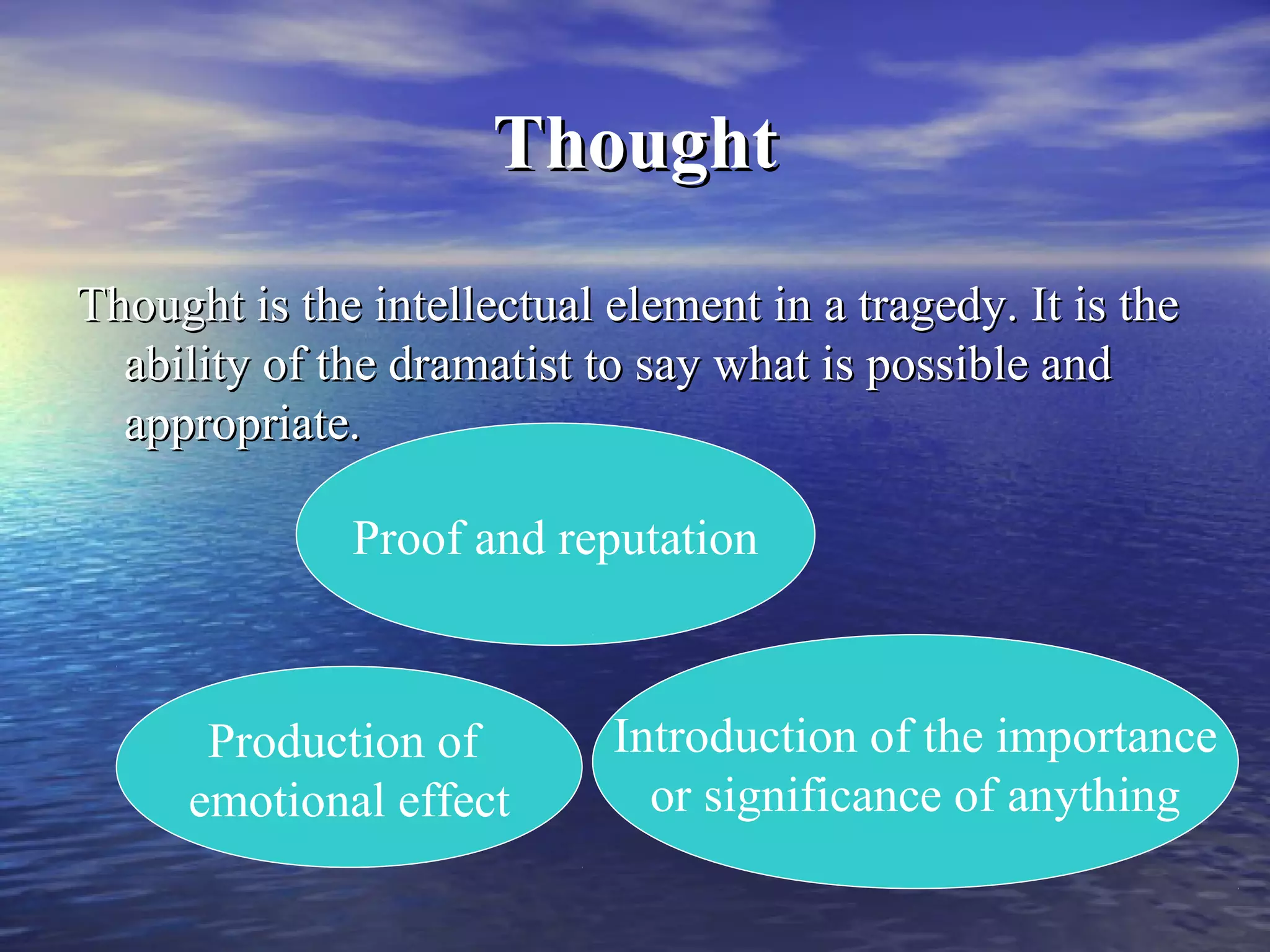
ThoughtThought
Thought is theintellectual element in a tragedy. It is theThought is the intellectual element in a tragedy. It is the
ability of the dramatist to say what is possible andability of the dramatist to say what is possible and
appropriate.appropriate.
Proof and reputation
Production of
emotional effect
Introduction of the importance
or significance of anything
13.
Diction and StyleDictionand Style
Diction is the choice and arrangement of words andDiction is the choice and arrangement of words and
images in a literary composition.images in a literary composition.
Six types of wordsSix types of words
• Current or ordinary wordsCurrent or ordinary words
• Foreign terms borrowed or dialectsForeign terms borrowed or dialects
• MetaphorsMetaphors
• Ornamental periphrasisOrnamental periphrasis
• Invented wordsInvented words
• Not invented, but made new lengtheningNot invented, but made new lengthening
or shorteningor shortening
14.
Songs or MelodySongsor Melody
Prologue
Episode
Choric Song
Exode
Songs is the pleasurable addition to a play. In a tragedy,
song is provided by the chorus.
15.
Spectacle or StageeffectSpectacle or Stage effect
Spectacle is the mode of imitation by which the story isSpectacle is the mode of imitation by which the story is
presented on a stage before an audience. It is the sightpresented on a stage before an audience. It is the sight
of disaster and Aristotle calls this can raise fear andof disaster and Aristotle calls this can raise fear and
pity in the spectator.pity in the spectator.
Types of spectaclesTypes of spectacles
• PlotPlot
• CharacterCharacter
• AnagnorisisAnagnorisis
• HamartiaHamartia
16.
Epic and TragedyEpicand Tragedy
Poetry is divided into epic or narrative poetry andPoetry is divided into epic or narrative poetry and
dramatic poetry on the basis of the manner ofdramatic poetry on the basis of the manner of
imitation. Epic is the narration of an action in verseimitation. Epic is the narration of an action in verse
and tragedy is the dramatic representation of anand tragedy is the dramatic representation of an
action.action.
17.
Similarities between EpicandSimilarities between Epic and
TragedyTragedy
• Use of refined dictionUse of refined diction
• Both in tragedy and epic the poet should know the artBoth in tragedy and epic the poet should know the art
of telling lies the right way.of telling lies the right way.
• Both should have the ability of artistic imitationBoth should have the ability of artistic imitation
(mimesis).(mimesis).
18.
Difference between EpicandDifference between Epic and
TragedyTragedy
EpicEpic
• NarrativeNarrative
• LongLong
• Unity of actionUnity of action
• Use of one metreUse of one metre
Heroic coupletHeroic couplet
• All elements of tragedyAll elements of tragedy
not song and spectaclenot song and spectacle
TragedyTragedy
• DramaticDramatic
• Must be confined to aMust be confined to a
single revolution of thesingle revolution of the
sunsun
• Three unitiesThree unities
• Use various metresUse various metres
• Six elements of tragedySix elements of tragedy
19.
Rules of TragedyRulesof Tragedy
• It is an imitation of an action.It is an imitation of an action.
• He should imaginatively visualize the action.He should imaginatively visualize the action.
• He should workout the emotions with the veryHe should workout the emotions with the very
gestures of his dramatic personages.gestures of his dramatic personages.
• He should begin with the universal form of the plot,He should begin with the universal form of the plot,
adding the names and episodes later.adding the names and episodes later.
20.
Types of TragedyTypesof Tragedy
• Complex tragedyComplex tragedy
It consists of reversal and recognition of truth.It consists of reversal and recognition of truth.
• Tragedy of sufferingTragedy of suffering
Tragedy depicts suffering.Tragedy depicts suffering.
• Tragedy of characterTragedy of character
Character more involved than plot.Character more involved than plot.
• Tragedy of spectacleTragedy of spectacle
It depends upon the sensational effectsIt depends upon the sensational effects
produced by the actors, the costume designers andproduced by the actors, the costume designers and
other mechanical and artificial devices.other mechanical and artificial devices.
21.
Types of RecognitionTypesof Recognition
Anagnorisis (discovery or recognition of truth)Anagnorisis (discovery or recognition of truth)
• Signs or objects, symbolsSigns or objects, symbols
• Author tells himselfAuthor tells himself
• Discovery from memoryDiscovery from memory
• Process of reasoningProcess of reasoning
• Discovery arising from the false reasoningDiscovery arising from the false reasoning
22.
Superiority of Tragedyover EpicSuperiority of Tragedy over Epic
• It has all the elements of an epic and has alsoIt has all the elements of an epic and has also
spectacle and song which the epic lacks.spectacle and song which the epic lacks.
• Unity of action only in a tragedy not in an epic.Unity of action only in a tragedy not in an epic.
• Simply reading the play without performing it isSimply reading the play without performing it is
already very potent.already very potent.
• Tragedy is shorter that is more compact concentratedTragedy is shorter that is more compact concentrated
effect.effect.
23.
Ideal Tragic HeroIdealTragic Hero
• He should not be an utter villain.He should not be an utter villain.
• He should neither the perfectly good not utterly bad.He should neither the perfectly good not utterly bad.
• He must be intermediary sort of person.He must be intermediary sort of person.
• He must posses both qualities and weakness.He must posses both qualities and weakness.
• He must be a human being.He must be a human being.
• Hamartia (tragic flow).Hamartia (tragic flow).