Unit III: THE POSTMODERN AGELiterature in English IIProf. Julia I. Martínez
MODERNITYEpochal term (refers to a historical period)From the Renaissance (reason)/ Enlightenment (18th c.) till today
MODERN AGEHistorical ageFrom the end of the 15th c. (discovery of America) to 1789 (the French Revolution). Then, the Contemporary Age begins
MODERNISMOne of the cultural manifestations of Modernity.A category that means change / rupture / beginning / a moment of crisisIt began in 1922 with Eliot’s “The Wasteland” and Joyce’s “Ulysses,” and finished (?) around 1960
MateiCalinescu: The Five Faces of Modernity (1987)Postmodernism is one other face of the extraordinary phenomenon that came to be known as modernismIt is another expression of the modernist ethos since there are “two conflicting and interdependent modernities -one socially progressive, rationalistic, competitive, technological; the other culturally critical and self-critical, bent on demystifying the basic values of the first...” (p. 265).
POSTMODERNISMA period in Western history beginning in the 1960s (Postmodernity)A style in culture (Postmodernism)A style of thought / an intellectual atmosphere (Postmodern theory)
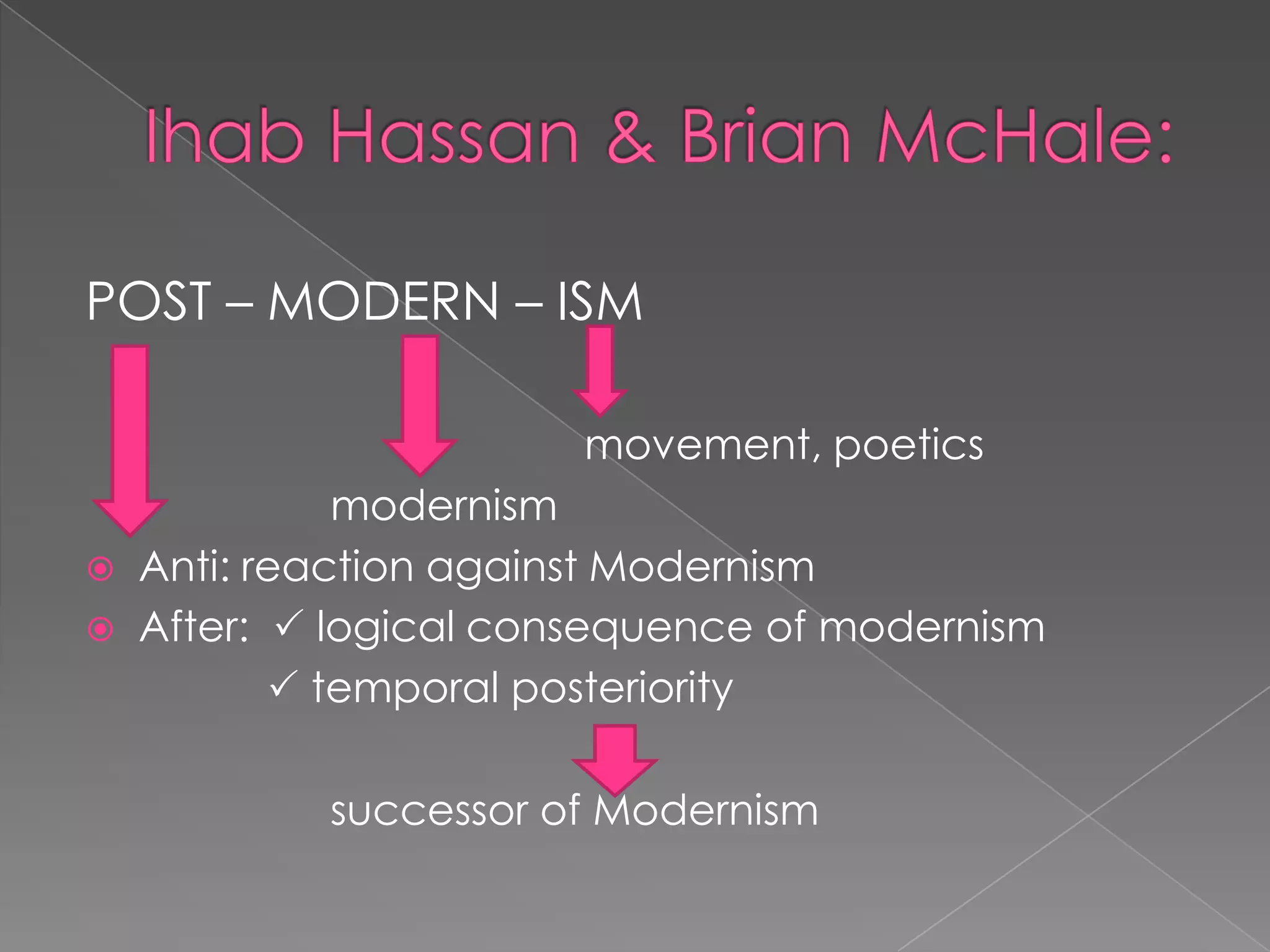
Ihab Hassan & Brian McHale:POST – MODERN – ISM					movement, poetics			modernismAnti: reaction against ModernismAfter:   logical consequence of modernism temporal posteriority			successor of Modernism
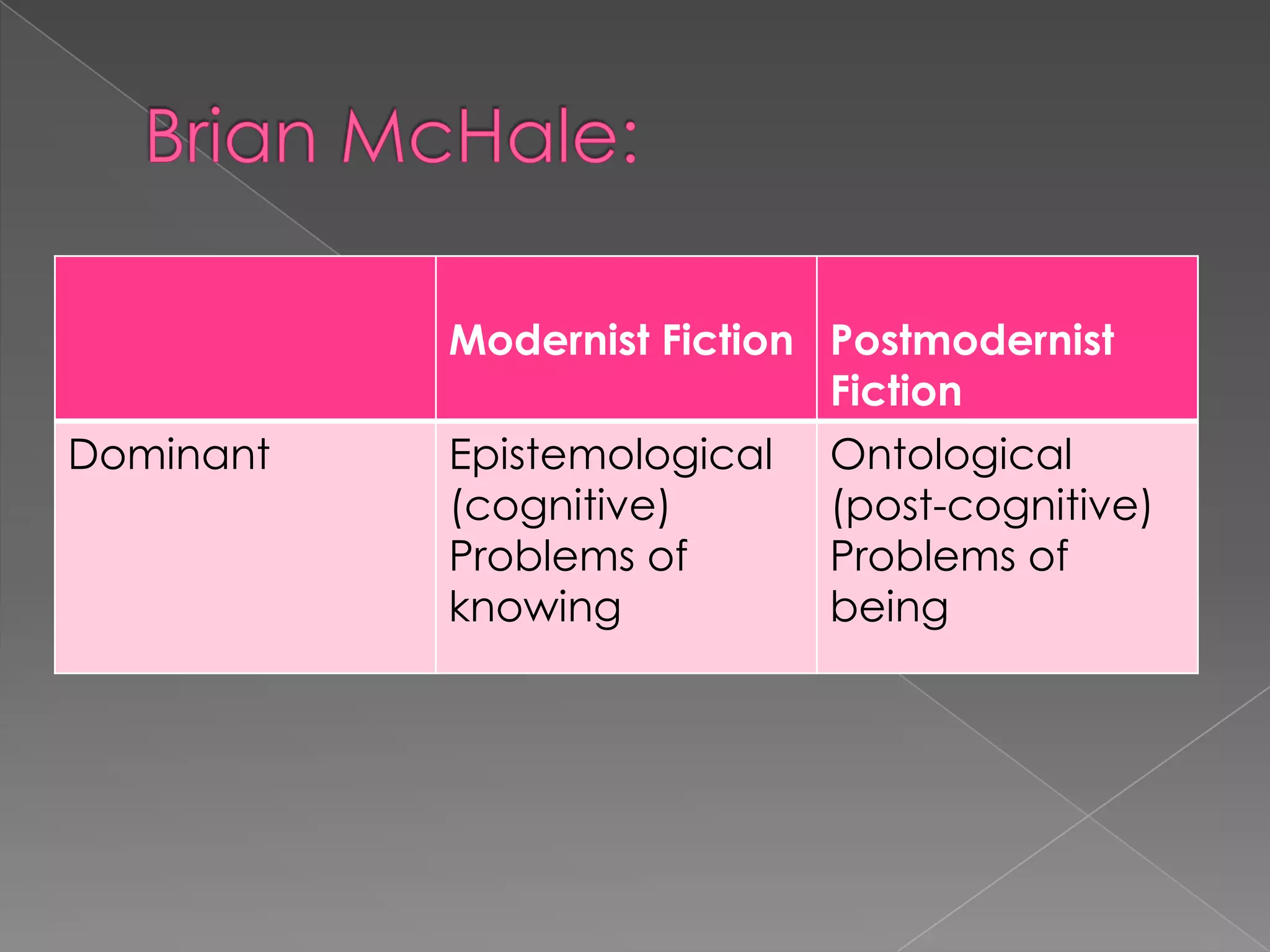
Brian McHale (1987):In order to differentiate modernist from postmodernist fiction, we should talk about the dominant of eachtaken from Jackobson (the focusing component or the principle of sistematicity)
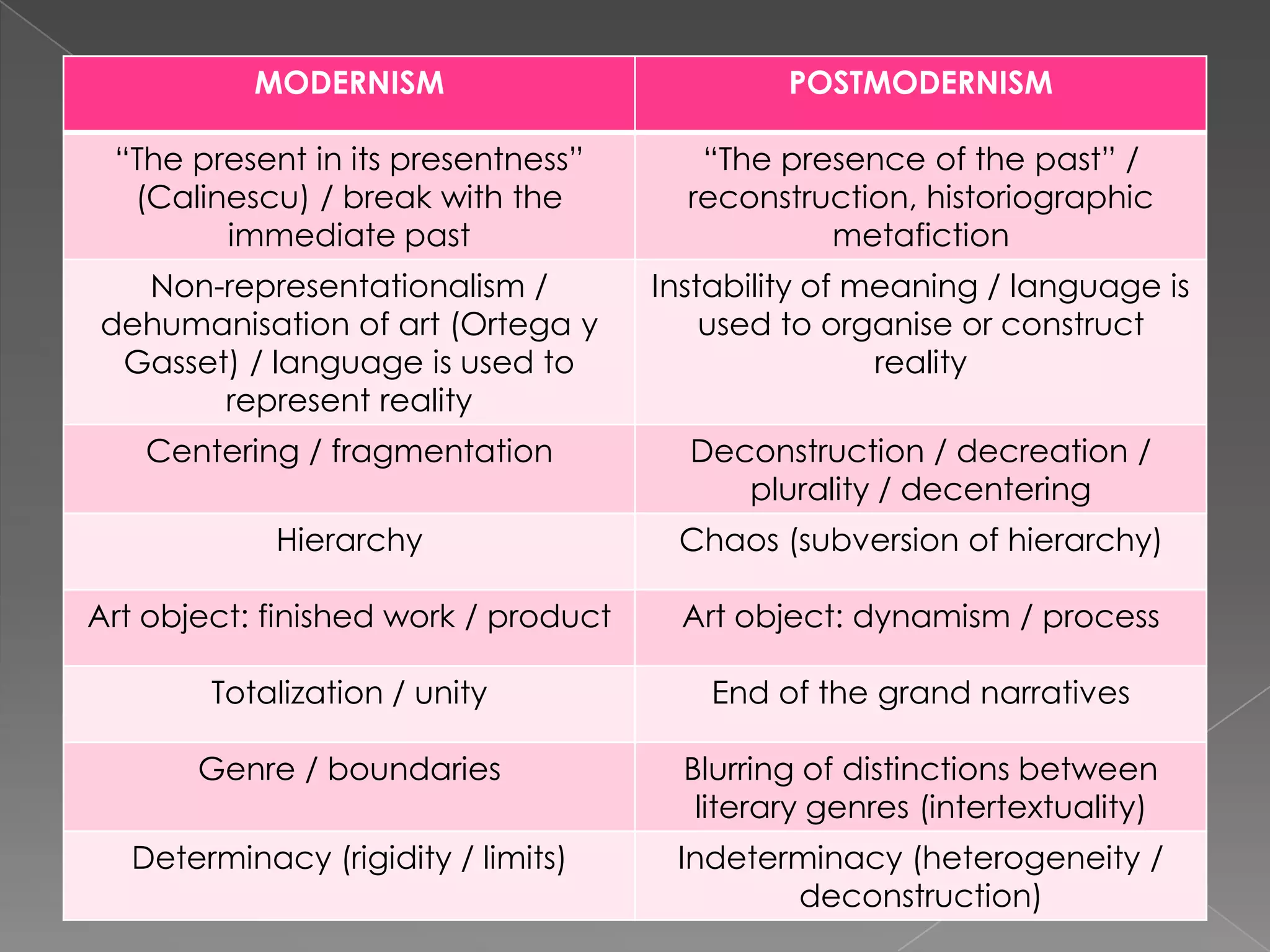
Brian McHale:
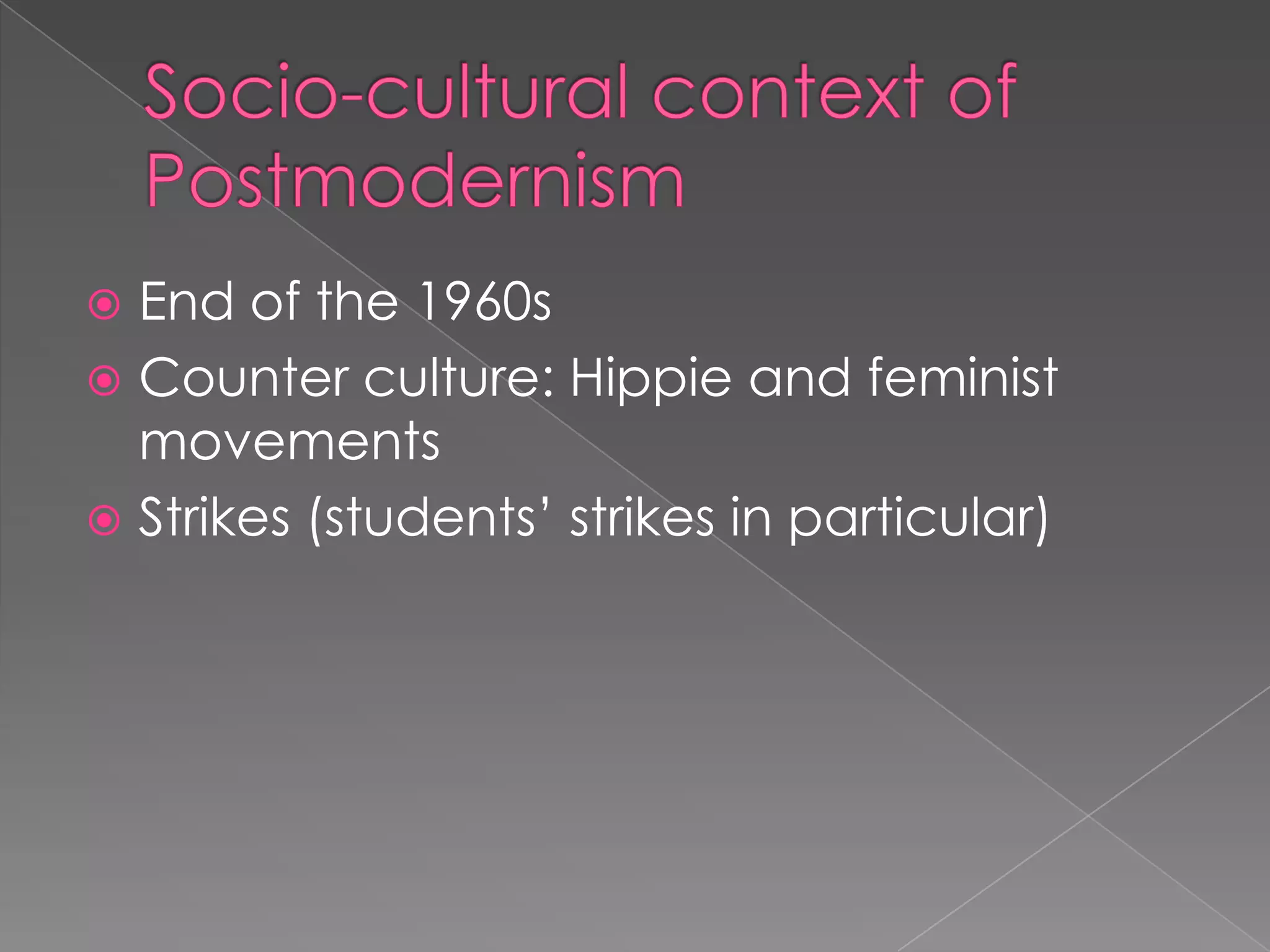
Socio-cultural context of PostmodernismEnd of the 1960sCounter culture: Hippie and feminist movementsStrikes (students’ strikes in particular)
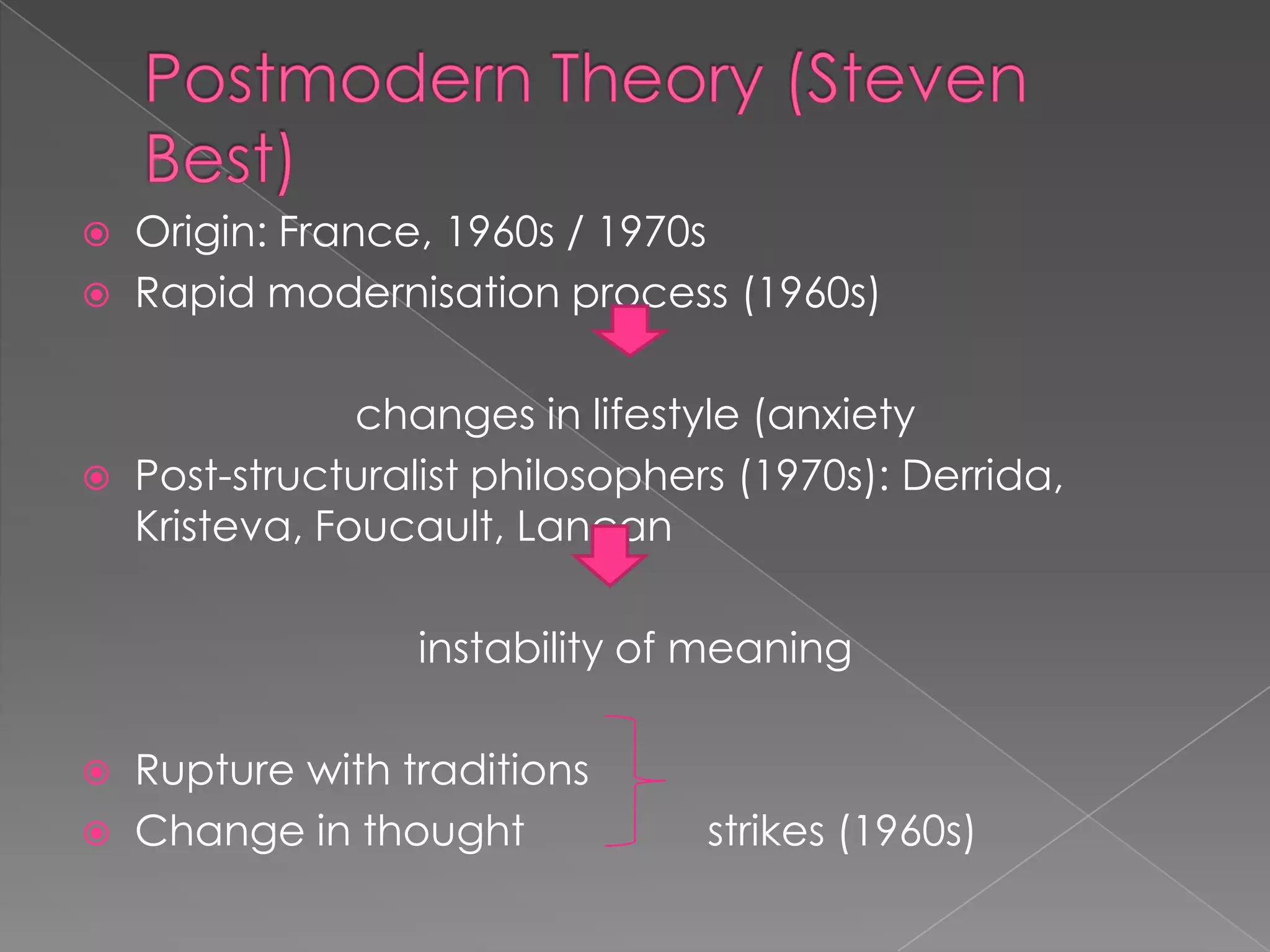
Postmodern Theory (Steven Best)Origin: France, 1960s / 1970sRapid modernisation process (1960s)changes in lifestyle (anxietyPost-structuralist philosophers (1970s): Derrida, Kristeva, Foucault, Lancaninstability of meaningRupture with traditionsChange in thought		strikes (1960s)
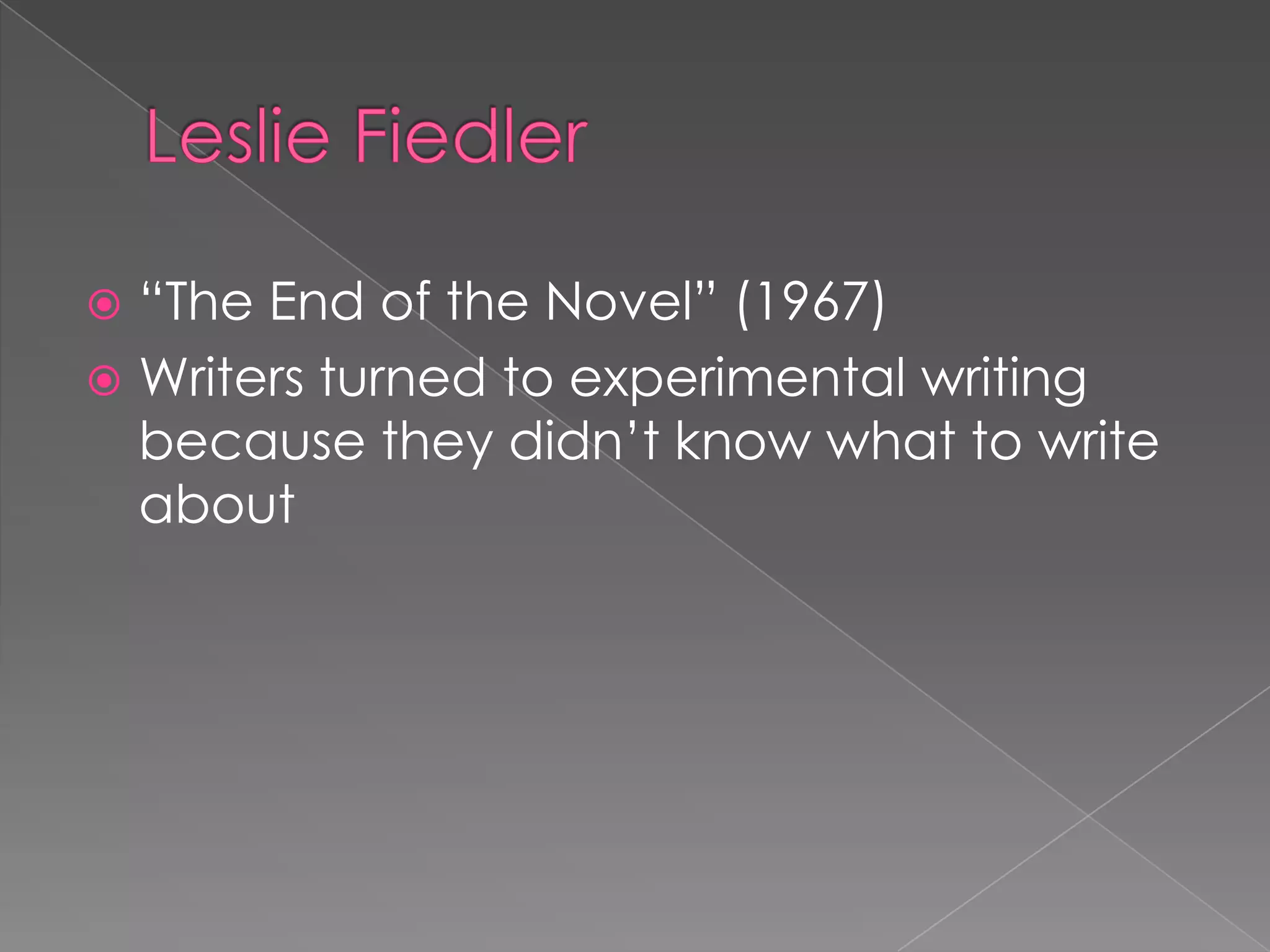
Leslie Fiedler“The End of the Novel” (1967)Writers turned to experimental writing because they didn’t know what to write about
John Barth“The Literature of Exhaustion” (1967)“The Literature of Replenishment” (1980)He reacted against FiedlerIn his view, it is true that some forms are exhausted, but this “experimentation” may lead to a new form.If there are no more topics to write about, we should use the past to recreate new fiction.Literature is inexhaustible
Effects:Writers abandoned classical fictionWriters turned to experimental fictionReality can’t be apprehendedIf we can’t tell what reality is, how can we represent reality? 		By constructing new realitiesPhenomenology (Husserl)
Main concerns of PostmodernismDeconstruction of:TruthLanguageHistoryRealityMeaningIdentityPowerSpace
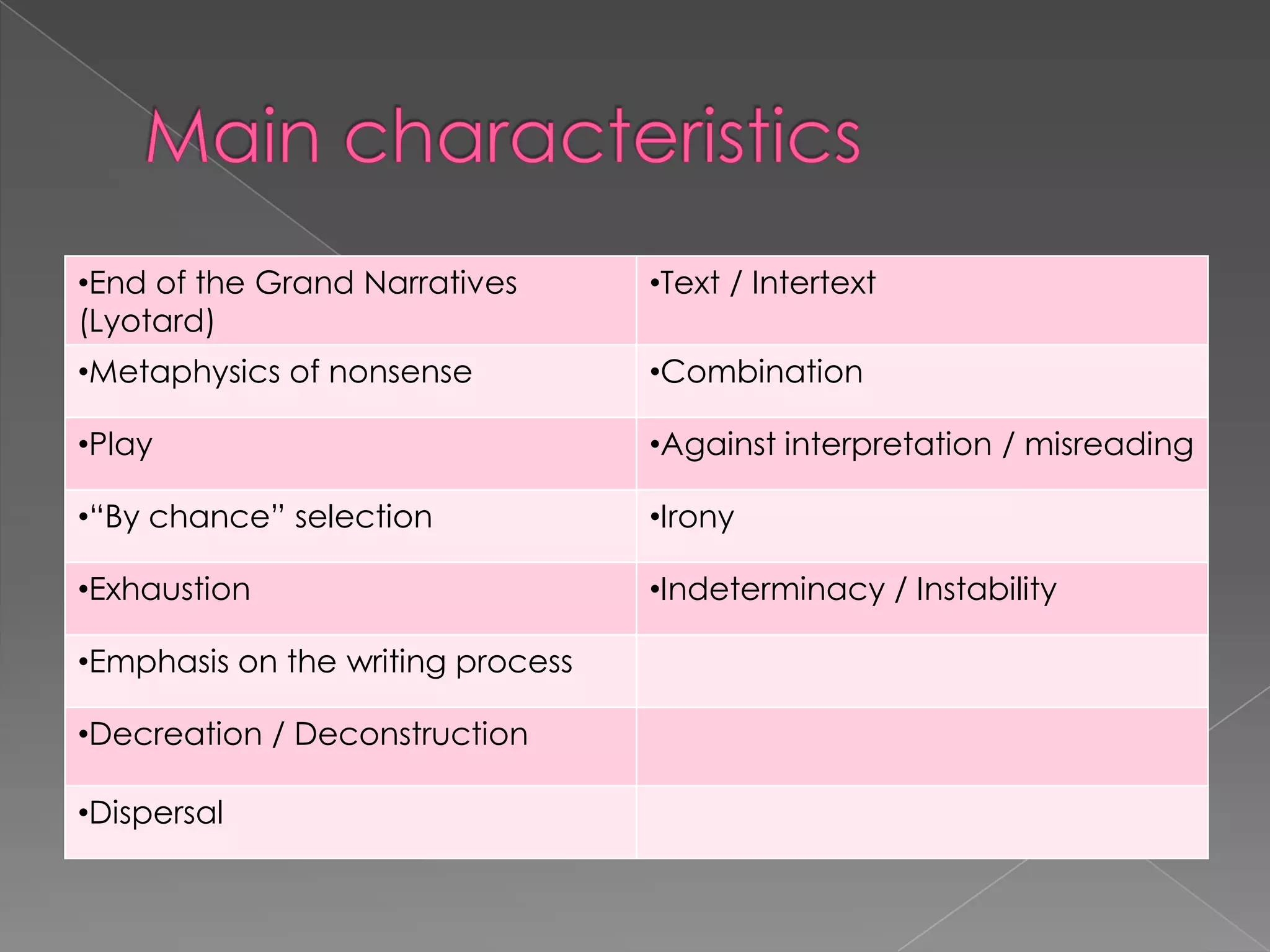
Main characteristics
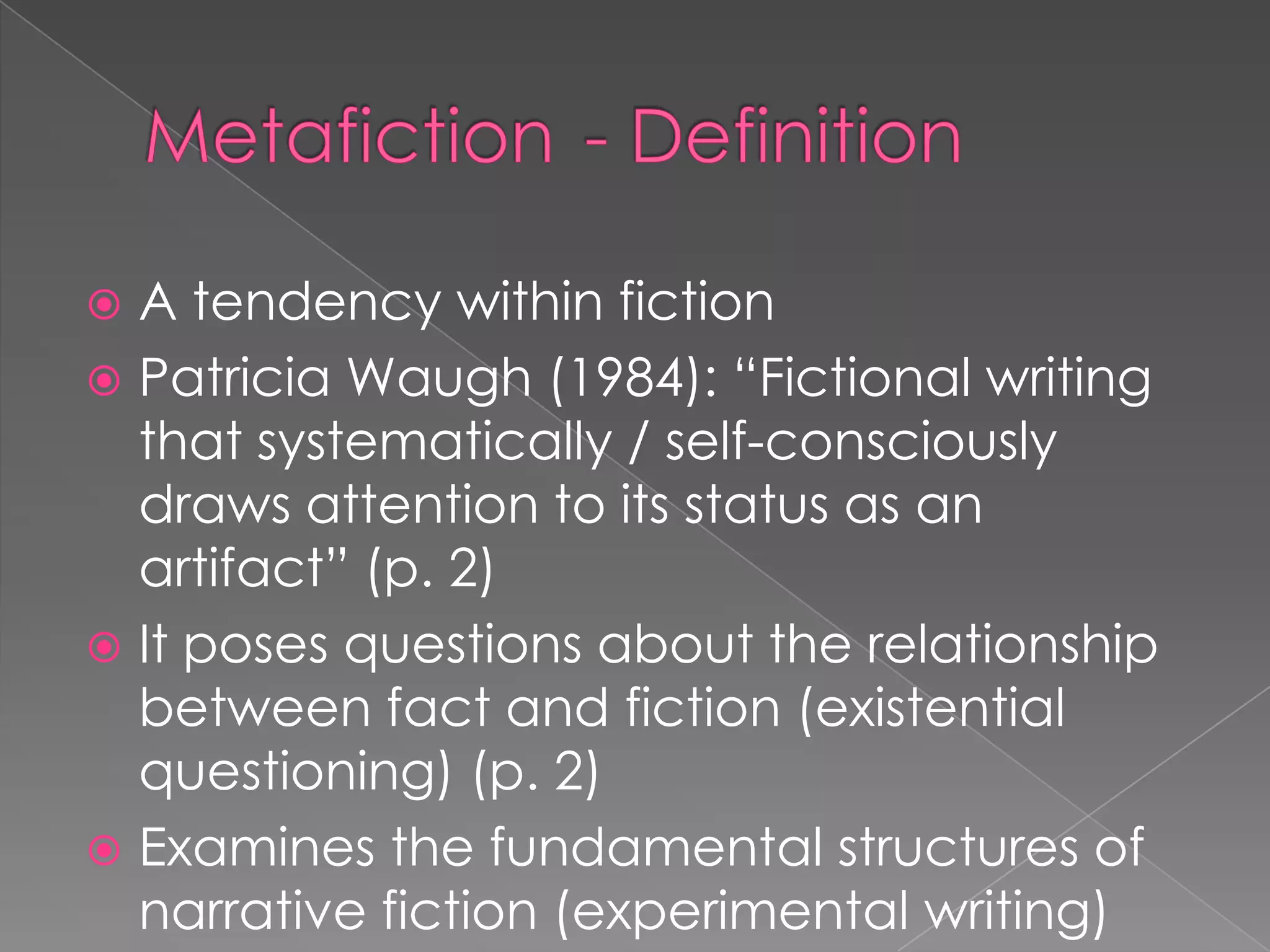
Metafiction	- Definition		A tendency within fictionPatricia Waugh (1984): “Fictional writing that systematically / self-consciously draws attention to its status as an artifact” (p. 2)It poses questions about the relationship between fact and fiction (existential questioning) (p. 2)Examines the fundamental structures of narrative fiction (experimental writing)
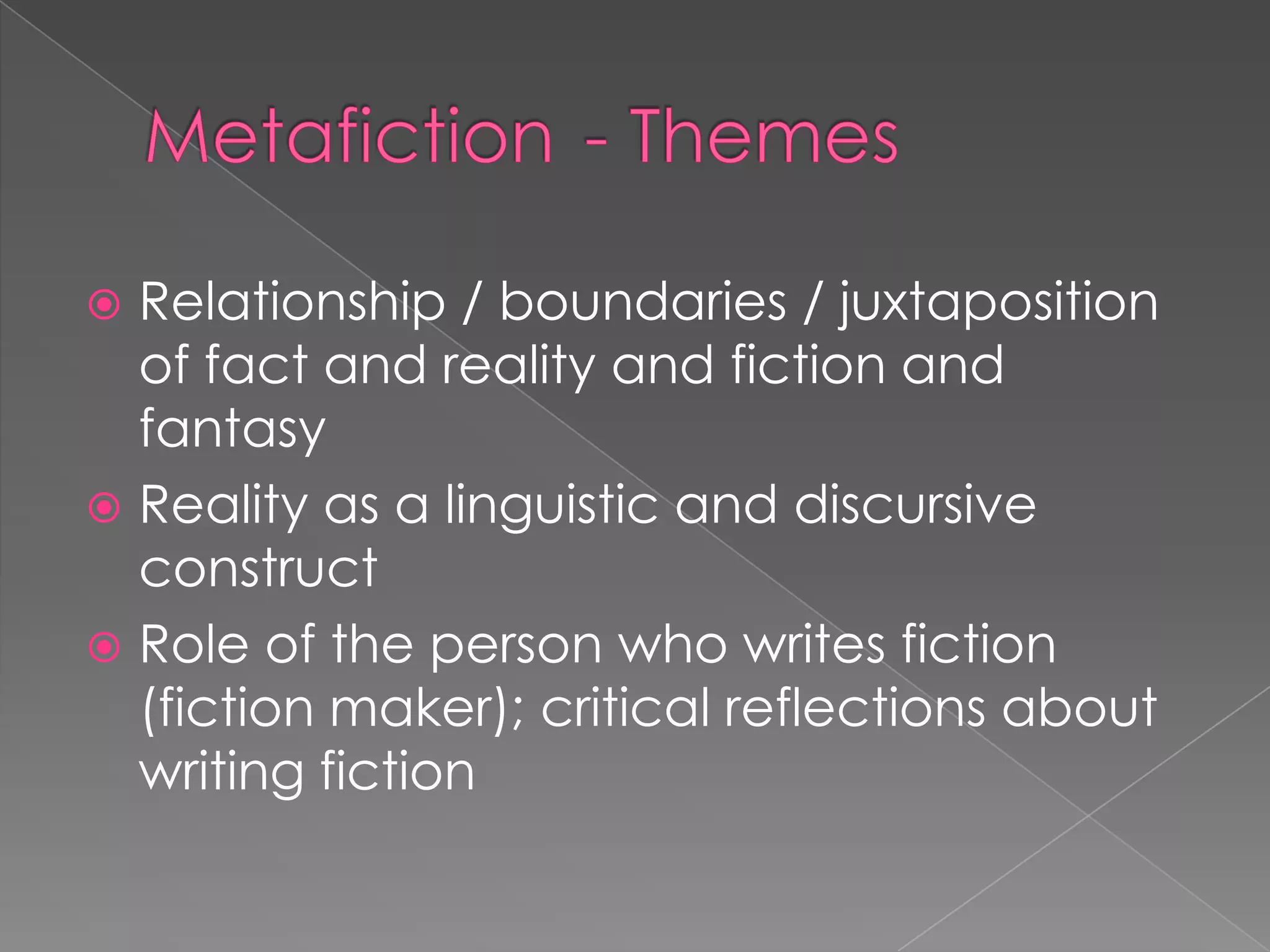
Metafiction	- ThemesRelationship / boundaries / juxtaposition of fact and reality and fiction and fantasyReality as a linguistic and discursive constructRole of the person who writes fiction (fiction maker); critical reflections about writing fiction
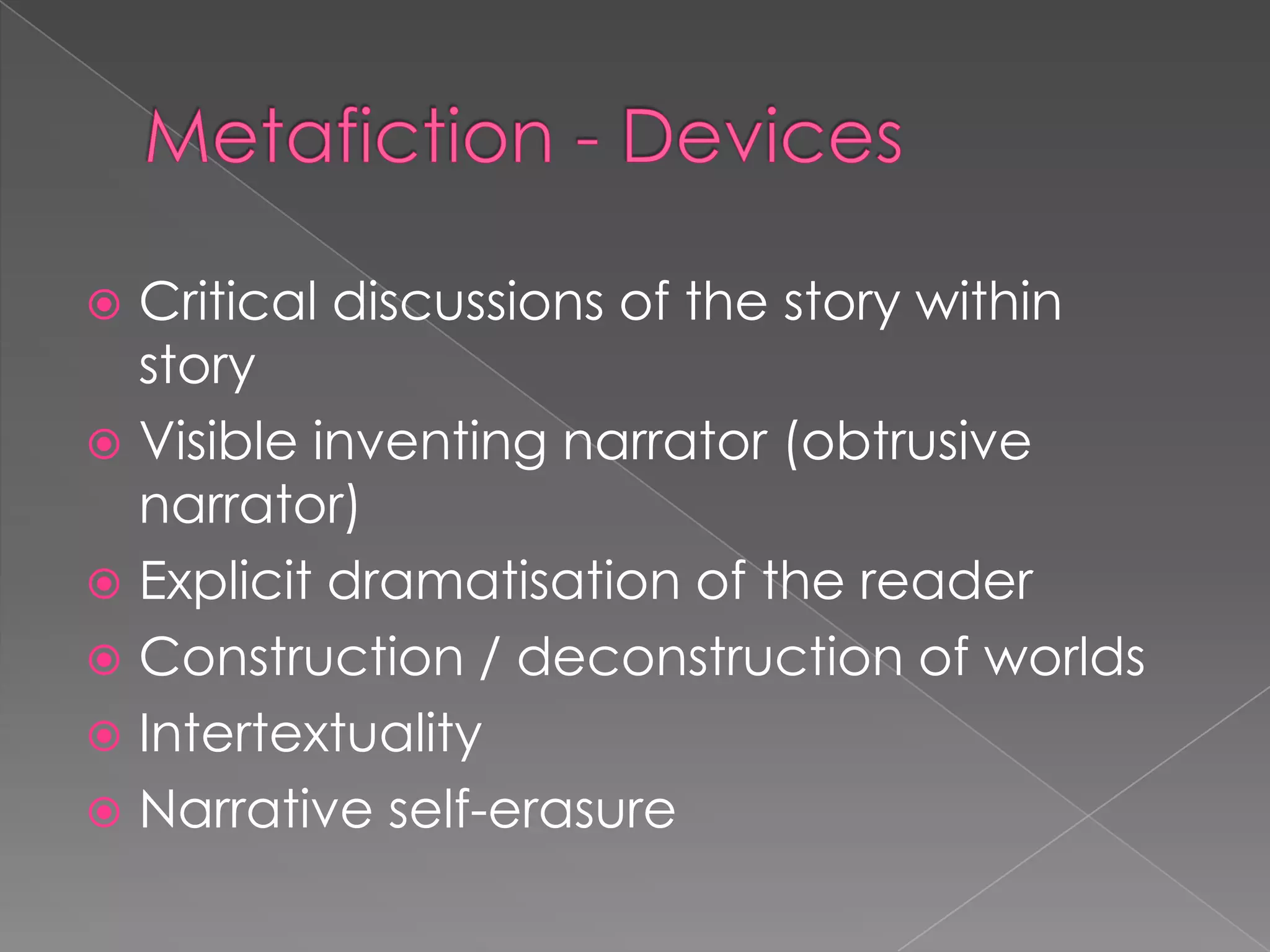
Metafiction - DevicesCritical discussions of the story within story Visible inventing narrator (obtrusive narrator)Explicit dramatisation of the readerConstruction / deconstruction of worldsIntertextualityNarrative self-erasure
Metafiction - DevicesMultiple endingsChinese-box structuresLexical exhibitionism, cataloguesHeteroglossia (polyphony of voices)Breakdown of spatial and temporal organisation of the narrative (playful)ParodyHistorical revisionismPastiche
HistoriographicMetafictionLinda Hutcheon (1988): “In the 19th century (…) literature and history were considered branches of the same tree of learning. (…) Then came the separation that resulted in the distinct disciplines of literary and historical studies today. (…) However, it is this very separation of the literary and the historical that is now being challenged  in postmodern theory and art” (p. 105)
HistoriographicMetafictionHutcheon: “they are both identified as linguistic constructs, highly conventionalized in their narrative forms, and not at all transparent either in terms of language or structure; and they appear to be equally intertextual, deploying the texts of the past within their own complex textuality” (p. 105)
HistoriographicMetafictionHutcheon: “this kind of novel asks us to recall that history and fiction are themselves historical terms and that their definitions and interrelations are historically determined and vary with time” (105)“Historiographic metafiction suggests that truth and falsity may indeed not be the right terms in which to discuss fiction” (109)
HistoriographicMetafictionHutcheon: “Postmodern fiction suggests that to re-write or to re-present the past in fiction and in history is, in both cases, to open it up to the present, to prevent it from being conclusive and teleological” (p. 110)Historiographic metafictions “both install and then blur the line between fiction and history” (p. 113)
HistoriographicMetafictionHutcheon: “Postmodern novels raise a number of specific issues regarding the interaction of historiography and fiction that deserve more detailed study: issues surrounding the nature of identity and subjectivity; the question of reference and representation; the intertextual nature of the past; and the ideological implications of writing about history” (p. 117)

Unit III Postmodernism

  • 1.
    Unit III: THEPOSTMODERN AGELiterature in English IIProf. Julia I. Martínez
  • 2.
    MODERNITYEpochal term (refersto a historical period)From the Renaissance (reason)/ Enlightenment (18th c.) till today
  • 3.
    MODERN AGEHistorical ageFromthe end of the 15th c. (discovery of America) to 1789 (the French Revolution). Then, the Contemporary Age begins
  • 4.
    MODERNISMOne of thecultural manifestations of Modernity.A category that means change / rupture / beginning / a moment of crisisIt began in 1922 with Eliot’s “The Wasteland” and Joyce’s “Ulysses,” and finished (?) around 1960
  • 5.
    MateiCalinescu: The FiveFaces of Modernity (1987)Postmodernism is one other face of the extraordinary phenomenon that came to be known as modernismIt is another expression of the modernist ethos since there are “two conflicting and interdependent modernities -one socially progressive, rationalistic, competitive, technological; the other culturally critical and self-critical, bent on demystifying the basic values of the first...” (p. 265).
  • 6.
    POSTMODERNISMA period inWestern history beginning in the 1960s (Postmodernity)A style in culture (Postmodernism)A style of thought / an intellectual atmosphere (Postmodern theory)
  • 7.
    Ihab Hassan &Brian McHale:POST – MODERN – ISM movement, poetics modernismAnti: reaction against ModernismAfter:  logical consequence of modernism temporal posteriority successor of Modernism
  • 8.
    Brian McHale (1987):Inorder to differentiate modernist from postmodernist fiction, we should talk about the dominant of eachtaken from Jackobson (the focusing component or the principle of sistematicity)
  • 9.
  • 10.
    Socio-cultural context ofPostmodernismEnd of the 1960sCounter culture: Hippie and feminist movementsStrikes (students’ strikes in particular)
  • 11.
    Postmodern Theory (StevenBest)Origin: France, 1960s / 1970sRapid modernisation process (1960s)changes in lifestyle (anxietyPost-structuralist philosophers (1970s): Derrida, Kristeva, Foucault, Lancaninstability of meaningRupture with traditionsChange in thought strikes (1960s)
  • 12.
    Leslie Fiedler“The Endof the Novel” (1967)Writers turned to experimental writing because they didn’t know what to write about
  • 13.
    John Barth“The Literatureof Exhaustion” (1967)“The Literature of Replenishment” (1980)He reacted against FiedlerIn his view, it is true that some forms are exhausted, but this “experimentation” may lead to a new form.If there are no more topics to write about, we should use the past to recreate new fiction.Literature is inexhaustible
  • 14.
    Effects:Writers abandoned classicalfictionWriters turned to experimental fictionReality can’t be apprehendedIf we can’t tell what reality is, how can we represent reality? By constructing new realitiesPhenomenology (Husserl)
  • 15.
    Main concerns ofPostmodernismDeconstruction of:TruthLanguageHistoryRealityMeaningIdentityPowerSpace
  • 16.
  • 18.
    Metafiction - Definition A tendencywithin fictionPatricia Waugh (1984): “Fictional writing that systematically / self-consciously draws attention to its status as an artifact” (p. 2)It poses questions about the relationship between fact and fiction (existential questioning) (p. 2)Examines the fundamental structures of narrative fiction (experimental writing)
  • 19.
    Metafiction - ThemesRelationship /boundaries / juxtaposition of fact and reality and fiction and fantasyReality as a linguistic and discursive constructRole of the person who writes fiction (fiction maker); critical reflections about writing fiction
  • 20.
    Metafiction - DevicesCriticaldiscussions of the story within story Visible inventing narrator (obtrusive narrator)Explicit dramatisation of the readerConstruction / deconstruction of worldsIntertextualityNarrative self-erasure
  • 21.
    Metafiction - DevicesMultipleendingsChinese-box structuresLexical exhibitionism, cataloguesHeteroglossia (polyphony of voices)Breakdown of spatial and temporal organisation of the narrative (playful)ParodyHistorical revisionismPastiche
  • 22.
    HistoriographicMetafictionLinda Hutcheon (1988):“In the 19th century (…) literature and history were considered branches of the same tree of learning. (…) Then came the separation that resulted in the distinct disciplines of literary and historical studies today. (…) However, it is this very separation of the literary and the historical that is now being challenged in postmodern theory and art” (p. 105)
  • 23.
    HistoriographicMetafictionHutcheon: “they areboth identified as linguistic constructs, highly conventionalized in their narrative forms, and not at all transparent either in terms of language or structure; and they appear to be equally intertextual, deploying the texts of the past within their own complex textuality” (p. 105)
  • 24.
    HistoriographicMetafictionHutcheon: “this kindof novel asks us to recall that history and fiction are themselves historical terms and that their definitions and interrelations are historically determined and vary with time” (105)“Historiographic metafiction suggests that truth and falsity may indeed not be the right terms in which to discuss fiction” (109)
  • 25.
    HistoriographicMetafictionHutcheon: “Postmodern fictionsuggests that to re-write or to re-present the past in fiction and in history is, in both cases, to open it up to the present, to prevent it from being conclusive and teleological” (p. 110)Historiographic metafictions “both install and then blur the line between fiction and history” (p. 113)
  • 26.
    HistoriographicMetafictionHutcheon: “Postmodern novelsraise a number of specific issues regarding the interaction of historiography and fiction that deserve more detailed study: issues surrounding the nature of identity and subjectivity; the question of reference and representation; the intertextual nature of the past; and the ideological implications of writing about history” (p. 117)