Literary Criticism:
Deconstruction
VANESSA LOU P. JAGDON
University of Mindanao
Historical Development
• Rene Descartes (1596-1650) and Fredrick
Nietzsche (1844-1900) were pioneers in
deconstruction.
• They began to question the objective truth of
language.
• This is also known as Poststructuralist, this
criticism came after structuralism.
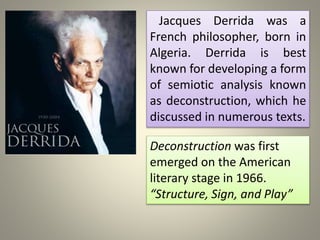
Jacques Derrida was a
French philosopher, born in
Algeria. Derrida is best
known for developing a form
of semiotic analysis known
as deconstruction, which he
discussed in numerous texts.
Deconstruction was first
emerged on the American
literary stage in 1966.
“Structure, Sign, and Play”
• Derrida questioned and
disputed the metaphysical
assumptions held to be true
by Western philosophy.
• His approach to reading and
literary analysis is more
“strategic device” than a
methodology.
• More strategy or approach
to literature than a school or
theory of criticism.
To understand
DECONSTRUCTION:
First, gain a working knowledge of the historical
and philosophical roots of structuralism.
After examining structuralism, we must
investigate the proposed radical changes
Derrida makes in Western philosophy.
Finally, we must master the new terms, coupled
with the new philosophical assumptions.
Ferdinand de
Saussure
• Looked at language
Diachronically.
• He traced words over
time looking for the
changes in sounds and
meanings.
Rules of Language
• These rules of language were developed by
Ferdinand de Saussure.
• Langue - Language is made of a set of rules,
known as this.
• Parole - General rules of language applied by
members of a specific community.
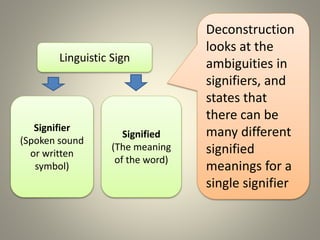
• Signs – He depicted language as a set of signs,
that came in two parts the Signifier and the
Signified
Linguistic Sign
Signifier
(Spoken sound
or written
symbol)
Signified
(The meaning
of the word)
Deconstruction
looks at the
ambiguities in
signifiers, and
states that
there can be
many different
signified
meanings for a
single signifier
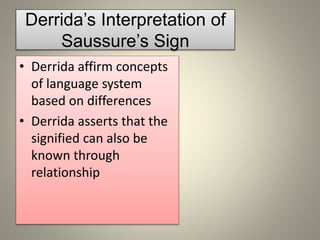
Derrida’s Interpretation of
Saussure’s Sign
• Derrida affirm concepts
of language system
based on differences
• Derrida asserts that the
signified can also be
known through
relationship
I filled the glass of milk
Glass is signifier of the signified concept of a
container to hold the milk
Glass = Signifier
Container = Signified
The container was filled with glass
• Spoken or written “container” was signified in
previous sentence, but now is the signifier
• It’s signified the concept of an object that can
be filled
• Notice the changing use of the word GLASS
Conclusion
Ferdinand de Saussure Jacques Derrida
Signifier
Signified
Signified
Signifier
Transcendental Signified
• An external point of reference upon which one
may build a concept of philosophy.
• It would provide ultimate meaning since it
would be the origin of origin.
• It functions as or provides the center of
meaning.
Logocentrism
• CENTERS: God, reason, origin, being, essence,
truth, humanity, beginning, end, and self…
each can serve as a transcendental signified
• Derrida names logocentrism: the belief that
there is an ultimate reality or center of truth
that can serve as the basis for all our thoughts
and actions.
• We live in a logo centric world – We want to
believe that everything is grounded.
UNCON
SCIOUS
SELF
To “DE-CENTER”
SELF
BINARY OPPOSITION
Binary Oppositions
 The most important part of Deconstruction.
 Two opposing concepts.
 Deconstruction uses Binary Oppositions to
look at what is not in a story.
 Of the two parts of binary oppositions, There
is a dominant and an oppressed or non-
dominant.
 The opposite of Logocentrism.
I want you to think of a TREE.
We like to think a tree as an easily defined
object. But think of defining the word ‘tree’ to
aliens who had very little knowledge of
objects on Earth. How would you describe it?
The words ‘branches’, ‘leaves’, ‘trunk’, and ‘root’
mean nothing to them.
It would be easier to describe something by
saying what it’s not. 
 Roland Barthes(1915-1980) – French Theorist
whom worked on the development of
structuralism and Deconstruction.
 Vladamir Propp(1895-1970) – Russian scholar
that worked on folk tales.
 Jonathan Culler(1944-Today) – Worked at
Cornell University; Worked on Structuralism.
Try to analyze these poems 
Snow
By Frederick Seidel
Snow is what it does.
It falls and it stays and it goes.
It melts and it is here somewhere.
We all will get there.
Source: Poetry (September 2012).
Six Lines for Louise Bogan
By Michael Collier
All that has tamed me I have learned to love
and lost that wildness that was once beloved.
All that was loved I’ve learned to tame
and lost the beloved that once was wild.
All that is wild is tamed by love—
and the beloved (wildness) that once was loved.
Source: Poetry (April 2012).

Deconstruction

  • 1.
    Literary Criticism: Deconstruction VANESSA LOUP. JAGDON University of Mindanao
  • 2.
    Historical Development • ReneDescartes (1596-1650) and Fredrick Nietzsche (1844-1900) were pioneers in deconstruction. • They began to question the objective truth of language. • This is also known as Poststructuralist, this criticism came after structuralism.
  • 3.
    Jacques Derrida wasa French philosopher, born in Algeria. Derrida is best known for developing a form of semiotic analysis known as deconstruction, which he discussed in numerous texts. Deconstruction was first emerged on the American literary stage in 1966. “Structure, Sign, and Play”
  • 4.
    • Derrida questionedand disputed the metaphysical assumptions held to be true by Western philosophy. • His approach to reading and literary analysis is more “strategic device” than a methodology. • More strategy or approach to literature than a school or theory of criticism.
  • 5.
    To understand DECONSTRUCTION: First, gaina working knowledge of the historical and philosophical roots of structuralism. After examining structuralism, we must investigate the proposed radical changes Derrida makes in Western philosophy. Finally, we must master the new terms, coupled with the new philosophical assumptions.
  • 6.
    Ferdinand de Saussure • Lookedat language Diachronically. • He traced words over time looking for the changes in sounds and meanings.
  • 7.
    Rules of Language •These rules of language were developed by Ferdinand de Saussure. • Langue - Language is made of a set of rules, known as this. • Parole - General rules of language applied by members of a specific community. • Signs – He depicted language as a set of signs, that came in two parts the Signifier and the Signified
  • 8.
    Linguistic Sign Signifier (Spoken sound orwritten symbol) Signified (The meaning of the word) Deconstruction looks at the ambiguities in signifiers, and states that there can be many different signified meanings for a single signifier
  • 9.
    Derrida’s Interpretation of Saussure’sSign • Derrida affirm concepts of language system based on differences • Derrida asserts that the signified can also be known through relationship
  • 10.
    I filled theglass of milk Glass is signifier of the signified concept of a container to hold the milk Glass = Signifier Container = Signified
  • 11.
    The container wasfilled with glass • Spoken or written “container” was signified in previous sentence, but now is the signifier • It’s signified the concept of an object that can be filled • Notice the changing use of the word GLASS
  • 12.
    Conclusion Ferdinand de SaussureJacques Derrida Signifier Signified Signified Signifier
  • 13.
    Transcendental Signified • Anexternal point of reference upon which one may build a concept of philosophy. • It would provide ultimate meaning since it would be the origin of origin. • It functions as or provides the center of meaning.
  • 14.
    Logocentrism • CENTERS: God,reason, origin, being, essence, truth, humanity, beginning, end, and self… each can serve as a transcendental signified • Derrida names logocentrism: the belief that there is an ultimate reality or center of truth that can serve as the basis for all our thoughts and actions. • We live in a logo centric world – We want to believe that everything is grounded.
  • 15.
  • 16.
    Binary Oppositions  Themost important part of Deconstruction.  Two opposing concepts.  Deconstruction uses Binary Oppositions to look at what is not in a story.  Of the two parts of binary oppositions, There is a dominant and an oppressed or non- dominant.  The opposite of Logocentrism.
  • 17.
    I want youto think of a TREE. We like to think a tree as an easily defined object. But think of defining the word ‘tree’ to aliens who had very little knowledge of objects on Earth. How would you describe it? The words ‘branches’, ‘leaves’, ‘trunk’, and ‘root’ mean nothing to them. It would be easier to describe something by saying what it’s not. 
  • 18.
     Roland Barthes(1915-1980)– French Theorist whom worked on the development of structuralism and Deconstruction.  Vladamir Propp(1895-1970) – Russian scholar that worked on folk tales.  Jonathan Culler(1944-Today) – Worked at Cornell University; Worked on Structuralism.
  • 19.
    Try to analyzethese poems 
  • 20.
    Snow By Frederick Seidel Snowis what it does. It falls and it stays and it goes. It melts and it is here somewhere. We all will get there. Source: Poetry (September 2012).
  • 21.
    Six Lines forLouise Bogan By Michael Collier All that has tamed me I have learned to love and lost that wildness that was once beloved. All that was loved I’ve learned to tame and lost the beloved that once was wild. All that is wild is tamed by love— and the beloved (wildness) that once was loved. Source: Poetry (April 2012).