HISTORIOGRAPHICAL
METAFICTION:THEPASTIMEOF
PASTTIME.
(IN THE POETICS OF POSTMODERNISM)
LINDA HUTCHEON
PRESENTEDBY
RINKU MARY RAJU
I MA ENGLISH
St. MARY’S COLLEGE
MANARCADU
METAFICTION
 Fiction about fiction.
 A fiction that calls attention to their fictional
status.
 An attempt to make the reader aware of its
fictionality and the presence of the author.
 Self conscious, Self referential quality that
blurs or explores.
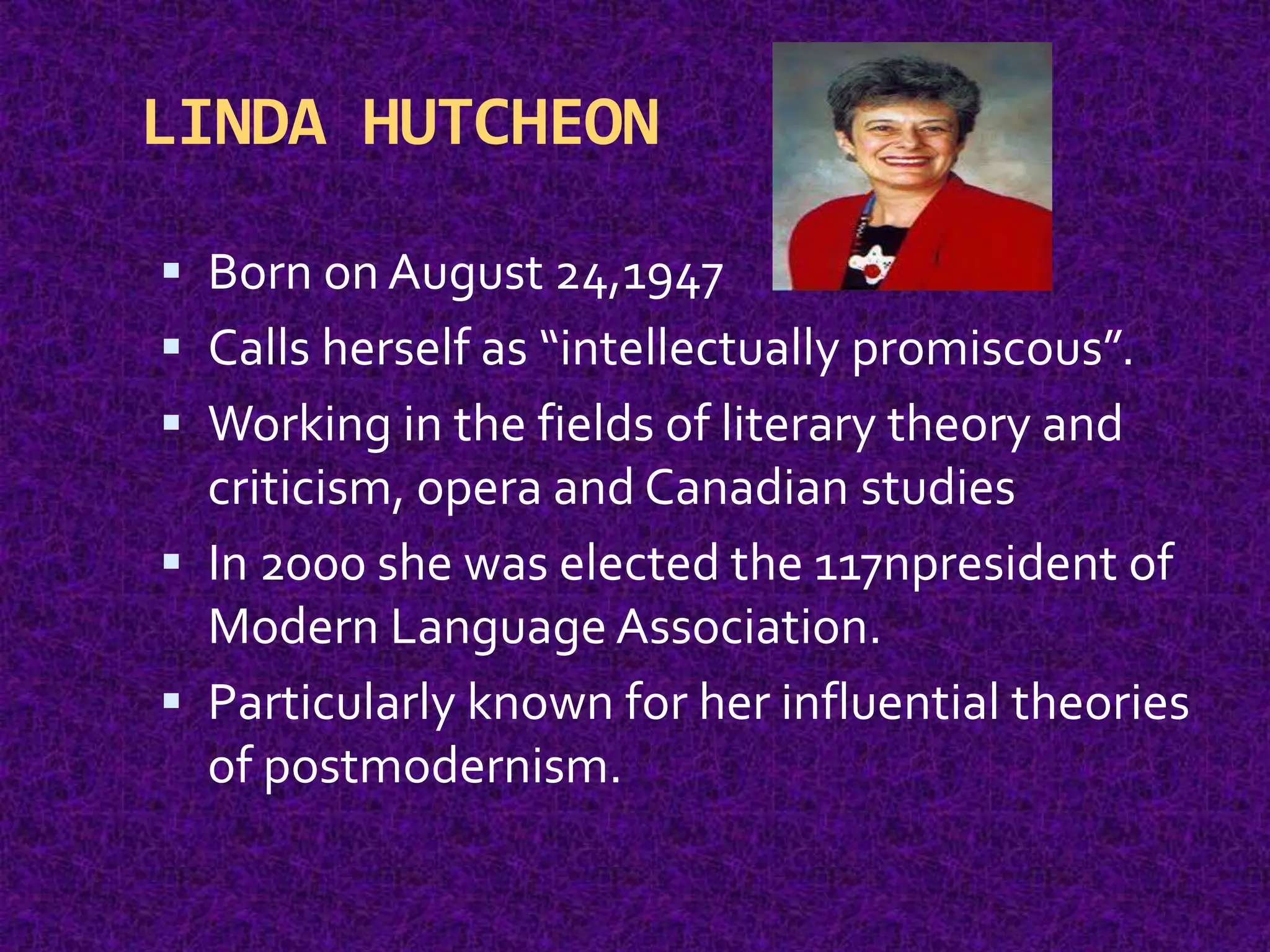
LINDA HUTCHEON
 Born on August 24,1947
 Calls herself as “intellectually promiscous”.
 Working in the fields of literary theory and
criticism, opera and Canadian studies
 In 2000 she was elected the 117npresident of
Modern Language Association.
 Particularly known for her influential theories
of postmodernism.
HISTORIOGRAPHICAL METAFICTION
 The essay discusses :
 The relation/distinction between literature
and history in nineteenth century.
 Ranke’s scientific history –
 Historical truth can be verify.
 Literary facts not real.
 History- object truth.
 Fiction-imaginary facts.
Postmodernism objects the
division of historical and
literary and finds parallels
1. They both derive their force more from
verisimilitude than from any other objective
truth.
2. Both are linguistic construct.
3. They make use of narrative form.
4. Intertextual.
Relation Between Art and
History
 History - focus on the events from the past.
 Poet – focus on what might happen allowing
he/she with more universal truth in an
imaginative manner.
 Postmodern novel confronts the paradox of
fictive /historical representation.
 Writers of fiction and historians can include
and exclude certain events and people.
 Postmodern novel and historical metafiction
advocates for multiplicity of truth(s).
 Supports that truth is relative to specificity of
time and culture.
 Historiographical Metafiction is a kind of
postmodern novel.
 It rejects projecting present believes and
standards on the past and asserts the specificity
and particularity of individual past events.
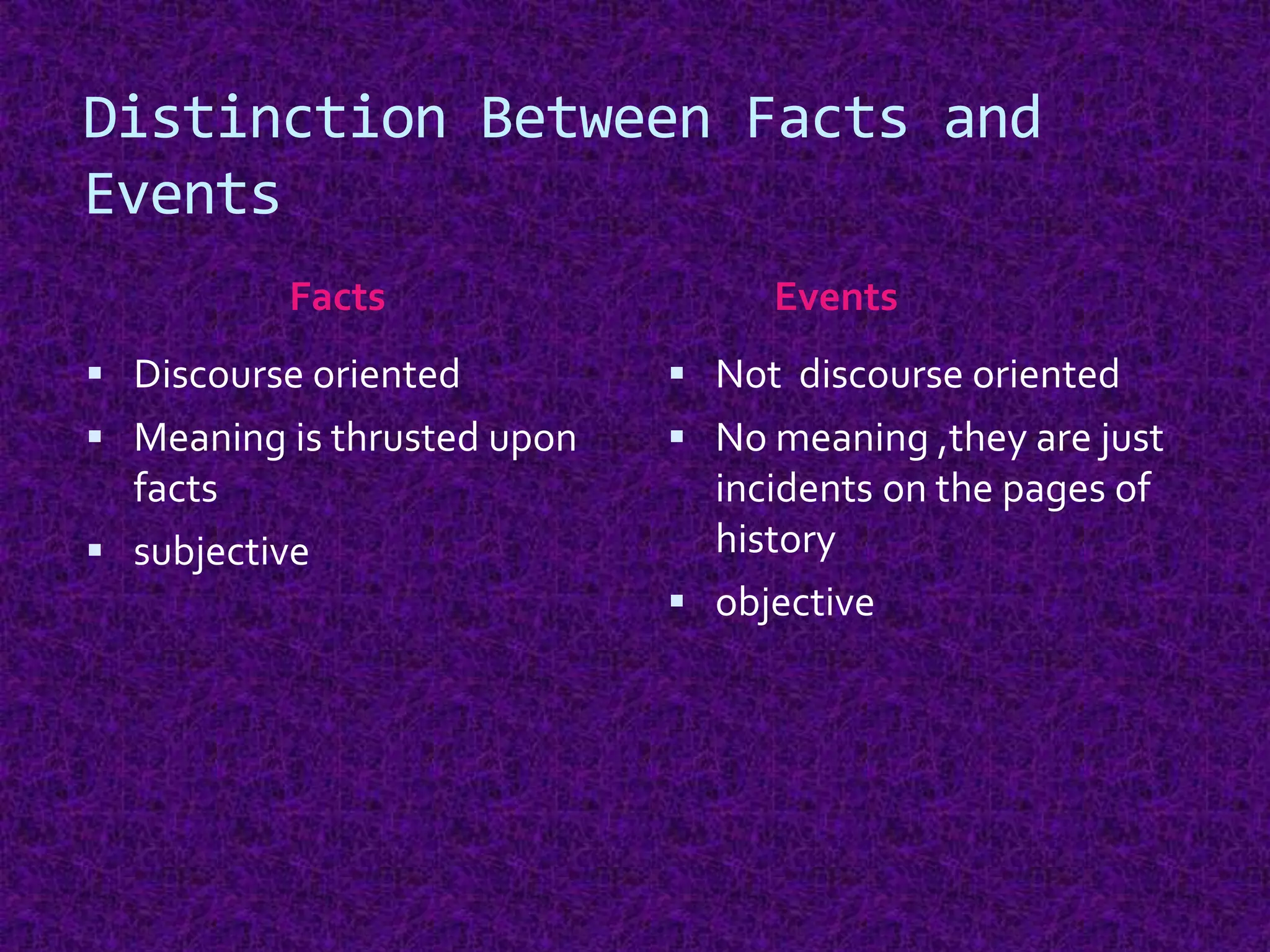
Distinction Between Facts and
Events
Facts Events
 Discourse oriented
 Meaning is thrusted upon
facts
 subjective
 Not discourse oriented
 No meaning ,they are just
incidents on the pages of
history
 objective
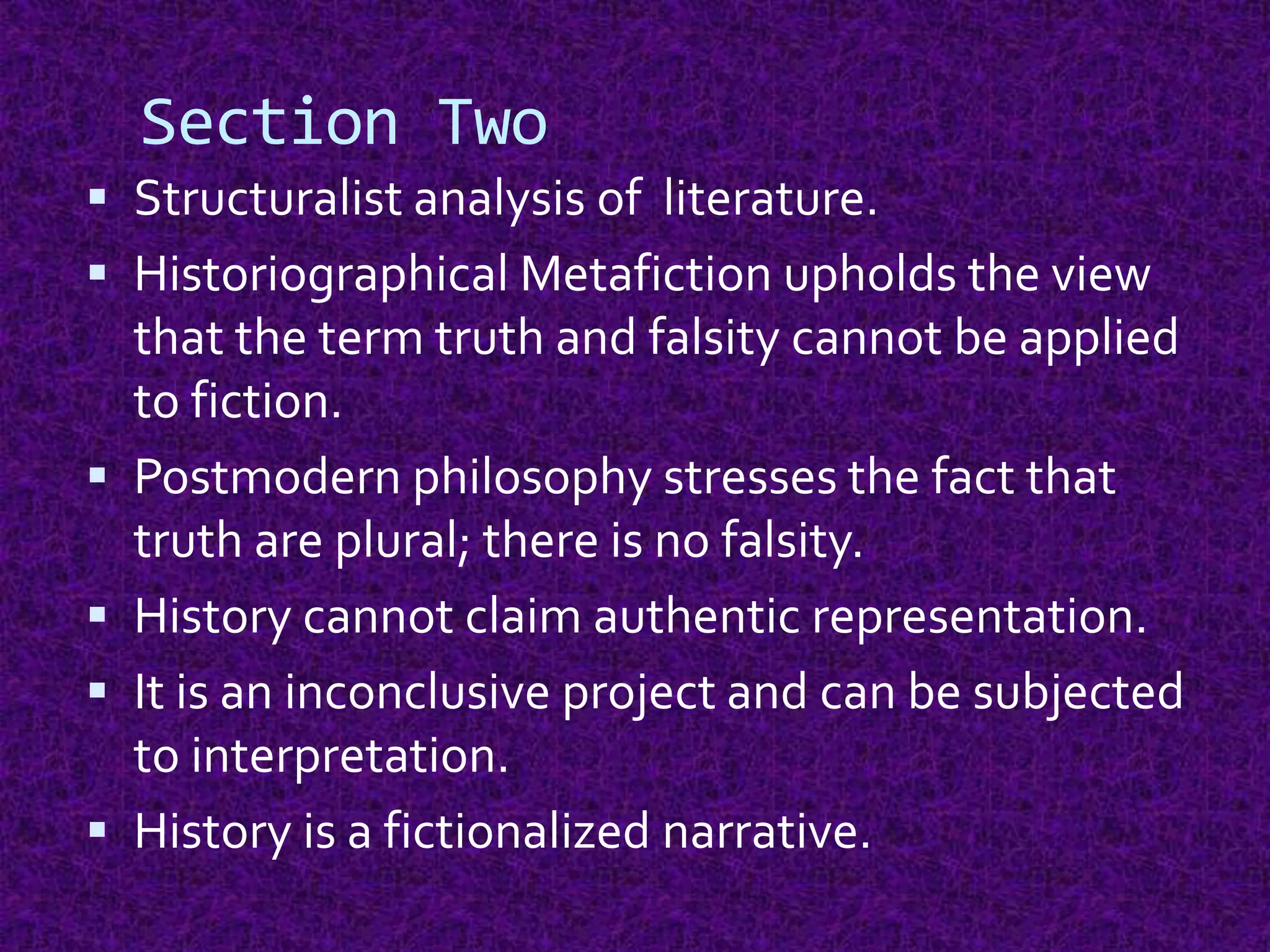
Section Two
 Structuralist analysis of literature.
 Historiographical Metafiction upholds the view
that the term truth and falsity cannot be applied
to fiction.
 Postmodern philosophy stresses the fact that
truth are plural; there is no falsity.
 History cannot claim authentic representation.
 It is an inconclusive project and can be subjected
to interpretation.
 History is a fictionalized narrative.
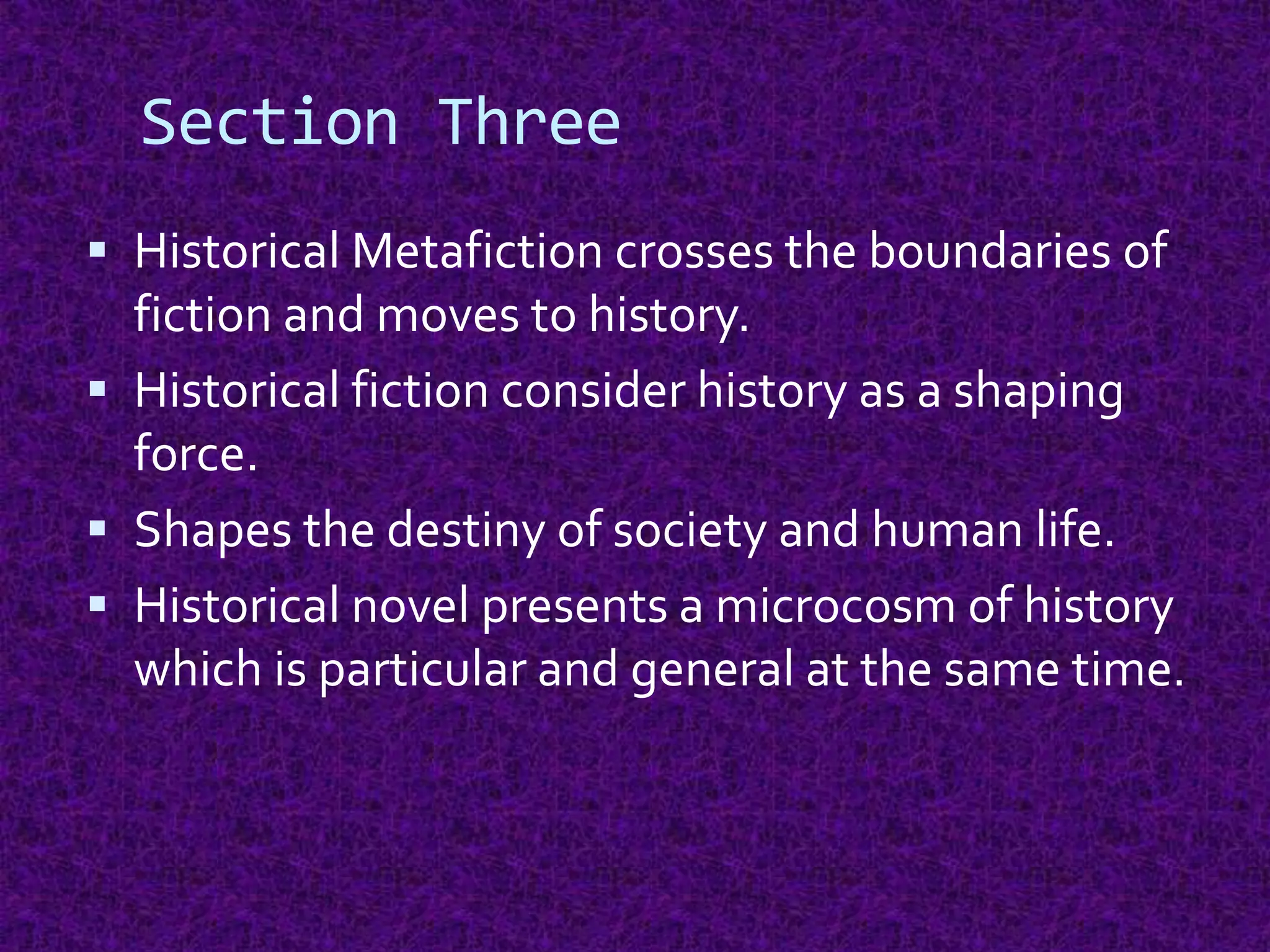
Section Three
 Historical Metafiction crosses the boundaries of
fiction and moves to history.
 Historical fiction consider history as a shaping
force.
 Shapes the destiny of society and human life.
 Historical novel presents a microcosm of history
which is particular and general at the same time.
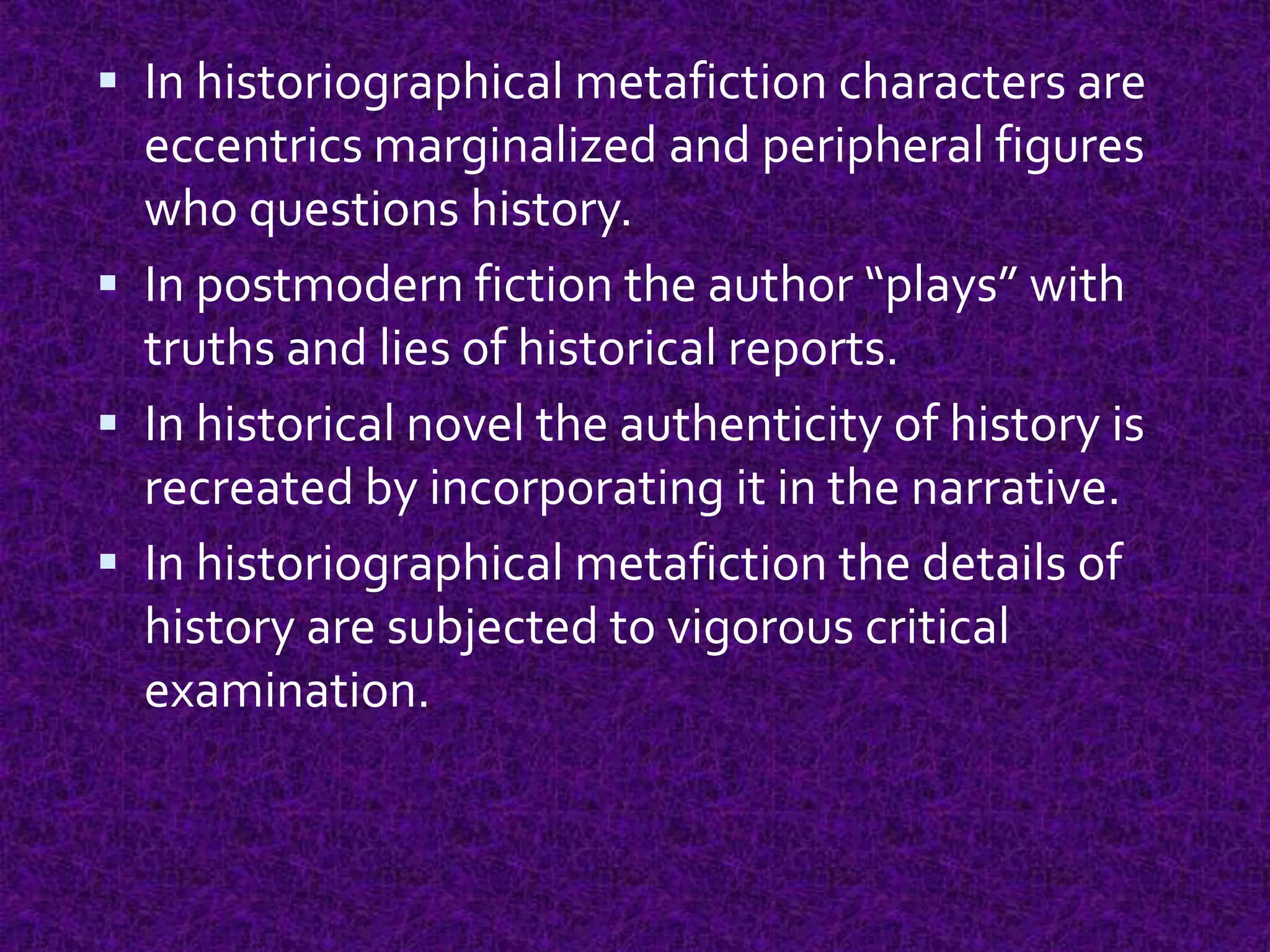
 In historiographical metafiction characters are
eccentrics marginalized and peripheral figures
who questions history.
 In postmodern fiction the author “plays” with
truths and lies of historical reports.
 In historical novel the authenticity of history is
recreated by incorporating it in the narrative.
 In historiographical metafiction the details of
history are subjected to vigorous critical
examination.
 New journalism and non-fictional novels are
considered to be the prototypes of historical
metafiction .
 Historical metafiction utilizes two modes of
narration .
1. Multiple point of view.
2. Openly controlling narrator.
 Historiographical metafiction uses the
postmodern technique of parody by
incorporating the past into the present.
 Questioned history is past and remind history is
present .One cannot escape history.
 Interaction between history and fiction in
postmodernism can be found in areas of
subjectivity,intertexuality,reference and
ideology.
 Postmodernism believes history is the reflection
of those who record it.

Historiographical Metafiction

  • 1.
  • 2.
    PRESENTEDBY RINKU MARY RAJU IMA ENGLISH St. MARY’S COLLEGE MANARCADU
  • 3.
    METAFICTION  Fiction aboutfiction.  A fiction that calls attention to their fictional status.  An attempt to make the reader aware of its fictionality and the presence of the author.  Self conscious, Self referential quality that blurs or explores.
  • 4.
    LINDA HUTCHEON  Bornon August 24,1947  Calls herself as “intellectually promiscous”.  Working in the fields of literary theory and criticism, opera and Canadian studies  In 2000 she was elected the 117npresident of Modern Language Association.  Particularly known for her influential theories of postmodernism.
  • 5.
    HISTORIOGRAPHICAL METAFICTION  Theessay discusses :  The relation/distinction between literature and history in nineteenth century.  Ranke’s scientific history –  Historical truth can be verify.  Literary facts not real.  History- object truth.  Fiction-imaginary facts.
  • 6.
    Postmodernism objects the divisionof historical and literary and finds parallels 1. They both derive their force more from verisimilitude than from any other objective truth. 2. Both are linguistic construct. 3. They make use of narrative form. 4. Intertextual.
  • 7.
    Relation Between Artand History  History - focus on the events from the past.  Poet – focus on what might happen allowing he/she with more universal truth in an imaginative manner.
  • 8.
     Postmodern novelconfronts the paradox of fictive /historical representation.  Writers of fiction and historians can include and exclude certain events and people.  Postmodern novel and historical metafiction advocates for multiplicity of truth(s).  Supports that truth is relative to specificity of time and culture.
  • 9.
     Historiographical Metafictionis a kind of postmodern novel.  It rejects projecting present believes and standards on the past and asserts the specificity and particularity of individual past events.
  • 10.
    Distinction Between Factsand Events Facts Events  Discourse oriented  Meaning is thrusted upon facts  subjective  Not discourse oriented  No meaning ,they are just incidents on the pages of history  objective
  • 11.
    Section Two  Structuralistanalysis of literature.  Historiographical Metafiction upholds the view that the term truth and falsity cannot be applied to fiction.  Postmodern philosophy stresses the fact that truth are plural; there is no falsity.  History cannot claim authentic representation.  It is an inconclusive project and can be subjected to interpretation.  History is a fictionalized narrative.
  • 12.
    Section Three  HistoricalMetafiction crosses the boundaries of fiction and moves to history.  Historical fiction consider history as a shaping force.  Shapes the destiny of society and human life.  Historical novel presents a microcosm of history which is particular and general at the same time.
  • 13.
     In historiographicalmetafiction characters are eccentrics marginalized and peripheral figures who questions history.  In postmodern fiction the author “plays” with truths and lies of historical reports.  In historical novel the authenticity of history is recreated by incorporating it in the narrative.  In historiographical metafiction the details of history are subjected to vigorous critical examination.
  • 14.
     New journalismand non-fictional novels are considered to be the prototypes of historical metafiction .  Historical metafiction utilizes two modes of narration . 1. Multiple point of view. 2. Openly controlling narrator.  Historiographical metafiction uses the postmodern technique of parody by incorporating the past into the present.
  • 15.
     Questioned historyis past and remind history is present .One cannot escape history.  Interaction between history and fiction in postmodernism can be found in areas of subjectivity,intertexuality,reference and ideology.  Postmodernism believes history is the reflection of those who record it.