This is a class presentation given by Megha Ma’am. The topic of this presentation is the Postmodern Age. It is a group presentation by Rozmin Padhan, Kumkum Hirani, Bhavisha Baraiya, Shivani , and Krishna Baraiya.
INTRODUCTION
❑Postmodernism Is OneOf The Most
Controversial Movements In Art And Design
History.
❑ Over Two Decades, From About 1970 To
1990, Postmodernism Shattered Established
Ideas About Art And Design, Bringing A New
Self-awareness About Style Itself.
4.
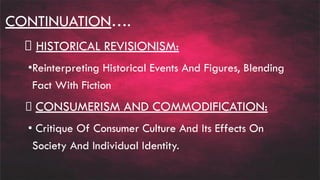
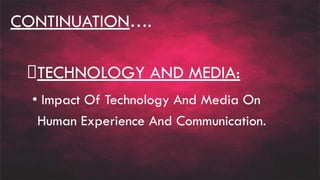
CONTINUATION….
❑The Postmodern Age,Or Postmodernism, Is A Period
And A Way Of Thinking That Emerged In The Late 20th
Century, Around The 1960s, And Continues To Influence
Culture Today.
❑Postmodern Literature Is A Literary Genre That
Emerged After World War II, And Is Characterized
By Its Use Of New Techniques And Forms To
Break Away From Conventional Traditions.
5.
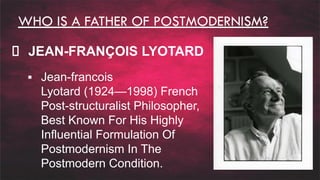
WHO IS AFATHER OF POSTMODERNISM?
JEAN-FRANÇOIS LYOTARD
▪ Jean-francois
Lyotard (1924—1998) French
Post-structuralist Philosopher,
Best Known For His Highly
Influential Formulation Of
Postmodernism In The
Postmodern Condition.
6.
HISTORICAL INFLUENCES
WORLD WARII AND ITS AFTERMATH:
•The Devastation And Human Suffering Caused By World War II Led
To Widespread Disillusionment With Traditional Beliefs In Progress,
Rationality, And Human Perfectibility.
• The Horrors Of The Holocaust And The Atomic Bombings
Emphasized The Destructive Potential Of Modern Science And
Technology.
7.
CONTINUATION….
COLD WAR ERA:
•The Geopolitical Tension Between The United States And The
Soviet Union Created An Atmosphere Of Uncertainty And
Skepticism.
•The Constant Threat Of Nuclear War And Ideological Battles
Between Capitalism And Communism Influenced The Postmodern
Emphasis On Fragmentation And The Questioning Of Grand
Narratives.
8.
CONTINUATION….
CIVIL RIGHTS MOVEMENTSAND SOCIAL CHANGE:
•The Civil Rights Movement In The United States, The End Of
Colonial Rule In Asia And Africa, And Second-wave Feminism
Challenged Established Power Structures And Advocated For The
Rights Of Marginalized Groups.
•These Movements Highlighted The Limitations And Exclusions Of
Modernist Ideologies.
9.
CONTINUATION….
TECHNOLOGICAL ADVANCEMENTS:
• TheRise Of Computers, The Internet, And Digital Technology
Transformed Information Production, Dissemination, And
Consumption.
• The Explosion Of New Media Forms, Such As Television And Later
The Internet, Led To An Increasingly Mediated And Fragmented
Perception Of Reality.
10.
CONTINUATION….
PHILOSOPHICAL AND THEORETICALFOUNDATIONS:
•Structuralist And Poststructuralist Theories Developed By
Intellectuals Like Ferdinand De Saussure, Roland Barthes,
Jacques Derrida, Michel Foucault, And Jean-françois Lyotard
Emphasized The Instability And Multiplicity Of Meaning.
• They Questioned The Idea Of Universal Truths And Highlighted
The Constructed Nature Of Knowledge And Reality.
11.
THEMES IN POSTMODERN
LITERATURE
IDENTITYAND SUBJECTIVITY:
• Exploration Of Fragmented And Fluid Identities,
Challenging Fixed Notions Of Selfhood.
REALITY AND REPRESENTATION:
• Examination Of The Blurred Lines Between Reality And
Fiction, Often Incorporating Self-referential And
Metafictional Elements.
12.
CONTINUATION….
POWER AND LANGUAGE:
•Investigation Of How Language Constructs Reality And
Exerts Power, Critiquing Traditional Notions Of Objective
Truth And Authority.
MULTICULTURALISM AND DIVERSITY:
• Reflection On Cultural Diversity And Global
Interconnectedness, Emphasizing The Diversity Of
Experiences And Perspectives.
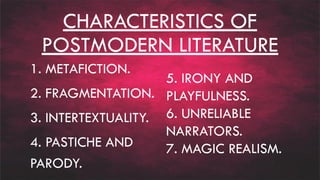
CHARACTERISTICS OF
POSTMODERN LITERATURE
1.METAFICTION.
2. FRAGMENTATION.
3. INTERTEXTUALITY.
4. PASTICHE AND
PARODY.
5. IRONY AND
PLAYFULNESS.
6. UNRELIABLE
NARRATORS.
7. MAGIC REALISM.
16.
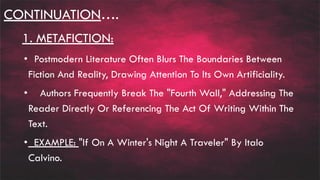
CONTINUATION….
1. METAFICTION:
• PostmodernLiterature Often Blurs The Boundaries Between
Fiction And Reality, Drawing Attention To Its Own Artificiality.
• Authors Frequently Break The "Fourth Wall," Addressing The
Reader Directly Or Referencing The Act Of Writing Within The
Text.
• EXAMPLE: "If On A Winter's Night A Traveler" By Italo
Calvino.
17.
CONTINUATION….
2. FRAGMENTATION:
• PostmodernWorks Often Have Fragmented
Structures, Nonlinear Narratives, And Disjointed
Timelines.
• This Reflects The Complexity And Chaotic Nature Of
Contemporary Life.
• EXAMPLE: "Gravity's Rainbow" By Thomas Pynchon.
18.
CONTINUATION….
3. INTERTEXTUALITY:
•Texts AreRich With References To Other Literary Works,
Historical Events, And Popular Culture.
• This Creates A Layered Reading Experience And
Emphasizes The Interconnectedness Of Texts.
• EXAMPLE: "Wide Sargasso Sea" By Jean Rhys (A Prequel
And Response To Charlotte Brontë's "Jane Eyre").
19.
CONTINUATION….
4. PASTICHE ANDPARODY:
• Postmodern Authors Often Mimic And Parody Various
Genres And Styles, Mixing Them Together.
• This Technique Questions Traditional Literary Forms
And Challenges The Idea Of Originality.
• EXAMPLE: "The Crying Of Lot 49" By Thomas
Pynchon.
20.
CONTINUATION….
5. IRONY ANDPLAYFULNESS:
• A Sense Of Playfulness And Irony Pervades
Postmodern Literature.
• Authors Often Employ Humor, Absurdity, And Satire
To Critique Societal Norms And Literary Conventions.
• EXAMPLE: "Catch-22" By Joseph Heller.
21.
CONTINUATION….
6. UNRELIABLE NARRATORS:
•Postmodern Works Frequently Feature Unreliable
Narrators, Whose Credibility Is Questioned.
• This Challenges Readers To Discern Truth And
Navigate Ambiguous Narratives.
• EXAMPLE: "Life Of Pi" By Yann Martel.
22.
CONTINUATION….
7. MAGIC REALISM:
•Incorporating Elements Of Fantasy And The
Supernatural Into Realistic Settings.
• Blurring The Line Between Reality And Fantasy,
Often To Explore Deeper Truths.
• EXAMPLE: "Midnight's Children" By Salman Rushdie.
23.
KEY FEATURES
❑SELF-REFLEXIVITY:
•The WriterIs Aware Of The Process Of Knowledge Creation,
Including The Collection Of Data And Limitations Of
Methodological Systems
❑ UNRELIABLE NARRATORS:
•The Narrator Might Be Unreliable.
❑ DARK HUMOR:
• The Writing Might Use Dark Humor.
24.
CONTINUATION….
❑ AUTHORIAL SELF-REFERENCE:
•The Writing Might Include Authorial
Self-reference
❑HISTORICAL AND POLITICAL THEMES:
• The Writing Might Explore Historical And
Political Issues
CONTINUATION….
❑PASTICHE AND PARODY:
•Imitation Of Various Genres And Styles To Create A
Patchwork Of Different Elements, Often With A
Humorous Or Critical Edge.
❑FRAGMENTATION:
•Non-linear Narratives, Fragmented Storylines, And
Disjointed Structures Reflecting The Chaotic Nature Of
Contemporary Life.
27.
CONTINUATION….
❑IRONY AND PLAYFULNESS:
•A Tone That Often Includes Irony, Playfulness, And
Black Humor, Challenging Readers To Question The
Text And Its Meanings.
❑QUESTIONING GRAND NARRATIVES:
• Skepticism Towards Overarching, Universal Truths,
Focusing Instead On Individual, Subjective
Experiences.
28.
POSTMODERN AUTHORS AND
WORKS
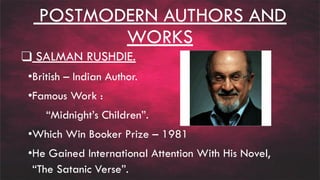
❑SALMAN RUSHDIE.
•British – Indian Author.
•Famous Work :
“Midnight’s Children”.
•Which Win Booker Prize – 1981
•He Gained International Attention With His Novel,
“The Satanic Verse”.
29.
CONTINUATION….
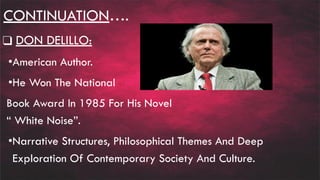
❑ DON DELILLO:
•AmericanAuthor.
•He Won The National
Book Award In 1985 For His Novel
“ White Noise”.
•Narrative Structures, Philosophical Themes And Deep
Exploration Of Contemporary Society And Culture.
30.
CONTINUATION….
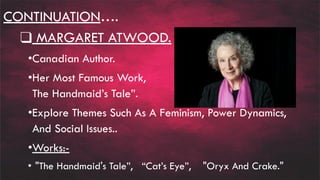
❑ MARGARET ATWOOD.
•CanadianAuthor.
•Her Most Famous Work, “
The Handmaid’s Tale”.
•Explore Themes Such As A Feminism, Power Dynamics,
And Social Issues..
•Works:-
• "The Handmaid's Tale”, “Cat’s Eye”, "Oryx And Crake."
31.
CONTINUATION….
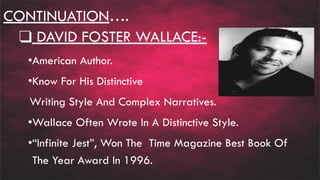
❑ DAVID FOSTERWALLACE:-
•American Author.
•Know For His Distinctive
Writing Style And Complex Narratives.
•Wallace Often Wrote In A Distinctive Style.
•“Infinite Jest”, Won The Time Magazine Best Book Of
The Year Award In 1996.
32.
CONTINUATION….
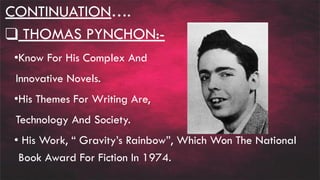
❑ THOMAS PYNCHON:-
•KnowFor His Complex And
Innovative Novels.
•His Themes For Writing Are,
Technology And Society.
• His Work, “ Gravity’s Rainbow”, Which Won The National
Book Award For Fiction In 1974.
33.
CONCLUSION
❑ These EmergingPerspectives Blend Elements Of
Modern And Post-modern Thought.
❑ Focusing On Renewed Sincerity And Meaning
While Continuing To Grapple Whit
Fragmentation And Relativism.