Modern China
Our Goals
 I can explain the causes of China’s rise to a
world power.
Essential Questions
 Historical Thinking
 What are the causes and effects of China’s rise as a
world power?
 SPICE Thematic Connections
 How do the SPICE Elements impact modern China?
 Critical Thinking
 To what extent is China a free society?
Modern China Reform
Planning
The Situation: Mao is old and has lost power.
You job is to work as a committee to decide the
direction of Communist China moving forward.
Your Task: As a group, decide what policies you
will take to turn China into a world economic
power. Make connections to SPICE Elements.
Work in reality, not fiction.
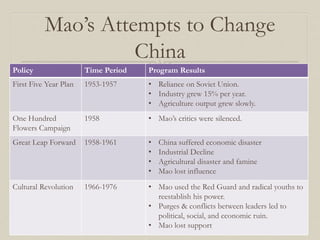
Mao’s Attempts to Change
China
Policy Time Period Program Results
First Five Year Plan 1953-1957 • Reliance on Soviet Union.
• Industry grew 15% per year.
• Agriculture output grew slowly.
One Hundred
Flowers Campaign
1958 • Mao’s critics were silenced.
Great Leap Forward 1958-1961 • China suffered economic disaster
• Industrial Decline
• Agricultural disaster and famine
• Mao lost influence
Cultural Revolution 1966-1976 • Mao used the Red Guard and radical youths to
reestablish his power.
• Purges & conflicts between leaders led to
political, social, and economic ruin.
• Mao lost support
Mao’s Decline
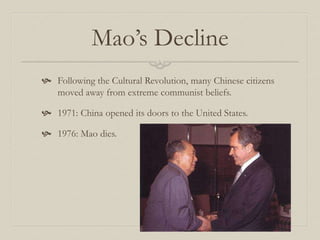
 Following the Cultural Revolution, many Chinese citizens
moved away from extreme communist beliefs.
 1971: China opened its doors to the United States.
 1976: Mao dies.
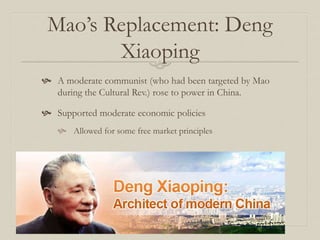
Mao’s Replacement: Deng
Xiaoping
 A moderate communist (who had been targeted by Mao
during the Cultural Rev.) rose to power in China.
 Supported moderate economic policies
 Allowed for some free market principles
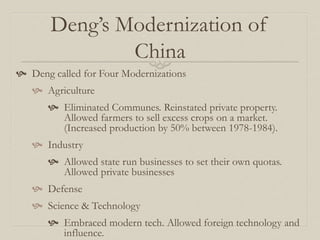
Deng’s Modernization of
China
 Deng called for Four Modernizations
 Agriculture
 Eliminated Communes. Reinstated private property.
Allowed farmers to sell excess crops on a market.
(Increased production by 50% between 1978-1984).
 Industry
 Allowed state run businesses to set their own quotas.
Allowed private businesses
 Defense
 Science & Technology
 Embraced modern tech. Allowed foreign technology and
influence.
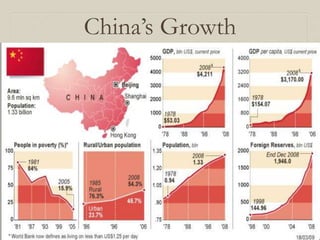
China’s Growth
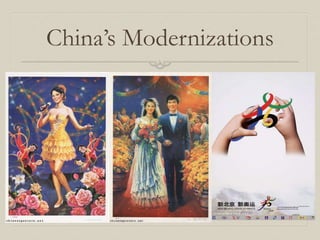
China’s Modernizations
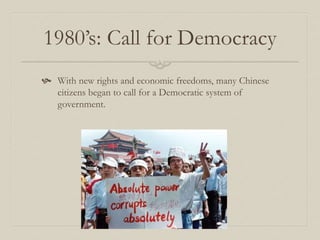
1980’s: Call for Democracy
 With new rights and economic freedoms, many Chinese
citizens began to call for a Democratic system of
government.
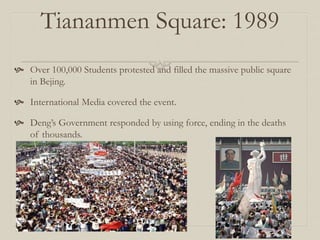
Tiananmen Square: 1989
 Over 100,000 Students protested and filled the massive public square
in Bejing.
 International Media covered the event.
 Deng’s Government responded by using force, ending in the deaths
of thousands.
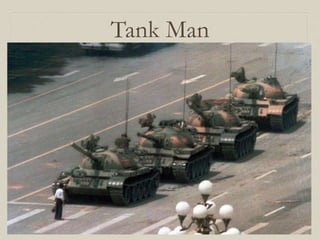
Tank Man
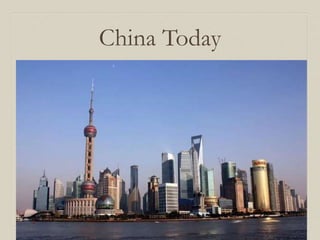
China Today
Modern China Articles
 Read Four Articles
 Record examples of SPICE Themes in
China today.
 Write three level 2 or 3 questions about
Modern China which will guide our
discussions later in this unit.

Modern china

  • 1.
  • 2.
    Our Goals  Ican explain the causes of China’s rise to a world power.
  • 3.
    Essential Questions  HistoricalThinking  What are the causes and effects of China’s rise as a world power?  SPICE Thematic Connections  How do the SPICE Elements impact modern China?  Critical Thinking  To what extent is China a free society?
  • 4.
    Modern China Reform Planning TheSituation: Mao is old and has lost power. You job is to work as a committee to decide the direction of Communist China moving forward. Your Task: As a group, decide what policies you will take to turn China into a world economic power. Make connections to SPICE Elements. Work in reality, not fiction.
  • 5.
    Mao’s Attempts toChange China Policy Time Period Program Results First Five Year Plan 1953-1957 • Reliance on Soviet Union. • Industry grew 15% per year. • Agriculture output grew slowly. One Hundred Flowers Campaign 1958 • Mao’s critics were silenced. Great Leap Forward 1958-1961 • China suffered economic disaster • Industrial Decline • Agricultural disaster and famine • Mao lost influence Cultural Revolution 1966-1976 • Mao used the Red Guard and radical youths to reestablish his power. • Purges & conflicts between leaders led to political, social, and economic ruin. • Mao lost support
  • 6.
    Mao’s Decline  Followingthe Cultural Revolution, many Chinese citizens moved away from extreme communist beliefs.  1971: China opened its doors to the United States.  1976: Mao dies.
  • 7.
    Mao’s Replacement: Deng Xiaoping A moderate communist (who had been targeted by Mao during the Cultural Rev.) rose to power in China.  Supported moderate economic policies  Allowed for some free market principles
  • 8.
    Deng’s Modernization of China Deng called for Four Modernizations  Agriculture  Eliminated Communes. Reinstated private property. Allowed farmers to sell excess crops on a market. (Increased production by 50% between 1978-1984).  Industry  Allowed state run businesses to set their own quotas. Allowed private businesses  Defense  Science & Technology  Embraced modern tech. Allowed foreign technology and influence.
  • 9.
  • 10.
  • 11.
    1980’s: Call forDemocracy  With new rights and economic freedoms, many Chinese citizens began to call for a Democratic system of government.
  • 12.
    Tiananmen Square: 1989 Over 100,000 Students protested and filled the massive public square in Bejing.  International Media covered the event.  Deng’s Government responded by using force, ending in the deaths of thousands.
  • 13.
  • 14.
  • 15.
    Modern China Articles Read Four Articles  Record examples of SPICE Themes in China today.  Write three level 2 or 3 questions about Modern China which will guide our discussions later in this unit.