Stress
I.B. Learning Outcomes
 B7- Using one or more examples, explain
functions of two hormones in human behavior.
 B8: Discuss two effects of the environment on
physiological (biological) processes
 B9: Examine one interaction between
cognition (memory) and physiology (biology).
Stress Questions
To what extent is stress helpful or
hurtful to your life?
What are the differences between
positive and negative stress in
your life?
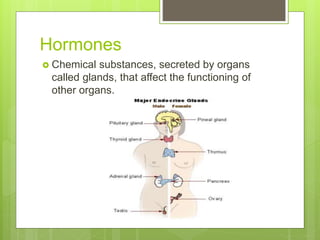
Hormones
 Chemical substances, secreted by organs
called glands, that affect the functioning of
other organs.
Stress: Fight or Flight
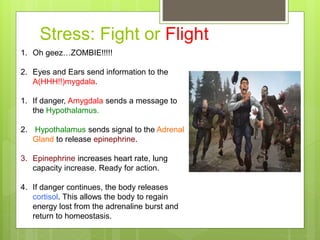
1. Oh geez…ZOMBIE!!!!!
2. Eyes and Ears send information to the
A(HHH!!)mygdala.
1. If danger, Amygdala sends a message to
the Hypothalamus.
2. Hypothalamus sends signal to the Adrenal
Gland to release epinephrine.
3. Epinephrine increases heart rate, lung
capacity increase. Ready for action.
4. If danger continues, the body releases
cortisol. This allows the body to regain
energy lost from the adrenaline burst and
return to homeostasis.
Types of Stress
Good Stress:
Eustress
 Stress that gives you
motivation to
accomplish needed
tasks.
Bad Stress:
Distress
 Stress that leads to
toxic results such as
anxiety.
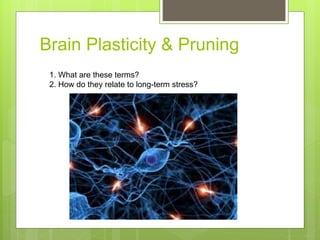
Brain Plasticity & Pruning
1. What are these terms?
2. How do they relate to long-term stress?
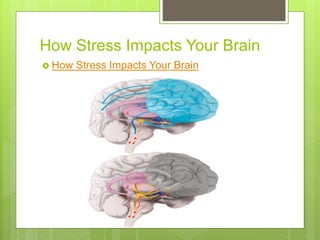
How Stress Impacts Your Brain
 How Stress Impacts Your Brain
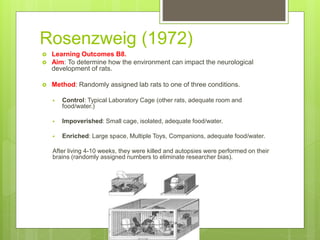
Rosenzweig (1972)
 Learning Outcomes B8.
 Aim: To determine how the environment can impact the neurological
development of rats.
 Method: Randomly assigned lab rats to one of three conditions.
 Control: Typical Laboratory Cage (other rats, adequate room and
food/water.)
 Impoverished: Small cage, isolated, adequate food/water.
 Enriched: Large space, Multiple Toys, Companions, adequate food/water.
After living 4-10 weeks, they were killed and autopsies were performed on their
brains (randomly assigned numbers to eliminate researcher bias).
Rosenzweig (1972) Cont.
 Findings: The enriched rats had…
1.Thicker and heavier cerebral cortexes
2. Larger Neurons
 Conclusion: An enriched environment
produced more developed and bigger brains.
A stressed Environment produced less
developed brains.
 Critical Thinking?
Bremner et al. (2003)
 Learning Outcome: B8, B10, (B5, B7)
 Aim: To investigate whether prolonged stress
(PTSD) reduces the volume of the
hippocampus.
 Method:
 Participants: War veterans and female adults
who were sexually abused as children. (Some
had PTSD, but not all)
 Took MRI scans of brains and had participants
take a memory test.
Bremner et al. (2003) continued
 Finding: Veterans with the most memory
problems had the smallest hippocampus.
 The Hippocampus of PTSD suffers was
smaller than a control group.
 Conclusions: Chronic stress reduces the
volume of the hippocampus and impairs
memory.
 Critical Thinking?
McEwen et al. (2006)
 Learning Outcome: B8: Environment & Physiology
 Aim: To determine the impact of chronic stress on
neural structure
 Method:
 Control: Rats in cages with two other rats.
 Treatment: Rats who were placed in highly stressful
restraints for 6 hour each day for 21 days.
 On the 22nd day, all rats were euthanized and their
brains dissected.
McEwen et al. (2006) Continued
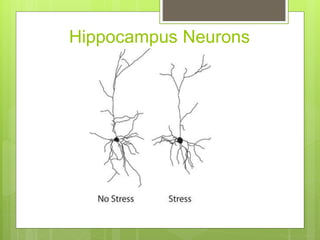
 Findings: The treatment rats had weakened
dendrites in their frontal lobes and hippocampus.
They also had stronger neural connections in their
amygdala.
 Conclusions: Chronic stress brought about by
isolation weakens the frontal lobe and
hippocampus, while strengthening the amygdala.
 Critical Thinking?
Hippocampus Neurons
Cortisol: The Stress Hormone
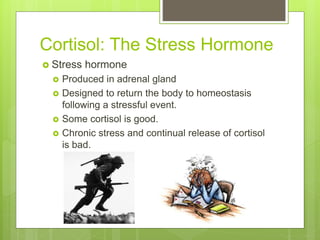
 Stress hormone
 Produced in adrenal gland
 Designed to return the body to homeostasis
following a stressful event.
 Some cortisol is good.
 Chronic stress and continual release of cortisol
is bad.
Newcomer et al (1999)
 Learning Outcome: B7 & B9
 Hormone: Cortisol
 Aim: To determine the role of cortisol on memory.
 Method: Double-Blind study that had asked three
groups to take varying levels of cortisol over a four
day period and tested their ability to remember
verbal information.
1. High Level: Tablet of 160 mg Cortisol each
day…simulates a major stressful event.
2. Low Level: Tablet of 40 mg of Cortisol each
day…Simulated a minor stressful event.
3. Placebo: Tablet with no active ingredient.
Newcomer et al. (1999)
continued
 Findings:
 The High Level group performed worse on the
memory test than the Low Level group.
 The Low Level group showed no memory
decrease when compared with the placebo
group.
 Conclusions: High Levels of cortisol have
a negative impact on a person’s ability to
recall verbal data.
 Critical Thinking?
Suor et al (2015)
 Learning Outcomes B7, B8, B9
 Aim: To investigate how levels of cortisol impact the
cognitive development of children.
 Method
 Performed a longitudinal study on 201 low-income
children in the United States.
 Measured the cortisol levels in children at ages of 2,
3, & 4.
 Watched children interact with parents and measure
family stability and trauma at age 2.
 Measured cognitive ability (language, motor
functioning, & problem solving) at age 4.
Suor et al (2015) Continued
 Findings
 Exposure to violence and Elevated levels of stress
were associated with higher and lower levels of
cortisol.
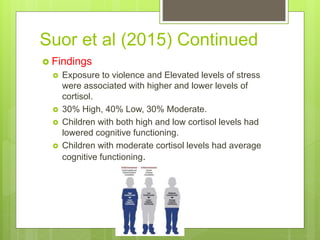
 30% High, 40% Low, 30% Moderate.
 Children with both high and low cortisol levels had
lowered cognitive functioning.
 Children with moderate cortisol levels had average
cognitive functioning.
Suor et al (2015) Conclusions
and Explanation
 Conclusions
 Children with high and low cortisol levels had
delayed cognitive functioning.
 Explanation
 High levels: High levels of cortisol are associated
with decreased strength in areas of the brain such as
the frontal lobe and hippocampus.
 Low Levels: Ongoing stress leads to a state of
hypocortisol (depletion of cortisol). Children lacked
motivation to engage in tasks.
 Critical Thinking?

Stress pp ib psych

  • 1.
  • 2.
    I.B. Learning Outcomes B7- Using one or more examples, explain functions of two hormones in human behavior.  B8: Discuss two effects of the environment on physiological (biological) processes  B9: Examine one interaction between cognition (memory) and physiology (biology).
  • 3.
    Stress Questions To whatextent is stress helpful or hurtful to your life? What are the differences between positive and negative stress in your life?
  • 4.
    Hormones  Chemical substances,secreted by organs called glands, that affect the functioning of other organs.
  • 5.
    Stress: Fight orFlight 1. Oh geez…ZOMBIE!!!!! 2. Eyes and Ears send information to the A(HHH!!)mygdala. 1. If danger, Amygdala sends a message to the Hypothalamus. 2. Hypothalamus sends signal to the Adrenal Gland to release epinephrine. 3. Epinephrine increases heart rate, lung capacity increase. Ready for action. 4. If danger continues, the body releases cortisol. This allows the body to regain energy lost from the adrenaline burst and return to homeostasis.
  • 6.
    Types of Stress GoodStress: Eustress  Stress that gives you motivation to accomplish needed tasks. Bad Stress: Distress  Stress that leads to toxic results such as anxiety.
  • 7.
    Brain Plasticity &Pruning 1. What are these terms? 2. How do they relate to long-term stress?
  • 8.
    How Stress ImpactsYour Brain  How Stress Impacts Your Brain
  • 9.
    Rosenzweig (1972)  LearningOutcomes B8.  Aim: To determine how the environment can impact the neurological development of rats.  Method: Randomly assigned lab rats to one of three conditions.  Control: Typical Laboratory Cage (other rats, adequate room and food/water.)  Impoverished: Small cage, isolated, adequate food/water.  Enriched: Large space, Multiple Toys, Companions, adequate food/water. After living 4-10 weeks, they were killed and autopsies were performed on their brains (randomly assigned numbers to eliminate researcher bias).
  • 10.
    Rosenzweig (1972) Cont. Findings: The enriched rats had… 1.Thicker and heavier cerebral cortexes 2. Larger Neurons  Conclusion: An enriched environment produced more developed and bigger brains. A stressed Environment produced less developed brains.  Critical Thinking?
  • 11.
    Bremner et al.(2003)  Learning Outcome: B8, B10, (B5, B7)  Aim: To investigate whether prolonged stress (PTSD) reduces the volume of the hippocampus.  Method:  Participants: War veterans and female adults who were sexually abused as children. (Some had PTSD, but not all)  Took MRI scans of brains and had participants take a memory test.
  • 12.
    Bremner et al.(2003) continued  Finding: Veterans with the most memory problems had the smallest hippocampus.  The Hippocampus of PTSD suffers was smaller than a control group.  Conclusions: Chronic stress reduces the volume of the hippocampus and impairs memory.  Critical Thinking?
  • 13.
    McEwen et al.(2006)  Learning Outcome: B8: Environment & Physiology  Aim: To determine the impact of chronic stress on neural structure  Method:  Control: Rats in cages with two other rats.  Treatment: Rats who were placed in highly stressful restraints for 6 hour each day for 21 days.  On the 22nd day, all rats were euthanized and their brains dissected.
  • 14.
    McEwen et al.(2006) Continued  Findings: The treatment rats had weakened dendrites in their frontal lobes and hippocampus. They also had stronger neural connections in their amygdala.  Conclusions: Chronic stress brought about by isolation weakens the frontal lobe and hippocampus, while strengthening the amygdala.  Critical Thinking?
  • 15.
  • 16.
    Cortisol: The StressHormone  Stress hormone  Produced in adrenal gland  Designed to return the body to homeostasis following a stressful event.  Some cortisol is good.  Chronic stress and continual release of cortisol is bad.
  • 17.
    Newcomer et al(1999)  Learning Outcome: B7 & B9  Hormone: Cortisol  Aim: To determine the role of cortisol on memory.  Method: Double-Blind study that had asked three groups to take varying levels of cortisol over a four day period and tested their ability to remember verbal information. 1. High Level: Tablet of 160 mg Cortisol each day…simulates a major stressful event. 2. Low Level: Tablet of 40 mg of Cortisol each day…Simulated a minor stressful event. 3. Placebo: Tablet with no active ingredient.
  • 18.
    Newcomer et al.(1999) continued  Findings:  The High Level group performed worse on the memory test than the Low Level group.  The Low Level group showed no memory decrease when compared with the placebo group.  Conclusions: High Levels of cortisol have a negative impact on a person’s ability to recall verbal data.  Critical Thinking?
  • 19.
    Suor et al(2015)  Learning Outcomes B7, B8, B9  Aim: To investigate how levels of cortisol impact the cognitive development of children.  Method  Performed a longitudinal study on 201 low-income children in the United States.  Measured the cortisol levels in children at ages of 2, 3, & 4.  Watched children interact with parents and measure family stability and trauma at age 2.  Measured cognitive ability (language, motor functioning, & problem solving) at age 4.
  • 20.
    Suor et al(2015) Continued  Findings  Exposure to violence and Elevated levels of stress were associated with higher and lower levels of cortisol.  30% High, 40% Low, 30% Moderate.  Children with both high and low cortisol levels had lowered cognitive functioning.  Children with moderate cortisol levels had average cognitive functioning.
  • 21.
    Suor et al(2015) Conclusions and Explanation  Conclusions  Children with high and low cortisol levels had delayed cognitive functioning.  Explanation  High levels: High levels of cortisol are associated with decreased strength in areas of the brain such as the frontal lobe and hippocampus.  Low Levels: Ongoing stress leads to a state of hypocortisol (depletion of cortisol). Children lacked motivation to engage in tasks.  Critical Thinking?