PSYCHOLOGICAL
RESEARCH:
CELL PHONES IN THE
CLASSROOM
OBJECTIVES
• I can use psychology to help me explore and
discuss real world human behavior.
• I can ask questions that can guide my thinking.
• I can locate evidence to answer my questions.
PSYCHOLOGY IS A SCIENCE
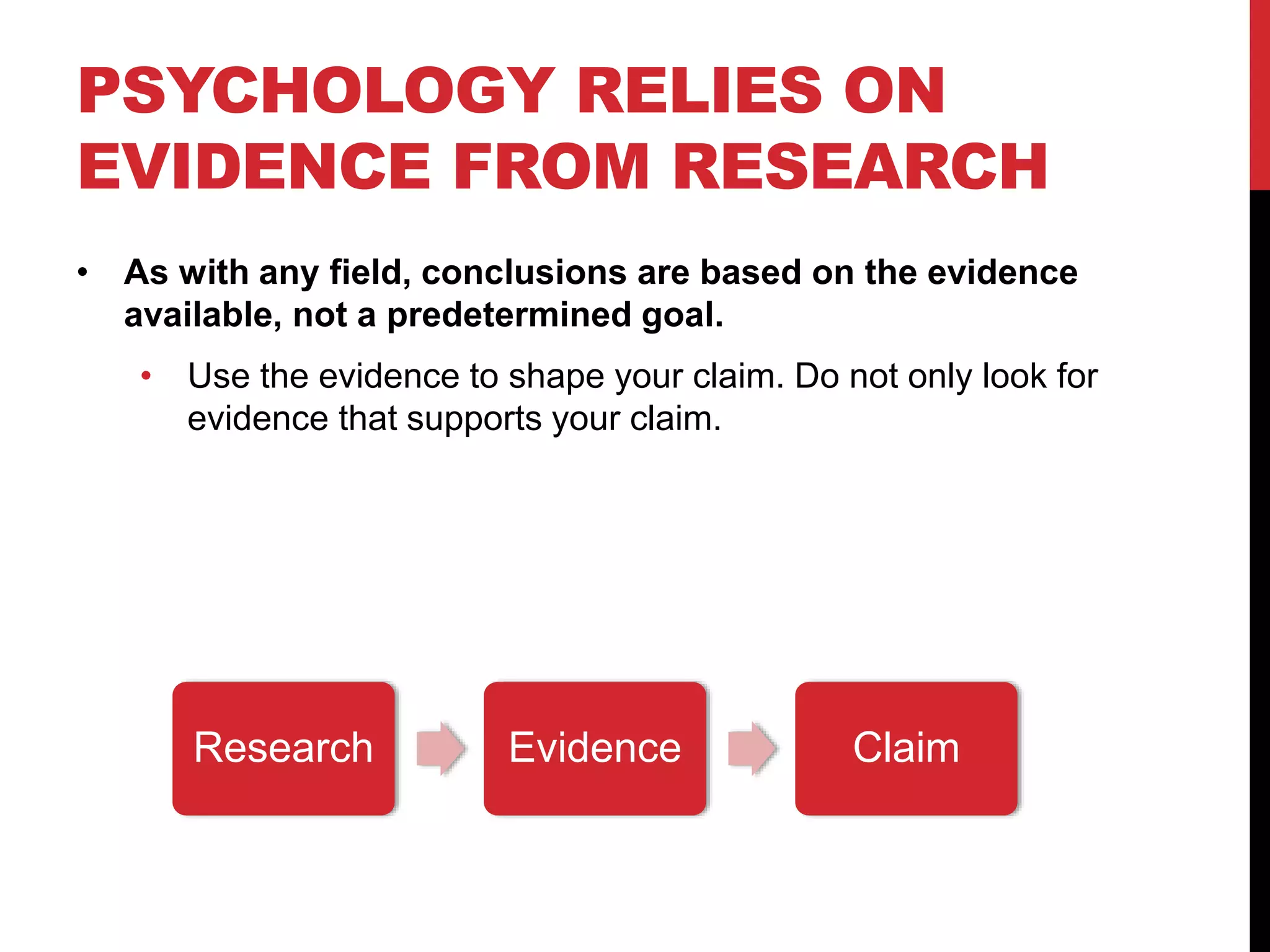
PSYCHOLOGY RELIES ON
EVIDENCE FROM RESEARCH
• As with any field, conclusions are based on the evidence
available, not a predetermined goal.
• Use the evidence to shape your claim. Do not only look for
evidence that supports your claim.
Research Evidence Claim
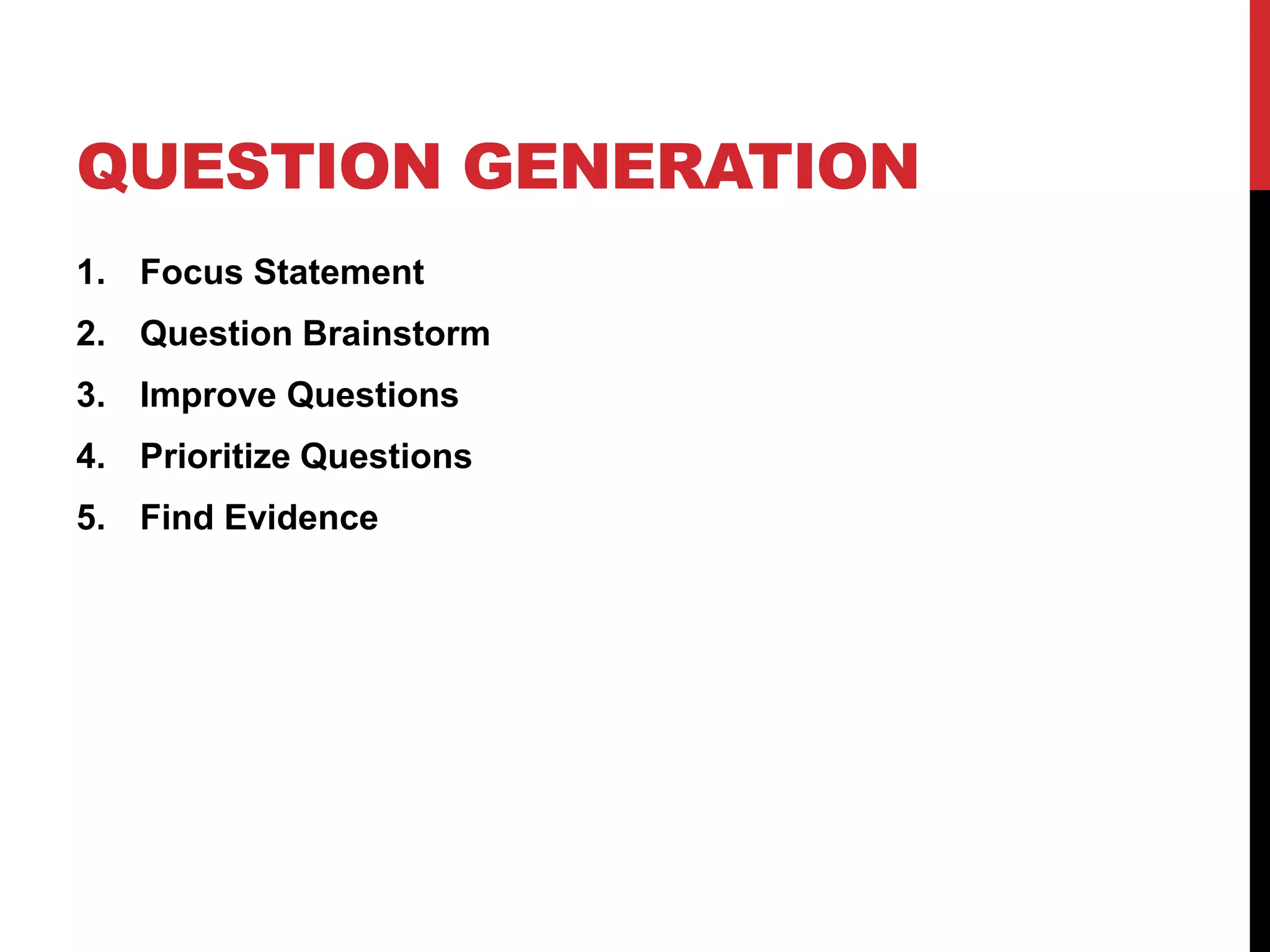
QUESTION GENERATION
1. Focus Statement
2. Question Brainstorm
3. Improve Questions
4. Prioritize Questions
5. Find Evidence
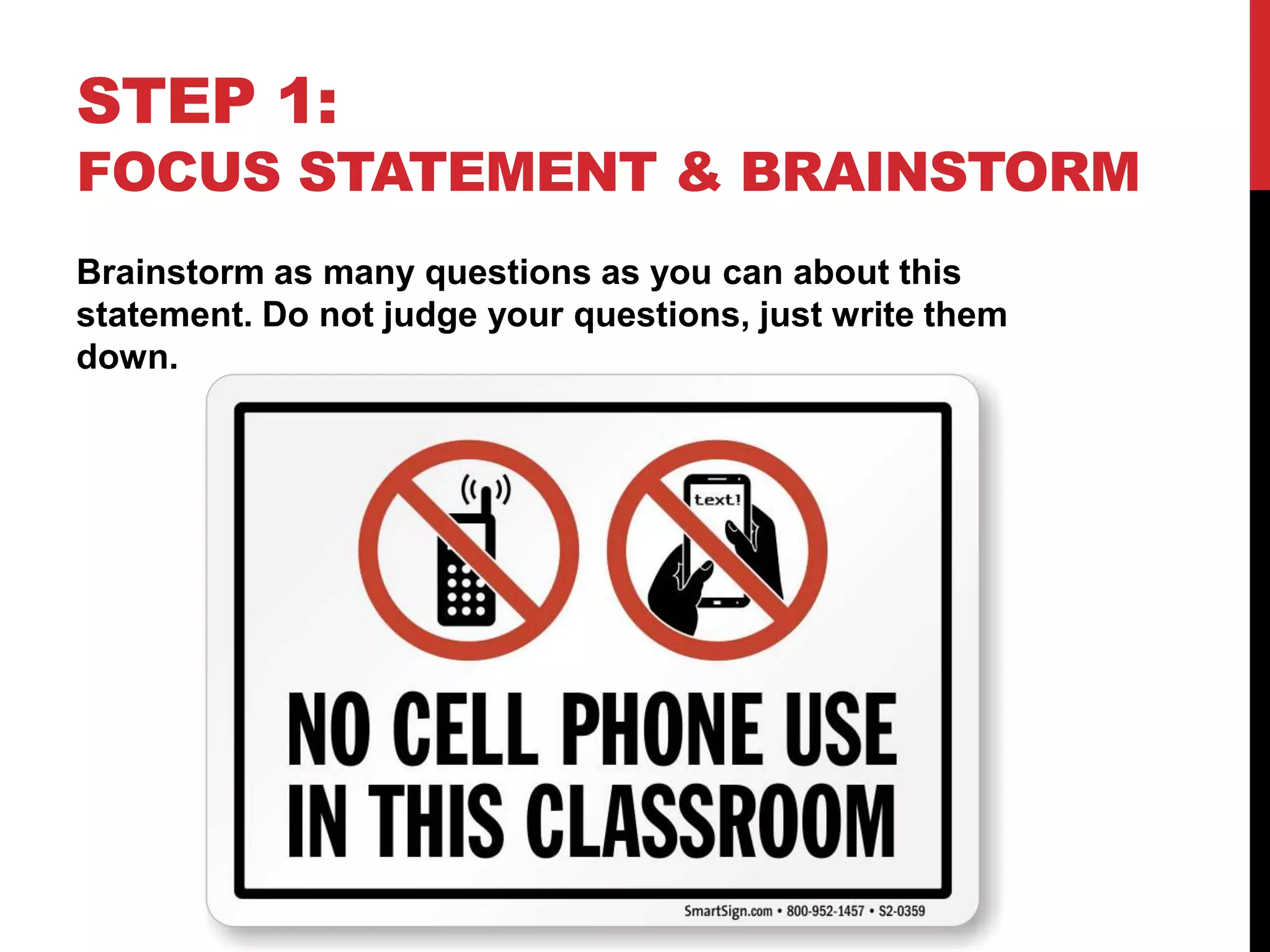
STEP 1:
FOCUS STATEMENT & BRAINSTORM
Brainstorm as many questions as you can about this
statement. Do not judge your questions, just write them
down.
TYPES OF QUESTIONS
CLOSED ENDED
QUESTIONS
• Questions that can be
answered with a single
word or sentence.
• Provides Facts or
definitions.
• Easy to Answer.
• Clear up Confusion.
• What percentage of
schools ban cell
phones?
• What does FOMO
stand for?
OPEN ENDED
QUESTIONS
• Questions that can
only be answered
with multiple
thoughts.
• Provides opinions.
• Requires critical
thinking to answer.
• What type of benefits
do cell phones pose
to learning?
• To what extent is
FOMO impactful to
students today?
STEP 2:
TYPES OF QUESTIONS
Instructions:
1. Mark your question with either a “C” or
“O” depending on the type of question
you asked.
2. Change one “C” question into an “O”
question & one “O” into a “C” question.
Which type is more helpful?
STEP 3:
PRIORITIZING YOUR QUESTIONS
1. Pick your top three most important questions. Rank them
1-3.
2. Why did you select these questions as being most
important?
3. How can these questions guide your research?
KEY TERMS
Control: A part of an experiment where there is no change
from normal conditions. The control is essential to scientific
experiments. It shows that any new effect is likely due only to
the part of the test that a researcher has altered. For
example, if scientists were testing different types of fertilizer
in a garden, they would want one section of it to remain
unfertilized, as the control. Its area would show how plants in
this garden grow under normal conditions. And that give
scientists something against which they can compare their
experimental data.
YOUR READING TASK
• Essential Question: Based on evidence from psychology,
should cell phone use be allowed in the classroom?
• Read the articles, beginning with Article #1.
• As you read, use your slips to record down the three pieces
of evidence that you think are most helpful in answering this
question.
• Share your evidence with your group.
• Sort your evidence slips into Topics or Common Themes.
Pay attention to duplicate evidence.
CREATING AN
ARGUMENTATIVE THESIS
• An argument is a claim backed by reasons that are supported
by evidence.
• Thesis: A statement that communicates your claim and
reasons.
• Claim: Your answer to a question.
• Reasons: Summaries of why you answer the question the
way you do.
• Evidence: Concrete support for your reasons.
Sample Argumentative Thesis
• Schools should have four day school weeks because it will
promote a balance lifestyle to students and allow for more
focus in the classroom.
ARGUMENT OUTLINE
1. Thesis
2. Reason #1 w/ 2 Evidence Slips
3. Reason #2 with 2 Evidence Slips
4. Counterclaim #3 with 2 Evidence Slips.
ARGUMENTATIVE EVIDENCE TYPES
Whenever we try to convince someone of
an idea, we use a variety of strategies to
accomplish this goal.
Ethos: Credibility Evidence
Pathos: Emotional Evidence
Logos: Logical Evidence
ETHOS
Evidence which shows to the audience that you are a
knowledgeable and trusty source of information. It
demonstrates that you as a presenter can be trusted.
• Introducing evidence from credible and reliable sources.
• Explaining your credibility.
• Correctly identifying and addressing the counterclaim.
In July 2017, Dr. Ann McKee, a neuroscientist Boston
University, released a report which showed that of 111
brains of former NFL players which were donated to her
research, 110 showed symptoms of the degenerative brain
condition known as CTE.
ETHOS
Strengths Limitations
• Adds credibility to your argument.
• Brings in the voices of others.
• Shows that you are willing to
consider multiple ideas.
• May use scientific data and
findings.
• Allows for a variety of types of
arguments to be made.
• Using evidence out of context.
• Relying on unreliable sources.
• Not all evidence is reliable.
PATHOS
Emotional Evidence: appeals to an audience's needs, values,
and emotional sensibilities.
• Telling a touching story
• Listening to an interview
• Linking to fear (should be avoided…not cool).
• “Emily Kelly, wife of former NFL player Rob Kelly, claims that
CTE has destroyed the mind of her husband. In the years
since their marriage, he has transformed from a loving and
attentive father and husband into a shadow of himself who
struggles to perform basic tasks like feeding himself. She
blames possible brain damage from his days playing football.
At the age of only 43, he has a brain that compares in
functionality to that of a person experiencing Alzheimer's.”
PATHOS
Strengths Limitations
• Builds a sense of empathy for
your argument.
• Grabs the attention of your
audience.
• Allows personal connections.
• Drives people to action.
• Fear and negative emotions can
be overemphasized.
• Simple reliance on it leads to lack
of “hard evidence.”
• Anecdotes do not always
represent the truth.
LOGOS
Logos or the appeal to reason relies on logic or reason to
make an argument.
“Linemen make up the largest share, by far, of those tested by Dr.
McKee, partly because nearly half of the 22 players on the field are
offensive and defensive linemen.
But that may not be the entire reason.
Linemen knock heads on most plays, and those who study brain trauma
say the accumulation of seemingly benign, non-violent blows — rather
than head-jarring concussions alone — probably causes C.T.E.
Data compiled by researchers at Stanford showed that one college
offensive lineman sustained 62 of these hits in a single game. Each one
came with an average force on the player’s head equivalent to what you
would see if he had driven his car into a brick wall at 30 m.p.h.”
LOGOS
Strengths Limitations
• Relies on “hard evidence” such
as facts and statistics.
• Allows for connections to be
made between two objects.
• Uses history as an example.
• Shows critical thinking and
creativity.
• Helps build ethos.
• Logical Fallacy: Not all situations
are the same.
• Can rely on Generalizations of
ideas or evidence.
EVIDENCE ANALYSIS
• Label your evidence as either being Ethos, Pathos,
or Logos. Remember, some evidence can be more
than one type.
• What type of evidence does your argument rely on?
What are the strengths and limits of this?
• What evidence was most convincing to you? Why?
• What type of evidence would you like to add to make
a more convincing argument?

Intro to psychological research cell phones

  • 1.
  • 2.
    OBJECTIVES • I canuse psychology to help me explore and discuss real world human behavior. • I can ask questions that can guide my thinking. • I can locate evidence to answer my questions.
  • 3.
  • 4.
    PSYCHOLOGY RELIES ON EVIDENCEFROM RESEARCH • As with any field, conclusions are based on the evidence available, not a predetermined goal. • Use the evidence to shape your claim. Do not only look for evidence that supports your claim. Research Evidence Claim
  • 5.
    QUESTION GENERATION 1. FocusStatement 2. Question Brainstorm 3. Improve Questions 4. Prioritize Questions 5. Find Evidence
  • 6.
    STEP 1: FOCUS STATEMENT& BRAINSTORM Brainstorm as many questions as you can about this statement. Do not judge your questions, just write them down.
  • 7.
    TYPES OF QUESTIONS CLOSEDENDED QUESTIONS • Questions that can be answered with a single word or sentence. • Provides Facts or definitions. • Easy to Answer. • Clear up Confusion. • What percentage of schools ban cell phones? • What does FOMO stand for? OPEN ENDED QUESTIONS • Questions that can only be answered with multiple thoughts. • Provides opinions. • Requires critical thinking to answer. • What type of benefits do cell phones pose to learning? • To what extent is FOMO impactful to students today?
  • 8.
    STEP 2: TYPES OFQUESTIONS Instructions: 1. Mark your question with either a “C” or “O” depending on the type of question you asked. 2. Change one “C” question into an “O” question & one “O” into a “C” question. Which type is more helpful?
  • 9.
    STEP 3: PRIORITIZING YOURQUESTIONS 1. Pick your top three most important questions. Rank them 1-3. 2. Why did you select these questions as being most important? 3. How can these questions guide your research?
  • 10.
    KEY TERMS Control: Apart of an experiment where there is no change from normal conditions. The control is essential to scientific experiments. It shows that any new effect is likely due only to the part of the test that a researcher has altered. For example, if scientists were testing different types of fertilizer in a garden, they would want one section of it to remain unfertilized, as the control. Its area would show how plants in this garden grow under normal conditions. And that give scientists something against which they can compare their experimental data.
  • 11.
    YOUR READING TASK •Essential Question: Based on evidence from psychology, should cell phone use be allowed in the classroom? • Read the articles, beginning with Article #1. • As you read, use your slips to record down the three pieces of evidence that you think are most helpful in answering this question. • Share your evidence with your group. • Sort your evidence slips into Topics or Common Themes. Pay attention to duplicate evidence.
  • 12.
    CREATING AN ARGUMENTATIVE THESIS •An argument is a claim backed by reasons that are supported by evidence. • Thesis: A statement that communicates your claim and reasons. • Claim: Your answer to a question. • Reasons: Summaries of why you answer the question the way you do. • Evidence: Concrete support for your reasons. Sample Argumentative Thesis • Schools should have four day school weeks because it will promote a balance lifestyle to students and allow for more focus in the classroom.
  • 13.
    ARGUMENT OUTLINE 1. Thesis 2.Reason #1 w/ 2 Evidence Slips 3. Reason #2 with 2 Evidence Slips 4. Counterclaim #3 with 2 Evidence Slips.
  • 14.
    ARGUMENTATIVE EVIDENCE TYPES Wheneverwe try to convince someone of an idea, we use a variety of strategies to accomplish this goal. Ethos: Credibility Evidence Pathos: Emotional Evidence Logos: Logical Evidence
  • 15.
    ETHOS Evidence which showsto the audience that you are a knowledgeable and trusty source of information. It demonstrates that you as a presenter can be trusted. • Introducing evidence from credible and reliable sources. • Explaining your credibility. • Correctly identifying and addressing the counterclaim. In July 2017, Dr. Ann McKee, a neuroscientist Boston University, released a report which showed that of 111 brains of former NFL players which were donated to her research, 110 showed symptoms of the degenerative brain condition known as CTE.
  • 16.
    ETHOS Strengths Limitations • Addscredibility to your argument. • Brings in the voices of others. • Shows that you are willing to consider multiple ideas. • May use scientific data and findings. • Allows for a variety of types of arguments to be made. • Using evidence out of context. • Relying on unreliable sources. • Not all evidence is reliable.
  • 17.
    PATHOS Emotional Evidence: appealsto an audience's needs, values, and emotional sensibilities. • Telling a touching story • Listening to an interview • Linking to fear (should be avoided…not cool). • “Emily Kelly, wife of former NFL player Rob Kelly, claims that CTE has destroyed the mind of her husband. In the years since their marriage, he has transformed from a loving and attentive father and husband into a shadow of himself who struggles to perform basic tasks like feeding himself. She blames possible brain damage from his days playing football. At the age of only 43, he has a brain that compares in functionality to that of a person experiencing Alzheimer's.”
  • 18.
    PATHOS Strengths Limitations • Buildsa sense of empathy for your argument. • Grabs the attention of your audience. • Allows personal connections. • Drives people to action. • Fear and negative emotions can be overemphasized. • Simple reliance on it leads to lack of “hard evidence.” • Anecdotes do not always represent the truth.
  • 19.
    LOGOS Logos or theappeal to reason relies on logic or reason to make an argument. “Linemen make up the largest share, by far, of those tested by Dr. McKee, partly because nearly half of the 22 players on the field are offensive and defensive linemen. But that may not be the entire reason. Linemen knock heads on most plays, and those who study brain trauma say the accumulation of seemingly benign, non-violent blows — rather than head-jarring concussions alone — probably causes C.T.E. Data compiled by researchers at Stanford showed that one college offensive lineman sustained 62 of these hits in a single game. Each one came with an average force on the player’s head equivalent to what you would see if he had driven his car into a brick wall at 30 m.p.h.”
  • 20.
    LOGOS Strengths Limitations • Relieson “hard evidence” such as facts and statistics. • Allows for connections to be made between two objects. • Uses history as an example. • Shows critical thinking and creativity. • Helps build ethos. • Logical Fallacy: Not all situations are the same. • Can rely on Generalizations of ideas or evidence.
  • 21.
    EVIDENCE ANALYSIS • Labelyour evidence as either being Ethos, Pathos, or Logos. Remember, some evidence can be more than one type. • What type of evidence does your argument rely on? What are the strengths and limits of this? • What evidence was most convincing to you? Why? • What type of evidence would you like to add to make a more convincing argument?