LEARNING
AN INTRODUCTION TO CLASSICAL AND
OPERANT CONDITIONING
OBJECTIVE
• I can explain how learning occurs.
• I can explain how learning has impacted
my behavior.
• Essential Question: How does learning
occur and shape my behavior?
TODAY’S LEARNING
INTENTIONS
• We are learning about different theories about how
humans learn to behave.
• We should be able to use key terms about learning to help
explain a change in a person or animal’s behavior.
• This is because we want to be able to explain how our
environment impacts our behavior.
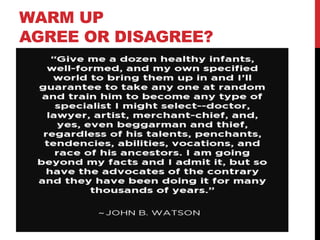
WARM UP
AGREE OR DISAGREE?
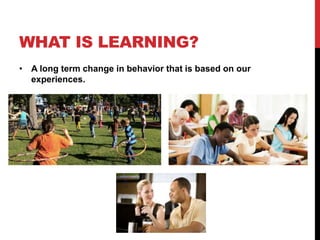
WHAT IS LEARNING?
• A long term change in behavior that is based on our
experiences.
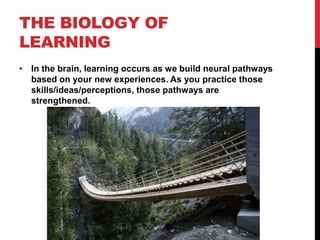
THE BIOLOGY OF
LEARNING
• In the brain, learning occurs as we build neural pathways
based on your new experiences. As you practice those
skills/ideas/perceptions, those pathways are
strengthened.
BONICA’S DOGS
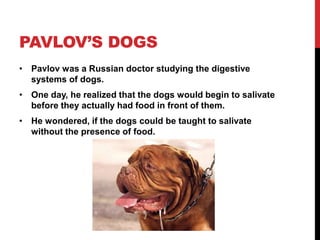
PAVLOV’S DOGS
• Pavlov was a Russian doctor studying the digestive
systems of dogs.
• One day, he realized that the dogs would begin to salivate
before they actually had food in front of them.
• He wondered, if the dogs could be taught to salivate
without the presence of food.
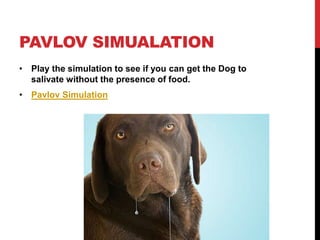
PAVLOV SIMUALATION
• Play the simulation to see if you can get the Dog to
salivate without the presence of food.
• Pavlov Simulation
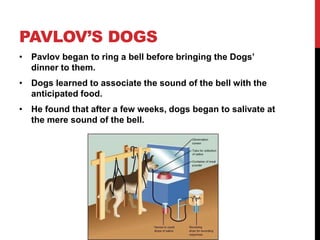
PAVLOV’S DOGS
• Pavlov began to ring a bell before bringing the Dogs’
dinner to them.
• Dogs learned to associate the sound of the bell with the
anticipated food.
• He found that after a few weeks, dogs began to salivate at
the mere sound of the bell.
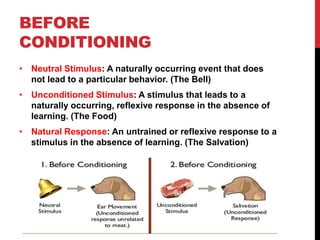
BEFORE
CONDITIONING
• Neutral Stimulus: A naturally occurring event that does
not lead to a particular behavior. (The Bell)
• Unconditioned Stimulus: A stimulus that leads to a
naturally occurring, reflexive response in the absence of
learning. (The Food)
• Natural Response: An untrained or reflexive response to a
stimulus in the absence of learning. (The Salvation)
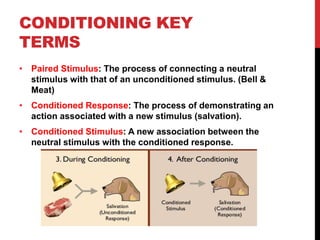
CONDITIONING KEY
TERMS
• Paired Stimulus: The process of connecting a neutral
stimulus with that of an unconditioned stimulus. (Bell &
Meat)
• Conditioned Response: The process of demonstrating an
action associated with a new stimulus (salvation).
• Conditioned Stimulus: A new association between the
neutral stimulus with the conditioned response.
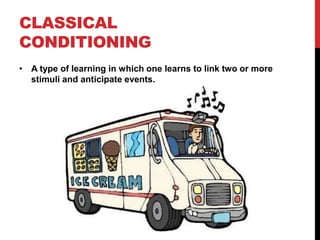
CLASSICAL
CONDITIONING
• A type of learning in which one learns to link two or more
stimuli and anticipate events.
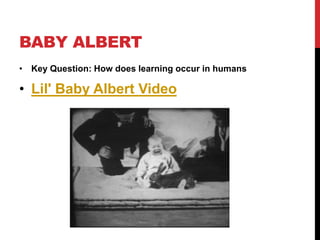
BABY ALBERT
• Key Question: How does learning occur in humans
• Lil' Baby Albert Video
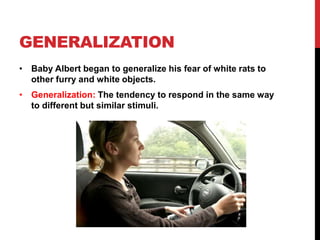
GENERALIZATION
• Baby Albert began to generalize his fear of white rats to
other furry and white objects.
• Generalization: The tendency to respond in the same way
to different but similar stimuli.
COMPLETING NOTES
• Work for the next three minutes to complete your notes
by…
• Checking with a neighbor to fill any pieces of information
that you may have missed.
• Write study questions in the side box.
• Highlight any key terms.
• Circle key ideas.
• Write questionmarks next to any areas that you still don’t
understand.
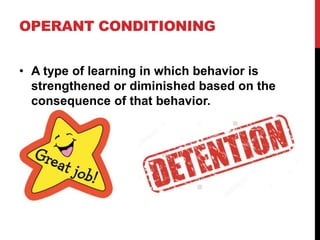
OPERANT CONDITIONING
• A type of learning in which behavior is
strengthened or diminished based on the
consequence of that behavior.
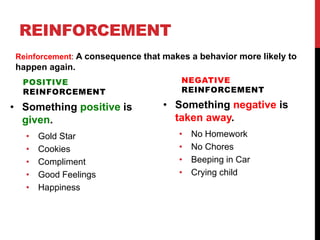
REINFORCEMENT
POSITIVE
REINFORCEMENT
• Something positive is
given.
• Gold Star
• Cookies
• Compliment
• Good Feelings
• Happiness
NEGATIVE
REINFORCEMENT
• Something negative is
taken away.
• No Homework
• No Chores
• Beeping in Car
• Crying child
Reinforcement: A consequence that makes a behavior more likely to
happen again.
WHEN REINFORCEMENT
WORKS
• Reinforcements work when they are…
• Immediate
• Continually reinforced
• Are intrinsically motivating
• Reinforcements can cause problems when they…
• Rely too heavily on extrinsic rewards.
• Are inconsistent
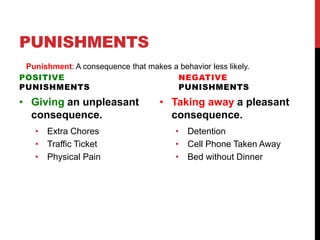
PUNISHMENTS
POSITIVE
PUNISHMENTS
• Giving an unpleasant
consequence.
• Extra Chores
• Traffic Ticket
• Physical Pain
NEGATIVE
PUNISHMENTS
• Taking away a pleasant
consequence.
• Detention
• Cell Phone Taken Away
• Bed without Dinner
Punishment: A consequence that makes a behavior less likely.
THE PROS & CONS OF
PUNISHMENT
• Punishments are most effective when they are…
• Appropriate and thoughtful
• Consistently enforced
• Enforced immediately following the behavior
• Helpful in teaching what to do.
• Not sources of additional wanted attention
• Punishment does not work when they are...
• Mindless or inappropriate
• Sources of anxiety, pain, rage, or fear
• Inconsistenly enforced
• Delayed
• Dependent on the presense of the enforcer
• Unclear or do not teach a lesson
• Sources of additional attention.
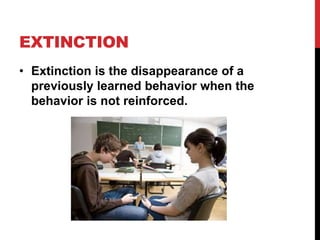
EXTINCTION
• Extinction is the disappearance of a
previously learned behavior when the
behavior is not reinforced.
COMPLETING NOTES
• Work for the next three minutes to complete your notes
by…
• Checking with a neighbor to fill any pieces of information
that you may have missed.
• Write study questions in the side box.
• Highlight any key terms.
• Circle key ideas.
• Write questionmarks next to any areas that you still don’t
understand.
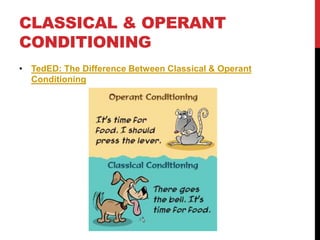
CLASSICAL & OPERANT
CONDITIONING
• TedED: The Difference Between Classical & Operant
Conditioning
BIG BANG
CONDITIONING
Sheldon the Teacher
• What was Sheldon’s goal by giving chocolates?
• To what extent do you think Sheldon would be
successful in changing behavior in real life?
• Where have you seen similar techniques?
• What does this show about human behavior?
LEARNING SKITS
• Your team are a group of experts on learning that has been
hired by the Tualatin High School to improve their school
community.
• Each team will be assigned with a different problem within
our school that you are tasked with fixing using principles
from Classical & Operant Conditioning.
• Create a short demonstration skit that will help the school
put in place procedures to help make TuHS a better school.
• Identify the problem you are addressing.
• Demonstrate what steps should be taken to change the
behavior of TuHS students.
• Be creative & have fun.
• Be prepared to present.

Learning pp

  • 1.
    LEARNING AN INTRODUCTION TOCLASSICAL AND OPERANT CONDITIONING
  • 2.
    OBJECTIVE • I canexplain how learning occurs. • I can explain how learning has impacted my behavior. • Essential Question: How does learning occur and shape my behavior?
  • 3.
    TODAY’S LEARNING INTENTIONS • Weare learning about different theories about how humans learn to behave. • We should be able to use key terms about learning to help explain a change in a person or animal’s behavior. • This is because we want to be able to explain how our environment impacts our behavior.
  • 4.
  • 5.
    WHAT IS LEARNING? •A long term change in behavior that is based on our experiences.
  • 6.
    THE BIOLOGY OF LEARNING •In the brain, learning occurs as we build neural pathways based on your new experiences. As you practice those skills/ideas/perceptions, those pathways are strengthened.
  • 7.
  • 8.
    PAVLOV’S DOGS • Pavlovwas a Russian doctor studying the digestive systems of dogs. • One day, he realized that the dogs would begin to salivate before they actually had food in front of them. • He wondered, if the dogs could be taught to salivate without the presence of food.
  • 9.
    PAVLOV SIMUALATION • Playthe simulation to see if you can get the Dog to salivate without the presence of food. • Pavlov Simulation
  • 10.
    PAVLOV’S DOGS • Pavlovbegan to ring a bell before bringing the Dogs’ dinner to them. • Dogs learned to associate the sound of the bell with the anticipated food. • He found that after a few weeks, dogs began to salivate at the mere sound of the bell.
  • 11.
    BEFORE CONDITIONING • Neutral Stimulus:A naturally occurring event that does not lead to a particular behavior. (The Bell) • Unconditioned Stimulus: A stimulus that leads to a naturally occurring, reflexive response in the absence of learning. (The Food) • Natural Response: An untrained or reflexive response to a stimulus in the absence of learning. (The Salvation)
  • 12.
    CONDITIONING KEY TERMS • PairedStimulus: The process of connecting a neutral stimulus with that of an unconditioned stimulus. (Bell & Meat) • Conditioned Response: The process of demonstrating an action associated with a new stimulus (salvation). • Conditioned Stimulus: A new association between the neutral stimulus with the conditioned response.
  • 13.
    CLASSICAL CONDITIONING • A typeof learning in which one learns to link two or more stimuli and anticipate events.
  • 14.
    BABY ALBERT • KeyQuestion: How does learning occur in humans • Lil' Baby Albert Video
  • 15.
    GENERALIZATION • Baby Albertbegan to generalize his fear of white rats to other furry and white objects. • Generalization: The tendency to respond in the same way to different but similar stimuli.
  • 16.
    COMPLETING NOTES • Workfor the next three minutes to complete your notes by… • Checking with a neighbor to fill any pieces of information that you may have missed. • Write study questions in the side box. • Highlight any key terms. • Circle key ideas. • Write questionmarks next to any areas that you still don’t understand.
  • 17.
    OPERANT CONDITIONING • Atype of learning in which behavior is strengthened or diminished based on the consequence of that behavior.
  • 18.
    REINFORCEMENT POSITIVE REINFORCEMENT • Something positiveis given. • Gold Star • Cookies • Compliment • Good Feelings • Happiness NEGATIVE REINFORCEMENT • Something negative is taken away. • No Homework • No Chores • Beeping in Car • Crying child Reinforcement: A consequence that makes a behavior more likely to happen again.
  • 19.
    WHEN REINFORCEMENT WORKS • Reinforcementswork when they are… • Immediate • Continually reinforced • Are intrinsically motivating • Reinforcements can cause problems when they… • Rely too heavily on extrinsic rewards. • Are inconsistent
  • 20.
    PUNISHMENTS POSITIVE PUNISHMENTS • Giving anunpleasant consequence. • Extra Chores • Traffic Ticket • Physical Pain NEGATIVE PUNISHMENTS • Taking away a pleasant consequence. • Detention • Cell Phone Taken Away • Bed without Dinner Punishment: A consequence that makes a behavior less likely.
  • 21.
    THE PROS &CONS OF PUNISHMENT • Punishments are most effective when they are… • Appropriate and thoughtful • Consistently enforced • Enforced immediately following the behavior • Helpful in teaching what to do. • Not sources of additional wanted attention • Punishment does not work when they are... • Mindless or inappropriate • Sources of anxiety, pain, rage, or fear • Inconsistenly enforced • Delayed • Dependent on the presense of the enforcer • Unclear or do not teach a lesson • Sources of additional attention.
  • 22.
    EXTINCTION • Extinction isthe disappearance of a previously learned behavior when the behavior is not reinforced.
  • 23.
    COMPLETING NOTES • Workfor the next three minutes to complete your notes by… • Checking with a neighbor to fill any pieces of information that you may have missed. • Write study questions in the side box. • Highlight any key terms. • Circle key ideas. • Write questionmarks next to any areas that you still don’t understand.
  • 24.
    CLASSICAL & OPERANT CONDITIONING •TedED: The Difference Between Classical & Operant Conditioning
  • 25.
    BIG BANG CONDITIONING Sheldon theTeacher • What was Sheldon’s goal by giving chocolates? • To what extent do you think Sheldon would be successful in changing behavior in real life? • Where have you seen similar techniques? • What does this show about human behavior?
  • 26.
    LEARNING SKITS • Yourteam are a group of experts on learning that has been hired by the Tualatin High School to improve their school community. • Each team will be assigned with a different problem within our school that you are tasked with fixing using principles from Classical & Operant Conditioning. • Create a short demonstration skit that will help the school put in place procedures to help make TuHS a better school. • Identify the problem you are addressing. • Demonstrate what steps should be taken to change the behavior of TuHS students. • Be creative & have fun. • Be prepared to present.