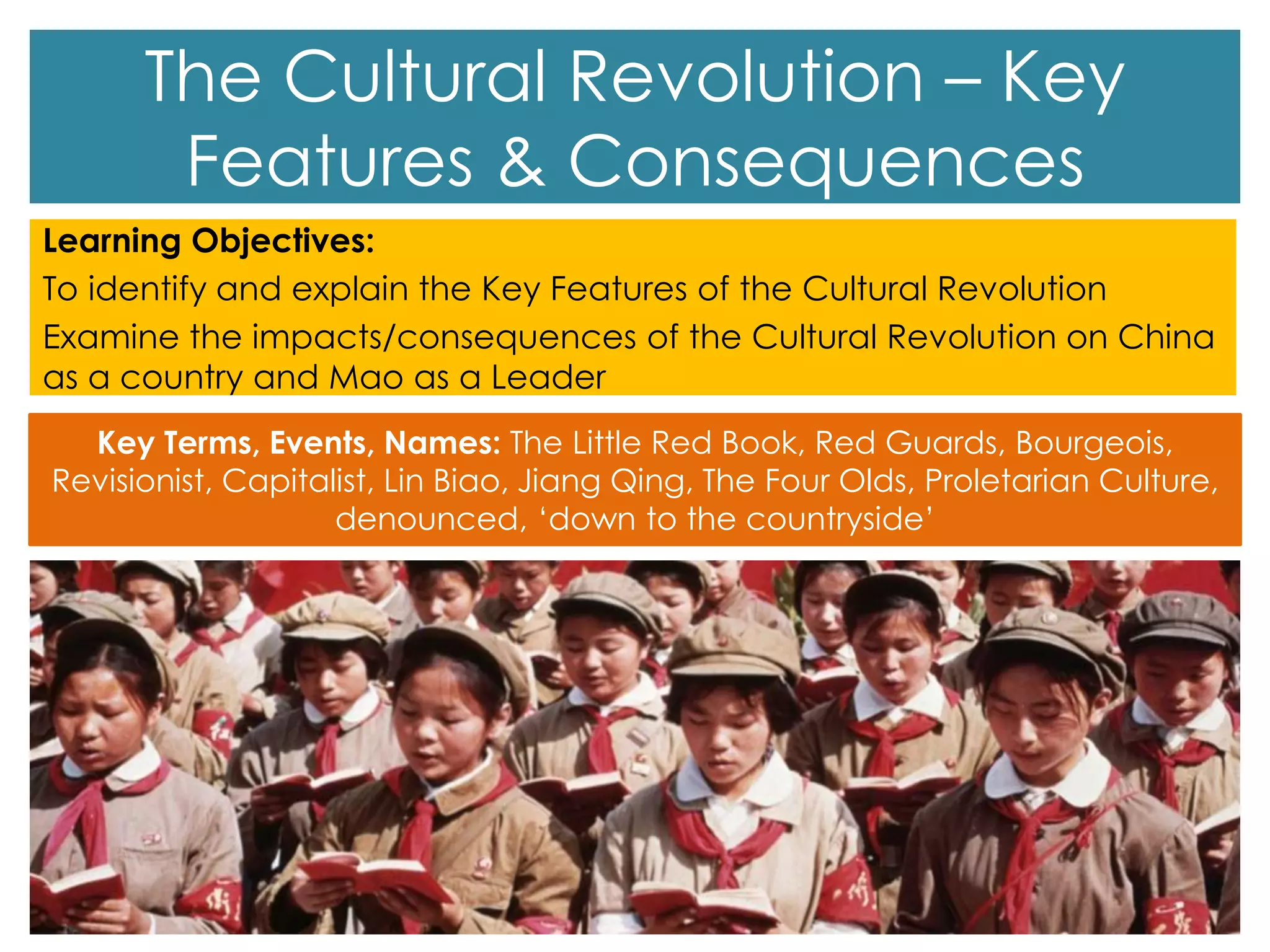
The Cultural Revolution – Key
Features & Consequences
Learning Objectives:
To identify and explain the Key Features of the Cultural Revolution
Examine the impacts/consequences of the Cultural Revolution on China
as a country and Mao as a Leader
Key Terms, Events, Names: The Little Red Book, Red Guards, Bourgeois,
Revisionist, Capitalist, Lin Biao, Jiang Qing, The Four Olds, Proletarian Culture,
denounced, ‘down to the countryside’
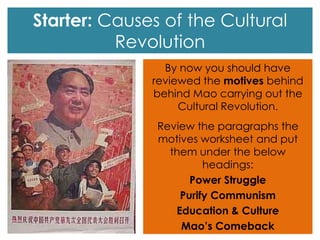
Starter: Causes of the Cultural
Revolution
By now you should have
reviewed the motives behind
behind Mao carrying out the
Cultural Revolution.
Review the paragraphs the
motives worksheet and put
them under the below
headings:
Power Struggle
Purify Communism
Education & Culture
Mao’s Comeback
Discuss: Causes of the Cultural
Revolution
Discuss with your partner and make a judgment as to which
factors you feel are most important as to why do Mao
launched the Cultural Revolution? Explain your answer with
evidence.
1. Genuinely concerned that China was becoming too
conservative?
2. Wanted to regain power after the failure of GLF?
3. Wanted a committed army to fight the USA in Vietnam?
4. He disliked other Communist leaders?
5. He was out of touch. Was acting like an ageing emperor
and was only interested in controlling people?
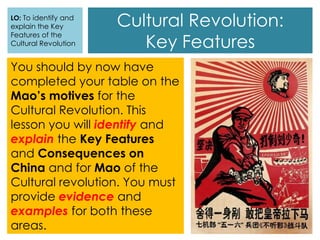
Cultural Revolution:
Key Features
You should by now have
completed your table on the
Mao’s motives for the
Cultural Revolution. This
lesson you will identify and
explain the Key Features
and Consequences on
China and for Mao of the
Cultural revolution. You must
provide evidence and
examples for both these
areas.
LO: To identify and
explain the Key
Features of the
Cultural Revolution
Who were the ‘Red
Guards’?
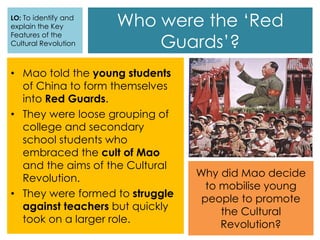
• Mao told the young students
of China to form themselves
into Red Guards.
• They were loose grouping of
college and secondary
school students who
embraced the cult of Mao
and the aims of the Cultural
Revolution.
• They were formed to struggle
against teachers but quickly
took on a larger role.
LO: To identify and
explain the Key
Features of the
Cultural Revolution
Why did Mao decide
to mobilise young
people to promote
the Cultural
Revolution?
What did they target?
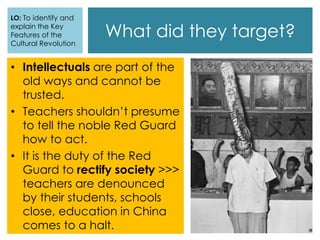
• Intellectuals are part of the
old ways and cannot be
trusted.
• Teachers shouldn’t presume
to tell the noble Red Guard
how to act.
• It is the duty of the Red
Guard to rectify society >>>
teachers are denounced
by their students, schools
close, education in China
comes to a halt.
LO: To identify and
explain the Key
Features of the
Cultural Revolution
What did they target?
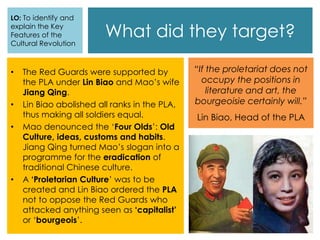
• The Red Guards were supported by
the PLA under Lin Biao and Mao’s wife
Jiang Qing.
• Lin Biao abolished all ranks in the PLA,
thus making all soldiers equal.
• Mao denounced the ‘Four Olds’: Old
Culture, ideas, customs and habits.
Jiang Qing turned Mao’s slogan into a
programme for the eradication of
traditional Chinese culture.
• A ‘Proletarian Culture’ was to be
created and Lin Biao ordered the PLA
not to oppose the Red Guards who
attacked anything seen as ‘capitalist’
or ‘bourgeois’.
LO: To identify and
explain the Key
Features of the
Cultural Revolution
“If the proletariat does not
occupy the positions in
literature and art, the
bourgeoisie certainly will.”
Lin Biao, Head of the PLA
What did they target?
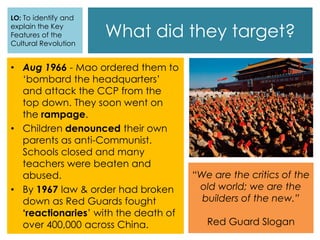
• Aug 1966 - Mao ordered them to
‘bombard the headquarters’
and attack the CCP from the
top down. They soon went on
the rampage.
• Children denounced their own
parents as anti-Communist.
Schools closed and many
teachers were beaten and
abused.
• By 1967 law & order had broken
down as Red Guards fought
‘reactionaries’ with the death of
over 400,000 across China.
LO: To identify and
explain the Key
Features of the
Cultural Revolution
“We are the critics of the
old world; we are the
builders of the new.”
Red Guard Slogan
Source Analysis
Read the following passage by 'Ken Ling' (a Red Guard who fled China to the
West at the end of the 1960s).
'Ken Ling', Red Guard, 1972
On the Athletic field, I saw rows of teachers, about 40 or 50 in all, with black
ink poured over their heads and faces... Hanging on their necks were
placards with such words as 'reactionary academic authority so-and-so',
class enemy so-and-so' ... They all wore dunce caps ... Hanging from their
necks were pails filled with rocks. I saw the principal, the pail round his neck
was so heavy that the wire had cut deep into his neck and he was
staggering. All were barefoot, hitting broken gongs ... as they walked round
the field and begged Mao Zedong to 'pardon their crimes' ...
Beatings and torture followed ... eating nightsoil and insects; being subjected
to electric shocks; forced to kneel in broken glass.
Discuss with a partner How useful is this source to an historian who wants to
understand the Cultural Revolution? (Take note of who wrote the source)
LO: To identify and
explain the Key
Features of the
Cultural Revolution
What did they target?
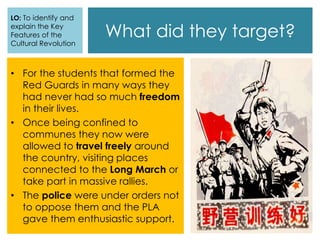
• For the students that formed the
Red Guards in many ways they
had never had so much freedom
in their lives.
• Once being confined to
communes they now were
allowed to travel freely around
the country, visiting places
connected to the Long March or
take part in massive rallies.
• The police were under orders not
to oppose them and the PLA
gave them enthusiastic support.
LO: To identify and
explain the Key
Features of the
Cultural Revolution
What did they target?
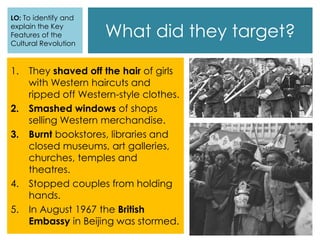
1. They shaved off the hair of girls
with Western haircuts and
ripped off Western-style clothes.
2. Smashed windows of shops
selling Western merchandise.
3. Burnt bookstores, libraries and
closed museums, art galleries,
churches, temples and
theatres.
4. Stopped couples from holding
hands.
5. In August 1967 the British
Embassy in Beijing was stormed.
LO: To identify and
explain the Key
Features of the
Cultural Revolution
What did they target?
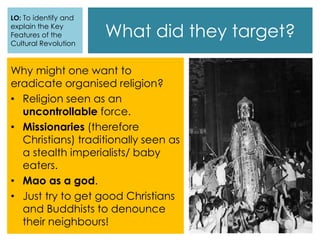
Why might one want to
eradicate organised religion?
• Religion seen as an
uncontrollable force.
• Missionaries (therefore
Christians) traditionally seen as
a stealth imperialists/ baby
eaters.
• Mao as a god.
• Just try to get good Christians
and Buddhists to denounce
their neighbours!
LO: To identify and
explain the Key
Features of the
Cultural Revolution
What did they target?
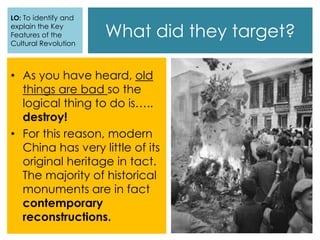
• As you have heard, old
things are bad so the
logical thing to do is…..
destroy!
• For this reason, modern
China has very little of its
original heritage in tact.
The majority of historical
monuments are in fact
contemporary
reconstructions.
LO: To identify and
explain the Key
Features of the
Cultural Revolution
Attacks on the Party
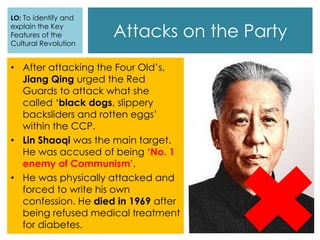
• After attacking the Four Old’s,
Jiang Qing urged the Red
Guards to attack what she
called ‘black dogs, slippery
backsliders and rotten eggs’
within the CCP.
• Lin Shaoqi was the main target.
He was accused of being ‘No. 1
enemy of Communism’.
• He was physically attacked and
forced to write his own
confession. He died in 1969 after
being refused medical treatment
for diabetes.
LO: To identify and
explain the Key
Features of the
Cultural Revolution
The Cult of Mao
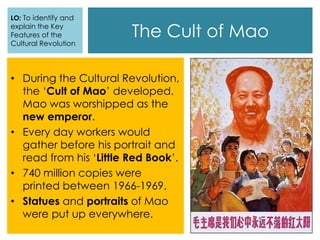
• During the Cultural Revolution,
the ‘Cult of Mao’ developed.
Mao was worshipped as the
new emperor.
• Every day workers would
gather before his portrait and
read from his ‘Little Red Book’.
• 740 million copies were
printed between 1966-1969.
• Statues and portraits of Mao
were put up everywhere.
LO: To identify and
explain the Key
Features of the
Cultural Revolution
The Cult of Mao
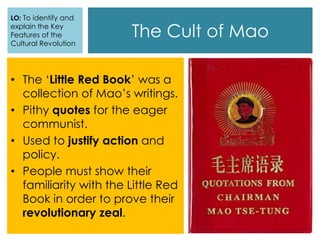
• The ‘Little Red Book’ was a
collection of Mao’s writings.
• Pithy quotes for the eager
communist.
• Used to justify action and
policy.
• People must show their
familiarity with the Little Red
Book in order to prove their
revolutionary zeal.
LO: To identify and
explain the Key
Features of the
Cultural Revolution
The End of the
Revolution
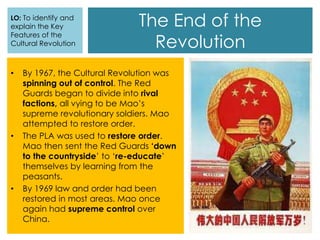
• By 1967, the Cultural Revolution was
spinning out of control. The Red
Guards began to divide into rival
factions, all vying to be Mao’s
supreme revolutionary soldiers. Mao
attempted to restore order.
• The PLA was used to restore order.
Mao then sent the Red Guards ‘down
to the countryside’ to ‘re-educate’
themselves by learning from the
peasants.
• By 1969 law and order had been
restored in most areas. Mao once
again had supreme control over
China.
LO: To identify and
explain the Key
Features of the
Cultural Revolution
Persecution during the
Cultural Revolution
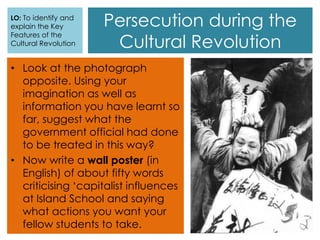
• Look at the photograph
opposite. Using your
imagination as well as
information you have learnt so
far, suggest what the
government official had done
to be treated in this way?
• Now write a wall poster (in
English) of about fifty words
criticising ‘capitalist influences
at Island School and saying
what actions you want your
fellow students to take.
LO: To identify and
explain the Key
Features of the
Cultural Revolution
Impact on China of the
Cultural Revolution
LO: Examine the
consequences of the
Cultural Revolution on
China as a country
and Mao as a Leader
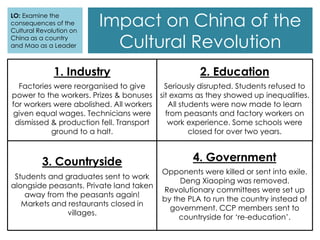
1. Industry
Factories were reorganised to give
power to the workers. Prizes & bonuses
for workers were abolished. All workers
given equal wages. Technicians were
dismissed & production fell. Transport
ground to a halt.
3. Countryside
Students and graduates sent to work
alongside peasants. Private land taken
away from the peasants again!
Markets and restaurants closed in
villages.
2. Education
Seriously disrupted. Students refused to
sit exams as they showed up inequalities.
All students were now made to learn
from peasants and factory workers on
work experience. Some schools were
closed for over two years.
4. Government
Opponents were killed or sent into exile.
Deng Xiaoping was removed.
Revolutionary committees were set up
by the PLA to run the country instead of
government. CCP members sent to
countryside for ‘re-education’.
Impact on China of the
Cultural Revolution
LO: Examine the
consequences of the
Cultural Revolution on
China as a country
and Mao as a Leader
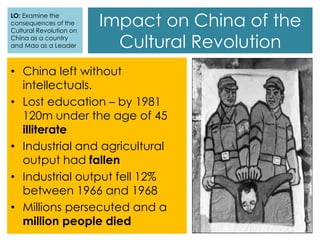
• China left without
intellectuals.
• Lost education – by 1981
120m under the age of 45
illiterate
• Industrial and agricultural
output had fallen
• Industrial output fell 12%
between 1966 and 1968
• Millions persecuted and a
million people died
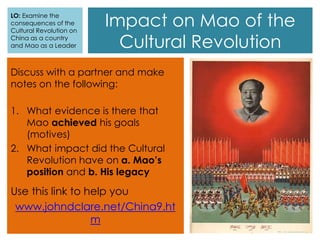
Discuss with a partner and make
notes on the following:
1. What evidence is there that
Mao achieved his goals
(motives)
2. What impact did the Cultural
Revolution have on a. Mao’s
position and b. His legacy
Use this link to help you
www.johndclare.net/China9.ht
m
Impact on Mao of the
Cultural Revolution
LO: Examine the
consequences of the
Cultural Revolution on
China as a country
and Mao as a Leader
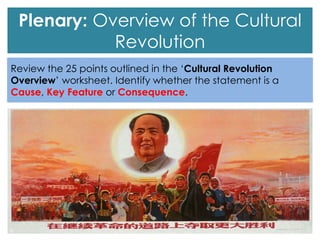
Review the 25 points outlined in the ‘Cultural Revolution
Overview’ worksheet. Identify whether the statement is a
Cause, Key Feature or Consequence.
Plenary: Overview of the Cultural
Revolution

The Cultural Revolution - Key Features & Consequences

  • 1.
    The Cultural Revolution– Key Features & Consequences Learning Objectives: To identify and explain the Key Features of the Cultural Revolution Examine the impacts/consequences of the Cultural Revolution on China as a country and Mao as a Leader Key Terms, Events, Names: The Little Red Book, Red Guards, Bourgeois, Revisionist, Capitalist, Lin Biao, Jiang Qing, The Four Olds, Proletarian Culture, denounced, ‘down to the countryside’
  • 2.
    Starter: Causes ofthe Cultural Revolution By now you should have reviewed the motives behind behind Mao carrying out the Cultural Revolution. Review the paragraphs the motives worksheet and put them under the below headings: Power Struggle Purify Communism Education & Culture Mao’s Comeback
  • 3.
    Discuss: Causes ofthe Cultural Revolution Discuss with your partner and make a judgment as to which factors you feel are most important as to why do Mao launched the Cultural Revolution? Explain your answer with evidence. 1. Genuinely concerned that China was becoming too conservative? 2. Wanted to regain power after the failure of GLF? 3. Wanted a committed army to fight the USA in Vietnam? 4. He disliked other Communist leaders? 5. He was out of touch. Was acting like an ageing emperor and was only interested in controlling people?
  • 4.
    Cultural Revolution: Key Features Youshould by now have completed your table on the Mao’s motives for the Cultural Revolution. This lesson you will identify and explain the Key Features and Consequences on China and for Mao of the Cultural revolution. You must provide evidence and examples for both these areas. LO: To identify and explain the Key Features of the Cultural Revolution
  • 5.
    Who were the‘Red Guards’? • Mao told the young students of China to form themselves into Red Guards. • They were loose grouping of college and secondary school students who embraced the cult of Mao and the aims of the Cultural Revolution. • They were formed to struggle against teachers but quickly took on a larger role. LO: To identify and explain the Key Features of the Cultural Revolution Why did Mao decide to mobilise young people to promote the Cultural Revolution?
  • 6.
    What did theytarget? • Intellectuals are part of the old ways and cannot be trusted. • Teachers shouldn’t presume to tell the noble Red Guard how to act. • It is the duty of the Red Guard to rectify society >>> teachers are denounced by their students, schools close, education in China comes to a halt. LO: To identify and explain the Key Features of the Cultural Revolution
  • 7.
    What did theytarget? • The Red Guards were supported by the PLA under Lin Biao and Mao’s wife Jiang Qing. • Lin Biao abolished all ranks in the PLA, thus making all soldiers equal. • Mao denounced the ‘Four Olds’: Old Culture, ideas, customs and habits. Jiang Qing turned Mao’s slogan into a programme for the eradication of traditional Chinese culture. • A ‘Proletarian Culture’ was to be created and Lin Biao ordered the PLA not to oppose the Red Guards who attacked anything seen as ‘capitalist’ or ‘bourgeois’. LO: To identify and explain the Key Features of the Cultural Revolution “If the proletariat does not occupy the positions in literature and art, the bourgeoisie certainly will.” Lin Biao, Head of the PLA
  • 8.
    What did theytarget? • Aug 1966 - Mao ordered them to ‘bombard the headquarters’ and attack the CCP from the top down. They soon went on the rampage. • Children denounced their own parents as anti-Communist. Schools closed and many teachers were beaten and abused. • By 1967 law & order had broken down as Red Guards fought ‘reactionaries’ with the death of over 400,000 across China. LO: To identify and explain the Key Features of the Cultural Revolution “We are the critics of the old world; we are the builders of the new.” Red Guard Slogan
  • 9.
    Source Analysis Read thefollowing passage by 'Ken Ling' (a Red Guard who fled China to the West at the end of the 1960s). 'Ken Ling', Red Guard, 1972 On the Athletic field, I saw rows of teachers, about 40 or 50 in all, with black ink poured over their heads and faces... Hanging on their necks were placards with such words as 'reactionary academic authority so-and-so', class enemy so-and-so' ... They all wore dunce caps ... Hanging from their necks were pails filled with rocks. I saw the principal, the pail round his neck was so heavy that the wire had cut deep into his neck and he was staggering. All were barefoot, hitting broken gongs ... as they walked round the field and begged Mao Zedong to 'pardon their crimes' ... Beatings and torture followed ... eating nightsoil and insects; being subjected to electric shocks; forced to kneel in broken glass. Discuss with a partner How useful is this source to an historian who wants to understand the Cultural Revolution? (Take note of who wrote the source) LO: To identify and explain the Key Features of the Cultural Revolution
  • 10.
    What did theytarget? • For the students that formed the Red Guards in many ways they had never had so much freedom in their lives. • Once being confined to communes they now were allowed to travel freely around the country, visiting places connected to the Long March or take part in massive rallies. • The police were under orders not to oppose them and the PLA gave them enthusiastic support. LO: To identify and explain the Key Features of the Cultural Revolution
  • 11.
    What did theytarget? 1. They shaved off the hair of girls with Western haircuts and ripped off Western-style clothes. 2. Smashed windows of shops selling Western merchandise. 3. Burnt bookstores, libraries and closed museums, art galleries, churches, temples and theatres. 4. Stopped couples from holding hands. 5. In August 1967 the British Embassy in Beijing was stormed. LO: To identify and explain the Key Features of the Cultural Revolution
  • 12.
    What did theytarget? Why might one want to eradicate organised religion? • Religion seen as an uncontrollable force. • Missionaries (therefore Christians) traditionally seen as a stealth imperialists/ baby eaters. • Mao as a god. • Just try to get good Christians and Buddhists to denounce their neighbours! LO: To identify and explain the Key Features of the Cultural Revolution
  • 13.
    What did theytarget? • As you have heard, old things are bad so the logical thing to do is….. destroy! • For this reason, modern China has very little of its original heritage in tact. The majority of historical monuments are in fact contemporary reconstructions. LO: To identify and explain the Key Features of the Cultural Revolution
  • 14.
    Attacks on theParty • After attacking the Four Old’s, Jiang Qing urged the Red Guards to attack what she called ‘black dogs, slippery backsliders and rotten eggs’ within the CCP. • Lin Shaoqi was the main target. He was accused of being ‘No. 1 enemy of Communism’. • He was physically attacked and forced to write his own confession. He died in 1969 after being refused medical treatment for diabetes. LO: To identify and explain the Key Features of the Cultural Revolution
  • 15.
    The Cult ofMao • During the Cultural Revolution, the ‘Cult of Mao’ developed. Mao was worshipped as the new emperor. • Every day workers would gather before his portrait and read from his ‘Little Red Book’. • 740 million copies were printed between 1966-1969. • Statues and portraits of Mao were put up everywhere. LO: To identify and explain the Key Features of the Cultural Revolution
  • 16.
    The Cult ofMao • The ‘Little Red Book’ was a collection of Mao’s writings. • Pithy quotes for the eager communist. • Used to justify action and policy. • People must show their familiarity with the Little Red Book in order to prove their revolutionary zeal. LO: To identify and explain the Key Features of the Cultural Revolution
  • 17.
    The End ofthe Revolution • By 1967, the Cultural Revolution was spinning out of control. The Red Guards began to divide into rival factions, all vying to be Mao’s supreme revolutionary soldiers. Mao attempted to restore order. • The PLA was used to restore order. Mao then sent the Red Guards ‘down to the countryside’ to ‘re-educate’ themselves by learning from the peasants. • By 1969 law and order had been restored in most areas. Mao once again had supreme control over China. LO: To identify and explain the Key Features of the Cultural Revolution
  • 18.
    Persecution during the CulturalRevolution • Look at the photograph opposite. Using your imagination as well as information you have learnt so far, suggest what the government official had done to be treated in this way? • Now write a wall poster (in English) of about fifty words criticising ‘capitalist influences at Island School and saying what actions you want your fellow students to take. LO: To identify and explain the Key Features of the Cultural Revolution
  • 19.
    Impact on Chinaof the Cultural Revolution LO: Examine the consequences of the Cultural Revolution on China as a country and Mao as a Leader 1. Industry Factories were reorganised to give power to the workers. Prizes & bonuses for workers were abolished. All workers given equal wages. Technicians were dismissed & production fell. Transport ground to a halt. 3. Countryside Students and graduates sent to work alongside peasants. Private land taken away from the peasants again! Markets and restaurants closed in villages. 2. Education Seriously disrupted. Students refused to sit exams as they showed up inequalities. All students were now made to learn from peasants and factory workers on work experience. Some schools were closed for over two years. 4. Government Opponents were killed or sent into exile. Deng Xiaoping was removed. Revolutionary committees were set up by the PLA to run the country instead of government. CCP members sent to countryside for ‘re-education’.
  • 20.
    Impact on Chinaof the Cultural Revolution LO: Examine the consequences of the Cultural Revolution on China as a country and Mao as a Leader • China left without intellectuals. • Lost education – by 1981 120m under the age of 45 illiterate • Industrial and agricultural output had fallen • Industrial output fell 12% between 1966 and 1968 • Millions persecuted and a million people died
  • 21.
    Discuss with apartner and make notes on the following: 1. What evidence is there that Mao achieved his goals (motives) 2. What impact did the Cultural Revolution have on a. Mao’s position and b. His legacy Use this link to help you www.johndclare.net/China9.ht m Impact on Mao of the Cultural Revolution LO: Examine the consequences of the Cultural Revolution on China as a country and Mao as a Leader
  • 22.
    Review the 25points outlined in the ‘Cultural Revolution Overview’ worksheet. Identify whether the statement is a Cause, Key Feature or Consequence. Plenary: Overview of the Cultural Revolution