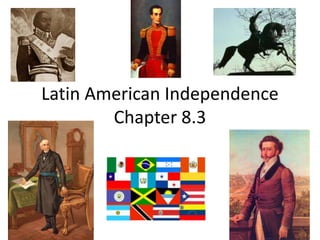
Latin American IndependenceChapter 8.3
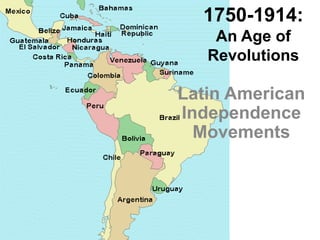
1750-1914:  An Age of RevolutionsLatin American Independence Movements
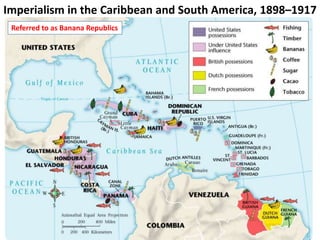
Imperialism in the Caribbean and South America, 1898–19174Referred to as Banana Republics
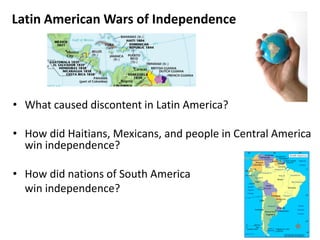
3Latin American Wars of IndependenceWhat caused discontent in Latin America? How did Haitians, Mexicans, and people in Central America win independence?How did nations of South America 	win independence?
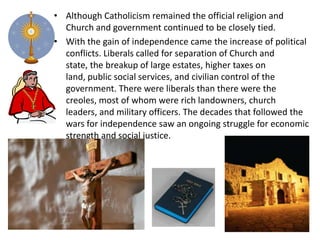
3What Caused Discontent in Latin America?By the late 1700s, the revolutionary fever that gripped    Western Europe had spread to Latin America.  There, discontent was rooted in the social, racial, and political system that had emerged during 300 years of Spanish rule.  Peninsulares were those born of Spanish parents in Spain; 	therefore, they had the most wealth, education, & status. 	Creoles resented their second-class status. 	Mestizos and mulattoes were angry at being denied              	the status, wealth, and power available to whites. 	Native Americans suffered economic misery under the  		Spanish.  	Enslaved Africans who worked on plantations longed               	for freedom.
3CENTRAL AMERICAMEXICOHAITIFather Miguel Hidalgo and José Morales led popular revolts. Rebels led by Agustín de Iturbide overthrew the Spanish viceroy, creating an   independent Mexico.Iturbide took the title of emperor, but was quickly overthrown. Liberal Mexicans set up the Republic of Mexico.In 1791, Toussaint L’Ouvertureled slaves in revolt.  By 1798, enslaved Haitians had been freed. In 1802, Napoleon sent an army to recapture Haiti.Napoleon’s forces agreed to a truce, or temporary peace. In 1804, Haitian leaders declared independence.  Spanish-ruled lands declared their independence in the early 1820s.  Local leaders set up the United Provinces of Central America. The union soon fragmented into separate republics of Guatemala, Nicaragua, Honduras, El Salvador, and Costa Rica. Struggles for Independence
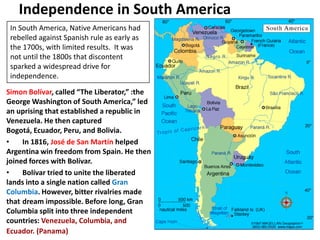
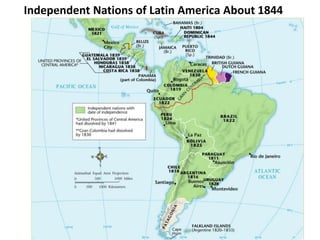
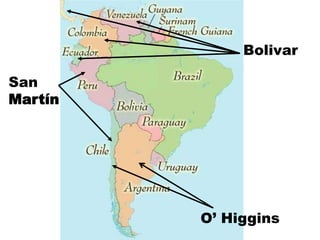
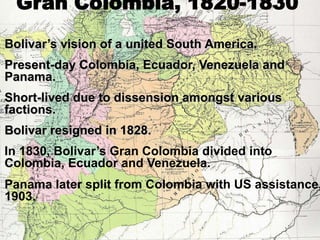
Independence in South America3In South America, Native Americans had rebelled against Spanish rule as early as the 1700s, with limited results.  It was not until the 1800s that discontent sparked a widespread drive for independence.Simon Bolívar, called “The Liberator,” :the George Washington of South America,” led an uprising that established a republic in Venezuela. He then captured Bogotá, Ecuador, Peru, and Bolivia.   	In 1816, José de San Martínhelped Argentina win freedom from Spain. He then joined forces with Bolívar.  	Bolívar tried to unite the liberated lands into a single nation called Gran Columbia. However, bitter rivalries made that 	dream impossible. Before long, Gran Columbia split into three independent countries: Venezuela, Columbia, and Ecuador.(Panama)
Independent Nations of Latin America About 18443
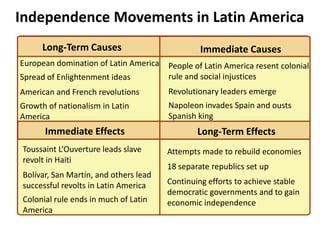
3Independence Movements in Latin AmericaLong-Term CausesImmediate CausesEuropean domination of Latin AmericaSpread of Enlightenment ideasAmerican and French revolutionsGrowth of nationalism in Latin AmericaPeople of Latin America resent colonial rule and social injusticesRevolutionary leaders emergeNapoleon invades Spain and ousts Spanish kingImmediate EffectsLong-Term EffectsToussaint L‘Ouverture leads slave revolt in HaitiBolívar, San Martín, and others lead successful revolts in Latin AmericaColonial rule ends in much of Latin AmericaAttempts made to rebuild economies18 separate republics set upContinuing efforts to achieve stable democratic governments and to gain economic independence
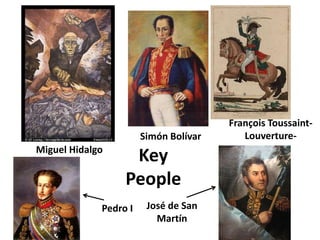
François Toussaint-Louverture- Simón BolívarMiguel HidalgoKey PeopleJosé de San MartínPedro I
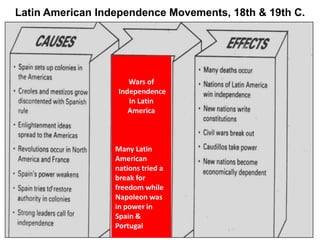
Latin American Independence Movements, 18th & 19th C.Wars of IndependenceIn Latin AmericaMany Latin American nations tried a break for freedom while Napoleon was in power in Spain & Portugal
ResultsCaudillosStrong military leaders emergeDictatorship and totalitarian systems emergeDependency theory challenges “Modernity” theoryWestern European markets determine the productSouth America dependent upon others buying their one cropBanana RepublicsUnited Fruit Company controlled Central America in late 19th and early 20th centuryPhrase coined to designate politically unstable, dependent on limited agriculture, and ruled by a small, wealthy and corrupt clique put in power by the United States government in conjunction with the CIA and the US business lobby
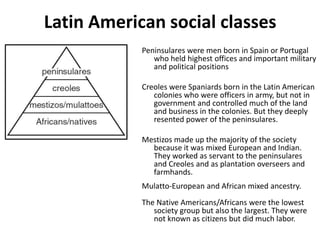
Latin American social classesPeninsulareswere men born in Spain or Portugalwho held highest offices and important military and political positionsCreoles were Spaniards born in the Latin American colonies who were officers in army, but not in government and controlled much of the land and business in the colonies. But they deeply resented power of the peninsulares.Mestizos made up the majority of the society because it was mixed European and Indian. They worked as servant to the peninsulares and Creoles and as plantation overseers and farmhands.The Native Americans/Africans were the lowest society group but also the largest. They were not known as citizens but did much labor. Mulatto-European and African mixed ancestry.
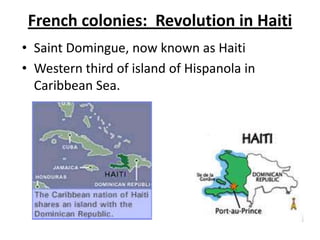
French colonies:  Revolution in HaitiSaint Domingue, now known as HaitiWestern third of island of Hispanola in Caribbean Sea.
The first Latin American uprising was in the French colony of Haiti, which was where huge plantations of sugar, cotton and coffee spread across the mountains and valleys of the lush tropical land. The Plantations were owed by French planters and worked by the colony’s enslaved African population
There was a high demand of sugar and coffee from the small colony of Haiti
500,000 to 560,000 people living in Haiti in the late 1700s were enslaved or had been
Unrest erupted in the early 1790’s when enslaved Africans led by François Toussaint-Louverture revolted by setting fires to plantation homes and fields of sugarcane.
Napoleon sent forces in 1802 in order to take control of the colony and successfully captured Toussaint-Louverture and imprisoned him in France until his death in 1803.
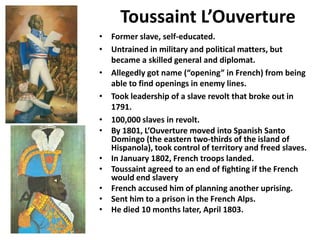
Yellow fever was the death of thousands of French soldiers which is what the Haiti people needed to defeat the French and gain their independence in 1804.Toussaint L’OuvertureFormer slave, self-educated.Untrained in military and political matters, but became a skilled general and diplomat.Allegedly got name (“opening” in French) from being able to find openings in enemy lines.Took leadership of a slave revolt that broke out in 1791.100,000 slaves in revolt.By 1801, L’Ouverture moved into Spanish Santo Domingo (the eastern two-thirds of the island of Hispanola), took control of territory and freed slaves.In January 1802, French troops landed.Toussaint agreed to an end of fighting if the French would end slaveryFrench accused him of planning another uprising.Sent him to a prison in the French Alps.He died 10 months later, April 1803.
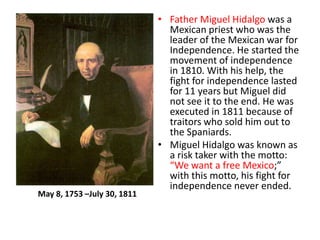
Father Miguel Hidalgo was a Mexican priest who was the leader of the Mexican war for Independence. He started the movement of independence in 1810. With his help, the fight for independence lasted for 11 years but Miguel did not see it to the end. He was executed in 1811 because of traitors who sold him out to the Spaniards.Miguel Hidalgo was known as a risk taker with the motto: “We want a free Mexico;” with this motto, his fight for independence never ended. May 8, 1753 –July 30, 1811
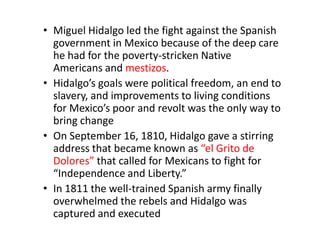
Miguel Hidalgo led the fight against the Spanish government in Mexico because of the deep care he had for the poverty-stricken Native Americans andmestizos.
Hidalgo’s goals were political freedom, an end to slavery, and improvements to living conditions for Mexico’s poor and revolt was the only way to bring change
On September 16, 1810, Hidalgo gave a stirring address that became known as “el Grito de Dolores” that called for Mexicans to fight for “Independence and Liberty.”
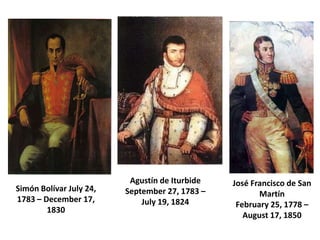
In 1811 the well-trained Spanish army finally overwhelmed the rebels and Hidalgo was captured and executedAgustín de Iturbide September 27, 1783 – July 19, 1824José Francisco de San MartínFebruary 25, 1778 – August 17, 1850Simón Bolívar July 24, 1783 – December 17, 1830
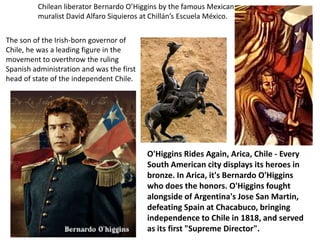
Chilean liberator Bernardo O’Higgins by the famous Mexican muralist David Alfaro Siquieros at Chillán’s Escuela México. The son of the Irish-born governor of Chile, he was a leading figure in the movement to overthrow the ruling Spanish administration and was the first head of state of the independent Chile.O'Higgins Rides Again, Arica, Chile - Every South American city displays its heroes in bronze. In Arica, it's Bernardo O'Higgins who does the honors. O'Higgins fought alongside of Argentina's Jose San Martin, defeating Spain at Chacabuco, bringing independence to Chile in 1818, and served as its first "Supreme Director".

Latin American Independence

  • 1.
  • 2.
    1750-1914: AnAge of RevolutionsLatin American Independence Movements
  • 3.
    Imperialism in theCaribbean and South America, 1898–19174Referred to as Banana Republics
  • 4.
    3Latin American Warsof IndependenceWhat caused discontent in Latin America? How did Haitians, Mexicans, and people in Central America win independence?How did nations of South America win independence?
  • 5.
    3What Caused Discontentin Latin America?By the late 1700s, the revolutionary fever that gripped Western Europe had spread to Latin America. There, discontent was rooted in the social, racial, and political system that had emerged during 300 years of Spanish rule. Peninsulares were those born of Spanish parents in Spain; therefore, they had the most wealth, education, & status. Creoles resented their second-class status. Mestizos and mulattoes were angry at being denied the status, wealth, and power available to whites. Native Americans suffered economic misery under the Spanish. Enslaved Africans who worked on plantations longed for freedom.
  • 6.
    3CENTRAL AMERICAMEXICOHAITIFather MiguelHidalgo and José Morales led popular revolts. Rebels led by Agustín de Iturbide overthrew the Spanish viceroy, creating an independent Mexico.Iturbide took the title of emperor, but was quickly overthrown. Liberal Mexicans set up the Republic of Mexico.In 1791, Toussaint L’Ouvertureled slaves in revolt. By 1798, enslaved Haitians had been freed. In 1802, Napoleon sent an army to recapture Haiti.Napoleon’s forces agreed to a truce, or temporary peace. In 1804, Haitian leaders declared independence. Spanish-ruled lands declared their independence in the early 1820s. Local leaders set up the United Provinces of Central America. The union soon fragmented into separate republics of Guatemala, Nicaragua, Honduras, El Salvador, and Costa Rica. Struggles for Independence
  • 7.
    Independence in SouthAmerica3In South America, Native Americans had rebelled against Spanish rule as early as the 1700s, with limited results. It was not until the 1800s that discontent sparked a widespread drive for independence.Simon Bolívar, called “The Liberator,” :the George Washington of South America,” led an uprising that established a republic in Venezuela. He then captured Bogotá, Ecuador, Peru, and Bolivia. In 1816, José de San Martínhelped Argentina win freedom from Spain. He then joined forces with Bolívar. Bolívar tried to unite the liberated lands into a single nation called Gran Columbia. However, bitter rivalries made that dream impossible. Before long, Gran Columbia split into three independent countries: Venezuela, Columbia, and Ecuador.(Panama)
  • 8.
    Independent Nations ofLatin America About 18443
  • 9.
    3Independence Movements inLatin AmericaLong-Term CausesImmediate CausesEuropean domination of Latin AmericaSpread of Enlightenment ideasAmerican and French revolutionsGrowth of nationalism in Latin AmericaPeople of Latin America resent colonial rule and social injusticesRevolutionary leaders emergeNapoleon invades Spain and ousts Spanish kingImmediate EffectsLong-Term EffectsToussaint L‘Ouverture leads slave revolt in HaitiBolívar, San Martín, and others lead successful revolts in Latin AmericaColonial rule ends in much of Latin AmericaAttempts made to rebuild economies18 separate republics set upContinuing efforts to achieve stable democratic governments and to gain economic independence
  • 10.
    François Toussaint-Louverture- SimónBolívarMiguel HidalgoKey PeopleJosé de San MartínPedro I
  • 11.
    Latin American IndependenceMovements, 18th & 19th C.Wars of IndependenceIn Latin AmericaMany Latin American nations tried a break for freedom while Napoleon was in power in Spain & Portugal
  • 12.
    ResultsCaudillosStrong military leadersemergeDictatorship and totalitarian systems emergeDependency theory challenges “Modernity” theoryWestern European markets determine the productSouth America dependent upon others buying their one cropBanana RepublicsUnited Fruit Company controlled Central America in late 19th and early 20th centuryPhrase coined to designate politically unstable, dependent on limited agriculture, and ruled by a small, wealthy and corrupt clique put in power by the United States government in conjunction with the CIA and the US business lobby
  • 13.
    Latin American socialclassesPeninsulareswere men born in Spain or Portugalwho held highest offices and important military and political positionsCreoles were Spaniards born in the Latin American colonies who were officers in army, but not in government and controlled much of the land and business in the colonies. But they deeply resented power of the peninsulares.Mestizos made up the majority of the society because it was mixed European and Indian. They worked as servant to the peninsulares and Creoles and as plantation overseers and farmhands.The Native Americans/Africans were the lowest society group but also the largest. They were not known as citizens but did much labor. Mulatto-European and African mixed ancestry.
  • 14.
    French colonies: Revolution in HaitiSaint Domingue, now known as HaitiWestern third of island of Hispanola in Caribbean Sea.
  • 15.
    The first LatinAmerican uprising was in the French colony of Haiti, which was where huge plantations of sugar, cotton and coffee spread across the mountains and valleys of the lush tropical land. The Plantations were owed by French planters and worked by the colony’s enslaved African population
  • 16.
    There was ahigh demand of sugar and coffee from the small colony of Haiti
  • 17.
    500,000 to 560,000people living in Haiti in the late 1700s were enslaved or had been
  • 18.
    Unrest erupted inthe early 1790’s when enslaved Africans led by François Toussaint-Louverture revolted by setting fires to plantation homes and fields of sugarcane.
  • 19.
    Napoleon sent forcesin 1802 in order to take control of the colony and successfully captured Toussaint-Louverture and imprisoned him in France until his death in 1803.
  • 20.
    Yellow fever wasthe death of thousands of French soldiers which is what the Haiti people needed to defeat the French and gain their independence in 1804.Toussaint L’OuvertureFormer slave, self-educated.Untrained in military and political matters, but became a skilled general and diplomat.Allegedly got name (“opening” in French) from being able to find openings in enemy lines.Took leadership of a slave revolt that broke out in 1791.100,000 slaves in revolt.By 1801, L’Ouverture moved into Spanish Santo Domingo (the eastern two-thirds of the island of Hispanola), took control of territory and freed slaves.In January 1802, French troops landed.Toussaint agreed to an end of fighting if the French would end slaveryFrench accused him of planning another uprising.Sent him to a prison in the French Alps.He died 10 months later, April 1803.
  • 21.
    Father Miguel Hidalgowas a Mexican priest who was the leader of the Mexican war for Independence. He started the movement of independence in 1810. With his help, the fight for independence lasted for 11 years but Miguel did not see it to the end. He was executed in 1811 because of traitors who sold him out to the Spaniards.Miguel Hidalgo was known as a risk taker with the motto: “We want a free Mexico;” with this motto, his fight for independence never ended. May 8, 1753 –July 30, 1811
  • 22.
    Miguel Hidalgo ledthe fight against the Spanish government in Mexico because of the deep care he had for the poverty-stricken Native Americans andmestizos.
  • 23.
    Hidalgo’s goals werepolitical freedom, an end to slavery, and improvements to living conditions for Mexico’s poor and revolt was the only way to bring change
  • 24.
    On September 16,1810, Hidalgo gave a stirring address that became known as “el Grito de Dolores” that called for Mexicans to fight for “Independence and Liberty.”
  • 25.
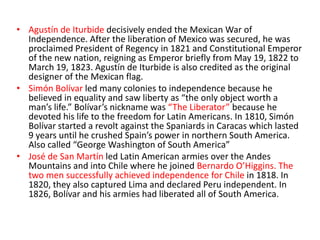
    In 1811 thewell-trained Spanish army finally overwhelmed the rebels and Hidalgo was captured and executedAgustín de Iturbide September 27, 1783 – July 19, 1824José Francisco de San MartínFebruary 25, 1778 – August 17, 1850Simón Bolívar July 24, 1783 – December 17, 1830
  • 26.
    Chilean liberator Bernardo O’Higgins bythe famous Mexican muralist David Alfaro Siquieros at Chillán’s Escuela México. The son of the Irish-born governor of Chile, he was a leading figure in the movement to overthrow the ruling Spanish administration and was the first head of state of the independent Chile.O'Higgins Rides Again, Arica, Chile - Every South American city displays its heroes in bronze. In Arica, it's Bernardo O'Higgins who does the honors. O'Higgins fought alongside of Argentina's Jose San Martin, defeating Spain at Chacabuco, bringing independence to Chile in 1818, and served as its first "Supreme Director".