Deng Xiaoping’s ReformsChanges &ChallengesJonathon Flegg and Chen Xin
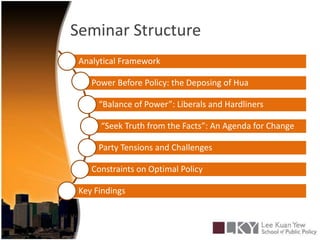
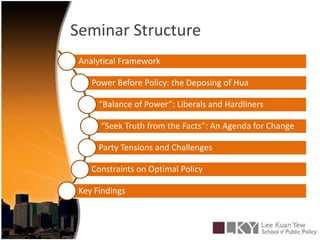
Seminar Structure
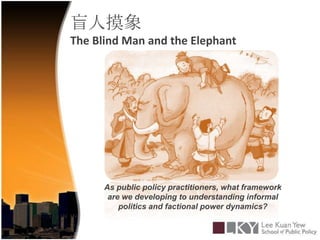
盲人摸象The Blind Man and the ElephantAs public policy practitioners, what framework are we developing to understanding informal politics and factional power dynamics?
Explaining EventsFewsmith (2000: 143)
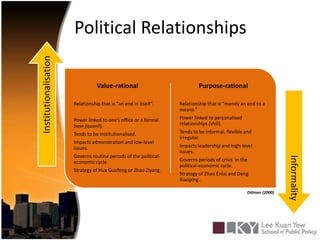
Political RelationshipsDittmer (2000)
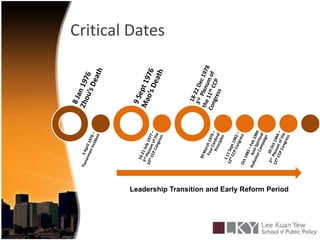
Critical DatesLeadership Transition and Early Reform Period
Seminar Structure
The System in 1976
Hua Guofeng and Deng XiaopingThe military (Xu Shiyou and Wei Guoqing) gave Hua an ultimatum to bring back Deng or face a challenge to his chairmanship.
A Winning CoalitionHuang (2000) and Fewsmith (2000)
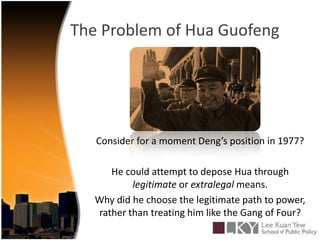
The Problem of Hua GuofengConsider for a moment Deng’s position in 1977?He could attempt to depose Hua through legitimate or extralegal means.Why did he choose the legitimate path to power, rather than treating him like the Gang of Four?
Seminar Structure
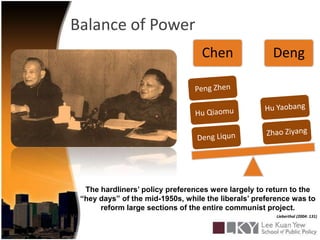
Balance of PowerThe hardliners’ policy preferences were largely to return to the “hey days” of the mid-1950s, while the liberals’ preference was to reform large sections of the entire communist project.Lieberthal (2004: 131)
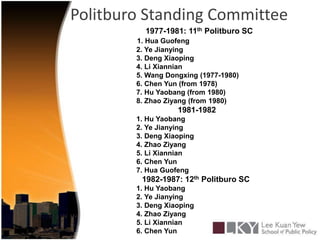
Politburo Standing Committee1977-1981: 11th Politburo SC1. HuaGuofeng   2. Ye Jianying   3. Deng Xiaoping   4. Li Xiannian   5. Wang Dongxing (1977-1980)   6. Chen Yun (from 1978)   7. Hu Yaobang (from 1980)   8. Zhao Ziyang (from 1980)1981-19821. Hu Yaobang   2. Ye Jianying   3. Deng Xiaoping   4. Zhao Ziyang   5. Li Xiannian   6. Chen Yun   7. HuaGuofeng1982-1987: 12th Politburo SC   1. Hu Yaobang   2. Ye Jianying   3. Deng Xiaoping   4. Zhao Ziyang   5. Li Xiannian   6. Chen Yun
Post-1978 Power SharingThe executive Potiburo Standing Committee was divided, between two factions with different seniority and policy preferences.While by 1980 Hu Yaobang held the most senior office of General Secretary of the CCP, final power still rest in the hands of the older Party ‘elders’, including Deng.Deng entrusted economic reform to Zhao Ziyang and ideological reform to Hu Yaobang.
Seminar Structure
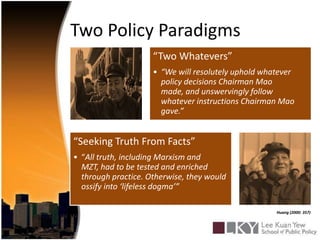
Two Policy ParadigmsHuang (2000: 357)
1978 Initial Reform AgendaRehabilitation of cadres persecuted in the CR.Give priority to economic development.Providing significant resources and incentives to bail out the agricultural sector that was draining the whole economy.Moving away from class struggle and mass movements.Breaking away from personally driven rigidities imposed by Mao.Opening up to the outside world.MacFarquhar(1997: 320-321);Lieberthal (2004: 132)
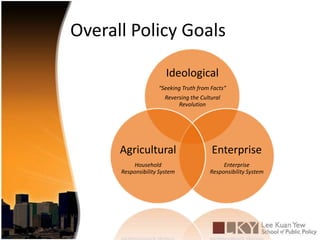
Overall Policy Goals
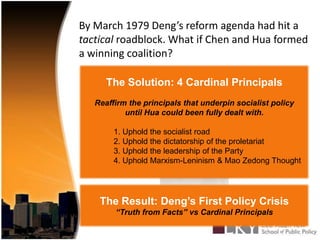
By March 1979 Deng’s reform agenda had hit a tactical roadblock. What if Chen and Hua formed a winning coalition?The Solution: 4 Cardinal PrincipalsReaffirm the principals that underpin socialist policy until Hua could been fully dealt with.	1. Uphold the socialist road	2. Uphold the dictatorship of the proletariat	3. Uphold the leadership of the Party	4. Uphold Marxism-Leninism & Mao Zedong Thought?The Result: Deng’s First Policy Crisis “Truth from Facts” vs Cardinal Principals
Seminar Structure
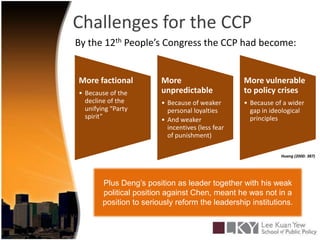
Challenges for the CCPBy the 12th People’s Congress the CCP had become:Huang (2000: 387)Plus Deng’s position as leader together with his weak political position against Chen, meant he was not in a position to seriously reform the leadership institutions.
Seminar Structure
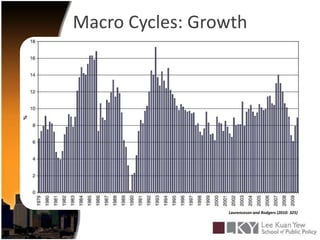
The Policy-Choice ModelThe system in 1976-84 can best be explained with the policy-choice model (Harding 1981).Information flows up to the Politburo significantly improved post-1976, informing leaders’ policy preferences.Leaders demonstrated clear differences in policy preferences, and pursued them within the political constraints.Leaders followed their policy preferences beyond what would have been politically most efficient.This is most evident in the policy ‘cycles’ that characterised the period.However power is always a pre-requisite for policy implementation.  Deng, with his strong informal political position, provided the political cover for Hu and Zhao to implement their policy preferences.
Suboptimal Policy EnvironmentDeng and Zhao were attempting to reform the economy, without control of the main economic arms of the government.State Planning CouncilFinance DepartmentLikewise Deng and Hu did not have control over the main ideological arms of the government.Propaganda DepartmentPersonnel DepartmentIn a institutionalised policy-making environment, this should not have been a problem.The Chinese informal political system forced Deng and his supporters towards a suboptimal policy reform process.Decentralisation (allowing Deng’s sympathisers in some provinces to ‘experiment’ with new policies).Think-tanks and intellectual networks.
Macro Cycles: GrowthLaurenceson and Rodgers (2010: 325)
Macro Cycles: InflationAsh and Kueh (1996: Table 9)
Challenges to Good PolicyThe executive did not have institutional policy-making power at their disposal.Having to resort to executing policy through informal channels meant policies were less than optimal.Fundamentally the problem lies in the process of compromise. Over this period, policy compromise occurred but was only ever a short-term tactical decision.If short-term political parameters change, the system was prone to policy crisis (eg. Four Cardinal Principals).
Whydid the reformssucceed?The system did not help the process of reform.   The momentum for reform was maintained because of:* Lau, Qian, and Roland (2000)
Seminar Structure
Key FindingsWe can explain events by the interplay of informal politics, formal structures and political issues.The system from 1976-84 can be explained best with the policy-choice model.The deposing of Hua was a precondition for policy reform. Reform agenda was constrained by Chen Yun and his supporters, resulting in an unstable policy environment prone to crisis.As Chen’s supporters still maintained control of much of the Beijing-based formal bureaucratic channels, Deng’s supporters were forced to rely on informal channels and decentralisation to achieved policy objectives.While the executed policies were viable, they were rarely, if ever, optimal.Early economic successes and targeting “reform without losers” lent crucial early support for the reformist agenda.
BibliographyAsh, R. F. and Y. Y. Kueh1996. The Chinese Economy Under Deng Xiaoping. 			Oxford: Oxford University Press.Dittmer, L.	2000. “Informal Politics Among the Chinese 				Communist Party Elite”, in L. Dittmer, H. Fukui, and P. 			N. S. Lee (eds.), Informal Politics in East Asia: 106-40.Fewsmith, J.		2000. “Formal Structures, Informal Politics, and 			Political Change in China”, in L. Dittmer, H. Fukui, and 			P. N. S. Lee (eds.), Informal Politics in East Asia: 141-			64.Harding, H.		1981. Organizing China. Stanford: Stanford University 			Press.Huang, J.		2000. Factionalism in Chinese Communist Politics. 			Cambridge: Cambridge University Press.Lau, L., Y. Qian, and G. Roland		2000. “Reform Without Losers: An Interpretation 			of China’s Dual-Track Approach to Transition”. Journal 			of Political Economy 108(1): 120-43.Laurenceson, J. and D. Rodgers		2010. “China’s macroeconomic volatility – How 			important is the business cycle?”. China Economic 			Review 21: 324-33.Lieberthal, K.	  	2004. Governing China: From Revolution through 			Reform. New York: W. W. Norton.MacFarquhar, R.		1997. The Politics of China: The Eras of Mao and 			Deng. Cambridge: Cambridge University Press.Naughton, B.	  	2007. The ChineseEconomy: Transitions and Growth. 			Cambridge, MA: MIT Press.
Questions?

Deng Xiaoping Reforms: Changes and Challenges

  • 1.
    Deng Xiaoping’s ReformsChanges&ChallengesJonathon Flegg and Chen Xin
  • 2.
  • 3.
    盲人摸象The Blind Manand the ElephantAs public policy practitioners, what framework are we developing to understanding informal politics and factional power dynamics?
  • 4.
  • 5.
  • 6.
  • 7.
  • 8.
  • 9.
    Hua Guofeng andDeng XiaopingThe military (Xu Shiyou and Wei Guoqing) gave Hua an ultimatum to bring back Deng or face a challenge to his chairmanship.
  • 10.
    A Winning CoalitionHuang(2000) and Fewsmith (2000)
  • 11.
    The Problem ofHua GuofengConsider for a moment Deng’s position in 1977?He could attempt to depose Hua through legitimate or extralegal means.Why did he choose the legitimate path to power, rather than treating him like the Gang of Four?
  • 12.
  • 13.
    Balance of PowerThehardliners’ policy preferences were largely to return to the “hey days” of the mid-1950s, while the liberals’ preference was to reform large sections of the entire communist project.Lieberthal (2004: 131)
  • 14.
    Politburo Standing Committee1977-1981:11th Politburo SC1. HuaGuofeng 2. Ye Jianying 3. Deng Xiaoping 4. Li Xiannian 5. Wang Dongxing (1977-1980) 6. Chen Yun (from 1978) 7. Hu Yaobang (from 1980) 8. Zhao Ziyang (from 1980)1981-19821. Hu Yaobang 2. Ye Jianying 3. Deng Xiaoping 4. Zhao Ziyang 5. Li Xiannian 6. Chen Yun 7. HuaGuofeng1982-1987: 12th Politburo SC 1. Hu Yaobang 2. Ye Jianying 3. Deng Xiaoping 4. Zhao Ziyang 5. Li Xiannian 6. Chen Yun
  • 15.
    Post-1978 Power SharingTheexecutive Potiburo Standing Committee was divided, between two factions with different seniority and policy preferences.While by 1980 Hu Yaobang held the most senior office of General Secretary of the CCP, final power still rest in the hands of the older Party ‘elders’, including Deng.Deng entrusted economic reform to Zhao Ziyang and ideological reform to Hu Yaobang.
  • 16.
  • 17.
  • 18.
    1978 Initial ReformAgendaRehabilitation of cadres persecuted in the CR.Give priority to economic development.Providing significant resources and incentives to bail out the agricultural sector that was draining the whole economy.Moving away from class struggle and mass movements.Breaking away from personally driven rigidities imposed by Mao.Opening up to the outside world.MacFarquhar(1997: 320-321);Lieberthal (2004: 132)
  • 19.
  • 20.
    By March 1979Deng’s reform agenda had hit a tactical roadblock. What if Chen and Hua formed a winning coalition?The Solution: 4 Cardinal PrincipalsReaffirm the principals that underpin socialist policy until Hua could been fully dealt with. 1. Uphold the socialist road 2. Uphold the dictatorship of the proletariat 3. Uphold the leadership of the Party 4. Uphold Marxism-Leninism & Mao Zedong Thought?The Result: Deng’s First Policy Crisis “Truth from Facts” vs Cardinal Principals
  • 21.
  • 22.
    Challenges for theCCPBy the 12th People’s Congress the CCP had become:Huang (2000: 387)Plus Deng’s position as leader together with his weak political position against Chen, meant he was not in a position to seriously reform the leadership institutions.
  • 23.
  • 24.
    The Policy-Choice ModelThesystem in 1976-84 can best be explained with the policy-choice model (Harding 1981).Information flows up to the Politburo significantly improved post-1976, informing leaders’ policy preferences.Leaders demonstrated clear differences in policy preferences, and pursued them within the political constraints.Leaders followed their policy preferences beyond what would have been politically most efficient.This is most evident in the policy ‘cycles’ that characterised the period.However power is always a pre-requisite for policy implementation. Deng, with his strong informal political position, provided the political cover for Hu and Zhao to implement their policy preferences.
  • 25.
    Suboptimal Policy EnvironmentDengand Zhao were attempting to reform the economy, without control of the main economic arms of the government.State Planning CouncilFinance DepartmentLikewise Deng and Hu did not have control over the main ideological arms of the government.Propaganda DepartmentPersonnel DepartmentIn a institutionalised policy-making environment, this should not have been a problem.The Chinese informal political system forced Deng and his supporters towards a suboptimal policy reform process.Decentralisation (allowing Deng’s sympathisers in some provinces to ‘experiment’ with new policies).Think-tanks and intellectual networks.
  • 26.
    Macro Cycles: GrowthLaurencesonand Rodgers (2010: 325)
  • 27.
    Macro Cycles: InflationAshand Kueh (1996: Table 9)
  • 28.
    Challenges to GoodPolicyThe executive did not have institutional policy-making power at their disposal.Having to resort to executing policy through informal channels meant policies were less than optimal.Fundamentally the problem lies in the process of compromise. Over this period, policy compromise occurred but was only ever a short-term tactical decision.If short-term political parameters change, the system was prone to policy crisis (eg. Four Cardinal Principals).
  • 29.
    Whydid the reformssucceed?Thesystem did not help the process of reform. The momentum for reform was maintained because of:* Lau, Qian, and Roland (2000)
  • 30.
  • 31.
    Key FindingsWe canexplain events by the interplay of informal politics, formal structures and political issues.The system from 1976-84 can be explained best with the policy-choice model.The deposing of Hua was a precondition for policy reform. Reform agenda was constrained by Chen Yun and his supporters, resulting in an unstable policy environment prone to crisis.As Chen’s supporters still maintained control of much of the Beijing-based formal bureaucratic channels, Deng’s supporters were forced to rely on informal channels and decentralisation to achieved policy objectives.While the executed policies were viable, they were rarely, if ever, optimal.Early economic successes and targeting “reform without losers” lent crucial early support for the reformist agenda.
  • 32.
    BibliographyAsh, R. F.and Y. Y. Kueh1996. The Chinese Economy Under Deng Xiaoping. Oxford: Oxford University Press.Dittmer, L. 2000. “Informal Politics Among the Chinese Communist Party Elite”, in L. Dittmer, H. Fukui, and P. N. S. Lee (eds.), Informal Politics in East Asia: 106-40.Fewsmith, J. 2000. “Formal Structures, Informal Politics, and Political Change in China”, in L. Dittmer, H. Fukui, and P. N. S. Lee (eds.), Informal Politics in East Asia: 141- 64.Harding, H. 1981. Organizing China. Stanford: Stanford University Press.Huang, J. 2000. Factionalism in Chinese Communist Politics. Cambridge: Cambridge University Press.Lau, L., Y. Qian, and G. Roland 2000. “Reform Without Losers: An Interpretation of China’s Dual-Track Approach to Transition”. Journal of Political Economy 108(1): 120-43.Laurenceson, J. and D. Rodgers 2010. “China’s macroeconomic volatility – How important is the business cycle?”. China Economic Review 21: 324-33.Lieberthal, K. 2004. Governing China: From Revolution through Reform. New York: W. W. Norton.MacFarquhar, R. 1997. The Politics of China: The Eras of Mao and Deng. Cambridge: Cambridge University Press.Naughton, B. 2007. The ChineseEconomy: Transitions and Growth. Cambridge, MA: MIT Press.
  • 33.

Editor's Notes

  • #4 We need to ask the “why” question? Why did Chinese politics develop the way it did? What structure do we have for analysing informal politics?
  • #5 I would divide political issues into: ideology and economic forces.
  • #7 July 1977: Deng the only one to criticise the “two whatevers”.1978: Deng called a CC conference but it took from Sept-Nov for Hu department to fight for every attendee’s name with the “whatever faction”. Because Deng has much better control of various levels of the central apparatus, army and provinces he had the support of 137/219 attendees. This was partly because of his support for wrongly accused cadres from the CR and this was to be a major topic of the conference. Because this issue directly sought reversal of Mao’s orders, it was an attack on the “two whatevers”. “Two whatevers” was officially discarded as a doctrine.  Third Plenum of the Eleventh CC (Dec 1978): declared “mass class struggle over”  “must be shifted on the economic construction”. Ag reform: from three-level (commune, brigade, and production team)  HRS. Chen Yun’s old remedy (1962) for industrial policy (reverse Hua’s 1977-8 GLF  “readjustment, reorganisation, consolidation and improvement.”) The Politburo was enlarged with Deng-Chen supporters. The CC Secretariat led by Hu and the enlarged Politburo made Hua a mere figurehead. The changes also set up the leadership relations for years to come.In the second half of the 1980s, our central government, under the guidance of Deng Xiaoping, attempted to shift the strategic focus of the reform from the countryside to the cities, and from the non-state sector to the state sector. In 1984, the 3rd Plenum of 12th CCP Congress promulgated the decisions on economic reform. However, these decisions were not implemented smoothly, and in 1987, the implementation completely stopped.
  • #8 Power Before Policy
  • #9 Power Before Policy
  • #11 While Hu (as head of party organisation) had to contend with Deng Liqun (who headed propaganda)and Zhao (as premier of state council) who had to contend with Yao Yilin/Song Peng (as heads of the State Planning Council)
  • #12 Answer:Hua was different from the Gang of Four in two waysHua was endorsed by Mao as his legitimate successor.Hua held the office of Chairman of the CCP.By acting extralegally to arrest Hua, Deng would have been (1) desecrating Mao and (2) desecrating the system. He had to depose Hua in a legitimate way.
  • #13 Balance of Power
  • #14 Deng couldn’t get rid of MZT, which was the ideological legitimacy for CCP rule. He had to come up with something new to justify his new approach to “the new historical conditions”. The working group formed by Deng and run by Hu was divided between liberals (Yu Guangyuan(国家科委副主任SSTC), Hu Jiwei( ), Li Honglin( ), and Su Shaozhi (人民日报社理论部组长 )) and hardliners (Hu Qiaomu ()and Deng Liqun()). Liberals wanted rejection of class struggle, some of MZT, the socialist economy and uphold a “new democratic system”. Hardliners wanted only rejection of “class struggle”, and no doubts about socialism – for them “the true central-planned economy brought about a miracle”.
  • #15 The trends of political power competition between factions:Beneficiaries purged gradually after CRBalance of power established between Liberals and HardlinersDeng insisted on ranking himself below Ye Jianying in the list of CCP vice-chairman long after CR. Instead, he quickly gathered around him the men he wished to succeed him, giving him posts and responsibilities so that they could gain experience and respect. This was the successor-training operation that Mao has talked about but never really implemented.
  • #17 Seek Truth from the Facts
  • #20 A virtual takeover occurred by conservatives of economic policy making: almost the entire Economic and Financial Commission from 1979 were conservatives.
  • #22 Party Tensions
  • #24 Constraints on Optimal Policy
  • #31 Key Findings