Modeling of Electrical System
•Basic Elements Modeling-R,L,C
•Solved Examples with RLC circuit
•L, C Modeling with Non-Zero Initial condition
1
Modeling of Electrical System
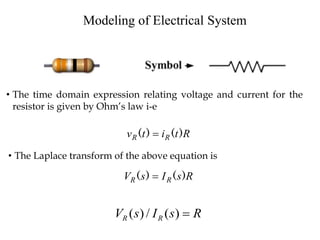
• The time domain expression relating voltage and current for the
resistor is given by Ohm’s law i-e
R
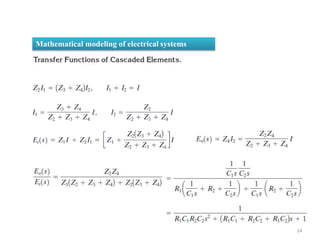
t
i
t
v R
R )
(
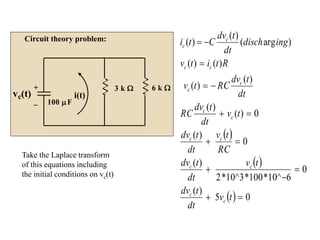
)
( 
• The Laplace transform of the above equation is
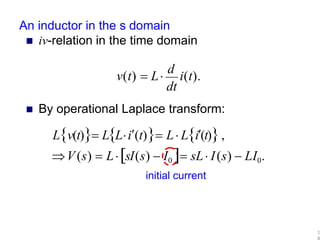
R
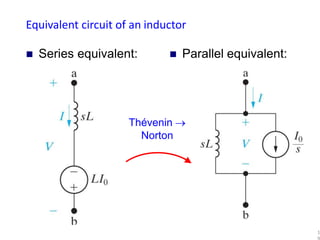
s
I
s
V R
R )
(
)
( 
R
s
I
s
V R
R 
)
(
/
)
(
Basic Elements of Electrical Systems
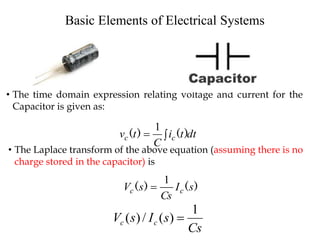
• The time domain expression relating voltage and current for the
Capacitor is given as:
dt
t
i
C
t
v c
c 
 )
(
)
(
1
• The Laplace transform of the above equation (assuming there is no
charge stored in the capacitor) is
)
(
)
( s
I
Cs
s
V c
c
1

Cs
s
I
s
V c
c
1
)
(
/
)
( 
Basic Elements of Electrical Systems
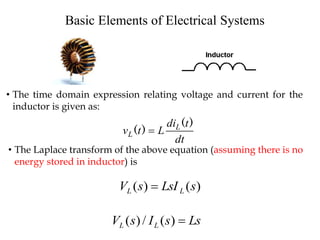
• The time domain expression relating voltage and current for the
inductor is given as:
dt
t
di
L
t
v L
L
)
(
)
( 
• The Laplace transform of the above equation (assuming there is no
energy stored in inductor) is
)
(
)
( s
LsI
s
V L
L 
Ls
s
I
s
V L
L 
)
(
/
)
(
V-I and I-V relations
5
Component Laplace V-I Relation I-V Relation
Resistor R
Capacitor
Inductor
dt
t
di
L
t
v L
L
)
(
)
( 
dt
t
i
C
t
v c
c 
 )
(
)
(
1
R
t
i
t
v R
R )
(
)
( 
R
t
v
t
i R
R
)
(
)
( 
dt
t
dv
C
t
i c
c
)
(
)
( 
dt
t
v
L
t
i L
L 
 )
(
)
(
1
Ls
Cs
1
Example-1
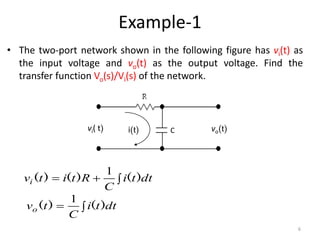
• The two-port network shown in the following figure has vi(t) as
the input voltage and vo(t) as the output voltage. Find the
transfer function Vo(s)/Vi(s) of the network.
6
C
i(t)
vi( t) vo(t)


 dt
t
i
C
R
t
i
t
vi )
(
)
(
)
(
1

 dt
t
i
C
t
vo )
(
)
(
1
Example-1
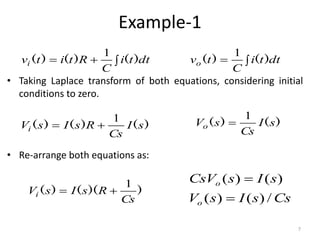
• Taking Laplace transform of both equations, considering initial
conditions to zero.
• Re-arrange both equations as:
7


 dt
t
i
C
R
t
i
t
vi )
(
)
(
)
(
1

 dt
t
i
C
t
vo )
(
)
(
1
)
(
)
(
)
( s
I
Cs
R
s
I
s
Vi
1

 )
(
)
( s
I
Cs
s
Vo
1

Cs
s
I
s
V
s
I
s
CsV
o
o
/
)
(
)
(
)
(
)
(


)
)(
(
)
(
Cs
R
s
I
s
Vi
1


Example-1
• .
8
Cs
s
I
s
Vo /
)
(
)
( 
)
)(
(
)
(
Cs
R
s
I
s
Vi
1


)
(
/
)
( s
V
s
V
nction
TransferFu i
o

)
1
)(
(
/
)
(
)
(
)
(
Cs
R
s
I
Cs
s
I
s
V
s
V
i
o


RCs
s
V
s
V
i
o


1
1
)
(
)
(
)
1
(
1
)
(
)
(
Cs
R
Cs
s
V
s
V
i
o


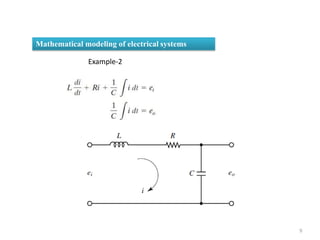
Mathematical modeling of electrical systems
9
Example-2
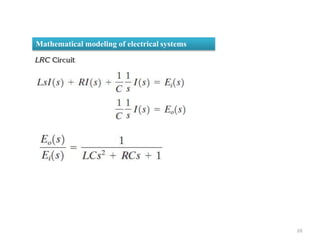
Mathematical modeling of electrical systems
10
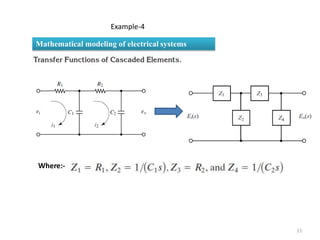
Mathematical modeling of electrical systems
Where:-
11
Example-4
Mathematical modeling of electrical systems
12
Mathematical modeling of electrical systems
13
Mathematical modeling of electrical systems
14
Example-4
Use Laplace transforms to find v(t) for t > 0.
+
_
 

t = 0 6 k 
3 k 
100 F
+
_
v(t)
12 V
volts
v 4
)
0
( 
Circuit theory problem:
+
_
vc(t) i(t)
3 k 
100 F
6 k 
 
 
  0
5
)
(
0
6
^
10
*
100
*
3
^
10
*
2
)
(
0
)
(
0
)
(
)
(
)
(
)
(
)
(
)
(
)
arg
(
)
(
)
(














t
v
dt
t
dv
t
v
dt
t
dv
RC
t
v
dt
t
dv
t
v
dt
t
dv
RC
dt
t
dv
RC
t
v
R
t
i
t
v
ing
disch
dt
t
dv
C
t
i
c
c
c
c
c
c
c
c
c
c
c
c
c
c
Take the Laplace transform
of this equations including
the initial conditions on vc(t)
Circuit theory problem:
)
(
4
)
(
5
4
)
(
0
)
(
5
4
)
(
0
)
(
5
)
(
5
t
u
e
t
v
s
s
V
s
V
s
sV
t
v
dt
t
dv
t
c
c
c
c
c
c









An inductor in the s domain
 iv-relation in the time domain
v(t)  L
d
i(t).
dt
 By operational Laplace transform:
Lv(t) LLi(t) L Li(t),
V(s)  LsI(s)  I0  sL I(s)  LI0.
initial current
1
Equivalent circuit of an inductor
 Series equivalent:  Parallel equivalent:
Thévenin 
Norton
1
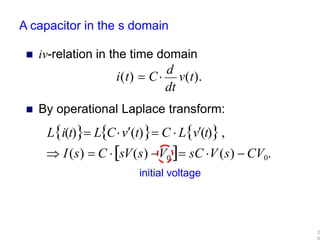
A capacitor in the s domain
 iv-relation in the time domain
i(t)  C
d
v(t).
dt
 By operational Laplace transform:
Li(t) LCv(t) C  Lv(t),
 I(s)  C sV(s) V0  sC V (s)  CV0.
initial voltage
2
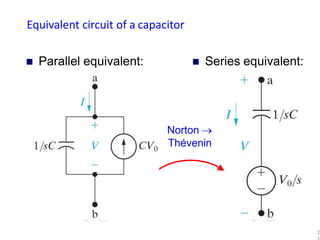
Equivalent circuit of a capacitor
 Parallel equivalent:  Series equivalent:
Norton 
Thévenin
2

modeling of system electrical, Basic Elements Modeling-R,L,C Solved Examples with RLC circuit L, C Modeling with Non-Zero Initial condition

  • 1.
    Modeling of ElectricalSystem •Basic Elements Modeling-R,L,C •Solved Examples with RLC circuit •L, C Modeling with Non-Zero Initial condition 1
  • 2.
    Modeling of ElectricalSystem • The time domain expression relating voltage and current for the resistor is given by Ohm’s law i-e R t i t v R R ) ( ) (  • The Laplace transform of the above equation is R s I s V R R ) ( ) (  R s I s V R R  ) ( / ) (
  • 3.
    Basic Elements ofElectrical Systems • The time domain expression relating voltage and current for the Capacitor is given as: dt t i C t v c c   ) ( ) ( 1 • The Laplace transform of the above equation (assuming there is no charge stored in the capacitor) is ) ( ) ( s I Cs s V c c 1  Cs s I s V c c 1 ) ( / ) ( 
  • 4.
    Basic Elements ofElectrical Systems • The time domain expression relating voltage and current for the inductor is given as: dt t di L t v L L ) ( ) (  • The Laplace transform of the above equation (assuming there is no energy stored in inductor) is ) ( ) ( s LsI s V L L  Ls s I s V L L  ) ( / ) (
  • 5.
    V-I and I-Vrelations 5 Component Laplace V-I Relation I-V Relation Resistor R Capacitor Inductor dt t di L t v L L ) ( ) (  dt t i C t v c c   ) ( ) ( 1 R t i t v R R ) ( ) (  R t v t i R R ) ( ) (  dt t dv C t i c c ) ( ) (  dt t v L t i L L   ) ( ) ( 1 Ls Cs 1
  • 6.
    Example-1 • The two-portnetwork shown in the following figure has vi(t) as the input voltage and vo(t) as the output voltage. Find the transfer function Vo(s)/Vi(s) of the network. 6 C i(t) vi( t) vo(t)    dt t i C R t i t vi ) ( ) ( ) ( 1   dt t i C t vo ) ( ) ( 1
  • 7.
    Example-1 • Taking Laplacetransform of both equations, considering initial conditions to zero. • Re-arrange both equations as: 7    dt t i C R t i t vi ) ( ) ( ) ( 1   dt t i C t vo ) ( ) ( 1 ) ( ) ( ) ( s I Cs R s I s Vi 1   ) ( ) ( s I Cs s Vo 1  Cs s I s V s I s CsV o o / ) ( ) ( ) ( ) (   ) )( ( ) ( Cs R s I s Vi 1  
  • 8.
    Example-1 • . 8 Cs s I s Vo / ) ( ) ( ) )( ( ) ( Cs R s I s Vi 1   ) ( / ) ( s V s V nction TransferFu i o  ) 1 )( ( / ) ( ) ( ) ( Cs R s I Cs s I s V s V i o   RCs s V s V i o   1 1 ) ( ) ( ) 1 ( 1 ) ( ) ( Cs R Cs s V s V i o  
  • 9.
    Mathematical modeling ofelectrical systems 9 Example-2
  • 10.
    Mathematical modeling ofelectrical systems 10
  • 11.
    Mathematical modeling ofelectrical systems Where:- 11 Example-4
  • 12.
    Mathematical modeling ofelectrical systems 12
  • 13.
    Mathematical modeling ofelectrical systems 13
  • 14.
    Mathematical modeling ofelectrical systems 14
  • 15.
    Example-4 Use Laplace transformsto find v(t) for t > 0. + _    t = 0 6 k  3 k  100 F + _ v(t) 12 V volts v 4 ) 0 ( 
  • 16.
    Circuit theory problem: + _ vc(t)i(t) 3 k  100 F 6 k        0 5 ) ( 0 6 ^ 10 * 100 * 3 ^ 10 * 2 ) ( 0 ) ( 0 ) ( ) ( ) ( ) ( ) ( ) ( ) arg ( ) ( ) (               t v dt t dv t v dt t dv RC t v dt t dv t v dt t dv RC dt t dv RC t v R t i t v ing disch dt t dv C t i c c c c c c c c c c c c c c Take the Laplace transform of this equations including the initial conditions on vc(t)
  • 17.
  • 18.
    An inductor inthe s domain  iv-relation in the time domain v(t)  L d i(t). dt  By operational Laplace transform: Lv(t) LLi(t) L Li(t), V(s)  LsI(s)  I0  sL I(s)  LI0. initial current 1
  • 19.
    Equivalent circuit ofan inductor  Series equivalent:  Parallel equivalent: Thévenin  Norton 1
  • 20.
    A capacitor inthe s domain  iv-relation in the time domain i(t)  C d v(t). dt  By operational Laplace transform: Li(t) LCv(t) C  Lv(t),  I(s)  C sV(s) V0  sC V (s)  CV0. initial voltage 2
  • 21.
    Equivalent circuit ofa capacitor  Parallel equivalent:  Series equivalent: Norton  Thévenin 2