Design Via Root Locus
Dr.R.Subasri
Professor, Kongu Engineering College,
Perundurai, Erode, Tamilnadu, INDIA
Dr.R.Subasri.KEC,INDIA
•The root locus typically allows us to choose the
proper loop gain to meet a transient response
specification.
•As the gain is varied, we move through different
regions of response.
•Setting the gain at a particular value yields the
transient response dictated by the poles at that
point on the root locus.
•Thus, we are limited to those responses that
exist along the root locus.
Design Via Root locus
Dr.R.Subasri.KEC,INDIA
Design K such that the settling time is 2.5 sec and
damping ratio is 0.6 in closed loop
k
G(s)H(s)
s(s 2)(s 4)

 
s
n
n
n
2
n n
4
t 2.5
δω
4
δω 1.6
2.5
1.6
ω 2.667
0.6
Required closed loop pole :-δω jω 1 δ
 
 
 
 
-1.6j2128
This closed loop pole should lie on the root locus
Dr.R.Subasri.KEC,INDIA
But , the closed loop pole lie on root locus along 0.6 damping ratio line is
-0.714 +0.926i
The settling time is 5.5 sec. The equivalent K value cannot be obtained
Dr.R.Subasri.KEC,INDIA
One way to solve our problem is to replace the existing
system with a system whose root locus intersects the
desired design point, B. Unfortunately, this replacement is
expensive and counterproductive.
Rather than change the existing system, we augment, or
compensate, the system with additional poles and zeros,
so that the compensated system has a root locus that
goes through the desired pole location for some value of
gain.
Dr.R.Subasri.KEC,INDIA
Both methods change the open-loop poles and zeros,
thereby creating a new root locus that goes through the
desired closed-loop pole location.
Compensators that use pure integration for improving
steady-state error or pure differentiation for improving
transient response are defined as ideal compensators
Ideal compensators must be implemented with active
networks, which, in the case of electric networks, require
the use of active amplifiers and possible additional power
sources
Dr.R.Subasri.KEC,INDIA
An advantage of ideal integral compensators is that
steady-state error is reduced to zero.
Compensators implemented with passive elements such
as resistors and capacitors are not ideal compensators.
Advantages of passive networks are that they are less
expensive and do not require additional power sources for
their operation.
Their disadvantage is that the steady-state error is not
driven to zero
Dr.R.Subasri.KEC,INDIA
Systems that feed the integral of the error to the plant
are called integral control systems.
Thus, we use the name PI controller interchangeably with
ideal integral compensator, and we use the name lag
compensator when the cascade compensator does not
employ pure integration.
Improving Steady-State Error
via Cascade Compensation
Dr.R.Subasri.KEC,INDIA
Lag Compensation
Ideal integral compensation-with its pole on the origin-
active network
passive networks- the pole and zero are moved to the left,
close to the origin, as shown
This placement of the pole and zero although it does
not increase the system type, does yield an
improvement in the static error constant over an
uncompensated system.
Dr.R.Subasri.KEC,INDIA
In order to reduce the steady state error,
the gain is increased.
The compensated steady state gain Kpc =
p times the uncompensated gain kpu
The factor p = Zc/Pc
For the lag compensator pole should be
nearer to origin compared to zero.
Also both compensator pole and zero should
be close to origin to retain the transient
response specifications.Dr.R.Subasri.KEC,INDIA
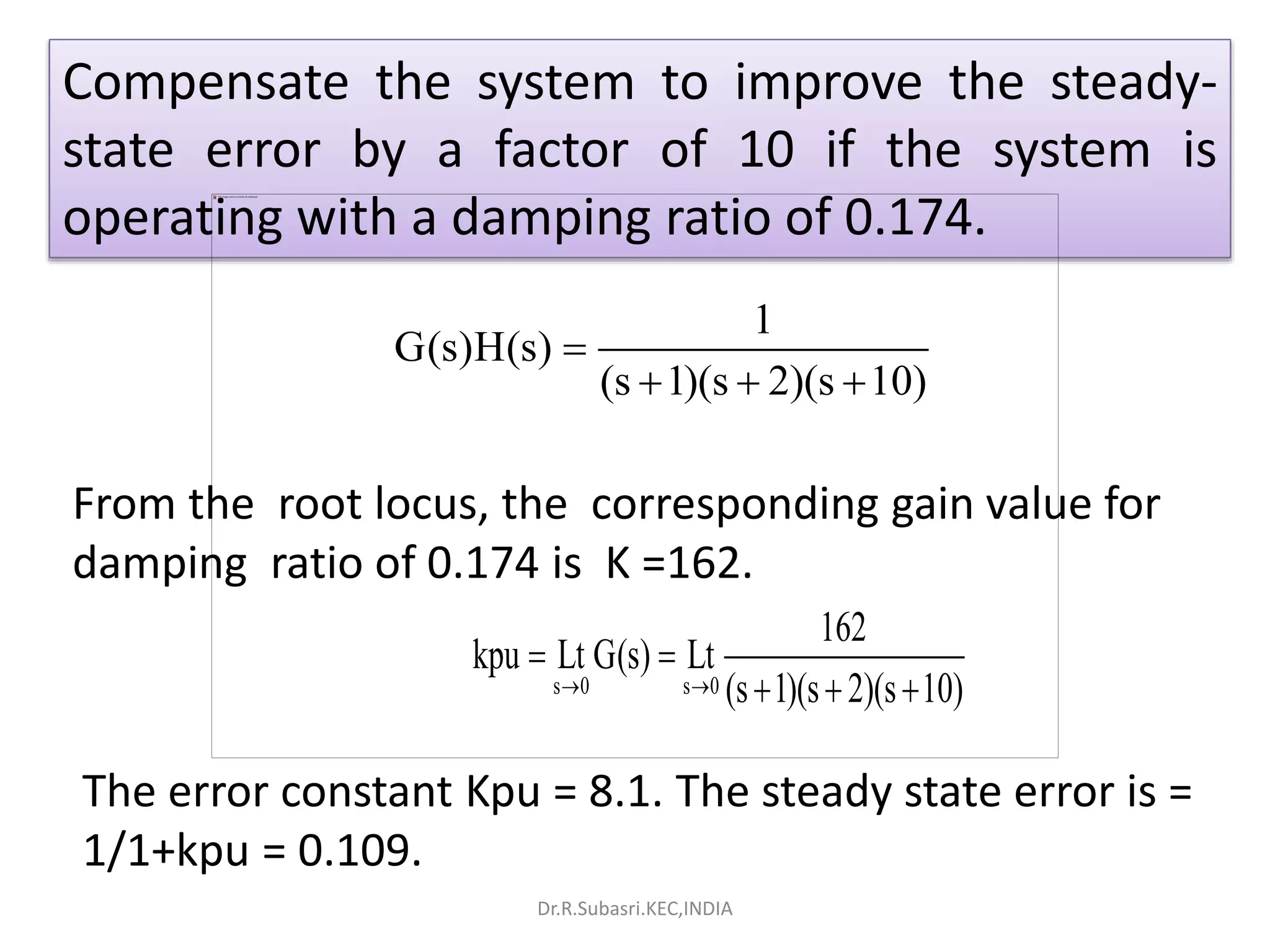
1
G(s)H(s)
(s 1)(s 2)(s 10)

  
Compensate the system to improve the steady-
state error by a factor of 10 if the system is
operating with a damping ratio of 0.174.
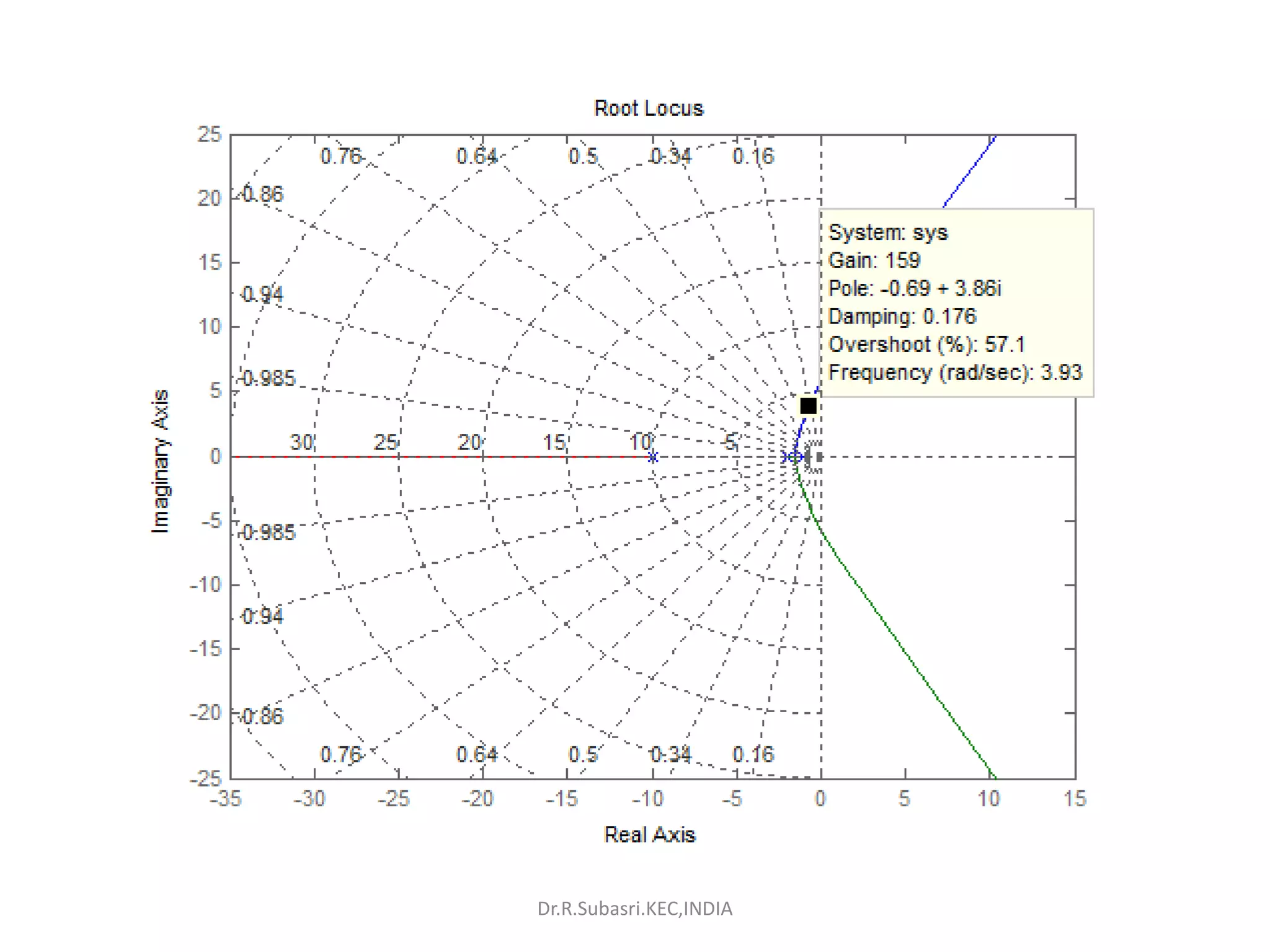
From the root locus, the corresponding gain value for
damping ratio of 0.174 is K =162.
The error constant Kpu = 8.1. The steady state error is =
1/1+kpu = 0.109.
s 0 s 0
162
kpu Lt G(s) Lt
(s 1)(s 2)(s 10) 
 
  
Dr.R.Subasri.KEC,INDIA
pc
pu
K 91.59
11.3
K 8.1
 
c
c
Z
11.3 β
P
 
To improve the steady state error requires to reduce the
error by 10 times = 0.0109.
The equivalent Kpc = 91.59
Construct a line at an angle of 10 (or less) with  line
from sd. Intersection with real axis is the compensator
zero(zc)
The compensator pole (pc) = zc/
The open loop transfer function of the compensated
system is
c
c
c
s z
G (s) K G(s)
s p



Dr.R.Subasri.KEC,INDIA
Improving Transient Response via Cascade
Compensation- Lead Compensator
The objective is to design a response that has a desirable
percent overshoot and a shorter settling time than the
uncompensated system.
For this, ideal derivative compensation, a pure
differentiator (a proportional-plus-derivative (PD)
controller) is added to the forward path of the feedback
control system.
Adding differentiation is the addition of a zero to the
forward-path transfer function (s+Zc). This type of
compensation requires an active network for its
realization. Dr.R.Subasri.KEC,INDIA
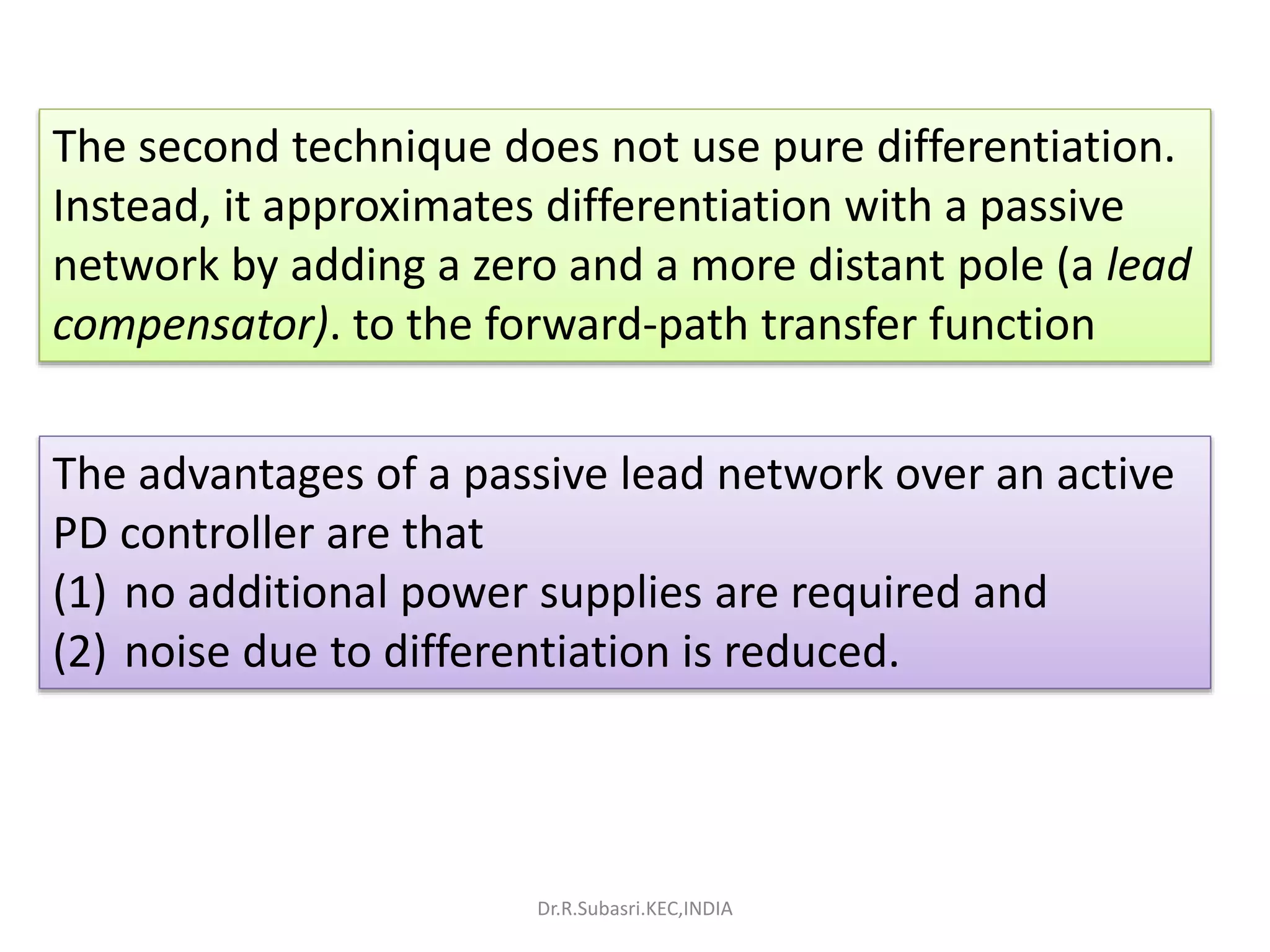
The second technique does not use pure differentiation.
Instead, it approximates differentiation with a passive
network by adding a zero and a more distant pole (a lead
compensator). to the forward-path transfer function
The advantages of a passive lead network over an active
PD controller are that
(1) no additional power supplies are required and
(2) noise due to differentiation is reduced.
Dr.R.Subasri.KEC,INDIA
Lead Compensator
Select a desired dominant, second-order pole on the s-
plane from the given specifications

The sum of the angles from the uncompensated
system's poles and zeros to the design point can be
found
The difference between 180° and the sum of the
angles must be the angular contribution required
of the compensator.
Dr.R.Subasri.KEC,INDIA
Design a lead compensator for the given system that will
reduce the settling time ts by a factor of 2 while maintaining
the overshoot as 30%.
k
G(s)
s(s 4)(s 6)

 
1. Draw root locus for the given system
2. Translate the transient response specifications into a pair of
complex dominant root
Given overshoot = 0.30.
Determine the equivalent damping ratio  =0.36
find = cos-1()
Draw a  line with an angle of cos-1() from the negative real
axis. The point of intersection of  line on the root locus, is the
complex dominant root (sd).
Sd =-1.01+j2.6
2
d n ns δω jω 1 δ   
Dr.R.Subasri.KEC,INDIA
3. Calculate settling time ts= 4/ n =4/1.01 =3.96 sec
required settling time = tsn =ts/2 =3.96/2 =1.98sec
Determine the desired dominant root with the revised settling
time tsn :
Real part n = 4/1.98 = 2.02
desired dominant root -2.02+j6Dr.R.Subasri.KEC,INDIA
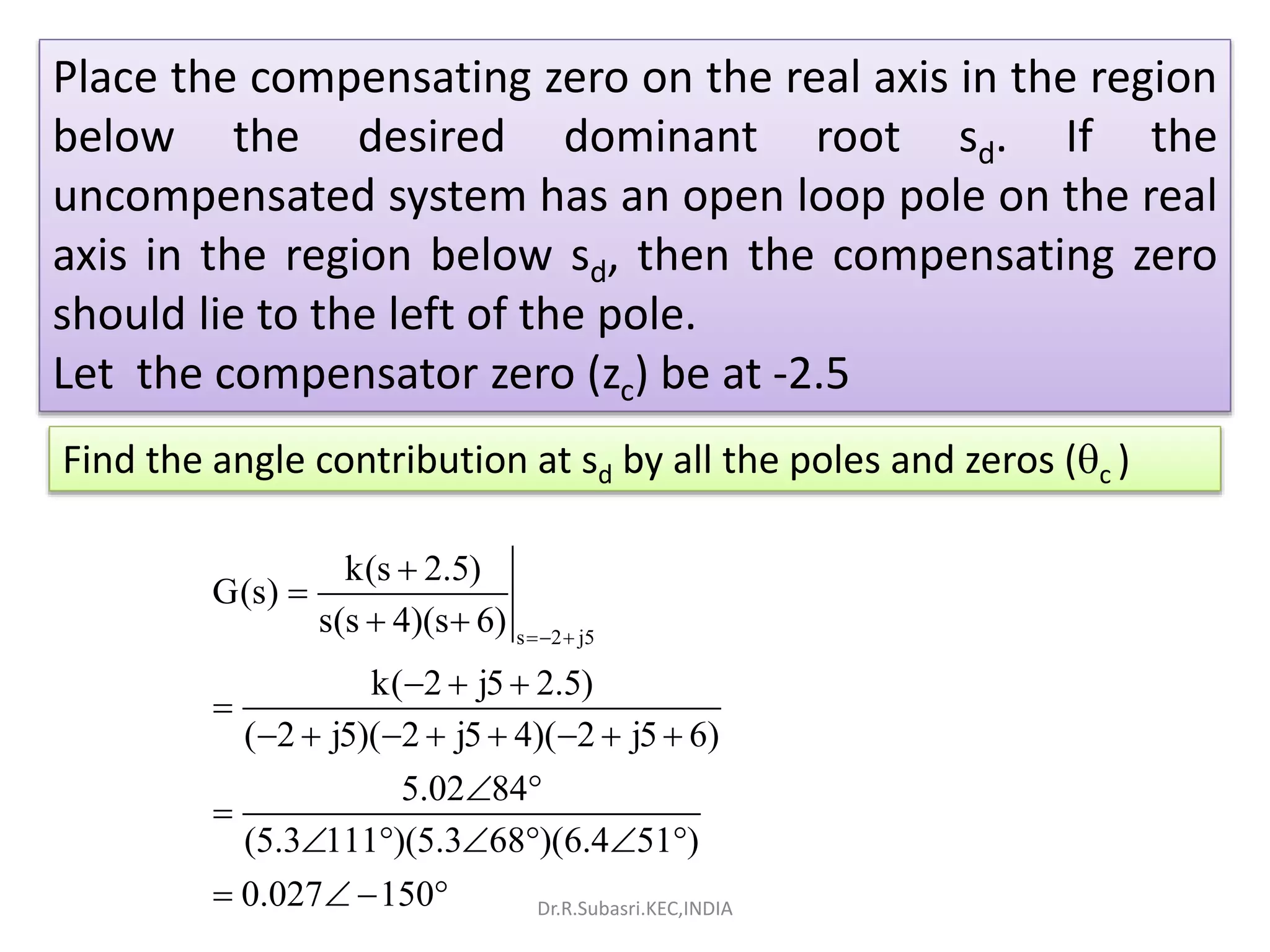
Place the compensating zero on the real axis in the region
below the desired dominant root sd. If the
uncompensated system has an open loop pole on the real
axis in the region below sd, then the compensating zero
should lie to the left of the pole.
Let the compensator zero (zc) be at -2.5
Find the angle contribution at sd by all the poles and zeros (c )
s 2 j5
k(s 2.5)
G(s)
s(s 4)(s 6)
k( 2 j5 2.5)
( 2 j5)( 2 j5 4)( 2 j5 6)
5.02 84
(5.3 111 )(5.3 68 )(6.4 51 )
0.027 150
 


 
  

       
 

     
    Dr.R.Subasri.KEC,INDIA
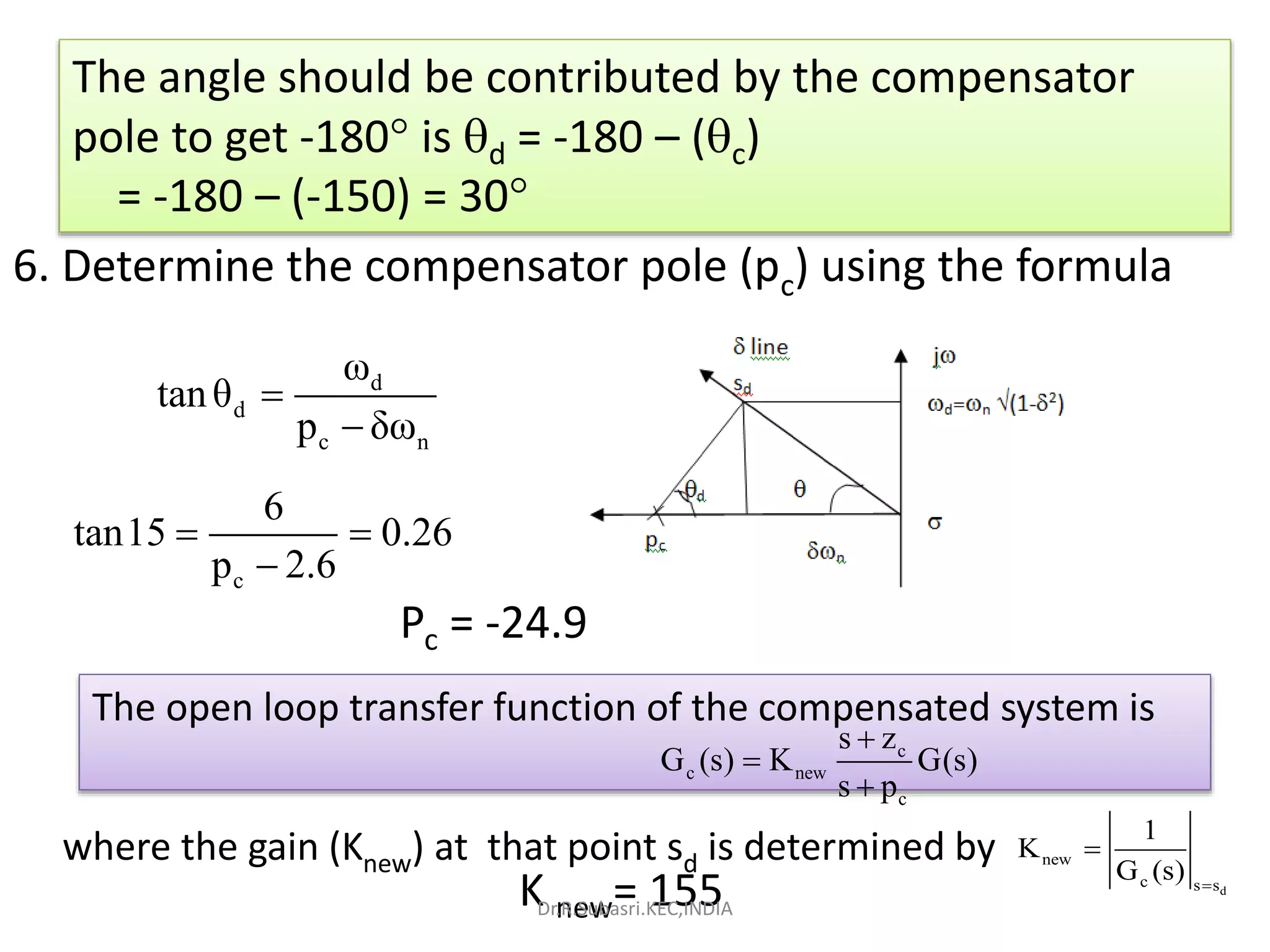
The angle should be contributed by the compensator
pole to get -180 is d = -180 – (c)
= -180 – (-150) = 30
6. Determine the compensator pole (pc) using the formula
d
d
c n
ω
tanθ
p δω


c
6
tan15 0.26
p 2.6
 

Pc = -24.9
The open loop transfer function of the compensated system is
c
c new
c
s z
G (s) K G(s)
s p



where the gain (Knew) at that point sd is determined by
d
new
c s s
1
K
G (s) 

K new= 155Dr.R.Subasri.KEC,INDIA
Dr.R.Subasri.KEC,INDIA
Thank you

Root locus compensation

  • 1.
    Design Via RootLocus Dr.R.Subasri Professor, Kongu Engineering College, Perundurai, Erode, Tamilnadu, INDIA Dr.R.Subasri.KEC,INDIA
  • 2.
    •The root locustypically allows us to choose the proper loop gain to meet a transient response specification. •As the gain is varied, we move through different regions of response. •Setting the gain at a particular value yields the transient response dictated by the poles at that point on the root locus. •Thus, we are limited to those responses that exist along the root locus. Design Via Root locus Dr.R.Subasri.KEC,INDIA
  • 3.
    Design K suchthat the settling time is 2.5 sec and damping ratio is 0.6 in closed loop k G(s)H(s) s(s 2)(s 4)    s n n n 2 n n 4 t 2.5 δω 4 δω 1.6 2.5 1.6 ω 2.667 0.6 Required closed loop pole :-δω jω 1 δ         -1.6j2128 This closed loop pole should lie on the root locus Dr.R.Subasri.KEC,INDIA
  • 4.
    But , theclosed loop pole lie on root locus along 0.6 damping ratio line is -0.714 +0.926i The settling time is 5.5 sec. The equivalent K value cannot be obtained Dr.R.Subasri.KEC,INDIA
  • 5.
    One way tosolve our problem is to replace the existing system with a system whose root locus intersects the desired design point, B. Unfortunately, this replacement is expensive and counterproductive. Rather than change the existing system, we augment, or compensate, the system with additional poles and zeros, so that the compensated system has a root locus that goes through the desired pole location for some value of gain. Dr.R.Subasri.KEC,INDIA
  • 6.
    Both methods changethe open-loop poles and zeros, thereby creating a new root locus that goes through the desired closed-loop pole location. Compensators that use pure integration for improving steady-state error or pure differentiation for improving transient response are defined as ideal compensators Ideal compensators must be implemented with active networks, which, in the case of electric networks, require the use of active amplifiers and possible additional power sources Dr.R.Subasri.KEC,INDIA
  • 7.
    An advantage ofideal integral compensators is that steady-state error is reduced to zero. Compensators implemented with passive elements such as resistors and capacitors are not ideal compensators. Advantages of passive networks are that they are less expensive and do not require additional power sources for their operation. Their disadvantage is that the steady-state error is not driven to zero Dr.R.Subasri.KEC,INDIA
  • 8.
    Systems that feedthe integral of the error to the plant are called integral control systems. Thus, we use the name PI controller interchangeably with ideal integral compensator, and we use the name lag compensator when the cascade compensator does not employ pure integration. Improving Steady-State Error via Cascade Compensation Dr.R.Subasri.KEC,INDIA
  • 9.
    Lag Compensation Ideal integralcompensation-with its pole on the origin- active network passive networks- the pole and zero are moved to the left, close to the origin, as shown This placement of the pole and zero although it does not increase the system type, does yield an improvement in the static error constant over an uncompensated system. Dr.R.Subasri.KEC,INDIA
  • 10.
    In order toreduce the steady state error, the gain is increased. The compensated steady state gain Kpc = p times the uncompensated gain kpu The factor p = Zc/Pc For the lag compensator pole should be nearer to origin compared to zero. Also both compensator pole and zero should be close to origin to retain the transient response specifications.Dr.R.Subasri.KEC,INDIA
  • 11.
    1 G(s)H(s) (s 1)(s 2)(s10)     Compensate the system to improve the steady- state error by a factor of 10 if the system is operating with a damping ratio of 0.174. From the root locus, the corresponding gain value for damping ratio of 0.174 is K =162. The error constant Kpu = 8.1. The steady state error is = 1/1+kpu = 0.109. s 0 s 0 162 kpu Lt G(s) Lt (s 1)(s 2)(s 10)       Dr.R.Subasri.KEC,INDIA
  • 12.
  • 13.
    pc pu K 91.59 11.3 K 8.1  c c Z 11.3 β P   To improve the steady state error requires to reduce the error by 10 times = 0.0109. The equivalent Kpc = 91.59 Construct a line at an angle of 10 (or less) with  line from sd. Intersection with real axis is the compensator zero(zc) The compensator pole (pc) = zc/ The open loop transfer function of the compensated system is c c c s z G (s) K G(s) s p    Dr.R.Subasri.KEC,INDIA
  • 14.
  • 15.
    Improving Transient Responsevia Cascade Compensation- Lead Compensator The objective is to design a response that has a desirable percent overshoot and a shorter settling time than the uncompensated system. For this, ideal derivative compensation, a pure differentiator (a proportional-plus-derivative (PD) controller) is added to the forward path of the feedback control system. Adding differentiation is the addition of a zero to the forward-path transfer function (s+Zc). This type of compensation requires an active network for its realization. Dr.R.Subasri.KEC,INDIA
  • 16.
    The second techniquedoes not use pure differentiation. Instead, it approximates differentiation with a passive network by adding a zero and a more distant pole (a lead compensator). to the forward-path transfer function The advantages of a passive lead network over an active PD controller are that (1) no additional power supplies are required and (2) noise due to differentiation is reduced. Dr.R.Subasri.KEC,INDIA
  • 17.
    Lead Compensator Select adesired dominant, second-order pole on the s- plane from the given specifications The sum of the angles from the uncompensated system's poles and zeros to the design point can be found The difference between 180° and the sum of the angles must be the angular contribution required of the compensator. Dr.R.Subasri.KEC,INDIA
  • 18.
    Design a leadcompensator for the given system that will reduce the settling time ts by a factor of 2 while maintaining the overshoot as 30%. k G(s) s(s 4)(s 6)    1. Draw root locus for the given system 2. Translate the transient response specifications into a pair of complex dominant root Given overshoot = 0.30. Determine the equivalent damping ratio  =0.36 find = cos-1() Draw a  line with an angle of cos-1() from the negative real axis. The point of intersection of  line on the root locus, is the complex dominant root (sd). Sd =-1.01+j2.6 2 d n ns δω jω 1 δ    Dr.R.Subasri.KEC,INDIA
  • 19.
  • 20.
    3. Calculate settlingtime ts= 4/ n =4/1.01 =3.96 sec required settling time = tsn =ts/2 =3.96/2 =1.98sec Determine the desired dominant root with the revised settling time tsn : Real part n = 4/1.98 = 2.02 desired dominant root -2.02+j6Dr.R.Subasri.KEC,INDIA
  • 21.
    Place the compensatingzero on the real axis in the region below the desired dominant root sd. If the uncompensated system has an open loop pole on the real axis in the region below sd, then the compensating zero should lie to the left of the pole. Let the compensator zero (zc) be at -2.5 Find the angle contribution at sd by all the poles and zeros (c ) s 2 j5 k(s 2.5) G(s) s(s 4)(s 6) k( 2 j5 2.5) ( 2 j5)( 2 j5 4)( 2 j5 6) 5.02 84 (5.3 111 )(5.3 68 )(6.4 51 ) 0.027 150                                Dr.R.Subasri.KEC,INDIA
  • 22.
    The angle shouldbe contributed by the compensator pole to get -180 is d = -180 – (c) = -180 – (-150) = 30 6. Determine the compensator pole (pc) using the formula d d c n ω tanθ p δω   c 6 tan15 0.26 p 2.6    Pc = -24.9 The open loop transfer function of the compensated system is c c new c s z G (s) K G(s) s p    where the gain (Knew) at that point sd is determined by d new c s s 1 K G (s)   K new= 155Dr.R.Subasri.KEC,INDIA
  • 23.
  • 24.