INTRODUCTION
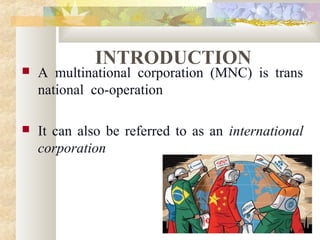
 A multinational corporation (MNC) is trans
national co-operation
 It can also be referred to as an international
corporation
Definition
 Multinational corporation (MNC) is a
enterprise that manages production or
delivers services in more than one country
can also be referred to as an international
corporation.
MULTI-NATIONALS
 A MNC is a business which owns or controls
production or service facilities outside the
country in which it is based.
 This means that they do not just
export their products, but make
them abroad.
 Usually have interests in at least
4 countries, but most operate in
more than this
History And Evolution of MNCs:
 These corporations originated early in the 20th
century and expanded after World War II.
 A multinational corporation developed new
products in its native country and manufactured
them abroad.
 Almost all the earliest and largest multinational
firms were either American, Japanese, or West
European.
Features of MNC
1. Big size
2. Huge intellectual capital
3. Operates in many countries
4. Large number of customer
5. Large number of competitors
6. Structured way of decision making
Multinational corporation
structure:
Multinational corporate structure
 Horizontally integrated multinational
corporations manage production establishments
located in different countries to produce the same or
similar products. (example: McDonald's)
 Vertically integrated multinational corporations
manage production establishment in certain
country/countries to produce products that serve as
input to its production establishments in other
country/countries. (example: Adidas)
Multinational corporate structure
(Contd..)
 Diversified multinational corporations manage
production establishments located in different
countries that are neither horizontally nor
vertically nor straight, nor non-straight integrated.
(example: Hilton Hotels)
MNC’s use five alternatives to organize their
operations in different countries
 Enabled by Internet based communication tools, a new
breed of multinational companies is growing in numbers.
 They are small businesses.
 Internet tools like Google, Yahoo, MSN, Ebay and
Amazon make it easier for the micro-multinationals to
reach potential customers in other countries.
Micro Multinationals
objectives
 To expand the business beyond
the boundaries of the home
country.
 Minimize cost of production,
especially labour cost.
 Avail of competitive advantage
internationally.
objectives
 Achieve greater efficiency by
producing in local market and
then exporting the products.
 Make best use of technological
advantages by setting up
production facilities abroad.
Reasons for The Establishment of
MNCs
 To increase market share.
 To secure cheaper premises and labour.
 Employment and Health & Safety Legislations in
other countries may be more relaxed.
 To avoid or minimise the amount of tax to be
paid.
 To take advantage of government grants available.
Conti...
 To save on costs of transporting goods to
the market place.
 To develop an international brand.
SWOT Analysis of MNCs:
Strengths
• Low Cost
• Well Developed
Infrastructure
Weakness
• Location is often very distant
• Lack of Transportation facilities
Opportunities
•Attract new industries
Threats
• Govt. restrictions
•Quotas
Advantages of MNCs to the Host
Country
 Greater employment and career opportunities are
provided by these MNC’s.
 MNC’s have become vehicles of technology to the
developing countries
 Often more efficient than local companies;
 They can lead to the introduction of new
management techniques;
 Often export their output therefore help the
Balance of Payments;
 They can lead to new businesses being set up
locally once people have learned new skills.
 Help to trade in international market
 Introduces with new products
 Improves financial status
 Foreign exchange gap is reduced
 Boosts up basic economic structure
 Natural resources are utilized
 Reduce technological gap
Disadvantages of MNCs
 They are very powerful and can influence the
government of a country;
 Local employment can be dependent on one large
employer;
 They may use up natural resources which may not
be renewable;
 They can force local firms out of business;
 The profit they make goes back to the ‘home’
country;
 They can be ‘footloose’ and may move to another
country if better incentives offered.
 MNC’s create monopolies in the market and
eliminate local competitors.
Advantages of MNCs to the Host
Country:
 Transfer of technology, capital and
entrepreneurship.
 Increase in the investment level and thus, the
income and employment in the host country.
 Greater availability of products for local
consumers.
 Increase in exports and decrease in imports.
Advantages of MNCs to the
Home Country.
 Acquisition of raw materials from
abroad.
 Technology and management expertise
acquired from competing in global
markets.
 Export of components and finished
Disadvantages of MNCs:
 Trade restrictions imposed at the government-level
 Limited quantities (quotas) of imports.
 Effective management of a globally dispersed
organization.
 Slow down in the growth of employment in home
countries.
 Destroy competition and acquire monopoly.
MNC In India
 MNC in India are attracted
towards:
 India’s large market potential
 India presents a remarkable
business opportunity by virtue
of its sheer size and growth
 Labor competiveness
 FDI attractiveness
MNC In India(Contd…)
 India’s vast population is
increasing its purchasing power
 India is also emerging as the
manufacturing and sourcing
location of choice for various
industries
WORLD’S TOP MNCs:
Fortune Global 500 List 2011: Top
10
RANK COMPANY COUNTRY FIELD
1 Wal-Mart Stores United States Retail
2 Royal Dutch Shell Netherlands Petroleum
3 Exxon Mobil United States Petroleum
4 BP United Kingdom Petroleum
5 Sinopec China Petroleum
6
China National
Petroleum
China Petroleum
7 State Grid China Power
8 Toyota Motor Japan Automobiles
9 Japan Post Holdings Japan Diversified
10 Chevron United States Petroleum
Fortune Global 500 2011: Country
wise:
RANK COUNTRY NUMBER OF
COMPANIES
1 United States 133
2 Japan 68
3 China 61
4 France 35
5 Germany 34
6 United Kingdom 30
7 Switzerland 15
8 South Korea 14
9 Netherlands 12
10 Canada 11
The Indian MNCs ………………
 Paints – Asian Paints
 Auto & Components – Tata Motors, Bharat
Forge
 Chemicals – Tata Chemicals, United
Phosphorus
 Metals – Sterlite Industries, TISCO
 Packaging – Essel
 Pharmaceuticals – Ranbaxy, Wockhardt, Sun,
DRL
 Oil & Gas – ONGC
What India offers??? One billion plus population.
 India is ranked as the 10th largest economy, 4th largest in
terms of Purchasing Power Parity.
 250-300 million middle class.
 Gross Domestic Product (GDP) is growing at over 7-9 %,
making it one of the fastest growing economies in the
world.
 Opportunities for U.S. exporters with the right products or
services.
 Easier access to capital.
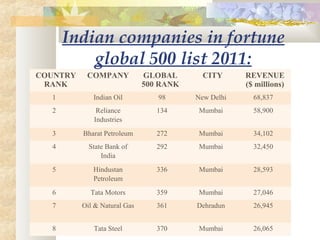
Indian companies in fortune
global 500 list 2011:
COUNTRY
RANK
COMPANY GLOBAL
500 RANK
CITY REVENUE
($ millions)
1 Indian Oil 98 New Delhi 68,837
2 Reliance
Industries
134 Mumbai 58,900
3 Bharat Petroleum 272 Mumbai 34,102
4 State Bank of
India
292 Mumbai 32,450
5 Hindustan
Petroleum
336 Mumbai 28,593
6 Tata Motors 359 Mumbai 27,046
7 Oil & Natural Gas 361 Dehradun 26,945
8 Tata Steel 370 Mumbai 26,065
MNC

MNC

  • 1.
    INTRODUCTION  A multinationalcorporation (MNC) is trans national co-operation  It can also be referred to as an international corporation
  • 2.
    Definition  Multinational corporation(MNC) is a enterprise that manages production or delivers services in more than one country can also be referred to as an international corporation.
  • 3.
    MULTI-NATIONALS  A MNCis a business which owns or controls production or service facilities outside the country in which it is based.  This means that they do not just export their products, but make them abroad.  Usually have interests in at least 4 countries, but most operate in more than this
  • 4.
    History And Evolutionof MNCs:  These corporations originated early in the 20th century and expanded after World War II.  A multinational corporation developed new products in its native country and manufactured them abroad.  Almost all the earliest and largest multinational firms were either American, Japanese, or West European.
  • 5.
    Features of MNC 1.Big size 2. Huge intellectual capital 3. Operates in many countries 4. Large number of customer 5. Large number of competitors 6. Structured way of decision making
  • 6.
  • 7.
    Multinational corporate structure Horizontally integrated multinational corporations manage production establishments located in different countries to produce the same or similar products. (example: McDonald's)  Vertically integrated multinational corporations manage production establishment in certain country/countries to produce products that serve as input to its production establishments in other country/countries. (example: Adidas)
  • 8.
    Multinational corporate structure (Contd..) Diversified multinational corporations manage production establishments located in different countries that are neither horizontally nor vertically nor straight, nor non-straight integrated. (example: Hilton Hotels)
  • 9.
    MNC’s use fivealternatives to organize their operations in different countries
  • 10.
     Enabled byInternet based communication tools, a new breed of multinational companies is growing in numbers.  They are small businesses.  Internet tools like Google, Yahoo, MSN, Ebay and Amazon make it easier for the micro-multinationals to reach potential customers in other countries. Micro Multinationals
  • 11.
    objectives  To expandthe business beyond the boundaries of the home country.  Minimize cost of production, especially labour cost.  Avail of competitive advantage internationally.
  • 12.
    objectives  Achieve greaterefficiency by producing in local market and then exporting the products.  Make best use of technological advantages by setting up production facilities abroad.
  • 13.
    Reasons for TheEstablishment of MNCs  To increase market share.  To secure cheaper premises and labour.  Employment and Health & Safety Legislations in other countries may be more relaxed.  To avoid or minimise the amount of tax to be paid.  To take advantage of government grants available. Conti...
  • 14.
     To saveon costs of transporting goods to the market place.  To develop an international brand.
  • 16.
    SWOT Analysis ofMNCs: Strengths • Low Cost • Well Developed Infrastructure Weakness • Location is often very distant • Lack of Transportation facilities Opportunities •Attract new industries Threats • Govt. restrictions •Quotas
  • 19.
    Advantages of MNCsto the Host Country  Greater employment and career opportunities are provided by these MNC’s.  MNC’s have become vehicles of technology to the developing countries  Often more efficient than local companies;  They can lead to the introduction of new management techniques;  Often export their output therefore help the Balance of Payments;  They can lead to new businesses being set up locally once people have learned new skills.
  • 20.
     Help totrade in international market  Introduces with new products  Improves financial status  Foreign exchange gap is reduced  Boosts up basic economic structure  Natural resources are utilized  Reduce technological gap
  • 21.
    Disadvantages of MNCs They are very powerful and can influence the government of a country;  Local employment can be dependent on one large employer;  They may use up natural resources which may not be renewable;  They can force local firms out of business;  The profit they make goes back to the ‘home’ country;  They can be ‘footloose’ and may move to another country if better incentives offered.  MNC’s create monopolies in the market and eliminate local competitors.
  • 23.
    Advantages of MNCsto the Host Country:  Transfer of technology, capital and entrepreneurship.  Increase in the investment level and thus, the income and employment in the host country.  Greater availability of products for local consumers.  Increase in exports and decrease in imports.
  • 24.
    Advantages of MNCsto the Home Country.  Acquisition of raw materials from abroad.  Technology and management expertise acquired from competing in global markets.  Export of components and finished
  • 25.
    Disadvantages of MNCs: Trade restrictions imposed at the government-level  Limited quantities (quotas) of imports.  Effective management of a globally dispersed organization.  Slow down in the growth of employment in home countries.  Destroy competition and acquire monopoly.
  • 26.
    MNC In India MNC in India are attracted towards:  India’s large market potential  India presents a remarkable business opportunity by virtue of its sheer size and growth  Labor competiveness  FDI attractiveness
  • 27.
    MNC In India(Contd…) India’s vast population is increasing its purchasing power  India is also emerging as the manufacturing and sourcing location of choice for various industries
  • 28.
  • 29.
    Fortune Global 500List 2011: Top 10 RANK COMPANY COUNTRY FIELD 1 Wal-Mart Stores United States Retail 2 Royal Dutch Shell Netherlands Petroleum 3 Exxon Mobil United States Petroleum 4 BP United Kingdom Petroleum 5 Sinopec China Petroleum 6 China National Petroleum China Petroleum 7 State Grid China Power 8 Toyota Motor Japan Automobiles 9 Japan Post Holdings Japan Diversified 10 Chevron United States Petroleum
  • 30.
    Fortune Global 5002011: Country wise: RANK COUNTRY NUMBER OF COMPANIES 1 United States 133 2 Japan 68 3 China 61 4 France 35 5 Germany 34 6 United Kingdom 30 7 Switzerland 15 8 South Korea 14 9 Netherlands 12 10 Canada 11
  • 32.
    The Indian MNCs………………  Paints – Asian Paints  Auto & Components – Tata Motors, Bharat Forge  Chemicals – Tata Chemicals, United Phosphorus  Metals – Sterlite Industries, TISCO  Packaging – Essel  Pharmaceuticals – Ranbaxy, Wockhardt, Sun, DRL  Oil & Gas – ONGC
  • 33.
    What India offers???One billion plus population.  India is ranked as the 10th largest economy, 4th largest in terms of Purchasing Power Parity.  250-300 million middle class.  Gross Domestic Product (GDP) is growing at over 7-9 %, making it one of the fastest growing economies in the world.  Opportunities for U.S. exporters with the right products or services.  Easier access to capital.
  • 34.
    Indian companies infortune global 500 list 2011: COUNTRY RANK COMPANY GLOBAL 500 RANK CITY REVENUE ($ millions) 1 Indian Oil 98 New Delhi 68,837 2 Reliance Industries 134 Mumbai 58,900 3 Bharat Petroleum 272 Mumbai 34,102 4 State Bank of India 292 Mumbai 32,450 5 Hindustan Petroleum 336 Mumbai 28,593 6 Tata Motors 359 Mumbai 27,046 7 Oil & Natural Gas 361 Dehradun 26,945 8 Tata Steel 370 Mumbai 26,065