NAME:- SHANTANU TYAGI
CLASS:- 11-B


SCHOOL:- GREEN FEILDS SCHOOL
MULTINATIONAL
  COMPANIES
OVERVIEW

 What is MNC?
 History and Evolution of MNC

 MNC Structure.

 Organization of MNC.

 SWOT Analysis of MNC.

 Reasons for establishment of MNC.

 Advantage and Disadvantage of MNC

 Criticism of MNC.

 MNCs in India.
WHAT IS A MULTINATIONAL
         CORPORATION???
   It is a corporation that:


      Manages            And/or
                                  Delivers
     production                   services


                    In more than
                     one country
DEFINITION
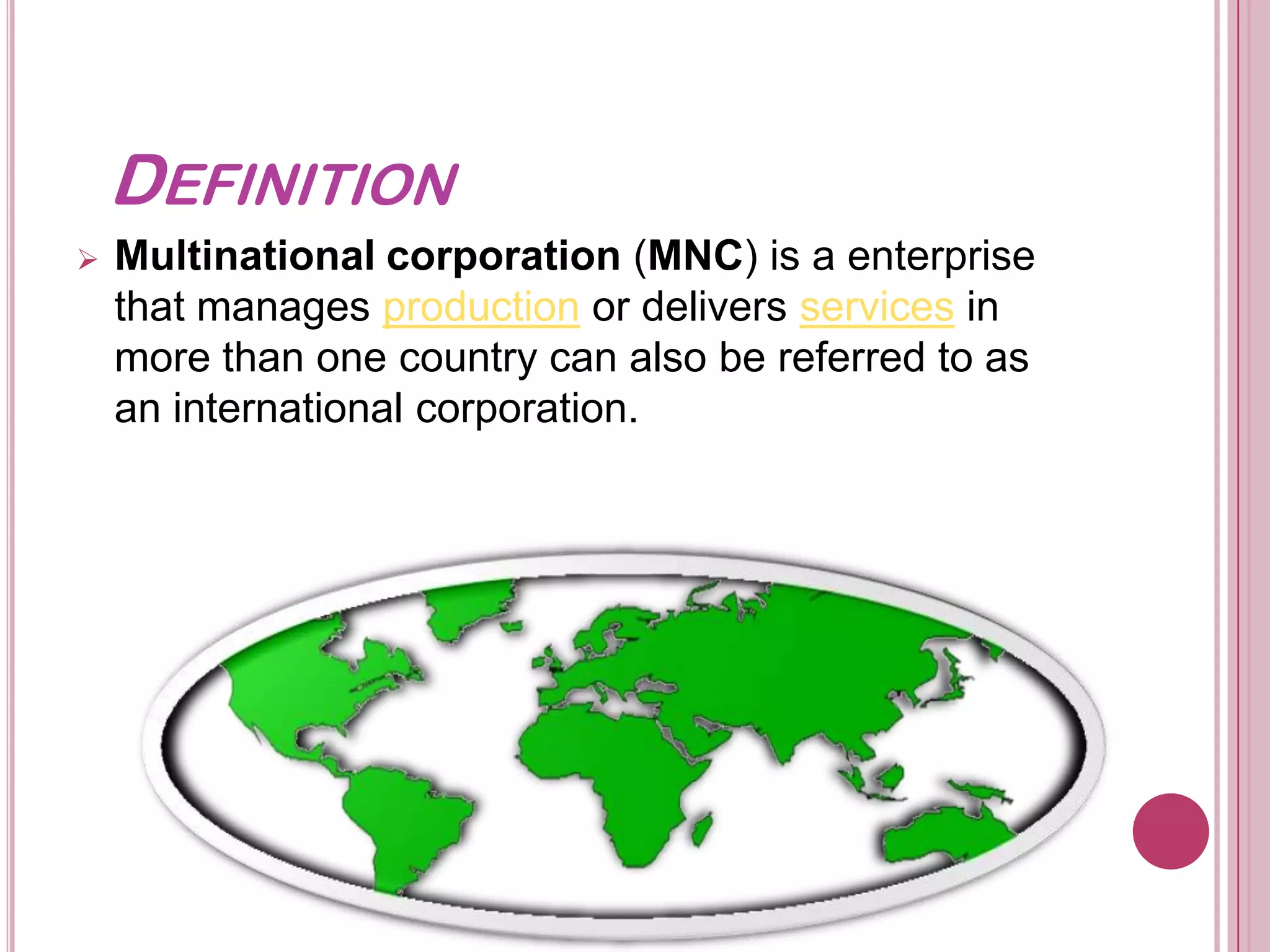
   Multinational corporation (MNC) is a enterprise
    that manages production or delivers services in
    more than one country can also be referred to as
    an international corporation.
WHAT IS A MULTINATIONAL
      CORPORATION? (CONTINUED)
   According to Franklin Root (1994), an MNC is a
    parent company that:

 engages in foreign production through its affiliates
  located in several countries,
 exercises direct control over the policies of its
  affiliates,
 implements business strategies in production,
  marketing, finance and staffing that transcend
  national boundaries.
EXAMPLES OF MNCS:
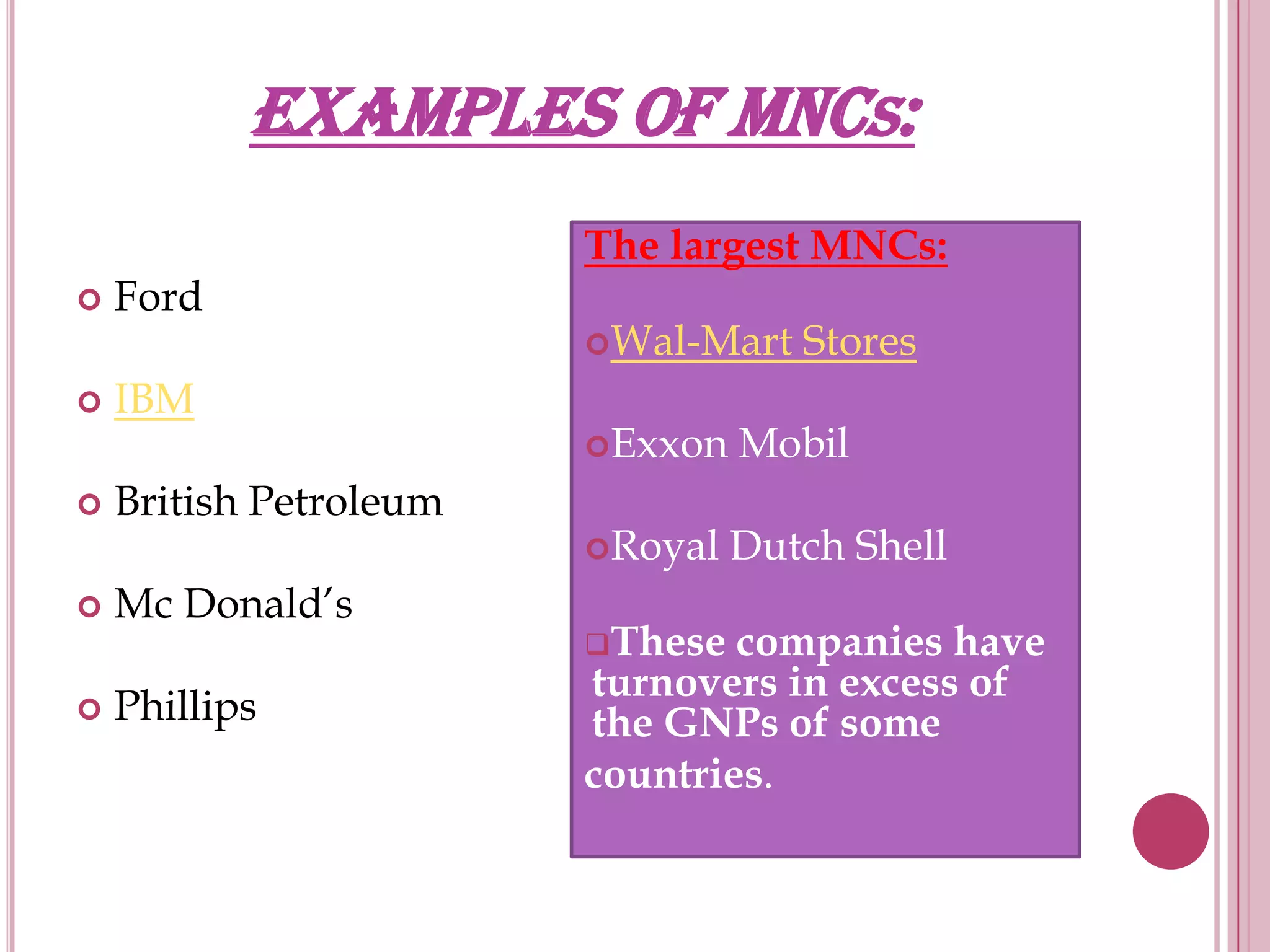
                        The largest MNCs:
   Ford
                        Wal-Mart   Stores
   IBM
                        Exxon   Mobil
   British Petroleum
                        Royal   Dutch Shell
   Mc Donald’s
                        These  companies have
                        turnovers in excess of
   Phillips            the GNPs of some
                        countries.
HOW IS A COMPANY CLASSIFIED
          AS AN MNC?

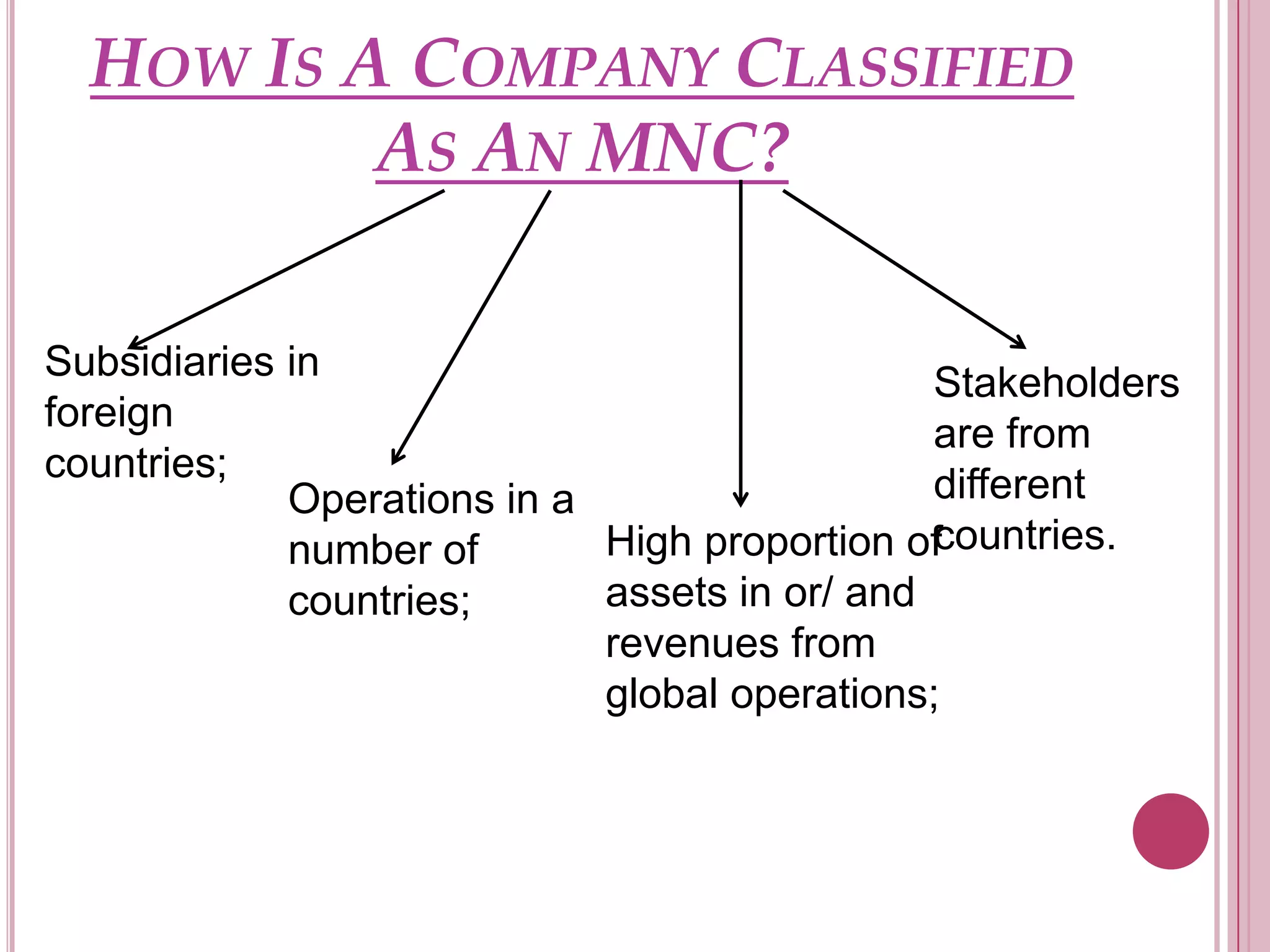
Subsidiaries in                                Stakeholders
foreign                                        are from
countries;
             Operations in a                   different
             number of       High proportion ofcountries.
             countries;      assets in or/ and
                             revenues from
                             global operations;
HISTORY AND EVOLUTION OF MNCS:

   These corporations originated early in the 20th
    century and expanded after World War II.

   A multinational corporation developed new
    products in its native country and manufactured
    them abroad.

   Almost all the earliest and largest multinational
    firms were either American, Japanese, or West
    European.
HISTORY AND EVOLUTION OF MNCS:

 Duringthe last three decades, many smaller
 corporations have also become
 multinational.

 Suchenterprises maintain that they create
 employment, create wealth, and improve
 technology in countries.
MNC IN INDIA…
   MNC in India represent a diversified portfolio of companies
    representing different nations.
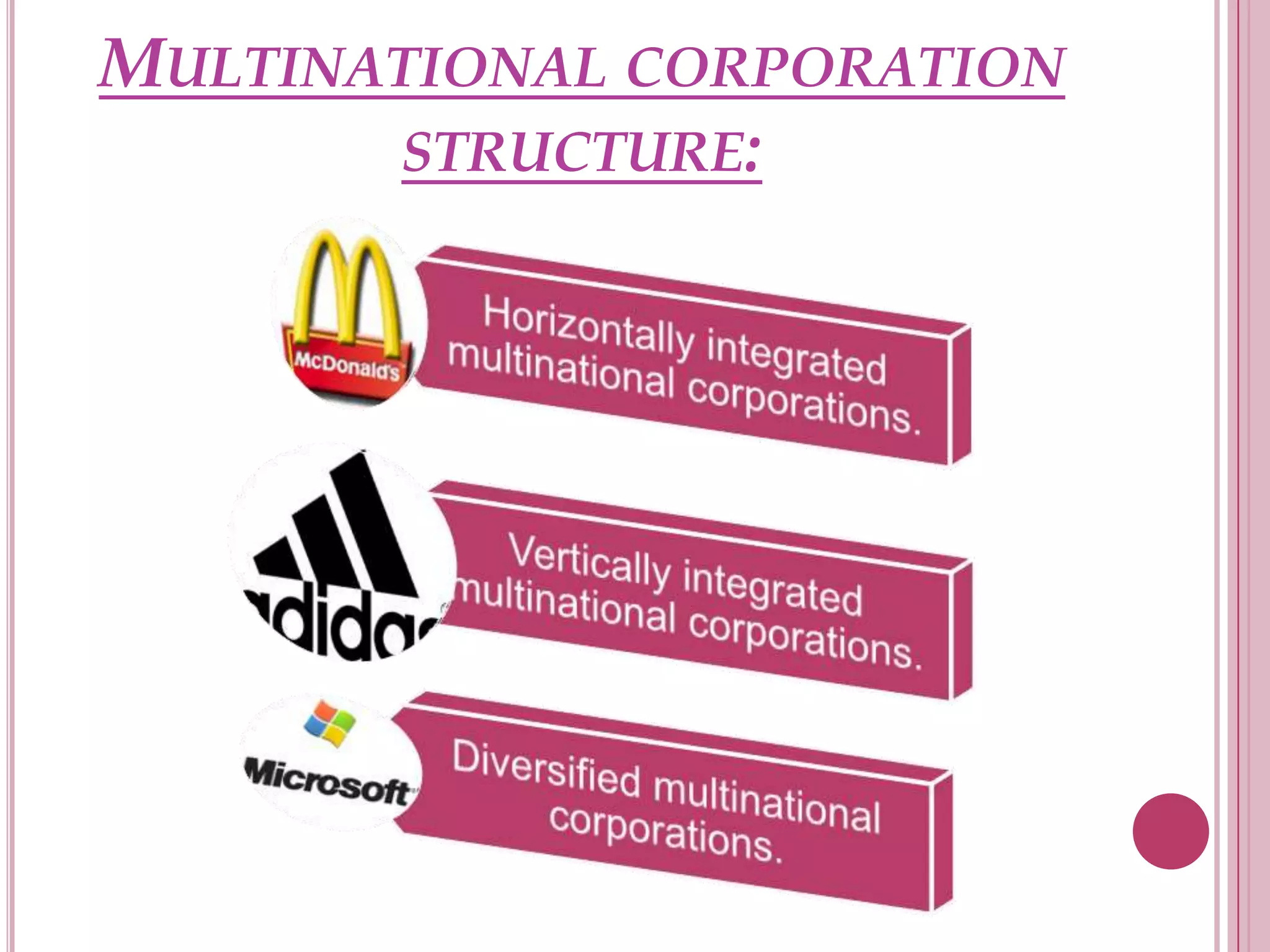
MULTINATIONAL CORPORATION
       STRUCTURE:
ORGANIZATION OF
MULTINATIONAL CORPORATIONS

   Subsidiaries

   Joint Ventures Companies

   Franchise Holders

   Turn Key Project.
SWOT Analysis of MNCs:

 Strengths                 Weakness
 • Low Cost                • Location is often very distant
 • Well Developed          • Lack of Transportation facilities
 Infrastructure            • Relative Inflexibility


Opportunities
                           Threats
• Leverage Government
• Attract new industries   • Govt. restrictions
                           •Quotas
REASONS FOR THE
       ESTABLISHMENT OF MNCS
   To increase market share.

   To secure cheaper premises and labour.

   Employment and Health & Safety Legislations in
    other countries may be more relaxed.

   To avoid or minimise the amount of tax to be paid.

   To take advantage of government grants available.

                                                 Conti...
   To save on costs of transporting goods to the
    market place.

   To develop an international brand.
Advantages


To the Host            To the Home
  Country                Country
ADVANTAGES OF MNCS TO THE
         HOST COUNTRY:
   Transfer of technology, capital and
    entrepreneurship.

   Increase in the investment level and thus, the
    income and employment in the host country.

   Greater availability of products for local consumers.

   Increase in exports and decrease in imports.
ADVANTAGES OF MNCS TO THE
     HOME COUNTRY.
   Acquisition of raw materials from abroad.

   Technology and management expertise acquired
    from competing in global markets.

   Export of components and finished goods for
    assembly or distribution in foreign markets.

   Inflow of income from overseas profits, royalties
    and management contracts.
DISADVANTAGES OF MNCS:
   Trade restrictions imposed at the government-level

   Limited quantities (quotas) of imports.

   Effective management of a globally dispersed
    organization.

   Slow down in the growth of employment in home
    countries.

   Destroy competition and acquire monopoly.
WORLD’S TOP MNCS:
FORTUNE GLOBAL 500 LIST 2011:
          TOP 10
RANK     COMPANY             COUNTRY           FIELD
  1      Wal-Mart Stores      United States     Retail

  2     Royal Dutch Shell     Netherlands     Petroleum

  3       Exxon Mobil         United States   Petroleum

  4            BP            United Kingdom   Petroleum

  5         Sinopec              China        Petroleum

         China National
  6                              China        Petroleum
          Petroleum

  7        State Grid            China          Power

  8       Toyota Motor           Japan        Automobiles

  9    Japan Post Holdings       Japan        Diversified

 10         Chevron           United States   Petroleum
FORTUNE GLOBAL 500 2011:
    COUNTRY WISE:
 RANK     COUNTRY         NUMBER OF
                          COMPANIES
  1       United States      133

  2          Japan           68

  3          China           61

  4          France          35

  5         Germany          34

  6      United Kingdom      30

  7       Switzerland        15

  8       South Korea        14

  9       Netherlands        12

  10        Canada           11
CRITICISM OF MNCS:

 Creation   of false needs in consumers.
 Interference and dominance in the internal
  affairs of sovereign nations.
 Invasive advertising and corporate lobbying.

 Creation of monopolies in the market and
  elimination of local competitors.


                                       contd…
 Depletion    of resources due to their
    continuous use by these corporations.

 Centralization    of R&D operations in their
    home country.

 Low     consideration for human rights and
    welfare.

   The problem of Dumping.
India’s Big Dream
• Harnessing the global trends by encouraging the MNCs
  to engage in product innovation for local consumers
  represents a big challenge in India.

• Policy-makers, industry leaders and academic institutes
  need to work together to create and disseminate a list of
  "dream innovations" that will inspire people.

• The development of Tata Motor's Rs 1 lakh car provides
  a powerful example
MNCs in India have a long history and tradition:
WHAT INDIA OFFERS???
   One billion plus population.

    India is ranked as the 10th largest economy, 4th largest in
    terms of Purchasing Power Parity.

   250-300 million middle class.

   Gross Domestic Product (GDP) is growing at over 7-9 %,
    making it one of the fastest growing economies in the
    world.

   Opportunities for U.S. exporters with the right products or
    services.

   Easier access to capital.
INDIAN COMPANIES IN FORTUNE
    GLOBAL 500 LIST 2011:
COUNTRY   COMPANY          GLOBAL      CITY       REVENUE
 RANK                     500 RANK               ($ millions)
  1        Indian Oil        98      New Delhi     68,837
  2         Reliance         134     Mumbai        58,900
           Industries
  3         Bharat           272     Mumbai        34,102
           Petroleum
  4       State Bank of      292     Mumbai        32,450
              India
  5        Hindustan         336     Mumbai        28,593
           Petroleum
  6       Tata Motors        359     Mumbai        27,046
  7       Oil & Natural      361     Dehradun      26,945
               Gas
  8        Tata Steel        370     Mumbai        26,065
TRENDS OF MNCS IN INDIA:

   First MNC in India was the EAST INDIA Company. in
    1600.

   American companies account for around 37% of the
    turnover of the top 20 firms operating in India.

   Oil companies and Infrastructure builders from the
    Middle East are also flocking in India to catch the boom.


                                               Contd…….
   Increasing flocking of Europian Union companies to
    India.
   Finnish mobile handset manufacturing giant Nokia
    is the largest Multinational Corporation In India.
   Italian automobile giants like Fiat, Ford Motors,
    Piaggio etc expanded their operations in India with
    R&D wing attached.

   South Korean Electronics giants Samsung and LG
    Electronics and small and mid-segment car giant
    Hyundai Motors are doing excellent business and
    using India as a hub for global delivery.
KEY ADVANTAGES OF EXISTENCE
     OF MNCS IN INDIA
   Work culture for employees.

   Training and Learning.

   Technology – especially concept of working with
    better technologies.

   Safety, Health and Environmental Learning.

   Excellent training grounds for many entrepreneurs.
KEY CHALLENGES THAT INDIAN
              MNCS FACE:
   Domestic market like India vis - a - vis International expansion.

   Language.

   Culture.

   Autonomy to “local” managers .

   Styles of doing business.

   Handling of potential liabilities related to Labor, IPR etc.
BIBLIOGRAPHY
   www.wikkipedia.com

   www.investopedia.com
Multinational corporations

Multinational corporations

  • 1.
    NAME:- SHANTANU TYAGI CLASS:-11-B SCHOOL:- GREEN FEILDS SCHOOL
  • 2.
  • 3.
    OVERVIEW  What isMNC?  History and Evolution of MNC  MNC Structure.  Organization of MNC.  SWOT Analysis of MNC.  Reasons for establishment of MNC.  Advantage and Disadvantage of MNC  Criticism of MNC.  MNCs in India.
  • 4.
    WHAT IS AMULTINATIONAL CORPORATION???  It is a corporation that: Manages And/or Delivers production services In more than one country
  • 5.
    DEFINITION  Multinational corporation (MNC) is a enterprise that manages production or delivers services in more than one country can also be referred to as an international corporation.
  • 6.
    WHAT IS AMULTINATIONAL CORPORATION? (CONTINUED)  According to Franklin Root (1994), an MNC is a parent company that:  engages in foreign production through its affiliates located in several countries,  exercises direct control over the policies of its affiliates,  implements business strategies in production, marketing, finance and staffing that transcend national boundaries.
  • 7.
    EXAMPLES OF MNCS: The largest MNCs:  Ford Wal-Mart Stores  IBM Exxon Mobil  British Petroleum Royal Dutch Shell  Mc Donald’s These companies have turnovers in excess of  Phillips the GNPs of some countries.
  • 8.
    HOW IS ACOMPANY CLASSIFIED AS AN MNC? Subsidiaries in Stakeholders foreign are from countries; Operations in a different number of High proportion ofcountries. countries; assets in or/ and revenues from global operations;
  • 9.
    HISTORY AND EVOLUTIONOF MNCS:  These corporations originated early in the 20th century and expanded after World War II.  A multinational corporation developed new products in its native country and manufactured them abroad.  Almost all the earliest and largest multinational firms were either American, Japanese, or West European.
  • 10.
    HISTORY AND EVOLUTIONOF MNCS:  Duringthe last three decades, many smaller corporations have also become multinational.  Suchenterprises maintain that they create employment, create wealth, and improve technology in countries.
  • 11.
    MNC IN INDIA…  MNC in India represent a diversified portfolio of companies representing different nations.
  • 12.
  • 13.
    ORGANIZATION OF MULTINATIONAL CORPORATIONS  Subsidiaries  Joint Ventures Companies  Franchise Holders  Turn Key Project.
  • 15.
    SWOT Analysis ofMNCs: Strengths Weakness • Low Cost • Location is often very distant • Well Developed • Lack of Transportation facilities Infrastructure • Relative Inflexibility Opportunities Threats • Leverage Government • Attract new industries • Govt. restrictions •Quotas
  • 16.
    REASONS FOR THE ESTABLISHMENT OF MNCS  To increase market share.  To secure cheaper premises and labour.  Employment and Health & Safety Legislations in other countries may be more relaxed.  To avoid or minimise the amount of tax to be paid.  To take advantage of government grants available. Conti...
  • 17.
    To save on costs of transporting goods to the market place.  To develop an international brand.
  • 18.
    Advantages To the Host To the Home Country Country
  • 19.
    ADVANTAGES OF MNCSTO THE HOST COUNTRY:  Transfer of technology, capital and entrepreneurship.  Increase in the investment level and thus, the income and employment in the host country.  Greater availability of products for local consumers.  Increase in exports and decrease in imports.
  • 20.
    ADVANTAGES OF MNCSTO THE HOME COUNTRY.  Acquisition of raw materials from abroad.  Technology and management expertise acquired from competing in global markets.  Export of components and finished goods for assembly or distribution in foreign markets.  Inflow of income from overseas profits, royalties and management contracts.
  • 21.
    DISADVANTAGES OF MNCS:  Trade restrictions imposed at the government-level  Limited quantities (quotas) of imports.  Effective management of a globally dispersed organization.  Slow down in the growth of employment in home countries.  Destroy competition and acquire monopoly.
  • 22.
  • 23.
    FORTUNE GLOBAL 500LIST 2011: TOP 10 RANK COMPANY COUNTRY FIELD 1 Wal-Mart Stores United States Retail 2 Royal Dutch Shell Netherlands Petroleum 3 Exxon Mobil United States Petroleum 4 BP United Kingdom Petroleum 5 Sinopec China Petroleum China National 6 China Petroleum Petroleum 7 State Grid China Power 8 Toyota Motor Japan Automobiles 9 Japan Post Holdings Japan Diversified 10 Chevron United States Petroleum
  • 24.
    FORTUNE GLOBAL 5002011: COUNTRY WISE: RANK COUNTRY NUMBER OF COMPANIES 1 United States 133 2 Japan 68 3 China 61 4 France 35 5 Germany 34 6 United Kingdom 30 7 Switzerland 15 8 South Korea 14 9 Netherlands 12 10 Canada 11
  • 25.
    CRITICISM OF MNCS: Creation of false needs in consumers.  Interference and dominance in the internal affairs of sovereign nations.  Invasive advertising and corporate lobbying.  Creation of monopolies in the market and elimination of local competitors. contd…
  • 26.
     Depletion of resources due to their continuous use by these corporations.  Centralization of R&D operations in their home country.  Low consideration for human rights and welfare.  The problem of Dumping.
  • 28.
    India’s Big Dream •Harnessing the global trends by encouraging the MNCs to engage in product innovation for local consumers represents a big challenge in India. • Policy-makers, industry leaders and academic institutes need to work together to create and disseminate a list of "dream innovations" that will inspire people. • The development of Tata Motor's Rs 1 lakh car provides a powerful example
  • 29.
    MNCs in Indiahave a long history and tradition:
  • 30.
    WHAT INDIA OFFERS???  One billion plus population.  India is ranked as the 10th largest economy, 4th largest in terms of Purchasing Power Parity.  250-300 million middle class.  Gross Domestic Product (GDP) is growing at over 7-9 %, making it one of the fastest growing economies in the world.  Opportunities for U.S. exporters with the right products or services.  Easier access to capital.
  • 31.
    INDIAN COMPANIES INFORTUNE GLOBAL 500 LIST 2011: COUNTRY COMPANY GLOBAL CITY REVENUE RANK 500 RANK ($ millions) 1 Indian Oil 98 New Delhi 68,837 2 Reliance 134 Mumbai 58,900 Industries 3 Bharat 272 Mumbai 34,102 Petroleum 4 State Bank of 292 Mumbai 32,450 India 5 Hindustan 336 Mumbai 28,593 Petroleum 6 Tata Motors 359 Mumbai 27,046 7 Oil & Natural 361 Dehradun 26,945 Gas 8 Tata Steel 370 Mumbai 26,065
  • 32.
    TRENDS OF MNCSIN INDIA:  First MNC in India was the EAST INDIA Company. in 1600.  American companies account for around 37% of the turnover of the top 20 firms operating in India.  Oil companies and Infrastructure builders from the Middle East are also flocking in India to catch the boom. Contd…….
  • 33.
    Increasing flocking of Europian Union companies to India.  Finnish mobile handset manufacturing giant Nokia is the largest Multinational Corporation In India.  Italian automobile giants like Fiat, Ford Motors, Piaggio etc expanded their operations in India with R&D wing attached.  South Korean Electronics giants Samsung and LG Electronics and small and mid-segment car giant Hyundai Motors are doing excellent business and using India as a hub for global delivery.
  • 34.
    KEY ADVANTAGES OFEXISTENCE OF MNCS IN INDIA  Work culture for employees.  Training and Learning.  Technology – especially concept of working with better technologies.  Safety, Health and Environmental Learning.  Excellent training grounds for many entrepreneurs.
  • 35.
    KEY CHALLENGES THATINDIAN MNCS FACE:  Domestic market like India vis - a - vis International expansion.  Language.  Culture.  Autonomy to “local” managers .  Styles of doing business.  Handling of potential liabilities related to Labor, IPR etc.
  • 36.
    BIBLIOGRAPHY  www.wikkipedia.com  www.investopedia.com