FOREIGN
DIRECT
INVESTMENT
Foreign investment
 Foreign investment refers to investment by
foreign investors in in shares, debentures
bonds of other nations companies.This type
of investment is mainly in the form of equity
capital, which has no fixed interest burden. It
can be classified as under:
 Foreign Direct Investment
 Portfolio Investment
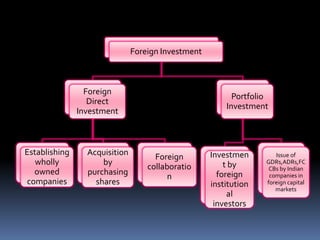
Foreign Investment
Foreign
Direct
Investment
Establishing
wholly
owned
companies
Acquisition
by
purchasing
shares
Foreign
collaboratio
n
Portfolio
Investment
Investmen
t by
foreign
institution
al
investors
Issue of
GDRs,ADRs,FC
CBs by Indian
companies in
foreign capital
markets
Foreign Direct Investment
 Foreign direct investment is made by foreign
companies in order to establish wholly owned
companies in another country and to manage
them or to purchase shares of companies in
another country for the purchase of
managing such companies. it also includes
foreign collaboration, which means setting up
of an enterprise, jointly by the foreign and
native entrepreneur.
Types of foreign collaboration
 Collaboration between domestic and foreign
private companies.
 Collaboration between government of host
nation and foreign private companies.
 Collaboration between government of host
nation and foreign government.
Objectives
of foreign direct investment
According to Murasoli maran, “Foreign direct
investment is not consider only as a stock of
capital but as something that provides
modern technology, managerial expertise,
employment opportunities and a new market
for product produce in India.
Foreign direct investment is needed due to
following reasons.
 To increase the level of investment by
supplementing the domestic investment.
 To develop basic industries.
 To develop infrastructure.
 To remove the shortage of foreign exchange.
 To improve managerial and entrepreneurial
ability.
 To exploit natural resources.
 To setup risky and capital intensive projects.
 To improve technology.
 To increase employment opportunities.
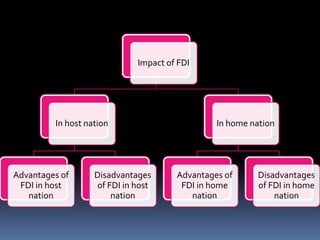
Impact of FDI
In host nation
Advantages of
FDI in host
nation
Disadvantages
of FDI in host
nation
In home nation
Advantages of
FDI in home
nation
Disadvantages
of FDI in home
nation
Availability of
capital
Availability of
modern
technology
Exploitation of
natural
resources
Availability
of risk capital
Increase in
Employment
Reduction in
inflation
Promotes
competition and
economic growth.
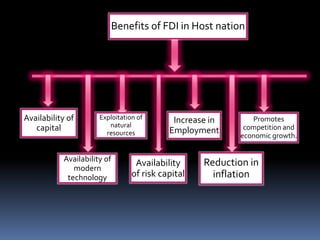
Benefits of FDI in Host nation
Host country benefits
 Availability of capital: Many nations suffers from lack of
capital. Since savings do not increase in the same ratio as
the income does, the gap is filled by foreign capital.
 Availability of modern technology: The use of modern
technology could become possible with foreign capital and
aid. Modern technology enhances the productivity of
economy.
 Exploitation of natural resources: Due to lack of capital
resources have not been properly exploited. Foreign capital
will help to make proper exploitation of natural resources.
 Availability of risk capital: FDI serves as venture capital
and thus makes up this deficiency. As a result of foreign
capital, development has taken place in basic industries and
risky ventures like iron and steel, coal, oil exploration etc.
 Increase in employment: Many industrial
units have been set up with foreign capital
and by foreign collaboration. Many MNCs
have also setup branches in host nations. All
this has created employment opportunity in
host nations.
 Reduction in inflation: foreign capital has
also made imports of essential goods possible
on a large scale. It increase total availability
of goods and reduces the rate of inflation.
 Promotes competition and economic growth :
FDI in the form of Greenfield investment
increases the level of competition in a market,
driving down prices and improving the welfare
of consumers
Increased competition can lead to increased
productivity growth, product and process
innovation, and greater economic growth
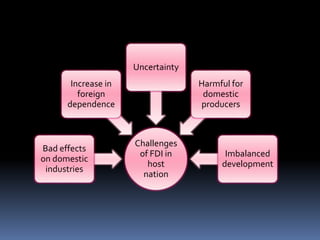
Challenges
of FDI in
host
nation
Bad effects
on domestic
industries
Increase in
foreign
dependence
Uncertainty
Harmful for
domestic
producers
Imbalanced
development
Challenges of FDI in host
nation
 Bad effects on Domestic industries:domestic
industries cannot face open competition with
these foreign companies who have
technological superiority, managerial
expertise, huge financial base, well reputed
global brands.
 Increase in foreign dependence: the
machines, raw material, technical know how
etc which are imported from abroad increase
the dependence on foreign company.
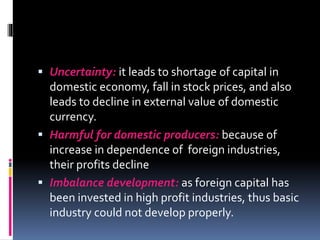
 Uncertainty: it leads to shortage of capital in
domestic economy, fall in stock prices, and also
leads to decline in external value of domestic
currency.
 Harmful for domestic producers: because of
increase in dependence of foreign industries,
their profits decline
 Imbalance development: as foreign capital has
been invested in high profit industries, thus basic
industry could not develop properly.
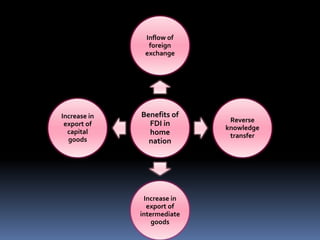
Benefits of
FDI in
home
nation
Inflow of
foreign
exchange
Reverse
knowledge
transfer
Increase in
export of
intermediate
goods
Increase in
export of
capital
goods
Benefits of FDI in Home
Nation
 Inflow of foreign exchange: When subsidiary unit is well
established, the parent company gets huge amount in form
of repatriation of profit, royalty, technical fees, interest on
capital etc. this repatriation results in inflow of foreign
exchange in parent nation.
 Increase in export of capital goods and intermediate
goods: The host nation has to import matching capital
goods and intermediate goods from the parent nations of
MNCs. It leads to increase in export of capital goods and
intermediate goods from parent nation.
 Reverse knowledge transfer: when an MNC set up its
subsidiary in host nation, its expatriates interact with
managers, technocrats of host nation and learn new
working styles from them.
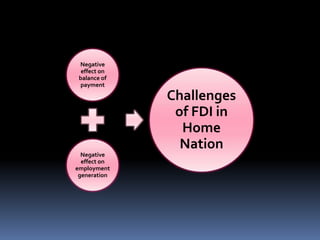
Negative
effect on
balance of
payment
Negative
effect on
employment
generation
Challenges
of FDI in
Home
Nation
Challenges of FDI in Home
Nation
 Negative effects on balance of payment:
1. initial capital outflow from home nation to host
nation adversely affects the BPO position of home
nation.
2. if FDI by home nation has replaced the export mode,
it adversely effects the exports of home nation.
3. if MNC has setup its production base in the host
nation because of its cheaper labor cost and low input
cost.
 Negative effect on employment generation:
if FDI is replaced the trade mode, then the
goods which were earlier manufactured in
home nation are now manufactured in host
nation. So investment mode promotes
unemployment in home nation.

Foreign direct investment

  • 1.
  • 2.
    Foreign investment  Foreigninvestment refers to investment by foreign investors in in shares, debentures bonds of other nations companies.This type of investment is mainly in the form of equity capital, which has no fixed interest burden. It can be classified as under:  Foreign Direct Investment  Portfolio Investment
  • 3.
  • 4.
    Foreign Direct Investment Foreign direct investment is made by foreign companies in order to establish wholly owned companies in another country and to manage them or to purchase shares of companies in another country for the purchase of managing such companies. it also includes foreign collaboration, which means setting up of an enterprise, jointly by the foreign and native entrepreneur.
  • 5.
    Types of foreigncollaboration  Collaboration between domestic and foreign private companies.  Collaboration between government of host nation and foreign private companies.  Collaboration between government of host nation and foreign government.
  • 6.
    Objectives of foreign directinvestment According to Murasoli maran, “Foreign direct investment is not consider only as a stock of capital but as something that provides modern technology, managerial expertise, employment opportunities and a new market for product produce in India. Foreign direct investment is needed due to following reasons.
  • 7.
     To increasethe level of investment by supplementing the domestic investment.  To develop basic industries.  To develop infrastructure.  To remove the shortage of foreign exchange.  To improve managerial and entrepreneurial ability.  To exploit natural resources.  To setup risky and capital intensive projects.  To improve technology.  To increase employment opportunities.
  • 8.
    Impact of FDI Inhost nation Advantages of FDI in host nation Disadvantages of FDI in host nation In home nation Advantages of FDI in home nation Disadvantages of FDI in home nation
  • 9.
    Availability of capital Availability of modern technology Exploitationof natural resources Availability of risk capital Increase in Employment Reduction in inflation Promotes competition and economic growth. Benefits of FDI in Host nation
  • 10.
    Host country benefits Availability of capital: Many nations suffers from lack of capital. Since savings do not increase in the same ratio as the income does, the gap is filled by foreign capital.  Availability of modern technology: The use of modern technology could become possible with foreign capital and aid. Modern technology enhances the productivity of economy.  Exploitation of natural resources: Due to lack of capital resources have not been properly exploited. Foreign capital will help to make proper exploitation of natural resources.  Availability of risk capital: FDI serves as venture capital and thus makes up this deficiency. As a result of foreign capital, development has taken place in basic industries and risky ventures like iron and steel, coal, oil exploration etc.
  • 11.
     Increase inemployment: Many industrial units have been set up with foreign capital and by foreign collaboration. Many MNCs have also setup branches in host nations. All this has created employment opportunity in host nations.  Reduction in inflation: foreign capital has also made imports of essential goods possible on a large scale. It increase total availability of goods and reduces the rate of inflation.
  • 12.
     Promotes competitionand economic growth : FDI in the form of Greenfield investment increases the level of competition in a market, driving down prices and improving the welfare of consumers Increased competition can lead to increased productivity growth, product and process innovation, and greater economic growth
  • 13.
    Challenges of FDI in host nation Badeffects on domestic industries Increase in foreign dependence Uncertainty Harmful for domestic producers Imbalanced development
  • 14.
    Challenges of FDIin host nation  Bad effects on Domestic industries:domestic industries cannot face open competition with these foreign companies who have technological superiority, managerial expertise, huge financial base, well reputed global brands.  Increase in foreign dependence: the machines, raw material, technical know how etc which are imported from abroad increase the dependence on foreign company.
  • 15.
     Uncertainty: itleads to shortage of capital in domestic economy, fall in stock prices, and also leads to decline in external value of domestic currency.  Harmful for domestic producers: because of increase in dependence of foreign industries, their profits decline  Imbalance development: as foreign capital has been invested in high profit industries, thus basic industry could not develop properly.
  • 16.
    Benefits of FDI in home nation Inflowof foreign exchange Reverse knowledge transfer Increase in export of intermediate goods Increase in export of capital goods
  • 17.
    Benefits of FDIin Home Nation  Inflow of foreign exchange: When subsidiary unit is well established, the parent company gets huge amount in form of repatriation of profit, royalty, technical fees, interest on capital etc. this repatriation results in inflow of foreign exchange in parent nation.  Increase in export of capital goods and intermediate goods: The host nation has to import matching capital goods and intermediate goods from the parent nations of MNCs. It leads to increase in export of capital goods and intermediate goods from parent nation.  Reverse knowledge transfer: when an MNC set up its subsidiary in host nation, its expatriates interact with managers, technocrats of host nation and learn new working styles from them.
  • 18.
    Negative effect on balance of payment Negative effecton employment generation Challenges of FDI in Home Nation
  • 19.
    Challenges of FDIin Home Nation  Negative effects on balance of payment: 1. initial capital outflow from home nation to host nation adversely affects the BPO position of home nation. 2. if FDI by home nation has replaced the export mode, it adversely effects the exports of home nation. 3. if MNC has setup its production base in the host nation because of its cheaper labor cost and low input cost.
  • 20.
     Negative effecton employment generation: if FDI is replaced the trade mode, then the goods which were earlier manufactured in home nation are now manufactured in host nation. So investment mode promotes unemployment in home nation.