 SEMINAR ON
 MULTI NATIONAL COMPANIES
 BY:GURUPRASAD N SHENOY J
 UNDER THE GUIDANCE AND CO OPERATION OF
PROFESSOR PREMALATHA PAI,H O D OF
ECONOMICS,SVS COLLEGE BANTWAL
A MNC is a company ,firm or enterprise with its
HQ in a developed country such as US, JAPAN
etc ,and also operates in other countries ,both
developed an developing .Trans national countries
and Global corporations.
ILO says that ,”the essential nature of the
multinational enterprise lies in the fact that its
managerial HQ are located in one country while
the enterprise carries out operations in a number of
other countries as well.”
Thus MNC is a corporation that controls
production facilities in more than one country,
such facilities having been acquired through the
process of FDI.
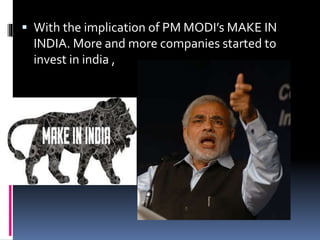
 With the implication of PM MODI’s MAKE IN
INDIA. More and more companies started to
invest in india ,
ORIGINANDGROWTHOFMNC’S
1.BARTER SYSTEM
2.MONEY LENDING BANKING SYSTEM
EMERGED
Then after that in 17 and 18 century MN, the
form of trading companies emerged.
Ex. HUDSON BAY CO.,EAST INDIA CO.,
Then export and import between the countries
started.
During 19 century ,FI flowed extensively from
Western Europe to the developing areas like
Asia, Africa and America.
UK,FRANCE, GERMANY etc were exporters of
capital. British made extensive investment in
India, Canada ,Australia and RSA.
 20 century ,MN corporate investment was
mainly in mining and petrol industries. BIG OIL
companies like BRITISH and STANDARD OIL
were the first multinationals in this areas.
THE first world war encouraged MN investment.
Due to PROTECTIONIST POLICY, firms
replaced exports with foreign production.
Gradually , manufacturing and merchandising
multinationalists like Unilever lever brothers,
Nestle, Coca Cola, Singer, Ford motors and
various German drugs and chemical firms , began
their operations on a world wide scale. Thus, the
concept of multinational enterprise is not new.
But the modern multinational corporation is
based on more than just trading. It tries to
optimize its international production and
marketing often doing so by the use of trade
marks and patents.
In recent years , it is interesting to note that the
multinational corporations have also been
produced by the developing economies like
India, Malaysia, Hong Kong, Singapore, South
Korea etc. At present 90 percent of the top
multinational corporations have their
headquarters in European union , Japan and the
United States. According to the world investment
report 2007, there were some 78000 MNC”s with
around 9,86000 affiliates. The MNC’s account for
a significant share of the worlds industrial
investments, production, employment and trade.
The MNCs share in global investment,
production, employment and trade has
assumed considerable proportions.
According to the UN, there are 63,000
MNCs with 6,90,000 affiliates all over
the globe with 2,40,000 in China and only
1400 in India. The US was the forerunner
in giving births to MNCs. Today, biggest
MNC’s are Japanese.
The global liberalization wave, paved the path for
faster expansion and growth of MNCs. The value
added by the foreign affiliates of MNCs, as a
percentage of global GDP grew from 5% in the
1980s to about 7% by the end of 90s. The MNCs
control about a third of world output and the total
sales of their foreign affiliates is almost equal to the
GNP of all developing countries. The value of the
annual sales of the largest manufacturing
multinational General Motors, was about $178bn in
1996. The total sales of the 3 largest automobile
firms of the world, namely, General Motors, Ford
and Toyota is greater than the value of India’s GDP.
In terms of direct employment, the MNCs
accounted for 73mn people worldwide and if
indirect employment is considered, the figure
approximates 150mn people. Over 350m
people were employed by the foreign affiliates
of MNCs in 1988.
FACTORS EFFECTING GROWTH OF MNC
Expansion of market territories:
–
Rapid economic growth in a number of countries
resulting in rising GDPs and per capita incomes
contributed to the growing standards of living.
This in turn contributed to the continuous
expansion of market territories. MNCs, both
contributed to the expansion of market territories
and also grew in size and spread as a result of
expansion of market territories.
2) Market superiorities: –
In many ways, MNCs have an edge over domestic
firms, such as: –
a) Availability of reliable and current data,
b) MNCs enjoy market reputation,
c) MNCs encounters relatively less problems and
difficulties in marketing the products.
d) MNCs adopt more effective advertising and sales
promotion techniques, and
e) MNCs enjoy faster transportation and adequate
warehousing facilities
 MNCs also enjoy a number of
financial advantages over domestic firms.
These are: –
a) Availability of huge financial resources
with the MNCs helps them to transform
business environment and circumstances
in their favor.
b) MNCs can use the funds more
effectively and economically on account
of their activities in numerous countries.
3) Financial superiorities: -
MNCs have easy access to international capital
markets, and
MNCs have easy assessed to international banks and
financial institutions.
4) Technological superiorities: -
MNCs are technologically prosperous on account of
high and sustained spend on R&D. developing
countries on account of their technological
backwardness welcome MNCs to their countries
because of the attendant benefits of technology .
Industrialization is backward in developing
countries and the resources available in
developing countries are insufficient to develop
the technology and thereby industrialization.
Developing countries are rich in mineral and
natural resources. They are unable to exploit
them fully due to paucity of financial resources
and low level technology.
Local manpower , materials, capital etc cannot be
optimally utilized by the developing countries to
help them in exploiting the resources.
Developing countries would be required to
import raw materials , capital equipment,
technology etc. on their own. This in turn needs
heavy foreign exchange resources. Developing
countries which suffer from paucity of foreign
exchange resources invite MNC’s in this regard.
Developing countries, though they produce goods
and services on their own by importing
technology and materials they fail in marketing
products due to severe competition. This inability
of developing countries , force them to invite
MNC’s on their own. Therefore MNC’s are
invited by them.
Product innovation: MNC’s , by the virtue of
their wide spread operations in many countries ;
collect information regarding customers , taste
and preferences . Furthur , the MNC’s with their
strong R & D departments invent new products.
Developing countries suffer from limitations in
this regard . Therefore , they invite MNC’s to
their countries.
Reasons for the Growth of MNCs:
(i) Non-Transferable Knowledge:
It is often possible for an MNC to sell its
knowledge in the form of patent rights and to
licence foreign producer. This relieves the MNC
of the need to make foreign direct investment.
However, sometimes an MNC that has a
Production Process or Product Patent can make a
larger profit by carrying out the production in a
foreign country itself. The reason for this is that
some kinds of knowledge cannot be sold and
which are the result of years of experience.
 (ii) Exploiting Reputations:
 In some situation, MNCs invest to exploit their
reputation rather than protect their reputation. This
motive is of particular importance in the case of
foreign direct investment by banks because in the
banking business an international reputation can
attract deposits.
 If the goodwill is established the bank can expand
and build a strong customer base. Quality service to a
large number of customers is bound to ensure
success. This probably explains the tremendous
growth of foreign banks such as Citibank, Grind-lays
and Standard Chartered in India
(iii) Protecting Reputations:
Normally, products, develop a good or bad name,
which transcends international boundaries. It would
be very difficult for an MNC to protect in reputation
if a foreign licensee does an inferior job. Therefore,
MNCs prefer to invest in a country rather than
licensing and transfer expertise, to ensure the
maintenance of their good name.
(iv) Protecting Secrecy:
MNCs prefer direct investment, rather than granting
a license to a foreign company if protecting the
secrecy of the product is important. While it may be
true that a license will take precautions to protect
patent rights, it is equally true that it may be less
conscientious than the original owner of the patent
 (v) Availability of Capital:
 The fact that MNCs have access to capital markets has been
advocated as another reason why firms themselves moved
abroad. A firm operating in only one country does not have
the same access to cheaper funds as a larger firm. However,
this argument, which has been put forward for the growth of
MNCs has been rejected by many critics.
 (vi) Product Life Cycle Hypothesis:
 It has been argued that opportunities for further gains at
home eventually dry up.To maintain the growth of profits, a
corporation must venture abroad where markets are not so
well penetrated and where there is perhaps less
competition.
 This hypothesis perfectly explains the growth ofAmerican
MNCs in other countries where they can fully exploit all the
stages of the life cycle of a product.A prime example would
 (vii) Avoiding Tariffs and Quotas:
 MNCs prefer to invest directly in a country in order to
avoid import tariffs and quotas that the firm may have to
face if it produces the goods at home and ship them. For
example, a number of foreign automobile and truck
producers opened plants in the US to avoid restrictions
on-selling foreign made cars. Automobile giants like.
Fiat, Volkswagen, Honda and Mazda are entering
different countries not with the products but with
technology and money.
 (viii) Strategic FDI:
 The strategic motive for making investments has been
advocated as another reason for the growth of MNCs.
MNCs enters foreign markets to protect their market
share when this is being threatened by the potential entry
of indigenous firms or multinationals from other
countries.
(ix) Symbiotic Relationships:
Some firms have followed clients who have made
direct investment. This is especially true in the case
of accountancy and consulting firms. Large US
accounting firms, which know the parent companies
special needs and practices have opened offices in
countries where their clients have opened
subsidiaries.
These US accounting firms have an advantage over
local firms because of their knowledge of the parent
company and because the client may prefer to engage
only one firm in order to reduce the number of
people with access to sensitive information.
Templeton, Goldman Sachs and Earnest and Young
are moving with their clients even to small countries
like Sri Lanka, Panama and Mauritius.
Some of the top MNC
OFWORLD
 ABN AMRO
 Accenture
 Accor
 Activision Blizzard
 Adidas
 Aditya Birla Group
 Advanced Micro Devices
 Affiliated Computer
Services
 Airbus
 Air France-KLM
 Aitken Spence
 Akzo Nobel
 Alcatel-Lucent
 Allianz
 Alstom
 Altria Group
 American International Group
 Apple
 Arcor
 Asian Paints
 Assicurazioni Generali
 Atari
 AXA
 Bacardi
 Banco Santander
 Bank of Montreal
 Barrick Gold Corporation
 Barilla Group
 BASF
 Baskin-Robbins
 Bayer
 BBVA
 Bic
 BIDV
 Barclays
 Billabong
 Black & Decker
 BMW
 BNP Paribas
 Boeing
 Bombardier Inc.
 Bouygues
 Bridgestone
 BritishAirways
 BP (British Petroleum)
 Cadbury Schweppes
 Canon Inc
 Capital One
 Caterpillar Inc.
 Celestica
 Chevron
Citigroup
CapGemini
Cognizant Technology Solutions
ConocoPhillips
Coca-Cola
Costco
Creative Labs
Credit Suisse
Crédit Agricole
Cummins
Dabur
Daikin
Daimler AG
Danone
Datang Telecom
Dell
Deloitte
Delta Airlines
Deutsche Bank
Deutsche Telekom
DHL
Dow Chemical
Dunkin' Donuts
EDF
Enviroway Bioscience
Electronic Arts
Electronic Data Systems
Electrolux
Emerson Electric
Eni
Enel
Embraer
Epson
Ericsson
Ernst & Young
Etisalat
ExxonMobil
Faber-Castell
Facebook
FedEx Express
France Télécom
Ferrero
Fiat
Ficosa
Finmeccanica
Ford Motor Company
FPT Group
Fujitsu
Gazprom
General Electric
General Motors
Generali
Gerdau
Gillette
Glaxo Smith Kline
Goodyear Tire and Rubber Company
Google
Halliburton
Haier
Hearst Corporation
Heineken
Hewlett-Packard
Hilti
Hindustan Computers Limited
Hitachi
Honda
Honeywell
HSBC
HTC
Huawei
Hutchison Whampoa Limited
Hyundai Motor Company
IBM
ICAP company
ICICI
IKEA
Indesit
Infosys
Ingersoll Rand
ING Group
Intel Corporation
Intesa Sanpaolo
Isuzu
Jardine Matheson
Johnson & Johnson
JPMorgan Chase & Co.
Kenya Airways
Kingston Technology
Knorr (brand)
Komatsu Limited
Konami
KPMG
Krispy Kreme
Lagardère
Lactalis
Lear
Leoni AG
Lenovo
Lexmark
LG
LG Electronics
LiuGong
Lockheed Martin
L'Oréal
Lukoil
Luxottica
Maggi
Marriott
Martini & Rossi
Masterfoods
Mattel
McDonald's
Mercedes-AMG
Mercedes-Benz
Michelin
Microsoft
Mitsubishi Electric
Mobil
Motorola
Millipore Corporation
Monsanto Company
Namco Bandai Games
Namco Bandai Holdings
Nestlé
NetApp Inc.
News Corporation
Nike, Inc.
Nintendo
Nishat Group
Nissan
Nokia
Novartis
Oracle Corporation
Panasonic Corporation
Parmalat
Pepper Lunch
PepsiCo
Petronas
Petrovietnam
Pfizer
Philips
Pirelli
Procter & Gamble
Proton (carmaker)
PSA Peugeot Citroën
Ranbaxy
Red Bull
Regus
Renault
Repsol
Ricoh
Rockstar Energy
Robert Bosch GmbH
Rohde & Schwarz
Royal Dutch Shell
Royal Bank of Canada
Royal Bank of Scotland
Rusal
SABMiller plc
Samsung Electronics
SanDisk
Sanofi Aventis
SAP AG
Sapient Corporation
SAS
Sasken Communication Technologies Limited
Sasol
Schlumberger
Towers Watson
Tech Mahindra
Telefonica
Tejas Networks
Tesco
The Harrison International Group
Thomson Reuters
Toshiba
Total S.A.
Toyota
TRW Automotive
Tyco
Unicredit
Unilever
Unisys
United Airlines
VNPT
Vimpelcom
Virgin Group
Vodafone
Wal-Mart
Whirlpool Corporation
Wipro
Yakult
THANKU FRIENDS
ANY QUERRIES

Mnc meaning growth origin

  • 1.
     SEMINAR ON MULTI NATIONAL COMPANIES  BY:GURUPRASAD N SHENOY J  UNDER THE GUIDANCE AND CO OPERATION OF PROFESSOR PREMALATHA PAI,H O D OF ECONOMICS,SVS COLLEGE BANTWAL
  • 3.
    A MNC isa company ,firm or enterprise with its HQ in a developed country such as US, JAPAN etc ,and also operates in other countries ,both developed an developing .Trans national countries and Global corporations. ILO says that ,”the essential nature of the multinational enterprise lies in the fact that its managerial HQ are located in one country while the enterprise carries out operations in a number of other countries as well.” Thus MNC is a corporation that controls production facilities in more than one country, such facilities having been acquired through the process of FDI.
  • 4.
     With theimplication of PM MODI’s MAKE IN INDIA. More and more companies started to invest in india ,
  • 5.
    ORIGINANDGROWTHOFMNC’S 1.BARTER SYSTEM 2.MONEY LENDINGBANKING SYSTEM EMERGED Then after that in 17 and 18 century MN, the form of trading companies emerged. Ex. HUDSON BAY CO.,EAST INDIA CO., Then export and import between the countries started.
  • 6.
    During 19 century,FI flowed extensively from Western Europe to the developing areas like Asia, Africa and America. UK,FRANCE, GERMANY etc were exporters of capital. British made extensive investment in India, Canada ,Australia and RSA.  20 century ,MN corporate investment was mainly in mining and petrol industries. BIG OIL companies like BRITISH and STANDARD OIL were the first multinationals in this areas.
  • 7.
    THE first worldwar encouraged MN investment. Due to PROTECTIONIST POLICY, firms replaced exports with foreign production. Gradually , manufacturing and merchandising multinationalists like Unilever lever brothers, Nestle, Coca Cola, Singer, Ford motors and various German drugs and chemical firms , began their operations on a world wide scale. Thus, the concept of multinational enterprise is not new. But the modern multinational corporation is based on more than just trading. It tries to optimize its international production and marketing often doing so by the use of trade marks and patents.
  • 8.
    In recent years, it is interesting to note that the multinational corporations have also been produced by the developing economies like India, Malaysia, Hong Kong, Singapore, South Korea etc. At present 90 percent of the top multinational corporations have their headquarters in European union , Japan and the United States. According to the world investment report 2007, there were some 78000 MNC”s with around 9,86000 affiliates. The MNC’s account for a significant share of the worlds industrial investments, production, employment and trade.
  • 9.
    The MNCs sharein global investment, production, employment and trade has assumed considerable proportions. According to the UN, there are 63,000 MNCs with 6,90,000 affiliates all over the globe with 2,40,000 in China and only 1400 in India. The US was the forerunner in giving births to MNCs. Today, biggest MNC’s are Japanese.
  • 10.
    The global liberalizationwave, paved the path for faster expansion and growth of MNCs. The value added by the foreign affiliates of MNCs, as a percentage of global GDP grew from 5% in the 1980s to about 7% by the end of 90s. The MNCs control about a third of world output and the total sales of their foreign affiliates is almost equal to the GNP of all developing countries. The value of the annual sales of the largest manufacturing multinational General Motors, was about $178bn in 1996. The total sales of the 3 largest automobile firms of the world, namely, General Motors, Ford and Toyota is greater than the value of India’s GDP.
  • 11.
    In terms ofdirect employment, the MNCs accounted for 73mn people worldwide and if indirect employment is considered, the figure approximates 150mn people. Over 350m people were employed by the foreign affiliates of MNCs in 1988.
  • 12.
    FACTORS EFFECTING GROWTHOF MNC Expansion of market territories: – Rapid economic growth in a number of countries resulting in rising GDPs and per capita incomes contributed to the growing standards of living. This in turn contributed to the continuous expansion of market territories. MNCs, both contributed to the expansion of market territories and also grew in size and spread as a result of expansion of market territories.
  • 13.
    2) Market superiorities:– In many ways, MNCs have an edge over domestic firms, such as: – a) Availability of reliable and current data, b) MNCs enjoy market reputation, c) MNCs encounters relatively less problems and difficulties in marketing the products. d) MNCs adopt more effective advertising and sales promotion techniques, and e) MNCs enjoy faster transportation and adequate warehousing facilities
  • 14.
     MNCs alsoenjoy a number of financial advantages over domestic firms. These are: – a) Availability of huge financial resources with the MNCs helps them to transform business environment and circumstances in their favor. b) MNCs can use the funds more effectively and economically on account of their activities in numerous countries.
  • 15.
    3) Financial superiorities:- MNCs have easy access to international capital markets, and MNCs have easy assessed to international banks and financial institutions. 4) Technological superiorities: - MNCs are technologically prosperous on account of high and sustained spend on R&D. developing countries on account of their technological backwardness welcome MNCs to their countries because of the attendant benefits of technology .
  • 16.
    Industrialization is backwardin developing countries and the resources available in developing countries are insufficient to develop the technology and thereby industrialization. Developing countries are rich in mineral and natural resources. They are unable to exploit them fully due to paucity of financial resources and low level technology. Local manpower , materials, capital etc cannot be optimally utilized by the developing countries to help them in exploiting the resources.
  • 17.
    Developing countries wouldbe required to import raw materials , capital equipment, technology etc. on their own. This in turn needs heavy foreign exchange resources. Developing countries which suffer from paucity of foreign exchange resources invite MNC’s in this regard. Developing countries, though they produce goods and services on their own by importing technology and materials they fail in marketing products due to severe competition. This inability of developing countries , force them to invite MNC’s on their own. Therefore MNC’s are invited by them.
  • 18.
    Product innovation: MNC’s, by the virtue of their wide spread operations in many countries ; collect information regarding customers , taste and preferences . Furthur , the MNC’s with their strong R & D departments invent new products. Developing countries suffer from limitations in this regard . Therefore , they invite MNC’s to their countries.
  • 19.
    Reasons for theGrowth of MNCs: (i) Non-Transferable Knowledge: It is often possible for an MNC to sell its knowledge in the form of patent rights and to licence foreign producer. This relieves the MNC of the need to make foreign direct investment. However, sometimes an MNC that has a Production Process or Product Patent can make a larger profit by carrying out the production in a foreign country itself. The reason for this is that some kinds of knowledge cannot be sold and which are the result of years of experience.
  • 20.
     (ii) ExploitingReputations:  In some situation, MNCs invest to exploit their reputation rather than protect their reputation. This motive is of particular importance in the case of foreign direct investment by banks because in the banking business an international reputation can attract deposits.  If the goodwill is established the bank can expand and build a strong customer base. Quality service to a large number of customers is bound to ensure success. This probably explains the tremendous growth of foreign banks such as Citibank, Grind-lays and Standard Chartered in India
  • 21.
    (iii) Protecting Reputations: Normally,products, develop a good or bad name, which transcends international boundaries. It would be very difficult for an MNC to protect in reputation if a foreign licensee does an inferior job. Therefore, MNCs prefer to invest in a country rather than licensing and transfer expertise, to ensure the maintenance of their good name. (iv) Protecting Secrecy: MNCs prefer direct investment, rather than granting a license to a foreign company if protecting the secrecy of the product is important. While it may be true that a license will take precautions to protect patent rights, it is equally true that it may be less conscientious than the original owner of the patent
  • 22.
     (v) Availabilityof Capital:  The fact that MNCs have access to capital markets has been advocated as another reason why firms themselves moved abroad. A firm operating in only one country does not have the same access to cheaper funds as a larger firm. However, this argument, which has been put forward for the growth of MNCs has been rejected by many critics.  (vi) Product Life Cycle Hypothesis:  It has been argued that opportunities for further gains at home eventually dry up.To maintain the growth of profits, a corporation must venture abroad where markets are not so well penetrated and where there is perhaps less competition.  This hypothesis perfectly explains the growth ofAmerican MNCs in other countries where they can fully exploit all the stages of the life cycle of a product.A prime example would
  • 23.
     (vii) AvoidingTariffs and Quotas:  MNCs prefer to invest directly in a country in order to avoid import tariffs and quotas that the firm may have to face if it produces the goods at home and ship them. For example, a number of foreign automobile and truck producers opened plants in the US to avoid restrictions on-selling foreign made cars. Automobile giants like. Fiat, Volkswagen, Honda and Mazda are entering different countries not with the products but with technology and money.  (viii) Strategic FDI:  The strategic motive for making investments has been advocated as another reason for the growth of MNCs. MNCs enters foreign markets to protect their market share when this is being threatened by the potential entry of indigenous firms or multinationals from other countries.
  • 24.
    (ix) Symbiotic Relationships: Somefirms have followed clients who have made direct investment. This is especially true in the case of accountancy and consulting firms. Large US accounting firms, which know the parent companies special needs and practices have opened offices in countries where their clients have opened subsidiaries. These US accounting firms have an advantage over local firms because of their knowledge of the parent company and because the client may prefer to engage only one firm in order to reduce the number of people with access to sensitive information. Templeton, Goldman Sachs and Earnest and Young are moving with their clients even to small countries like Sri Lanka, Panama and Mauritius.
  • 25.
    Some of thetop MNC OFWORLD
  • 26.
     ABN AMRO Accenture  Accor  Activision Blizzard  Adidas  Aditya Birla Group  Advanced Micro Devices  Affiliated Computer Services  Airbus  Air France-KLM  Aitken Spence  Akzo Nobel  Alcatel-Lucent
  • 27.
     Allianz  Alstom Altria Group  American International Group  Apple  Arcor  Asian Paints  Assicurazioni Generali  Atari  AXA  Bacardi  Banco Santander  Bank of Montreal  Barrick Gold Corporation  Barilla Group  BASF  Baskin-Robbins  Bayer  BBVA
  • 28.
     Bic  BIDV Barclays  Billabong  Black & Decker  BMW  BNP Paribas  Boeing  Bombardier Inc.  Bouygues  Bridgestone  BritishAirways  BP (British Petroleum)  Cadbury Schweppes  Canon Inc  Capital One  Caterpillar Inc.  Celestica  Chevron
  • 29.
    Citigroup CapGemini Cognizant Technology Solutions ConocoPhillips Coca-Cola Costco CreativeLabs Credit Suisse Crédit Agricole Cummins Dabur Daikin Daimler AG Danone Datang Telecom Dell Deloitte Delta Airlines
  • 30.
    Deutsche Bank Deutsche Telekom DHL DowChemical Dunkin' Donuts EDF Enviroway Bioscience Electronic Arts Electronic Data Systems Electrolux Emerson Electric Eni Enel Embraer Epson Ericsson Ernst & Young Etisalat ExxonMobil
  • 31.
    Faber-Castell Facebook FedEx Express France Télécom Ferrero Fiat Ficosa Finmeccanica FordMotor Company FPT Group Fujitsu Gazprom General Electric General Motors Generali Gerdau Gillette Glaxo Smith Kline Goodyear Tire and Rubber Company
  • 32.
    Google Halliburton Haier Hearst Corporation Heineken Hewlett-Packard Hilti Hindustan ComputersLimited Hitachi Honda Honeywell HSBC HTC Huawei Hutchison Whampoa Limited Hyundai Motor Company IBM ICAP company ICICI IKEA Indesit Infosys Ingersoll Rand
  • 33.
    ING Group Intel Corporation IntesaSanpaolo Isuzu Jardine Matheson Johnson & Johnson JPMorgan Chase & Co. Kenya Airways Kingston Technology Knorr (brand) Komatsu Limited Konami KPMG Krispy Kreme Lagardère Lactalis
  • 34.
    Lear Leoni AG Lenovo Lexmark LG LG Electronics LiuGong LockheedMartin L'Oréal Lukoil Luxottica Maggi Marriott Martini & Rossi Masterfoods Mattel McDonald's Mercedes-AMG Mercedes-Benz
  • 35.
    Michelin Microsoft Mitsubishi Electric Mobil Motorola Millipore Corporation MonsantoCompany Namco Bandai Games Namco Bandai Holdings Nestlé NetApp Inc. News Corporation Nike, Inc. Nintendo Nishat Group Nissan Nokia
  • 36.
    Novartis Oracle Corporation Panasonic Corporation Parmalat PepperLunch PepsiCo Petronas Petrovietnam Pfizer Philips Pirelli Procter & Gamble Proton (carmaker) PSA Peugeot Citroën Ranbaxy Red Bull Regus Renault Repsol
  • 37.
    Ricoh Rockstar Energy Robert BoschGmbH Rohde & Schwarz Royal Dutch Shell Royal Bank of Canada Royal Bank of Scotland Rusal SABMiller plc Samsung Electronics SanDisk Sanofi Aventis SAP AG Sapient Corporation SAS Sasken Communication Technologies Limited Sasol Schlumberger
  • 38.
    Towers Watson Tech Mahindra Telefonica TejasNetworks Tesco The Harrison International Group Thomson Reuters Toshiba Total S.A. Toyota TRW Automotive Tyco Unicredit Unilever Unisys United Airlines
  • 39.
  • 40.