Business Terms &
Concepts
Some Basic Definitions
• An organization is a group of people within some structure
who possess a common objective, usually expressed in a
mission statement.
• Organizations may be:
• for profit (frequently referred to as “firms”)
• not-for-profit
• A market is a place (real or virtual) where potential sellers
and buyers meet to exchange resources (which may be
money, products, services, etc.).
• An industry is a group of organizations competing in a
predefined market under similar bases of competition
General Bases of Competition
•A “basis of competition’ is a dimension upon which
companies choose to compete, e.g.,
• Price
• Quality
• Delivery
• Service
• Innovation
• Knowledge
• Others?
Organization and Environment
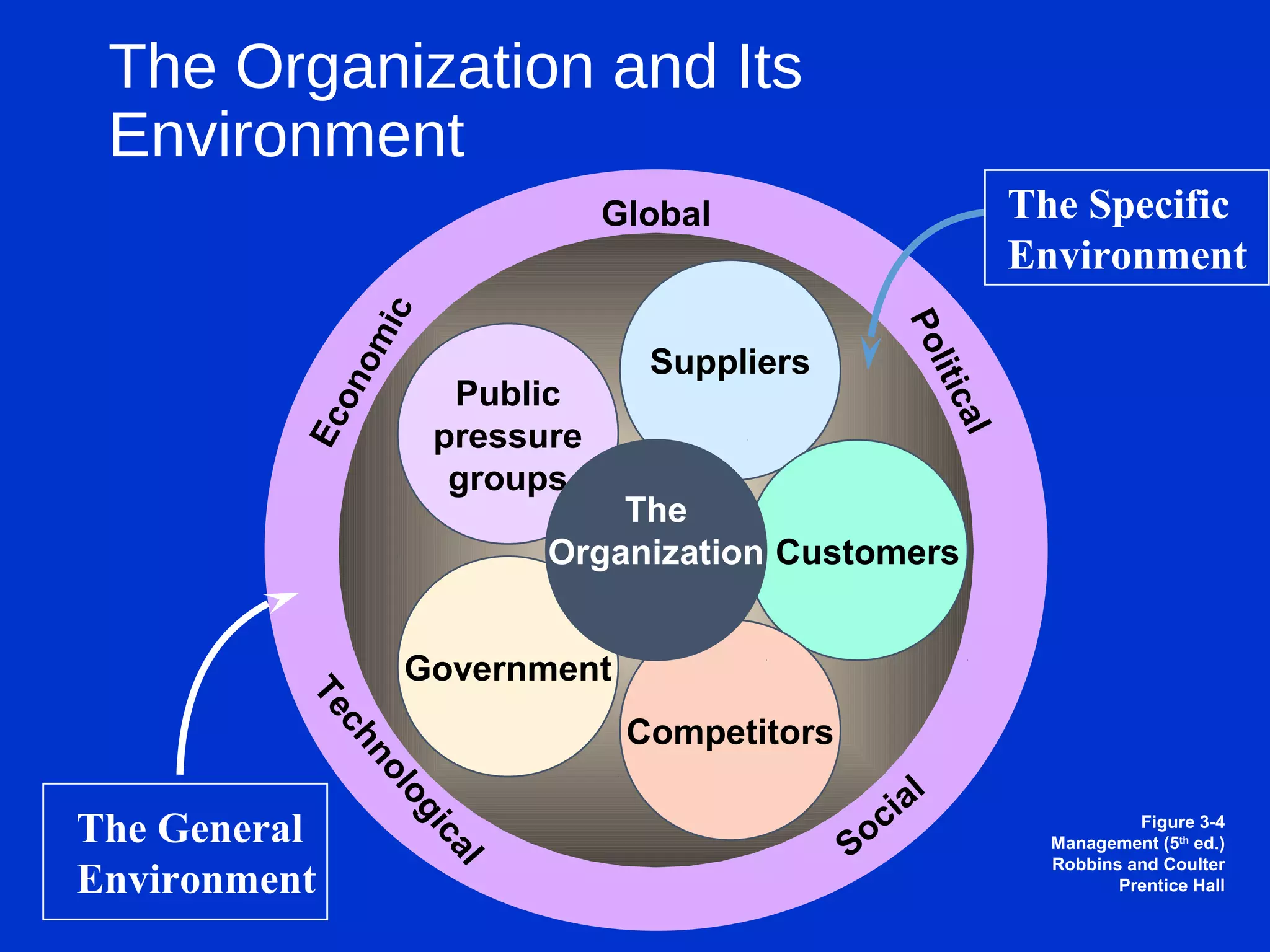
• An organization operates within an environment that is in a constant
state of change
• Too often we hear of change and its effects, but exactly what can
change?
Global
Social
Economic
Technological
Political
The General
Environment
The Organization and Its
Environment
Figure 3-4
Management (5th
ed.)
Robbins and Coulter
Prentice Hall
Suppliers
Public
pressure
groups
Government
Competitors
Customers
The Specific
Environment
The
Organization
Objective(s) of the Firm
•What is the objective of the firm?
• Maximize shareholder wealth
• Generate above average economic rents (profits)
•Shareholder: Someone who holds stock
(ownership) in the firm.
•Stakeholder: Anyone who possesses an interest in
the firm’s activities (govt., public pressure groups,
alumni, students, etc.)
Strategy
•To meet the organization’s objective, managers craft a
strategy. What’s a strategy?
• The science of planning and directing large-scale operations,
of maneuvering forces into the most advantageous position
prior to actual engagement with the enemy (Webster)
• A strategy is a plan to marshall or deploy scarce resources.
(Simpler)
•Levels of strategy:
• Corporate (Portfolio management)
• Business (Generate sustainable competitive advantage)
• Functional (Support the business level strategy)
Corporate-Level Strategy
• Diversification: the minimization of cash flow variance
• Integration
• Forward integration (one type of vertical):
• Gaining ownership or increased control over distributors or retailers (UA
buys Priceline)
• Backward integration (the other):
• Gaining ownership or increased control over suppliers (Amazon buys RCA
records)
• Horizontal integration
• Seeking ownership or increased control over competitors (Amazon buys
BestBookBuys.Com)
• Also approving (but not crafting) business-level strategies
Business-Level Strategy
• The primary objective of business-level strategy is to create sources
of sustainable competitive advantage.
• OK… what is sustainable competitive advantage?
• There are many definitions, used by different people in different ways.
• Here is a practical description. But first, we have to back up…
Sustainable Competitive
Advantage
•An asset is anything the firm owns or controls.
• Loosely, “Asset” is to Accounting as “Resource” is to
Management.
•Types of assets:
• Physical: plant equipment, location, access to raw materials
• Human: training, experience, judgment, decision-making skills,
intelligence, relationships, knowledge
• Organizational: Culture, formal reporting structures, control
systems, coordinating systems, informal relationships
Sustainable Competitive
Advantage
• A capability is usually considered a “bundle” of assets or
resources to perform a business process (which is composed of
individual activities)
• E.g. The product development process involves conceptualization, product
design, pilot testing, new product launch in production, process
debugging, etc.
• All firms have capabilities. However, a firm will usually focus on
certain capabilities consistent with its strategy.
• For example, a firm pursuing a differentiation strategy would focus on new
product development. A firm focusing on a low cost strategy would focus
on improving manufacturing process efficiency.
• The firm’s most important capabilities are called competencies.
Competencies vs. Core
Competencies vs. Distinctive
Competencies
• A competency is an internal capability that a
company performs better than other internal
capabilities.
• A core competency is a well-performed internal
capability that is central, not peripheral, to a
company’s strategy, competitiveness, and
profitability.
• A distinctive competence is a competitively valuable
capability that a company performs better than its
rivals.
Examples: Distinctive Competencies
• Sharp Corporation
• Expertise in flat-panel display technology
• Toyota, Honda, Nissan
• Low-cost, high-quality manufacturing capability and short
design-to-market cycles
• Intel
• Ability to design and manufacture ever more powerful
microprocessors for PCs
• Motorola
• Defect-free manufacture (six-sigma quality) of cell phones
Where are we?
•We are discussing sustainable competitive
advantage. Here we are now:
• AssetsCapabilitiesCompetenciesCompetitive Advantage
•Next is competitive advantage.
• A competitive advantage is simply an advantage you have
over your competitors.
• A competitive advantage is a special type of competency
that will produce competitive advantage provided:
A) it produces value for the organization, and
B) it does this in a way that cannot easily be pursued by competitors.

Business Terms & Concepts

  • 1.
  • 2.
    Some Basic Definitions •An organization is a group of people within some structure who possess a common objective, usually expressed in a mission statement. • Organizations may be: • for profit (frequently referred to as “firms”) • not-for-profit • A market is a place (real or virtual) where potential sellers and buyers meet to exchange resources (which may be money, products, services, etc.). • An industry is a group of organizations competing in a predefined market under similar bases of competition
  • 3.
    General Bases ofCompetition •A “basis of competition’ is a dimension upon which companies choose to compete, e.g., • Price • Quality • Delivery • Service • Innovation • Knowledge • Others?
  • 4.
    Organization and Environment •An organization operates within an environment that is in a constant state of change • Too often we hear of change and its effects, but exactly what can change?
  • 5.
    Global Social Economic Technological Political The General Environment The Organizationand Its Environment Figure 3-4 Management (5th ed.) Robbins and Coulter Prentice Hall Suppliers Public pressure groups Government Competitors Customers The Specific Environment The Organization
  • 6.
    Objective(s) of theFirm •What is the objective of the firm? • Maximize shareholder wealth • Generate above average economic rents (profits) •Shareholder: Someone who holds stock (ownership) in the firm. •Stakeholder: Anyone who possesses an interest in the firm’s activities (govt., public pressure groups, alumni, students, etc.)
  • 7.
    Strategy •To meet theorganization’s objective, managers craft a strategy. What’s a strategy? • The science of planning and directing large-scale operations, of maneuvering forces into the most advantageous position prior to actual engagement with the enemy (Webster) • A strategy is a plan to marshall or deploy scarce resources. (Simpler) •Levels of strategy: • Corporate (Portfolio management) • Business (Generate sustainable competitive advantage) • Functional (Support the business level strategy)
  • 8.
    Corporate-Level Strategy • Diversification:the minimization of cash flow variance • Integration • Forward integration (one type of vertical): • Gaining ownership or increased control over distributors or retailers (UA buys Priceline) • Backward integration (the other): • Gaining ownership or increased control over suppliers (Amazon buys RCA records) • Horizontal integration • Seeking ownership or increased control over competitors (Amazon buys BestBookBuys.Com) • Also approving (but not crafting) business-level strategies
  • 9.
    Business-Level Strategy • Theprimary objective of business-level strategy is to create sources of sustainable competitive advantage. • OK… what is sustainable competitive advantage? • There are many definitions, used by different people in different ways. • Here is a practical description. But first, we have to back up…
  • 10.
    Sustainable Competitive Advantage •An assetis anything the firm owns or controls. • Loosely, “Asset” is to Accounting as “Resource” is to Management. •Types of assets: • Physical: plant equipment, location, access to raw materials • Human: training, experience, judgment, decision-making skills, intelligence, relationships, knowledge • Organizational: Culture, formal reporting structures, control systems, coordinating systems, informal relationships
  • 11.
    Sustainable Competitive Advantage • Acapability is usually considered a “bundle” of assets or resources to perform a business process (which is composed of individual activities) • E.g. The product development process involves conceptualization, product design, pilot testing, new product launch in production, process debugging, etc. • All firms have capabilities. However, a firm will usually focus on certain capabilities consistent with its strategy. • For example, a firm pursuing a differentiation strategy would focus on new product development. A firm focusing on a low cost strategy would focus on improving manufacturing process efficiency. • The firm’s most important capabilities are called competencies.
  • 12.
    Competencies vs. Core Competenciesvs. Distinctive Competencies • A competency is an internal capability that a company performs better than other internal capabilities. • A core competency is a well-performed internal capability that is central, not peripheral, to a company’s strategy, competitiveness, and profitability. • A distinctive competence is a competitively valuable capability that a company performs better than its rivals.
  • 13.
    Examples: Distinctive Competencies •Sharp Corporation • Expertise in flat-panel display technology • Toyota, Honda, Nissan • Low-cost, high-quality manufacturing capability and short design-to-market cycles • Intel • Ability to design and manufacture ever more powerful microprocessors for PCs • Motorola • Defect-free manufacture (six-sigma quality) of cell phones
  • 14.
    Where are we? •Weare discussing sustainable competitive advantage. Here we are now: • AssetsCapabilitiesCompetenciesCompetitive Advantage •Next is competitive advantage. • A competitive advantage is simply an advantage you have over your competitors. • A competitive advantage is a special type of competency that will produce competitive advantage provided: A) it produces value for the organization, and B) it does this in a way that cannot easily be pursued by competitors.