Presented By:
Saurabh Negi
014-I-150
MULTINATIONAL ENTERPRISE
SAURABH NEGI 014-I-150
OVERVIEW
 What is MNE?
 History and Evolution of MNE
 MNE Structure.
 Organization of MNE.
 Reasons for establishment of MNE.
 Advantage and Disadvantage of MNE
 Criticism of MNE.
 MNE in India.
WHAT IS A MULTINATIONAL
ENTERPRISE???
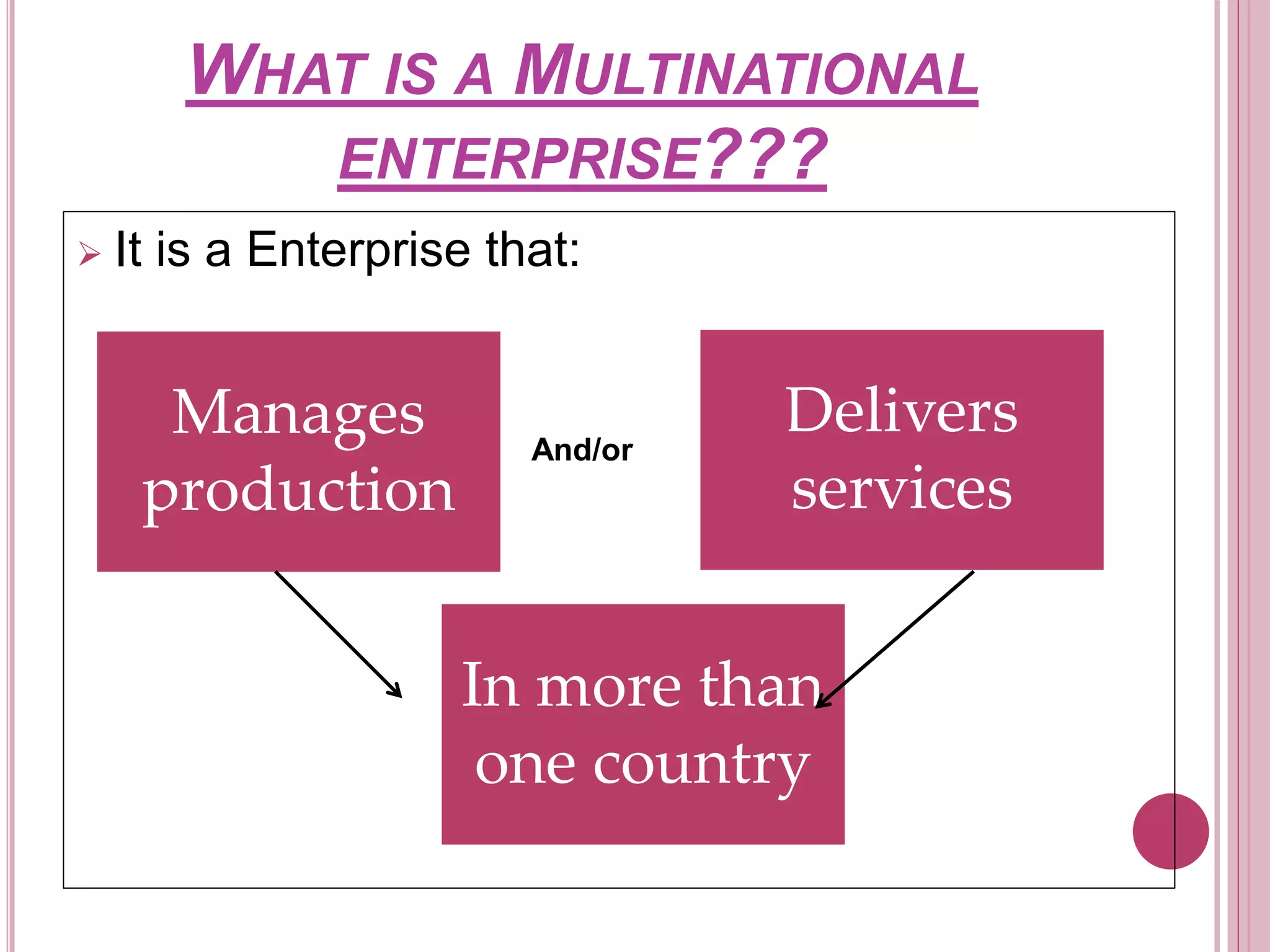
 It is a Enterprise that:
Manages
production
In more than
one country
Delivers
services
And/or
WHAT IS A MULTINATIONAL
ENTERPRISE?
o According to Franklin Root (1994), an MNE is a parent
company that:
 Engages in foreign production through its affiliates
located in several countries,
 Exercises direct control over the policies of its affiliates,
 Implements business strategies in production,
marketing, finance and staffing that transcend national
boundaries.
EXAMPLESOFMNE S:
 Ford
 IBM
 British Petroleum
 Mc Donald’s
 Phillips
The largest mnes:
Wal-Mart Stores
Exxon Mobil
Royal Dutch Shell
These companies have
turnovers in excess of
the GNPs of some
countries.
HOW IS A COMPANY CLASSIFIED
AS AN MNE?
Subsidiaries in
foreign
countries;
Operations in a
number of
countries;
High proportion of
assets in or/ and
revenues from
global operations;
Stakeholders
are from
different
countries.
HISTORY AND EVOLUTION OF MNES:
 These enterprise originated early in the 20th century and
expanded after World War II.
 A Multinational Enterprise developed new products in its
native country and manufactured them abroad.
 Almost all the earliest and largest multinational firms were
either American, Japanese, or West European.
 During the last three decades, many smaller enterprise
have also become multinational.
 Such enterprises maintain that they create employment,
create wealth, and improve technology in countries.
MULTINATIONAL ENTERPRISE
STRUCTURE:
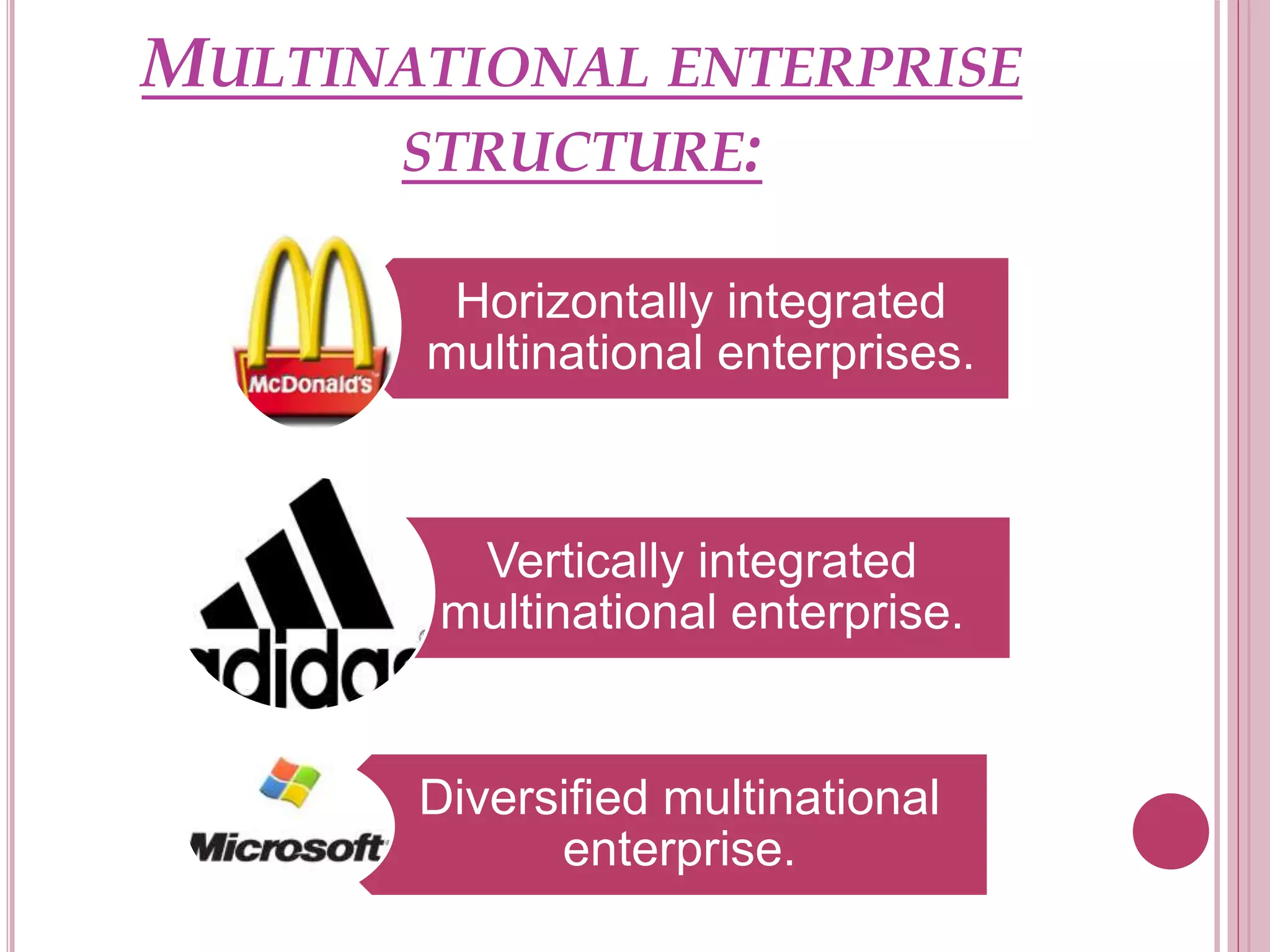
Horizontally integrated
multinational enterprises.
Vertically integrated
multinational enterprise.
Diversified multinational
enterprise.
ORGANIZATION OF MULTINATIONAL
ENTERPRISE
 Subsidiaries
 Joint Ventures Companies
 Franchise Holders
 Turn Key Project.
REASONS FOR THE ESTABLISHMENT
OF MNE’S
 To increase market share.
 To secure cheaper premises and labour.
 Employment and Health & Safety Legislations in other
countries may be more relaxed.
 To avoid or minimise the amount of tax to be paid.
 To take advantage of government grants available.
 To save on costs of transporting goods to the market
place.
 To develop an international brand.
ADVANTAGES OF MNE S TO THE
HOST COUNTRY:
 Transfer of technology, capital and entrepreneurship.
 Increase in the investment level and thus, the income
and employment in the host country.
 Greater availability of products for local consumers.
 Increase in exports and decrease in imports.
ADVANTAGES OF MNE S TO THE
HOME COUNTRY.
 Acquisition of raw materials from abroad.
 Technology and management expertise acquired from
competing in global markets.
 Export of components and finished goods for assembly
or distribution in foreign markets.
 Inflow of income from overseas profits, royalties and
management contracts.
DISADVANTAGES OF MNE S:
 Trade restrictions imposed at the government-level
 Limited quantities (quotas) of imports.
 Effective management of a globally dispersed
organization.
 Slow down in the growth of employment in home
countries.
 Destroy competition and acquire monopoly.
WHY FIRMS BECOME MULTINATIONAL
ENTERPRISES?
 A desire to protect themselves from the risks and
uncertainties of the domestic business cycle.
 A growing world market for their goods or services.
 A response to increased foreign competition.
 A desire to internalize in order to reduce costs.
 A desire to overcome tariffs barriers.
 And the chance to take advantage of technological
expertise by manufacturing goods directly rather
than allowing others to do it under a license
agreement
MNES in India have a long history and tradition:
WHAT INDIA OFFERS???
 One billion plus population.
 India is ranked as the 10th largest economy, 4th largest in
terms of Purchasing Power Parity.
 250-300 million middle class.
 Gross Domestic Product (GDP) is growing at over 7-9 %,
making it one of the fastest growing economies in the
world.
 Opportunities for U.S. exporters with the right products or
services.
 Easier access to capital.
TRENDS OF MNES IN INDIA:
 First mne in India was the EAST INDIA Company. in
1600.
 American companies account for around 37% of the
turnover of the top 20 firms operating in India.
 Oil companies and Infrastructure builders from the
Middle East are also flocking in India to catch the boom.
Contd…….
 Increasing flocking of Europian Union companies to
India.
 Italian automobile giants like Fiat, Ford Motors,
Piaggio etc expanded their operations in India with
R&D wing attached.
 South Korean Electronics giants Samsung and LG
Electronics and small and mid-segment car giant
Hyundai Motors are doing excellent business and
using India as a hub for global delivery.
KEY ADVANTAGES OF EXISTENCE
OF MNE’S IN INDIA
 Work culture for employees.
 Training and Learning.
 Technology – especially concept of working with
better technologies.
 Safety, Health and Environmental Learning.
 Excellent training grounds for many entrepreneurs.
KEY CHALLENGES THAT INDIAN MNES
FACE:
 Domestic market like India vis - a - vis International expansion.
 Language.
 Culture.
 Autonomy to “local” managers .
 Styles of doing business.
 Handling of potential liabilities related to Labor, IPR etc.
Multinational Enterprises

Multinational Enterprises

  • 1.
    Presented By: Saurabh Negi 014-I-150 MULTINATIONALENTERPRISE SAURABH NEGI 014-I-150
  • 2.
    OVERVIEW  What isMNE?  History and Evolution of MNE  MNE Structure.  Organization of MNE.  Reasons for establishment of MNE.  Advantage and Disadvantage of MNE  Criticism of MNE.  MNE in India.
  • 3.
    WHAT IS AMULTINATIONAL ENTERPRISE???  It is a Enterprise that: Manages production In more than one country Delivers services And/or
  • 4.
    WHAT IS AMULTINATIONAL ENTERPRISE? o According to Franklin Root (1994), an MNE is a parent company that:  Engages in foreign production through its affiliates located in several countries,  Exercises direct control over the policies of its affiliates,  Implements business strategies in production, marketing, finance and staffing that transcend national boundaries.
  • 5.
    EXAMPLESOFMNE S:  Ford IBM  British Petroleum  Mc Donald’s  Phillips The largest mnes: Wal-Mart Stores Exxon Mobil Royal Dutch Shell These companies have turnovers in excess of the GNPs of some countries.
  • 6.
    HOW IS ACOMPANY CLASSIFIED AS AN MNE? Subsidiaries in foreign countries; Operations in a number of countries; High proportion of assets in or/ and revenues from global operations; Stakeholders are from different countries.
  • 7.
    HISTORY AND EVOLUTIONOF MNES:  These enterprise originated early in the 20th century and expanded after World War II.  A Multinational Enterprise developed new products in its native country and manufactured them abroad.  Almost all the earliest and largest multinational firms were either American, Japanese, or West European.  During the last three decades, many smaller enterprise have also become multinational.  Such enterprises maintain that they create employment, create wealth, and improve technology in countries.
  • 8.
    MULTINATIONAL ENTERPRISE STRUCTURE: Horizontally integrated multinationalenterprises. Vertically integrated multinational enterprise. Diversified multinational enterprise.
  • 9.
    ORGANIZATION OF MULTINATIONAL ENTERPRISE Subsidiaries  Joint Ventures Companies  Franchise Holders  Turn Key Project.
  • 10.
    REASONS FOR THEESTABLISHMENT OF MNE’S  To increase market share.  To secure cheaper premises and labour.  Employment and Health & Safety Legislations in other countries may be more relaxed.  To avoid or minimise the amount of tax to be paid.  To take advantage of government grants available.  To save on costs of transporting goods to the market place.  To develop an international brand.
  • 11.
    ADVANTAGES OF MNES TO THE HOST COUNTRY:  Transfer of technology, capital and entrepreneurship.  Increase in the investment level and thus, the income and employment in the host country.  Greater availability of products for local consumers.  Increase in exports and decrease in imports.
  • 12.
    ADVANTAGES OF MNES TO THE HOME COUNTRY.  Acquisition of raw materials from abroad.  Technology and management expertise acquired from competing in global markets.  Export of components and finished goods for assembly or distribution in foreign markets.  Inflow of income from overseas profits, royalties and management contracts.
  • 13.
    DISADVANTAGES OF MNES:  Trade restrictions imposed at the government-level  Limited quantities (quotas) of imports.  Effective management of a globally dispersed organization.  Slow down in the growth of employment in home countries.  Destroy competition and acquire monopoly.
  • 14.
    WHY FIRMS BECOMEMULTINATIONAL ENTERPRISES?  A desire to protect themselves from the risks and uncertainties of the domestic business cycle.  A growing world market for their goods or services.  A response to increased foreign competition.  A desire to internalize in order to reduce costs.  A desire to overcome tariffs barriers.  And the chance to take advantage of technological expertise by manufacturing goods directly rather than allowing others to do it under a license agreement
  • 15.
    MNES in Indiahave a long history and tradition:
  • 16.
    WHAT INDIA OFFERS??? One billion plus population.  India is ranked as the 10th largest economy, 4th largest in terms of Purchasing Power Parity.  250-300 million middle class.  Gross Domestic Product (GDP) is growing at over 7-9 %, making it one of the fastest growing economies in the world.  Opportunities for U.S. exporters with the right products or services.  Easier access to capital.
  • 17.
    TRENDS OF MNESIN INDIA:  First mne in India was the EAST INDIA Company. in 1600.  American companies account for around 37% of the turnover of the top 20 firms operating in India.  Oil companies and Infrastructure builders from the Middle East are also flocking in India to catch the boom. Contd…….
  • 18.
     Increasing flockingof Europian Union companies to India.  Italian automobile giants like Fiat, Ford Motors, Piaggio etc expanded their operations in India with R&D wing attached.  South Korean Electronics giants Samsung and LG Electronics and small and mid-segment car giant Hyundai Motors are doing excellent business and using India as a hub for global delivery.
  • 19.
    KEY ADVANTAGES OFEXISTENCE OF MNE’S IN INDIA  Work culture for employees.  Training and Learning.  Technology – especially concept of working with better technologies.  Safety, Health and Environmental Learning.  Excellent training grounds for many entrepreneurs.
  • 20.
    KEY CHALLENGES THATINDIAN MNES FACE:  Domestic market like India vis - a - vis International expansion.  Language.  Culture.  Autonomy to “local” managers .  Styles of doing business.  Handling of potential liabilities related to Labor, IPR etc.