MULTINATIONALCORPORATIONS
GROUP IITEAM MEMBERSVINEETHACINDHYADEEPARENJUSUJINTHOMSON
CONTENTSmultinational corporation-(definition)multinational corporate structureprocess of evolutionmultinational corporationshierarchy of MNCs activitiesfactors leading to growth in IBbenefits of MNCscode of conductwhat MNCs have to do ?conclusion list of MNCs in India
MULTINATIONAL CORPORATIONMultinational corporation    (or Transnational corporation) (MNC/TNC) :      It    manages     production establishments  or   delivers   services in at  least two countries    Definition:  It engages    in    foreign    direct investment   (FDI)  and  that  owns  and controls value   added    activities   in    more   than   one country.
	Large multinationals have budgets that exceed those of entire countries. They have a powerful influence in international relations and local economies.They have play an important role  in  globalization ;  some  argue that a new form  of MNC  is  evolving  in   response   to globalization: the 'globally integrated enterprise'. MNCs have existed since1602, in which year the first MNC, the Dutch East India Company, was established.
According to MNCs,it represents a cluster of affiliated firms located in different countries that:    Are linked through common      	ownership
    Draw upon a common pool of 	resources
    Respond to a common strategy		    All this shows high degree of integration among different units of the firm.
 MULTINATIONAL CORPORATE STRUCTURE			     Multinational corporations can be divided into three broad groups according to the configuration of their production facilities:1.Horizontally integrated multinational corporations ;manage production establishments located in different  countries  to produce the same or similar products.(example: McDonald's)
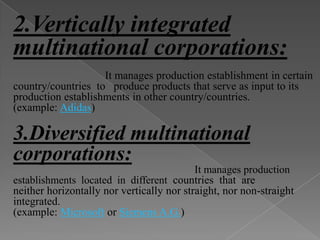
2.Vertically integrated multinational corporations:            			                                                            		          It manages production establishment in certain country/countries  to   produce products that serve as input to its production establishments in other country/countries. (example: Adidas)3.Diversified multinational corporations:					        It manages production establishments  located  in  different  countries  that  are neither horizontally nor vertically nor straight, nor non-straight integrated. (example: Microsoft or Siemens A.G.)
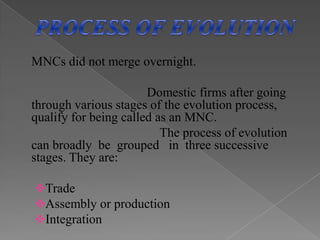
PROCESS OF EVOLUTION MNCs did not merge overnight.           			 Domestic firms after going through various stages of the evolution process, qualify for being called as an MNC.                                            The process of evolution can broadly  be  grouped   in  three successive stages. They are:Trade
Assembly or production
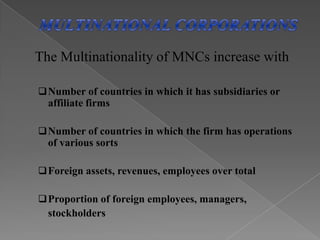
IntegrationMULTINATIONAL CORPORATIONSThe Multinationality of MNCs increase withNumber of countries in which it has subsidiaries or affiliate firms
Number of countries in which the firm has operations of various sorts
Foreign assets, revenues, employees over total
Proportion of foreign employees, managers, 	stockholders
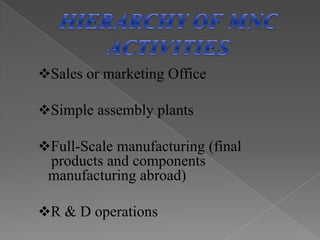
HIERARCHY OF MNC ACTIVITIESSales or marketing Office
Simple assembly plants
Full-Scale manufacturing (final 	        	products and components 			 manufacturing abroad)
R & D operationsFACTORS LEADING TO GROWTH IN IB The factors leading to the growth in IB are:Rapid technological advancement
Emergence of supportive institutions
Openness of economic policies among large number of countries
Increase in competitionBENEFITS OF MNCBenefits  from MNCs  can be studied under two broad heads:-Benefits  to  the host
Benefits  to the home countries
Benefits  to the host countries  :
Transfer of technology, capital  and entrepreneurship to the host country.
Improvement of the host country’s balance of payment .Creation of local job and career opportunities .
Improved competition in the local economy and better utilisation of available resources .
Greater availability of products for local consumers .

Copy Of Mpob

  • 1.
  • 2.
  • 3.
    CONTENTSmultinational corporation-(definition)multinational corporatestructureprocess of evolutionmultinational corporationshierarchy of MNCs activitiesfactors leading to growth in IBbenefits of MNCscode of conductwhat MNCs have to do ?conclusion list of MNCs in India
  • 4.
    MULTINATIONAL CORPORATIONMultinational corporation (or Transnational corporation) (MNC/TNC) : It manages production establishments or delivers services in at least two countries Definition: It engages in foreign direct investment (FDI) and that owns and controls value added activities in more than one country.
  • 5.
    Large multinationals havebudgets that exceed those of entire countries. They have a powerful influence in international relations and local economies.They have play an important role in globalization ; some argue that a new form of MNC is evolving in response to globalization: the 'globally integrated enterprise'. MNCs have existed since1602, in which year the first MNC, the Dutch East India Company, was established.
  • 6.
    According to MNCs,itrepresents a cluster of affiliated firms located in different countries that: Are linked through common ownership
  • 7.
    Draw upon a common pool of resources
  • 8.
    Respond to a common strategy All this shows high degree of integration among different units of the firm.
  • 9.
    MULTINATIONAL CORPORATESTRUCTURE Multinational corporations can be divided into three broad groups according to the configuration of their production facilities:1.Horizontally integrated multinational corporations ;manage production establishments located in different countries to produce the same or similar products.(example: McDonald's)
  • 10.
    2.Vertically integrated multinationalcorporations: It manages production establishment in certain country/countries to produce products that serve as input to its production establishments in other country/countries. (example: Adidas)3.Diversified multinational corporations: It manages production establishments located in different countries that are neither horizontally nor vertically nor straight, nor non-straight integrated. (example: Microsoft or Siemens A.G.)
  • 11.
    PROCESS OF EVOLUTION MNCsdid not merge overnight. Domestic firms after going through various stages of the evolution process, qualify for being called as an MNC. The process of evolution can broadly be grouped in three successive stages. They are:Trade
  • 12.
  • 13.
    IntegrationMULTINATIONAL CORPORATIONSThe Multinationalityof MNCs increase withNumber of countries in which it has subsidiaries or affiliate firms
  • 14.
    Number of countriesin which the firm has operations of various sorts
  • 15.
    Foreign assets, revenues,employees over total
  • 16.
    Proportion of foreignemployees, managers, stockholders
  • 17.
    HIERARCHY OF MNCACTIVITIESSales or marketing Office
  • 18.
  • 19.
    Full-Scale manufacturing (final products and components manufacturing abroad)
  • 20.
    R & DoperationsFACTORS LEADING TO GROWTH IN IB The factors leading to the growth in IB are:Rapid technological advancement
  • 21.
  • 22.
    Openness of economicpolicies among large number of countries
  • 23.
    Increase in competitionBENEFITSOF MNCBenefits from MNCs can be studied under two broad heads:-Benefits to the host
  • 24.
    Benefits tothe home countries
  • 25.
    Benefits tothe host countries :
  • 26.
    Transfer of technology,capital and entrepreneurship to the host country.
  • 27.
    Improvement of thehost country’s balance of payment .Creation of local job and career opportunities .
  • 28.
    Improved competition inthe local economy and better utilisation of available resources .
  • 29.
    Greater availability ofproducts for local consumers .