MANAGING MNCs

Presented by:
Mahendra Singh Chauhan
Shashank Shekher Singh
Shudhanshu Sharma
CONTENT
• What is an MNC
• Difference between multinational and non-multi-national
• Types of multi-national
on the basis of investment
on the basis of operation
•
Impact of MNC –INDIA
•
Positive/negative effect
•
What INDIA offers
•
Indian companies in fortune 500 list
•
Trend of MNC in INDIA
•
Advantage of MNC in INDIA
•
Key issues in Indian context
•
Example: Asian paints
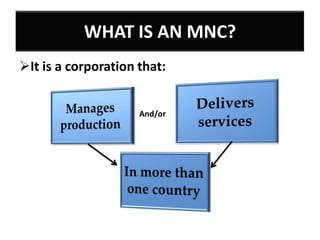
WHAT IS AN MNC?
It is a corporation that:
And/or
WHAT IS AN MNC?....continued
 According to Franklin Root (1994), an MNC
is a parent company that:
• engages in foreign production through its
affiliates located in several countries,
• exercises direct control over the policies of
its affiliates,
• implements business strategies in
production, marketing, finance and staffing
that transcend national boundaries.
• A firm to be an MNC following criteria has to be
fulfilled:
 The firm should own or control operations in
multiple countries, typically across the world
 It should generate a substantial portion of its
revenue by its operations from foreign countries
 Should employ workforce from multiple
countries, including employees at the senior
levels
 It should have a strategic management
perspective and a vision of multinational
operations
What differs a multinational firm
from a non multi-national firm
• For this one must know what constitutes a nonmultinational firm. The key attributes of a nonmultinational firm are:

1. It produces and market goods and
services in one country
2. It is headquartered in one country
3. It faces low international risk exposure
TYPES OF MULTINATIONALS
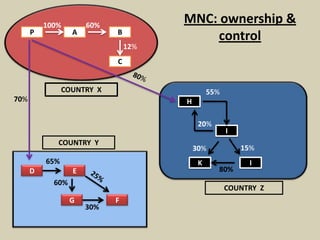
ON THE BASIS OF INVESTMENT
ASSOCIATES: an enterprise in which a non resident
investors own between 10 and 50%
SUBSIDIARIES: an enterprises in which a non-resident
investor owns more than 50%
BRANCHES: unincorporated enterprises wholly or
jointly owned by a non-resident investor
P

100%

A

60%

B
12%

MNC: ownership &
control

C

COUNTRY X

55%

70%

H
20%
COUNTRY Y

15%

30%

65%
D

I

K
E

60%

80%

I

COUNTRY Z
G

30%

F
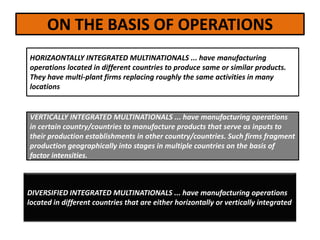
ON THE BASIS OF OPERATIONS
HORIZAONTALLY INTEGRATED MULTINATIONALS ... have manufacturing
operations located in different countries to produce same or similar products.
They have multi-plant firms replacing roughly the same activities in many
locations

VERTICALLY INTEGRATED MULTINATIONALS ... have manufacturing operations
in certain country/countries to manufacture products that serve as inputs to
their production establishments in other country/countries. Such firms fragment
production geographically into stages in multiple countries on the basis of
factor intensities.

DIVERSIFIED INTEGRATED MULTINATIONALS ... have manufacturing operations
located in different countries that are either horizontally or vertically integrated
ON THE BASIS OF MANAGEMENT
ORIENTATION
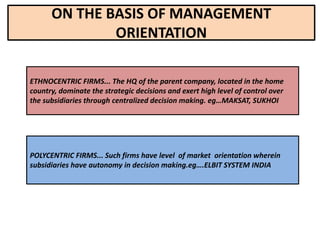
ETHNOCENTRIC FIRMS... The HQ of the parent company, located in the home
country, dominate the strategic decisions and exert high level of control over
the subsidiaries through centralized decision making. eg…MAKSAT, SUKHOI

POLYCENTRIC FIRMS... Such firms have level of market orientation wherein
subsidiaries have autonomy in decision making.eg….ELBIT SYSTEM INDIA
REGIOCENTRIC FIRMS... Foreign affiliates consolidates their decision making
and organization on regional basis. Eg…Mc Donald

GEOCENTRIC FIRMS... Such follow a collaborative approach to decision- making
between HQ and subsidiaries. Eg…Phillips
ON THE BASIS OF MANAGEMENT
ORIENTATION continued……
ORIENTATION

ETHNOCENTRIC POLYCENTRIC

Mission

Profitability
(viability)

Public
acceptance
(legitimacy)

Top down

Bottom up

Mutually
negotiated
between
region &
subsidiaries

Mutually
negotiated at
all level

Little
communication
to & from HQ
& between
subsidiaries

Both vertical &
lateral
communication
within region

Both vertical
and lateral
communication
within
company

Governance
•Direction of
goal setting

communication Hierarchical
with HQ giving
high volumes
of orders,
commands and
advice

REGIOCENTRIC

GEOCENTRIC

Both profitability and public
acceptance
ORIENTATION

ETHNOCENTRIC POLYCENTRIC

REGIOCENTRIC

GEOCENTRIC

•Allocation of
resources

Investment
opportunities
decided at HQ

Self-supporting
subsidiaries, no
crosssubsidiaries

Regions
allocate
resources
under
guidelines from
HQ

Worldwide
projects
allocation
influenced by
local and HQ’s
manager

STRATEGY

Global
integrative

National
responsiveness

Regional
integrative and
national
responsiveness

Global
integrative and
national
responsiveness

STRUCTURE

Hierarchical
product
division

Hierarchical
area division,
with
autonomous
national units

Product &
regional
organizations
tied through a
matrix

A network of
organizations

CULTURE

Home country

Host country

Regional

Global
IMPACT OF MNC
POSITIVE EFFECT OF MNCs
•
•
•
•
•
•

Bring in FDI
Transfer of technology
Promote competition
Promote research and development
Benefit customer
Promote export in the host economies
NEGATIVE EFFECT
• Influencing host-country government
decisions
• Transfer of inappropriate technology
• Dumping of obsolete technology
• Cultural imperialism
• Exploitation of host country resources
• Perceived as agents of neo-colonialism
•
•
•
•
•

Promotes unhealthy market competition
Promotes hostile mergers and acquisitions
Crowding out domestic entrepreneurship
Limited benefits to host countries
Circumventing host countries’ regulatory
framework
Mnc in india

MNC IN INDIA
What India offers…. to the world
One billion plus population.
 India is ranked as the 10th largest economy, 3rd largest in terms of
Purchasing Power Parity.
200-250 million middle class.
Gross Domestic Product 6.48 %, (avg. of last 5 years) making it one
of the fastest growing economies in the world.
Opportunities for world exporters with the right products or
services.
Easier access to capital.
INDIAN MNCs
1. TATA STEEL
2. TATA MOTORS
3. Wipro
4. HCL
5. Tally Solutions
6. Infosys
7. NIIT
8. I-Flex Solutions
9. Zenith Computers
10. Microtek
Trends Of MNCs In INDIA
First MNC in India was the EAST INDIA Company. in
1600
American companies account for around 37%
(approx.)of the turnover of the top 20 firms operating
in India
Oil companies and Infrastructure builders from the
Middle East are also flocking in India to catch the boom
 Hewlett-Packard (HP) is the largest multinational
corporation operating in INDIA
Increasing flocking of European Union companies to
India.
JCB owned by INDIOPHILE is one of the most
successful multinational corporation in India.
Italian automobile giants like Fiat, Ford Motors,
Piaggio etc expanded their operations in India with R&D
wing attached.
South Korean Electronics giants Samsung and LG
Electronics and small and mid-segment car giant
Hyundai Motors are doing excellent business and using
India as a hub for global delivery.
India currently has some 750 captive centres of
foreign multinationals; of these around 350 are engaged
in engineering R&D
Key Advantages of existence of MNCs in
India
 Work culture of employees.
 Training and Learning.
 Technology – especially concept of working with
better technologies.
 Safety, Health and Environmental Learning.

 Excellent training grounds for many
entrepreneurs.
What are the key issues in the Indian
context which have hindered MNCs growth?
• “Global parent strategy” dictates India plans
• Limitations of growth due to regulatory / legislation / IPR
issues

• Limited Autonomy for top MNC Managers
• Sometimes bureaucratic setups have delayed decision
making – sharp contrast to most Indian entrepreneur
companies
• Insistence of some companies on having expats
• Rigidity and insistence on evaluating India like any other
market
• Not being able to recognize early enough that India is a price
and quality conscious market
• Limitations of following aggressive M&A options

• Many MNCs have got consistently caught in rounds of
“parent consolidation”
• 100% subsidiary conundrum
Case study : Asian Paints
• Asian Paints rise from a mid sized domestic focused coatings
company to a $ 1.6 billion multinational with a global presence
across 17 markets. Among the top 10 decorative coatings
companies globally.
– Key strengths are continuous innovations in all spheres of
operations, economies of scale, strong management
team, IT capabilities, stronghold over the distribution
network, width of product portfolio and strong brand equity
– Consistently generated EBITDAs of 14.2% and ROEs of 20%+ higher than most Indian and global peers
– Operates in 17 countries across the world - manufacturing
facilities in each of these countries and is the largest paint
company in 11 of these market
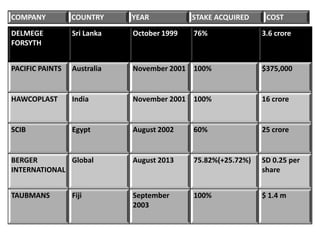
COMPANY

COUNTRY

YEAR

STAKE ACQUIRED

DELMEGE
FORSYTH

Sri Lanka

October 1999

76%

PACIFIC PAINTS

Australia

November 2001 100%

$375,000

HAWCOPLAST

India

November 2001 100%

16 crore

SCIB

Egypt

August 2002

60%

25 crore

BERGER
Global
INTERNATIONAL

August 2013

75.82%(+25.72%)

SD 0.25 per
share

TAUBMANS

September
2003

100%

$ 1.4 m

Fiji

COST
3.6 crore
Caribbean Region
(Barbados, Jamaica, Trinidad and Tobago)
• the revenue from paint sales has increased by 15% to 197.2
crores from 171.8 crores
• PBIT (profit before interest and tax) for the region is 11.2
crores as compared to ` 7.6 crores during the previous
year(2012)
• Continuing economic slowdown in all the Caribbean
economies, impacted demand conditions

Middle East Region
(Egypt, Oman, Bahrain and UAE)
• the revenue from paint sales has increased by 26% to 726.7
crores from 578.4 crores during the previous year(2012)
• PBIT for the region is 73.9 crores as compared to 61.5 crores
during the previous year(2012)
Asia Region
(Bangladesh, Nepal, Sri Lanka and Singapore)
• Revenue from paint sales has increased by 21% to ` 380
crores from ` 314.7 crores during
• the previous year
• The PBIT for the region is ` 35.6 crores as compared to ` 24.6
crores during the previous year(2012)
Managing MNC

Managing MNC

  • 1.
    MANAGING MNCs Presented by: MahendraSingh Chauhan Shashank Shekher Singh Shudhanshu Sharma
  • 2.
    CONTENT • What isan MNC • Difference between multinational and non-multi-national • Types of multi-national on the basis of investment on the basis of operation • Impact of MNC –INDIA • Positive/negative effect • What INDIA offers • Indian companies in fortune 500 list • Trend of MNC in INDIA • Advantage of MNC in INDIA • Key issues in Indian context • Example: Asian paints
  • 3.
    WHAT IS ANMNC? It is a corporation that: And/or
  • 4.
    WHAT IS ANMNC?....continued  According to Franklin Root (1994), an MNC is a parent company that: • engages in foreign production through its affiliates located in several countries, • exercises direct control over the policies of its affiliates, • implements business strategies in production, marketing, finance and staffing that transcend national boundaries.
  • 5.
    • A firmto be an MNC following criteria has to be fulfilled:  The firm should own or control operations in multiple countries, typically across the world  It should generate a substantial portion of its revenue by its operations from foreign countries  Should employ workforce from multiple countries, including employees at the senior levels  It should have a strategic management perspective and a vision of multinational operations
  • 6.
    What differs amultinational firm from a non multi-national firm • For this one must know what constitutes a nonmultinational firm. The key attributes of a nonmultinational firm are: 1. It produces and market goods and services in one country 2. It is headquartered in one country 3. It faces low international risk exposure
  • 7.
    TYPES OF MULTINATIONALS ONTHE BASIS OF INVESTMENT ASSOCIATES: an enterprise in which a non resident investors own between 10 and 50% SUBSIDIARIES: an enterprises in which a non-resident investor owns more than 50% BRANCHES: unincorporated enterprises wholly or jointly owned by a non-resident investor
  • 8.
    P 100% A 60% B 12% MNC: ownership & control C COUNTRYX 55% 70% H 20% COUNTRY Y 15% 30% 65% D I K E 60% 80% I COUNTRY Z G 30% F
  • 9.
    ON THE BASISOF OPERATIONS HORIZAONTALLY INTEGRATED MULTINATIONALS ... have manufacturing operations located in different countries to produce same or similar products. They have multi-plant firms replacing roughly the same activities in many locations VERTICALLY INTEGRATED MULTINATIONALS ... have manufacturing operations in certain country/countries to manufacture products that serve as inputs to their production establishments in other country/countries. Such firms fragment production geographically into stages in multiple countries on the basis of factor intensities. DIVERSIFIED INTEGRATED MULTINATIONALS ... have manufacturing operations located in different countries that are either horizontally or vertically integrated
  • 10.
    ON THE BASISOF MANAGEMENT ORIENTATION ETHNOCENTRIC FIRMS... The HQ of the parent company, located in the home country, dominate the strategic decisions and exert high level of control over the subsidiaries through centralized decision making. eg…MAKSAT, SUKHOI POLYCENTRIC FIRMS... Such firms have level of market orientation wherein subsidiaries have autonomy in decision making.eg….ELBIT SYSTEM INDIA
  • 11.
    REGIOCENTRIC FIRMS... Foreignaffiliates consolidates their decision making and organization on regional basis. Eg…Mc Donald GEOCENTRIC FIRMS... Such follow a collaborative approach to decision- making between HQ and subsidiaries. Eg…Phillips
  • 12.
    ON THE BASISOF MANAGEMENT ORIENTATION continued…… ORIENTATION ETHNOCENTRIC POLYCENTRIC Mission Profitability (viability) Public acceptance (legitimacy) Top down Bottom up Mutually negotiated between region & subsidiaries Mutually negotiated at all level Little communication to & from HQ & between subsidiaries Both vertical & lateral communication within region Both vertical and lateral communication within company Governance •Direction of goal setting communication Hierarchical with HQ giving high volumes of orders, commands and advice REGIOCENTRIC GEOCENTRIC Both profitability and public acceptance
  • 13.
    ORIENTATION ETHNOCENTRIC POLYCENTRIC REGIOCENTRIC GEOCENTRIC •Allocation of resources Investment opportunities decidedat HQ Self-supporting subsidiaries, no crosssubsidiaries Regions allocate resources under guidelines from HQ Worldwide projects allocation influenced by local and HQ’s manager STRATEGY Global integrative National responsiveness Regional integrative and national responsiveness Global integrative and national responsiveness STRUCTURE Hierarchical product division Hierarchical area division, with autonomous national units Product & regional organizations tied through a matrix A network of organizations CULTURE Home country Host country Regional Global
  • 14.
  • 15.
    POSITIVE EFFECT OFMNCs • • • • • • Bring in FDI Transfer of technology Promote competition Promote research and development Benefit customer Promote export in the host economies
  • 16.
    NEGATIVE EFFECT • Influencinghost-country government decisions • Transfer of inappropriate technology • Dumping of obsolete technology • Cultural imperialism • Exploitation of host country resources • Perceived as agents of neo-colonialism
  • 17.
    • • • • • Promotes unhealthy marketcompetition Promotes hostile mergers and acquisitions Crowding out domestic entrepreneurship Limited benefits to host countries Circumventing host countries’ regulatory framework
  • 18.
  • 19.
    What India offers….to the world One billion plus population.  India is ranked as the 10th largest economy, 3rd largest in terms of Purchasing Power Parity. 200-250 million middle class. Gross Domestic Product 6.48 %, (avg. of last 5 years) making it one of the fastest growing economies in the world. Opportunities for world exporters with the right products or services. Easier access to capital.
  • 20.
    INDIAN MNCs 1. TATASTEEL 2. TATA MOTORS 3. Wipro 4. HCL 5. Tally Solutions 6. Infosys 7. NIIT 8. I-Flex Solutions 9. Zenith Computers 10. Microtek
  • 21.
    Trends Of MNCsIn INDIA First MNC in India was the EAST INDIA Company. in 1600 American companies account for around 37% (approx.)of the turnover of the top 20 firms operating in India Oil companies and Infrastructure builders from the Middle East are also flocking in India to catch the boom  Hewlett-Packard (HP) is the largest multinational corporation operating in INDIA
  • 22.
    Increasing flocking ofEuropean Union companies to India. JCB owned by INDIOPHILE is one of the most successful multinational corporation in India. Italian automobile giants like Fiat, Ford Motors, Piaggio etc expanded their operations in India with R&D wing attached. South Korean Electronics giants Samsung and LG Electronics and small and mid-segment car giant Hyundai Motors are doing excellent business and using India as a hub for global delivery.
  • 23.
    India currently hassome 750 captive centres of foreign multinationals; of these around 350 are engaged in engineering R&D
  • 24.
    Key Advantages ofexistence of MNCs in India  Work culture of employees.  Training and Learning.  Technology – especially concept of working with better technologies.  Safety, Health and Environmental Learning.  Excellent training grounds for many entrepreneurs.
  • 25.
    What are thekey issues in the Indian context which have hindered MNCs growth? • “Global parent strategy” dictates India plans • Limitations of growth due to regulatory / legislation / IPR issues • Limited Autonomy for top MNC Managers • Sometimes bureaucratic setups have delayed decision making – sharp contrast to most Indian entrepreneur companies • Insistence of some companies on having expats
  • 26.
    • Rigidity andinsistence on evaluating India like any other market • Not being able to recognize early enough that India is a price and quality conscious market • Limitations of following aggressive M&A options • Many MNCs have got consistently caught in rounds of “parent consolidation” • 100% subsidiary conundrum
  • 27.
    Case study :Asian Paints • Asian Paints rise from a mid sized domestic focused coatings company to a $ 1.6 billion multinational with a global presence across 17 markets. Among the top 10 decorative coatings companies globally. – Key strengths are continuous innovations in all spheres of operations, economies of scale, strong management team, IT capabilities, stronghold over the distribution network, width of product portfolio and strong brand equity – Consistently generated EBITDAs of 14.2% and ROEs of 20%+ higher than most Indian and global peers – Operates in 17 countries across the world - manufacturing facilities in each of these countries and is the largest paint company in 11 of these market
  • 28.
    COMPANY COUNTRY YEAR STAKE ACQUIRED DELMEGE FORSYTH Sri Lanka October1999 76% PACIFIC PAINTS Australia November 2001 100% $375,000 HAWCOPLAST India November 2001 100% 16 crore SCIB Egypt August 2002 60% 25 crore BERGER Global INTERNATIONAL August 2013 75.82%(+25.72%) SD 0.25 per share TAUBMANS September 2003 100% $ 1.4 m Fiji COST 3.6 crore
  • 29.
    Caribbean Region (Barbados, Jamaica,Trinidad and Tobago) • the revenue from paint sales has increased by 15% to 197.2 crores from 171.8 crores • PBIT (profit before interest and tax) for the region is 11.2 crores as compared to ` 7.6 crores during the previous year(2012) • Continuing economic slowdown in all the Caribbean economies, impacted demand conditions Middle East Region (Egypt, Oman, Bahrain and UAE) • the revenue from paint sales has increased by 26% to 726.7 crores from 578.4 crores during the previous year(2012) • PBIT for the region is 73.9 crores as compared to 61.5 crores during the previous year(2012)
  • 30.
    Asia Region (Bangladesh, Nepal,Sri Lanka and Singapore) • Revenue from paint sales has increased by 21% to ` 380 crores from ` 314.7 crores during • the previous year • The PBIT for the region is ` 35.6 crores as compared to ` 24.6 crores during the previous year(2012)