STAGES OF
INTERNATIONALIZATION
Presented By:-
Mohit bebni
MEANING OF INTERNATIONALIZATION
 ‘’As the process of increasing involvement in
international operations’’
-By Prof WELCH
 Internationalization is the designing of the
product in such a way that it will meet the
needs of users in many countries or can be
easily adapted to do so .
ADVANTAGES OF INTERNATIONALIZATION
 Faster growth
 Effect on performance of enterprise
 Job creation
 Meeting our needs
 Attracting investment
 New technology and materials
DISADVANTAGES OF INTERNATIONALIZATION
 Cultural identity issues
 Political issues
 Difficulty in times of need
 Social welfare issues
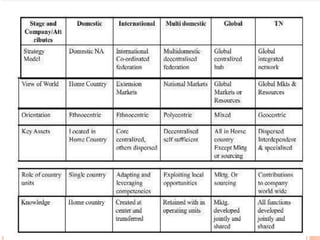
STAGES OF INTERNATIONALIZATION
STAGE-1
• DOMESTIC OPERATION
STAGE-2
• EXPORT OPERATIONS
STAGE-3
• SUBSIDIARIES OR JOINT VENTURE
STAGE-4
• MULTI- NATIONAL OPERATIONS
STAGE-5
• TRANSNATIONAL OPERATIONS
STAGE 1:- DOMESTIC OPERATIONS
 The firm’s market is exclusively domestic.
 Most international companies have their
origin as domestic companies. These
companies focus on domestic operations
only.
 Example: Patanjali have currently its major
operations in India only.
STAGE 2:- EXPORT OPERATIONS
 The firm expands its market by engaging
into export operations and offering the
domestic products to other countries also,
but retains production facilities within
domestic borders.
 Example: Indian firms exporting textiles,
jute, spices, nuts, rice all around the world.
STAGE 3:- SUBSIDIARIES OR JOINT VENTURES
 The firm physically moves some of its
operations out of the home country.
 There is a mutual cost, profit sharing and
management in such method.
 Example: A joint venture between Maruti
(Indian Company) and Suzuki (Japanese
Company).
STAGE 4:- MULTINATIONAL OPERATIONS
 The firm becomes the fully fledged
multinational co.[MNC] with the assembly of
production facilities in several countries &
regions of the world. Some decentralization
of decision making is common but many
personnel decisions are still made at
corporate level in headquarters.
 Example: Mc Donalds is a MNC operating
worldwide.
STAGE 5:- TRANSNATIONAL OPERATIONS
 In this the firms that reach this particular
stage are often called transnational
companies because they achieve both
global efficiency and local responsiveness.
They use global market and resources for
their functioning.
 Example: Coca-Cola, Nestle
THANK YOU

Stages of internationalization

  • 1.
  • 2.
    MEANING OF INTERNATIONALIZATION ‘’As the process of increasing involvement in international operations’’ -By Prof WELCH  Internationalization is the designing of the product in such a way that it will meet the needs of users in many countries or can be easily adapted to do so .
  • 3.
    ADVANTAGES OF INTERNATIONALIZATION Faster growth  Effect on performance of enterprise  Job creation  Meeting our needs  Attracting investment  New technology and materials
  • 4.
    DISADVANTAGES OF INTERNATIONALIZATION Cultural identity issues  Political issues  Difficulty in times of need  Social welfare issues
  • 5.
    STAGES OF INTERNATIONALIZATION STAGE-1 •DOMESTIC OPERATION STAGE-2 • EXPORT OPERATIONS STAGE-3 • SUBSIDIARIES OR JOINT VENTURE STAGE-4 • MULTI- NATIONAL OPERATIONS STAGE-5 • TRANSNATIONAL OPERATIONS
  • 6.
    STAGE 1:- DOMESTICOPERATIONS  The firm’s market is exclusively domestic.  Most international companies have their origin as domestic companies. These companies focus on domestic operations only.  Example: Patanjali have currently its major operations in India only.
  • 7.
    STAGE 2:- EXPORTOPERATIONS  The firm expands its market by engaging into export operations and offering the domestic products to other countries also, but retains production facilities within domestic borders.  Example: Indian firms exporting textiles, jute, spices, nuts, rice all around the world.
  • 8.
    STAGE 3:- SUBSIDIARIESOR JOINT VENTURES  The firm physically moves some of its operations out of the home country.  There is a mutual cost, profit sharing and management in such method.  Example: A joint venture between Maruti (Indian Company) and Suzuki (Japanese Company).
  • 9.
    STAGE 4:- MULTINATIONALOPERATIONS  The firm becomes the fully fledged multinational co.[MNC] with the assembly of production facilities in several countries & regions of the world. Some decentralization of decision making is common but many personnel decisions are still made at corporate level in headquarters.  Example: Mc Donalds is a MNC operating worldwide.
  • 10.
    STAGE 5:- TRANSNATIONALOPERATIONS  In this the firms that reach this particular stage are often called transnational companies because they achieve both global efficiency and local responsiveness. They use global market and resources for their functioning.  Example: Coca-Cola, Nestle
  • 12.