Presentation By: 
Deepika Luthra Diwakar Saini 
Sagar Batra
DEFINITION: 
“A corporation that controls production facilities in more than 
one country, such facilities having been acquired through the 
process of foreign direct investment. Firms that participate in 
international business, however large they may be solely by 
exporting or by licensing technology are not multinational 
enterprises.”
SOME MULTINATIONAL COMAPANIES
DEFINITIONAL DIMENSIONS 
By Size: The term MNC implies 
bigness. Bigness also has 
number of factors like market 
value, sales, profits, return on 
equity 
By Structure: Structural 
requirement include the 
number of countries in which 
the firm does business and 
the citizenship of corporate 
owners and top managers. 
By Behaviour: This is an 
abstract as a measure of 
multinationalisation and it refers 
mostly to the behavioural 
characteristics of top 
management. 
By Performance: 
Performance depends on 
such characteristics as 
earnings, sales and assets.
FACTS AND FIGUERS 
published by the UNCTAD (United Nations Conference on Trade and Development) 
 There is a total of 889,416 MNCs around the world. 
 The 100 largest MNCs sales combined amounted to nearly $8.5 
trillion. 
 There is a total of 3,057 multinational companies (MNCs) in India: 
815 based in the country and 2,242 foreign affiliates. 
 From 2004 to 2009, the number of Indian-based MNCs decreased 
nearly 50%, while the number of foreign affiliates increased 90%.
SOME IMPORTANT TERMS 
Parent 
enterprises 
Subsidiary 
Transnational 
corporations 
Associate Foreign affiliates
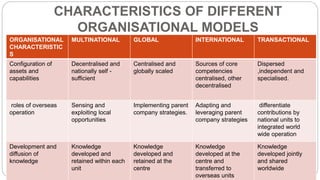
CHARACTERISTICS OF DIFFERENT 
ORGANISATIONAL MODELS 
ORGANISATIONAL 
CHARACTERISTIC 
S 
MULTINATIONAL GLOBAL INTERNATIONAL TRANSACTIONAL 
Configuration of 
assets and 
capabilities 
Decentralised and 
nationally self - 
sufficient 
Centralised and 
globally scaled 
Sources of core 
competencies 
centralised, other 
decentralised 
Dispersed 
,independent and 
specialised. 
roles of overseas 
operation 
Sensing and 
exploiting local 
opportunities 
Implementing parent 
company strategies. 
Adapting and 
leveraging parent 
company strategies 
differentiate 
contributions by 
national units to 
integrated world 
wide operation 
Development and 
diffusion of 
knowledge 
Knowledge 
developed and 
retained within each 
unit 
Knowledge 
developed and 
retained at the 
centre 
Knowledge 
developed at the 
centre and 
transferred to 
overseas units 
Knowledge 
developed jointly 
and shared 
worldwide
BENEFITS TO THE HOST COUNTRY 
 Increase the investment level and thereby income and 
employment 
 Transfer technology mainly in developing countries 
 Also kindle a managerial revolution through professional and 
highly sophisticated management techniques 
 MNCs enable to increase their export and decrease the import 
 Equalise the cost of factors of production around the world 
 Provide an efficient means of integrating national economies 
 MNCs make a contribution to inventions and innovations 
through research and development systems 
MNCs may encourage and assist domestic supplier 
 MNCs help increase competition and break domestic
MNCs AND INTERNATIONAL TRADE 
 According to peter drucker MNCs and international trade are the two 
side of the same coin 
 The period of fifties and sixties was the most rapid growth of 
multinational trade 
 Foreign affiliates of MNCs account for about one-third of the world 
exports 
 More than 40% of total exports of China is done by MNCs 
 Apart from trade in commodities other transaction also take place 
extensively: 
 The granting of loans 
 Licensing of technologies 
 Provision of services
PROBLEMS FACED BY HOST COUNTRY 
MNCs technology is designed for world wide profit 
maximisation, not the development needs of poor countries 
 Through there power and flexibility, MNCs can evade or 
undermine national economic autonomy and control 
MNCs may destroy competition and acquire monopoly powers 
 On political involvement, MNCs have been accused on 
occasion of: 
 Supporting repressive regimes 
 Paying protection money to terrorist groups 
 Paying bribes to secure political influence 
 Not respecting human rights 
 Destabilizing national government of which they do not 
approve
Cont. 
MNCs retard growth of employment in the home country 
 Transfer pricing enables MNCs to avoid taxes by manipulating 
prices on intra-company transactions 
 MNCs have been accused of the following environmental 
problems: 
 Polluting the environment 
 Not paying compensation for the environmental damages 
 Causing harmful changes in the local living conditions 
 Paying little regard to the risks of accidents causing major 
environmental catastrophes
Cont. 
 The MNCs criticized for their business strategies and 
practices in the host countries for: 
 Undermine local cultures and traditions 
 Change the consumption habits for their benefits 
 Promote conspicuous consumption 
 Dump harmful products in developing countries etc.
PERSPECTIVES 
Increasing emphasis on market 
forces 
Growing role for the private sector 
in nearly all developing countries 
Rapidly changing technologies 
that are transforming the nature of 
organisation 
The rise of services to constitute 
the largest single sector in the 
world economy 
The globalisation of firms and 
industries 
Regional economic integration
CODE OF CONDUCT 
 MNCs must respect the national sovereignty of host countries 
and observe their domestic laws, regulations and 
administrative practices 
 Adhere to host nations economic goals, development 
objections and sociocultural values 
 Respect human rights 
 Not interfere in internal political affairs or in intergovernmental 
relations 
 Not engage in corrupt practices
MULTINATIONALS IN INDIA 
 There was very little foreign investment has taken place in 
INDIA. Due to Government conditions which were 
unacceptable to them. For Ex. Coca Cola and IBM, even left 
India in late 1970’s. 
 The Foreign Exchange Regulation Act (FERA), 1973 was not 
in the favour of Multinational's. 
 An often heard criticism is that MNC’s drain the foreign 
exchange of the developing countries
Cont. 
 India followed policies that discriminate against export 
production and in favour of production for the local market 
since 1980s 
 Due to economic liberalisation in 1991, many multinationals in 
different line of business have entered in Indian market and 
multinational prior in India have expanded their business.
TOP 10 MNCs IN INDIA 
 Microsoft 
 IBM 
 PepsiCo 
 Ranbaxy Laboratories Ltd. 
 Nestle 
 CocaCola 
 Procter & Gamble 
 Nokia 
 Sony Corporation 
 Citigroup Inc
Round:- 1
 A corporation that controls ________ facilities in more than 
one country 
a) Trade 
b) farming 
c) developing 
d) Production 
QUESTIONS: 1
QUESTION: 2 
 Different dimensions used to define the MNCs are size, structure, 
behaviour and __________. 
a) Emotions 
b) Investment 
c) Performance 
d) employment
QUESTION: 3 
 MNCs must respect ______ rights 
a) Animals 
b) politician 
c) Human 
d) Bribers
QUESTION: 4 
 There is a total of MNCs _______ around the world. 
a) 889,416 
b) 889,616 
c) 666,666 
d) 989,516
Round:- 2
QUESTION: 5 
 According to ________ ________ MNCs and international 
trade are the two side of the same coin 
a) Peter parker 
b) Peter subhramanyam swami 
c) Peter dranken 
d) Peter drucker
QUESTION: 6 
 Due to economic _____________ in 1991, many 
multinationals in different line of business have entered in 
Indian market 
a) Demonization 
b) Development 
c) Liability 
d) Liberalisation
QUESTION: 7 
 The Foreign ________ Regulation Act, 1973 was not in the 
favour of Multinational's. 
a) Investment 
b) Exchange 
c) Import Export 
d) Policies
Final Round
QUESTION: 8 
 Transnational corporation are enterprises comprising 
________ _________ and there _________ affiliates. 
a) Foreign enterprises and their parent 
b) Native enterprises and their host 
c) Associate enterprises and their subsidiary 
d) Parent enterprises and their foreign
THANK YOU HAI JI …..

Multinational corporation

  • 1.
    Presentation By: DeepikaLuthra Diwakar Saini Sagar Batra
  • 2.
    DEFINITION: “A corporationthat controls production facilities in more than one country, such facilities having been acquired through the process of foreign direct investment. Firms that participate in international business, however large they may be solely by exporting or by licensing technology are not multinational enterprises.”
  • 3.
  • 4.
    DEFINITIONAL DIMENSIONS BySize: The term MNC implies bigness. Bigness also has number of factors like market value, sales, profits, return on equity By Structure: Structural requirement include the number of countries in which the firm does business and the citizenship of corporate owners and top managers. By Behaviour: This is an abstract as a measure of multinationalisation and it refers mostly to the behavioural characteristics of top management. By Performance: Performance depends on such characteristics as earnings, sales and assets.
  • 5.
    FACTS AND FIGUERS published by the UNCTAD (United Nations Conference on Trade and Development)  There is a total of 889,416 MNCs around the world.  The 100 largest MNCs sales combined amounted to nearly $8.5 trillion.  There is a total of 3,057 multinational companies (MNCs) in India: 815 based in the country and 2,242 foreign affiliates.  From 2004 to 2009, the number of Indian-based MNCs decreased nearly 50%, while the number of foreign affiliates increased 90%.
  • 6.
    SOME IMPORTANT TERMS Parent enterprises Subsidiary Transnational corporations Associate Foreign affiliates
  • 7.
    CHARACTERISTICS OF DIFFERENT ORGANISATIONAL MODELS ORGANISATIONAL CHARACTERISTIC S MULTINATIONAL GLOBAL INTERNATIONAL TRANSACTIONAL Configuration of assets and capabilities Decentralised and nationally self - sufficient Centralised and globally scaled Sources of core competencies centralised, other decentralised Dispersed ,independent and specialised. roles of overseas operation Sensing and exploiting local opportunities Implementing parent company strategies. Adapting and leveraging parent company strategies differentiate contributions by national units to integrated world wide operation Development and diffusion of knowledge Knowledge developed and retained within each unit Knowledge developed and retained at the centre Knowledge developed at the centre and transferred to overseas units Knowledge developed jointly and shared worldwide
  • 8.
    BENEFITS TO THEHOST COUNTRY  Increase the investment level and thereby income and employment  Transfer technology mainly in developing countries  Also kindle a managerial revolution through professional and highly sophisticated management techniques  MNCs enable to increase their export and decrease the import  Equalise the cost of factors of production around the world  Provide an efficient means of integrating national economies  MNCs make a contribution to inventions and innovations through research and development systems MNCs may encourage and assist domestic supplier  MNCs help increase competition and break domestic
  • 9.
    MNCs AND INTERNATIONALTRADE  According to peter drucker MNCs and international trade are the two side of the same coin  The period of fifties and sixties was the most rapid growth of multinational trade  Foreign affiliates of MNCs account for about one-third of the world exports  More than 40% of total exports of China is done by MNCs  Apart from trade in commodities other transaction also take place extensively:  The granting of loans  Licensing of technologies  Provision of services
  • 10.
    PROBLEMS FACED BYHOST COUNTRY MNCs technology is designed for world wide profit maximisation, not the development needs of poor countries  Through there power and flexibility, MNCs can evade or undermine national economic autonomy and control MNCs may destroy competition and acquire monopoly powers  On political involvement, MNCs have been accused on occasion of:  Supporting repressive regimes  Paying protection money to terrorist groups  Paying bribes to secure political influence  Not respecting human rights  Destabilizing national government of which they do not approve
  • 11.
    Cont. MNCs retardgrowth of employment in the home country  Transfer pricing enables MNCs to avoid taxes by manipulating prices on intra-company transactions  MNCs have been accused of the following environmental problems:  Polluting the environment  Not paying compensation for the environmental damages  Causing harmful changes in the local living conditions  Paying little regard to the risks of accidents causing major environmental catastrophes
  • 12.
    Cont.  TheMNCs criticized for their business strategies and practices in the host countries for:  Undermine local cultures and traditions  Change the consumption habits for their benefits  Promote conspicuous consumption  Dump harmful products in developing countries etc.
  • 13.
    PERSPECTIVES Increasing emphasison market forces Growing role for the private sector in nearly all developing countries Rapidly changing technologies that are transforming the nature of organisation The rise of services to constitute the largest single sector in the world economy The globalisation of firms and industries Regional economic integration
  • 14.
    CODE OF CONDUCT  MNCs must respect the national sovereignty of host countries and observe their domestic laws, regulations and administrative practices  Adhere to host nations economic goals, development objections and sociocultural values  Respect human rights  Not interfere in internal political affairs or in intergovernmental relations  Not engage in corrupt practices
  • 15.
    MULTINATIONALS IN INDIA  There was very little foreign investment has taken place in INDIA. Due to Government conditions which were unacceptable to them. For Ex. Coca Cola and IBM, even left India in late 1970’s.  The Foreign Exchange Regulation Act (FERA), 1973 was not in the favour of Multinational's.  An often heard criticism is that MNC’s drain the foreign exchange of the developing countries
  • 16.
    Cont.  Indiafollowed policies that discriminate against export production and in favour of production for the local market since 1980s  Due to economic liberalisation in 1991, many multinationals in different line of business have entered in Indian market and multinational prior in India have expanded their business.
  • 17.
    TOP 10 MNCsIN INDIA  Microsoft  IBM  PepsiCo  Ranbaxy Laboratories Ltd.  Nestle  CocaCola  Procter & Gamble  Nokia  Sony Corporation  Citigroup Inc
  • 19.
  • 20.
     A corporationthat controls ________ facilities in more than one country a) Trade b) farming c) developing d) Production QUESTIONS: 1
  • 21.
    QUESTION: 2 Different dimensions used to define the MNCs are size, structure, behaviour and __________. a) Emotions b) Investment c) Performance d) employment
  • 22.
    QUESTION: 3 MNCs must respect ______ rights a) Animals b) politician c) Human d) Bribers
  • 23.
    QUESTION: 4 There is a total of MNCs _______ around the world. a) 889,416 b) 889,616 c) 666,666 d) 989,516
  • 24.
  • 25.
    QUESTION: 5 According to ________ ________ MNCs and international trade are the two side of the same coin a) Peter parker b) Peter subhramanyam swami c) Peter dranken d) Peter drucker
  • 26.
    QUESTION: 6 Due to economic _____________ in 1991, many multinationals in different line of business have entered in Indian market a) Demonization b) Development c) Liability d) Liberalisation
  • 27.
    QUESTION: 7 The Foreign ________ Regulation Act, 1973 was not in the favour of Multinational's. a) Investment b) Exchange c) Import Export d) Policies
  • 28.
  • 29.
    QUESTION: 8 Transnational corporation are enterprises comprising ________ _________ and there _________ affiliates. a) Foreign enterprises and their parent b) Native enterprises and their host c) Associate enterprises and their subsidiary d) Parent enterprises and their foreign
  • 30.
    THANK YOU HAIJI …..